FORCETALLY
Loading the evidence…
Preparing your view.


Preparing your view.
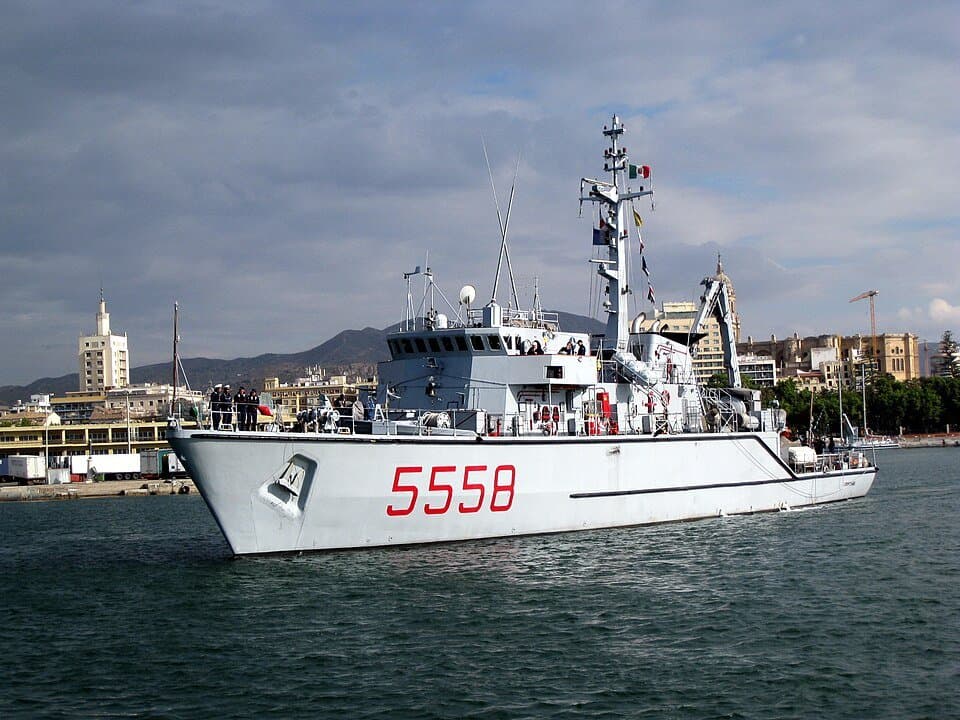
Patrol & mine warfare vesselsIn service
Minehunter
Lerici-class minehunter is a minehunter. It was built by Intermarine SpA. Reported operators include Italian Navy Algerian National Navy Royal Australian Navy Finnish Navy Royal Malaysian Navy Nigerian Navy Republic of China Navy Royal Thai Navy United States Navy.
 Italy
Lerici-class minehunter
Javier Bueno Iturbe · CC BY-SA 3.0 · Resized · CC BY-SA 3.0 · Source ↗ · ModifiedLerici class
Intermarine SpA
Italian Navy Algerian National Navy Royal Australian Navy Finnish Navy Royal Malaysian Navy Nigerian Navy Republic of China Navy Royal Thai Navy United States Navy
Subclasses: Lerici class Second Series Lerici class or Gaeta class Export derivatives: Mahamiru class (Malaysia and Nigeria) Osprey class (United States) Huon class (Australia) Lat Ya class (Thailand) Katanpää class (Finland)
1985–1997 (Italian-operated vessels)
5 (Taiwan)
2 (Algeria) 1 (Taiwan)
12 (Italy) 1 (Algeria) 3 (Finland) 4 (Malaysia) 2 (Nigeria) 12 (USA) 6 (Australia) 2 (Thailand)
6 (Thailand)
Minehunter
- 635 t (625 long tons ) full load - 503 t (495 long tons) light
49.98 m (164 ft 0 in)
9.56 m (31 ft 4 in)
2.9 m (9 ft 6 in)
- (Italian Lerici ): 1 × diesel engine Grandi Motori Trieste GMT BL-230.8M, 1,089 kW (1,460 bhp), driving a single variable pitch propeller - (Italian Lerici ): 3 × active rudders by 3 diesel engines Isotta Fraschini ID-36-SS 6V
- 14 knots (26 km/h; 16 mph) maximum speed - 6 knots (11 km/h; 6.9 mph) minehunting speed
1,500 nautical miles (2,800 km; 1,700 mi) at 6 knots (11 km/h; 6.9 mph)
2 remote-operated mine-clearance vehicles
47: 4 officers, 7 clearance divers , 36 ratings
VDS FIAR SQQ-14 (IT) sonar
1 × Bofors 40 mm gun or 1 × Oerlikon 20 mm cannon
All other characteristics as above are taken from:
The Lerici class is a class of minehunters constructed by Intermarine SpA and owned and operated by the Italian and Algerian navies. The class incorporates two subclasses: the first four ships are referred to specifically as the first series of the Lerici class, while eight more ships produced to a slightly modified design are known as "second series Lerici s" or as the Gaeta class .
Lerici -class ships have a displacement of 620 tons full load, 50 metres (164 ft 1 in) long, 9.9 metres (32 ft 6 in) wide, and a draught of 2.6 metres (8 ft 6 in).
Mahamiru -class ships vary in design from the Lerici class. Most significant of these is that Mahamiru s are equipped with two diesel engines with dedicated propeller shafts instead of a single engine and propeller, giving them a maximum speed of 16 knots (30 km/h; 18 mph) and a minehunting speed of 7 knots (13 km/h; 8.1 mph). The Malaysian ships are also equipped with Thomson Sintra TSM 2022 sonar, Thomson-CSF radar, and two PAP-104 remote-operated submersibles, and are 1 metre (3.3 ft) longer than the Italian vessels they were based on. Instead of the 20 mm Oerlikon, the ships are armed with a single Bofors 40 mm L/70 gun. The standard crew complement is 42, 5 of whom are officers.
The Nigerian Lerici s are based on the Mahamiru class, but use the Pluto submersible, a Racal Decca 1226 radar, and are slightly slower with a maximum speed of 15.5 knots (28.7 km/h; 17.8 mph). The Nigerian ships are armed with two 30 mm cannons, and have a crew complement of 50, including 5 officers.
The Australian ships, which are referred to as the Huon class , have a slightly greater displacement and draft than the Gaeta s. The ships use a GEC-Marconi Type 2093 sonar, two SUTEC Double Eagle remote mine disposal vehicles , and are armed with a 30 mm DC30B gun. The ships have a crew of 36 (including 6 officers), with further accommodation for 13 more, including 6 divers. The class entered service between 1998 and 2002 and is based at HMAS Waterhen in Sydney.
In comparison to the Gaeta s, Lat Ya -class ships have a slightly greater displacement of 680 tons, with a corresponding increase in draught to 2.9 metres (9.5 ft). They use Atlas Elektronik radar and sonar, Pluto ROVs, and are fitted with a 30-millimetre (1.2 in) MSI cannon. Each ship carries 8 officers, and 42 other crew.
{"datatype": "wikibase-item", "datavalue": {"type": "wikibase-entityid", "value": {"entity-type": "item", "id": "Q38", "numeric-id": 38}}, "hash": "62faf00998325aad6b60b99fca1465baf1adb5a4", "property": "P495", "snaktype": "value"}
Reference text from Wikipedia contributors, used under CC BY-SA 4.0.
True scale
Sourced dimensions beside a 1.75 m human reference.
See it in your room. Scan with your phone to open this model in 3D, then place it in your space.
Points represent sourced observations, including revisions. Revisions on the same effective date are not separate inventory events. Ranges appear in the table and are not plotted as exact points.
| Observation / report period | Value | Source | Claim state |
|---|---|---|---|
| 28 Sept 2026 | 9.56 m | Wikipedia contributors | superseded |
Lerici-class minehunter equipment records. Variants, orders and quantities are shown as reported in each inventory source; coverage is incomplete.
ItalyNaval inventory of the source class and listed configurations; excludes orders and construction. Source-year holdings, not immediately deployable strength.
 Malaysia
Reported count for Mahamiru. Service scope: Royal Malaysian Navy; does not replace a national total. 1 distinct count cell(s) from the same source list; shared rowspan cells counted once. Excludes retired/reserve/on-order rows. Count column(s): quantity: 4. Origin: Italy. The listed variants/roles are the scope, not an immediately deployable count. The components do not establish one inventory census date; the stored date is the retrieved source snapshot.
Italian Navy Algerian National Navy Royal Australian Navy Finnish Navy Royal Malaysian Navy Nigerian Navy Republic of China Navy Royal Thai Navy United States Navy
Equipment reference ↗Keep exploring
 United Kingdom
 France
 Germany