FORCETALLY
Loading the evidence…
Preparing your view.


Preparing your view.
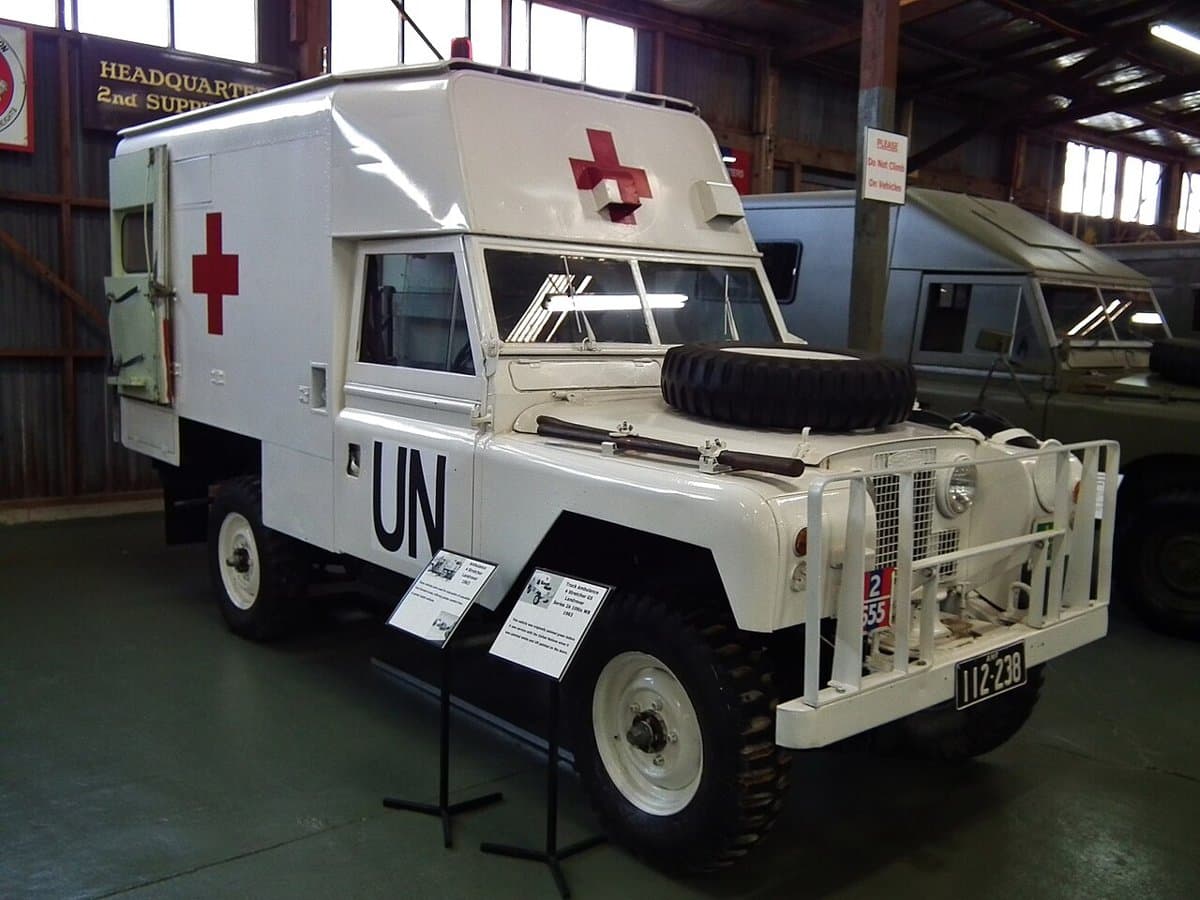
Military transport & logisticsIn service
Land Rover series is documented in the equipment reference catalogue. It was built by Rover Company (1948–1967) British Leyland (1968–1978) Land Rover Ltd. (1978–1985).
 United Kingdom
Rover Company (1948–1967) British Leyland (1968–1978) Land Rover Ltd. (1978–1985)
1948–1985
United Kingdom: Solihull ( Solihull plant ) Australia: Enfield ( BMC Australia ) Belgium: Antwerp ( Minerva ) Ethiopia: Addis Ababa (A.M.C.E) Iran: Tehran ( Morattab ) Kenya: Thika (Leyland Kenya Limited) New Zealand: Nelson ( NZMC ) Nigeria: Ibadan (Leyland Nigeria Ltd) South Africa: Port Elizabeth (BMC SA) Spain: Linares ( Santana Motors ) West Germany: Hamburg ( Tempo ) Zambia: Ndola (Rover (Zambia) Ltd)
Off-road vehicle
FR layout / All-wheel drive
Land Rover Ninety & One Ten / Defender
Maurice Wilks
2-door Off-road vehicle 4-door Off-road vehicle 2-door pickup
1.6 L I4 (1948–1951) 2.0 L I4 (1950–1958) 2.0 L diesel I4 (1957–1958)
4-speed manual
1948–1953: 80.0 in (2,032 mm) 1954–1956: 86.0 in (2,184 mm) (SWB) 1956–1958: 88.0 in (2,235 mm) (SWB) 1954–1956: 107.0 in (2,718 mm) (LWB) 1956½–1959:109.0 in (2,769 mm) (LWB)
132.0 in (3,353 mm)/140.5 in (3,569 mm) (SWB) 173.5 in (4,407 mm) (LWB)
61.0 in (1,549 mm)
73.5 in (1,867 mm)
Originally the Land Rover was a single model offering, which from 1948 until 1951 used an 80-inch (2.03 m) wheelbase and a 1.6-litre petrol engine producing around 50 bhp (37 kW; 51 PS). The four-speed gearbox from the Rover P3 was used, with a new two-speed transfer box. This incorporated an unusual four-wheel-drive system, with a freewheel unit (as used on several Rover cars of the time). This disengaged the front axle from the manual transmission on the overrun, allowing a form of non- permanent 4WD. A ring-pull mechanism in the driver's footwell allowed the freewheel to be locked to provide more traditional 4WD. This was a basic vehicle: tops for the doors and a roof (canvas or metal) were optional extras. In 1950, the lights moved from a position behind the grille to protruding through the grille.
In 1957 a brand new 2.0-litre diesel engine was introduced that, despite the similar capacity, was not related to the petrol engines used. The petrol engines of the time used the rather out-dated inlet-over-exhaust valve arrangement; the diesel used the more modern overhead valve layout. This diesel engine was one of the first high-speed diesels developed for road use, producing 52 hp (39 kW) at 4,000 rpm.
The successor to the successful Series I was the Series II , produced from 1958 until the Series IIA was introduced in 1961. It came in 88 in (2.24 m) and 109 in (2.77 m) wheelbases (normally referred to as the 'SWB' and 'LWB'). This was the first Land Rover to receive the attention of Rover's styling department. Chief Stylist David Bache produced the familiar 'barrel side' waistline, with a 5 in (12.7 cm) greater width to cover the vehicle's wider tracks, as well as the improved design of the truck cab variant, introducing the curved side windows and rounded roof still used on current Land Rovers. The Series II was the first vehicle to use the well-known 2.25-litre petrol engine , although the first 1,500 or so short wheelbase (SWB) models retained the 52 hp (39 kW) 2.0-litre petrol engine from the Series I. This larger petrol engine produced 72 hp (54 kW) and was closely related to the 2.0-litre diesel unit still in use. This engine became the standard Land Rover unit until the mid-1980s when diesel engines became more popular.
From 1979 until 1985, the Stage 1 was built using some of the same components as the Range Rover and 101 Forward Control, such as the LT95 gearbox and 3.5-litre Rover V8 petrol engine. The engine was detuned to 91 hp (68 kW) from the 135BHP of the contemporary Range Rover. The vehicle came about because the competing Toyota Land Cruiser and Nissan Patrol vehicles, fitted with powerful and durable 6-cylinder engines, were making considerable inroads into the market, particularly in Australia and Africa. A V8-powered Land Rover with the Range Rover's constant 4WD system was a considerable technological advancement on the part-time 4WD and 4-cyl engines of previous variants, though the Stage 1 still used the Series III's leaf springs.
In the early 1980s, Land Rover Australia had made some changes to the vehicle to try to combat this sales decline. As well as the fitting of the V8 petrol engine in the 1979 "Stage One", as in the rest of the world, Australia also received the same vehicle with the option of a 3.9-litre 97 hp (72 kW) four-cylinder Isuzu diesel engine ( 4BD1 ). This was introduced in 1982, and was meant to be equipped in about ten per cent of the Australian production. Top speed is 77 mph (124 km/h). This helped slow the sales decline, but the rest of the vehicle's shortcomings let it down. The One Ten was also available with this engine, and a turbocharged version producing in excess of 100 horsepower (75 kW) powered the military 6×6.
In the early 1980s, Land Rover Australia had made some changes to the vehicle to try to combat this sales decline. As well as the fitting of the V8 petrol engine in the 1979 "Stage One", as in the rest of the world, Australia also received the same vehicle with the option of a 3.9-litre 97 hp (72 kW) four-cylinder Isuzu diesel engine ( 4BD1 ). This was introduced in 1982, and was meant to be equipped in about ten per cent of the Australian production. Top speed is 77 mph (124 km/h). This helped slow the sales decline, but the rest of the vehicle's shortcomings let it down. The One Ten was also available with this engine, and a turbocharged version producing in excess of 100 horsepower (75 kW) powered the military 6×6.
Masse à vide 1 181 kg
Land Rover series United Kingdom Light utility vehicle Series II Unknown For ceremonial duty
Reference text from Wikipedia contributors, used under CC BY-SA 4.0.
True scale
Sourced dimensions beside a 1.75 m human reference.
Points represent sourced observations, including revisions. Revisions on the same effective date are not separate inventory events. Ranges appear in the table and are not plotted as exact points.
| Observation / report period | Value | Source | Claim state |
|---|---|---|---|
| 1 Oct 2026 | 1.867 m | Wikipedia contributors | superseded |
| 1 Oct 2026 | 1.867 m | Wikipedia contributors | approved |
Land Rover series equipment records. Variants, orders and quantities are shown as reported in each inventory source; coverage is incomplete.
Keep exploring
 Indonesia
 Kenya
 United States
 Germany