Design and configuration
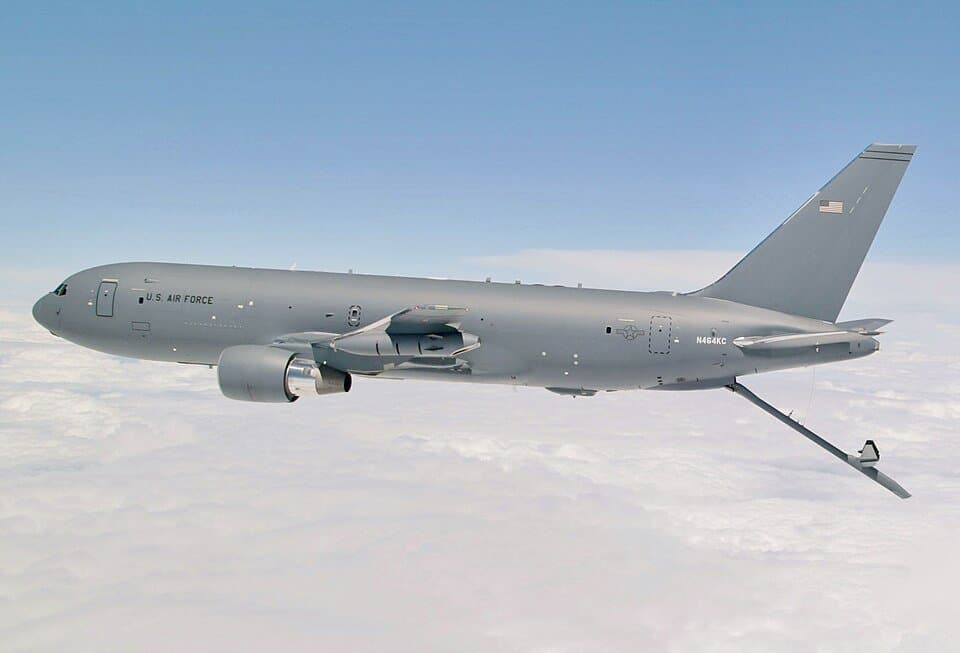
The airframe combines a wide transport fuselage with two underwing engines and a tail-mounted refuelling boom. Wing pods and a centreline drogue provide hose-and-drogue options.1


Preparing your view.
Support aircraftIn serviceProfile in progress
The KC-46A is a 767-derived tanker that also carries cargo, passengers and medical patients. Its central role is transferring fuel to compatible receiver aircraft.
 United States
Boeing KC-46 Pegasus
USAF Christopher Okula · Public domain · Resized · Public domain · Source ↗ · ModifiedTanker / transport
United States
Boeing Defense, Space & Security
In service
U.S. Air Force (USAF) Japan Air Self-Defense Force Israeli Air Force
113 as of Aug 2026
2013–present
2019
25 September 2015
Boeing KC-767
3 (2 pilots, 1 boom operator ) basic crew; 15 permanent seats for additional crew members, including aeromedical evacuation crew members
65,000 lb (29,500 kg) payload, configurable as: seating for up to 54 passengers (up to 114 in contingencies), up to 18 463L pallets , or up to 58 patients (24 litters, 34 ambulatory)
165 ft 6 in (50.5 m)
157 ft 8 in (48.1 m)
52 ft 1 in (15.9 m)
181,610 lb (82,377 kg)
415,000 lb (188,240 kg)
212,299 lb (96,297 kg) / 31,220 US gal (118,200 L; 26,000 imp gal)
207,672 lb (94,198 kg)
2 × Pratt & Whitney PW4062 turbofan , 62,000 lbf (280 kN) thrust each
570 mph (914 km/h, 500 kn)
530 mph (851 km/h, 460 kn)
7,350 mi (11,830 km, 6,385 nmi) – global with in flight refueling
40,100 ft (12,200 m)
The Boeing KC-46 Pegasus is an American military aerial refueling and strategic military transport aircraft developed by Boeing from its 767 jet airliner .
The United States Air Force has taken delivery of 105 KC-46A aircraft and intends to procure 263 in total, a number which has grown with the cancellation of the KC-Y program and may grow further if the Next Generation Air-refueling System (NGAS) program does not develop as planned. Other nations which operate or have purchased the KC-46A include Japan and Israel.
In September 2009, the USAF began a new round of bids with clearer criteria, including reducing the number of requirements from 800 to 373 in an attempt to simplify the process and allow more objective decision making. In March 2010, Boeing announced it would bid the KC-767 for the new KC-X round. EADS stated in April 2010 it would submit a bid without Northrop Grumman as a U.S. partner. Boeing submitted its KC-767 "NewGen Tanker" bid, based on the 767-200 with an improved version of the KC-10 's refueling boom , and cockpit displays from the 787, in July 2010. Boeing submitted a revised bid in February 2011.
In December 2013, Boeing joined the wings and fuselage for the first 767-2C to be adapted into a KC-46A. The first of four 767-2C provision freighters were to complete assembly by the end of January 2014. Once assembled, it would go through ground vibration and instrumentation testing and have body fuel tanks added. The first test flight would occur during summer 2014 and include measuring its rate of climb and descent. The Engineering Manufacturing and Design (EMD) model was to be integrated with the needed systems and technologies to become a military-standard KC-46A by January 2015. Seven low-rate production KC-46s were to be delivered in 2015, 12 in 2016, and 15 delivered annually from 2017 to 2027. The last of four test aircraft began assembly in January 2014.
The 767-2C's first flight took place on 28 December 2014. It flew from Paine Field and landed at Boeing Field . In March 2015, a refueling test with a C-17 transport was stopped because of a higher-than-expected boom axial load while delivering fuel. The problem was caused by the turbulent "bow wave effect" generated by two large aircraft flying in line. In January 2016, the KC-46 successfully refueled an F-16 for the first time during a five hour 36 minute sortie. Test refueling of several other military aircraft followed, including a C-17, F/A-18 , A-10 , and AV-8B . In February 2016, a KC-46 refueled an F/A-18, using its probe-and-drogue system for the first time.
On 5 July 2016, USAF spokesman Daryl Mayer stated that, despite the testing delays, Milestone C approval was expected in the following month, and that Boeing would add a fifth EMD aircraft to accelerate testing. EMD-1 and EMD-3 primarily conducted flight tests towards FAA airworthiness certificates, while EMD-2 and EMD-4 focused on USAF aerial refueling and mission system testing. An F-16 was successfully refueled on 8 July, and a C-17 on 12 July 2016. Once the hardware fix was verified, a KC-46 with the updated boom underwent regression testing on the F-16, followed by refueling demonstrations with the C-17 and A-10 for the final test for Milestone C approval. On 15 July 2016, the KC-46 successfully refueled an A-10, offloading 1,500 pounds of fuel at 15,000 feet. At the time, more than 900 flight test hours have been completed by the five EMD aircraft. On 12 August 2016, the program received Milestone C approval, indicating production readiness. The issuing of contracts for two lots covering 19 aircraft was expected within 30 days.
Ongoing development efforts associated with the KC-46 aim to provide new capabilities and fix problems. In the FY27 budget request, the USAF proposed reallocating funds ($13M as requested) from the Next Generation air-refueling System (NGAS) to a new effort called the Advanced Tanker System (ATS). ATS will develop upgrades for connectivity, electronic warfare , and self-defense capabilities—many of the features associated with NGAS—for the existing tanker fleet. The USAF has clarified that they are not abandoning plans for the future NGAS.
The aircraft is FAA-certified to transport up to 58 passengers in the rear fuselage using palletized seating similar to that of the C-17, along with a galley/lavatory pallet and passenger baggage loaded onto a cargo pallet.
Boeing states that in contingency operations, the aircraft could accommodate up to 114 passengers.
In an all-cargo configuration, the KC-46A can carry up to 65,000 pounds (29,000 kg) of cargo across 18 pallets.
The KC-46A can carry 212,299 pounds (96,297 kg) of fuel, 10 percent more than the KC-135.
In June 2024 the USAF completed a 45 hour non-stop flight around the globe as part of Project Magellan. The flight, which took off and landed at McConnell Air Force Base, was refueled several times while it refueled other operational aircraft at various places around the world.
The three tankers were to be fielded around 2020 at a cost of more than ¥20.8 billion, about US$173 million (~$206 million in 2024) per aircraft. An order for a third and fourth KC-46 was placed in October 2020. Japan ordered two additional KC-46s in December 2022, bringing Japan's order total to six. In February 2021, the JASDF conducted its first KC-46 flight. Training of Japanese KC-46 pilots began in June 2021 and Japan received its first KC-46 in November 2021.
Capacity: 65,000 lb (29,500 kg) payload, configurable as: seating for up to 54 passengers (up to 114 in contingencies), up to 18 463L pallets , or up to 58 patients (24 litters, 34 ambulatory)
Length: 165 ft 6 in (50.5 m)
Length: 165 ft 6 in (50.5 m)
Wingspan: 157 ft 8 in (48.1 m)
Wingspan: 157 ft 8 in (48.1 m)
Height: 52 ft 1 in (15.9 m)
Height: 52 ft 1 in (15.9 m)
Empty weight: 181,610 lb (82,377 kg)
Max takeoff weight: 415,000 lb (188,240 kg)
Fuel Capacity: 212,299 lb (96,297 kg) / 31,220 US gal (118,200 L; 26,000 imp gal)
Maximum Fuel Available for Transfer: 207,672 lb (94,198 kg)
Powerplant: 2 × Pratt & Whitney PW4062 turbofan , 62,000 lbf (280 kN) thrust each
Maximum speed: 570 mph (914 km/h, 500 kn)
Cruise speed: 530 mph (851 km/h, 460 kn)
Range: 7,350 mi (11,830 km, 6,385 nmi) – global with in flight refueling
Service ceiling: 40,100 ft (12,200 m)
KC-46 Pegasus United States Aerial refueling / Transport KC-46A 2 4 more on order.
Reference text from Wikipedia contributors, used under CC BY-SA 4.0.
The system in detail
The airframe combines a wide transport fuselage with two underwing engines and a tail-mounted refuelling boom. Wing pods and a centreline drogue provide hose-and-drogue options.1
Boom and drogue receiver clearances are aircraft-specific. Cargo pallets and patient-support equipment allow transport missions, but these arrangements compete with passenger and mission-space requirements.1
The Boeing specification lists structural, fuel and cabin limits. A receiver certification or upgrade should retain its own date instead of being assumed across the whole fleet.1
Total fuel capacity is not fuel offload at a distant station. A tanker comparison needs transit distance, reserve policy and time on station before offload figures become comparable.1
Visual reference
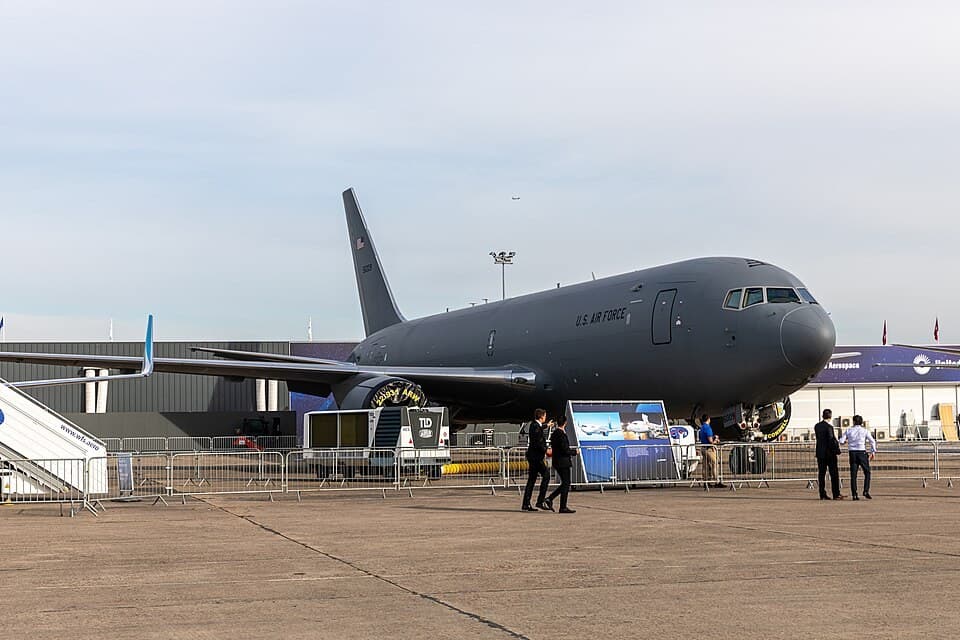
Boeing KC-46A at Paris Air Show 2019 Historical equipment reference photograph. It does not establish current availability or every detail of the named variant.
Matti Blume · CC BY-SA 4.0 · Wikimedia Commons · CC BY-SA 4.0 · Source ↗ · ModifiedKC-46 Pegasus equipment records. Variants, orders and quantities are shown as reported in each inventory source; coverage is incomplete.
 Israel
Reported count for KC-46 Pegasus · KC-46A. Service scope: Israeli Air Force; does not replace a national total. 1 distinct quantity component(s) from the same source list; shared rowspan cells counted once. Explicit source inventory scope: active; no other stock status or total inferred. Count column(s): in service: 2. Origin: United States. The listed variants/roles are the scope, not an immediately deployable count. The components do not establish one inventory census date; the stored date is the retrieved source snapshot.
Reported count for KC-46 Pegasus · KC-46A. Service scope: Israeli Air Force; does not replace a national total. 1 distinct count cell(s) from the same source list; shared rowspan cells counted once. Excludes retired/reserve/on-order rows. Count column(s): in service: 2. Origin: United States. The listed variants/roles are the scope, not an immediately deployable count. The components do not establish one inventory census date; the stored date is the retrieved source snapshot.
 Japan
JapanReported count for Boeing KC-46 Pegasus · KC-46A. Service scope: Japan Air Self-Defense Force; does not replace a national total. 1 distinct count cell(s) from the same source list; shared rowspan cells counted once. Excludes retired/reserve/on-order rows. Count column(s): in service: 4. Origin: United States. The listed variants/roles are the scope, not an immediately deployable count. Dates are the count-cell citations' stated source period (2026), not the article revision. 2026 cited source edition. Edition or publication years do not claim an exact inventory census day.
United StatesUS Air Force (USAF) exact named equipment holdings: KC-46A Pegasus. Active, operational-reserve and training units excluding equipment in store; November 2025 IISS assessment. Named service only; no parent-force or national total inferred. Source role: AIRCRAFT / TKR/TPT. Original estimates, ranges, reporting names, reserve, lease and employment scopes retained; nested included counts are not added. Missile-system quantities mean launchers, not rounds. No readiness, crew, carried weapon, payload, factory-production or future order count inherited.
U.S. Air Force (USAF) Japan Air Self-Defense Force Israeli Air Force
Equipment reference ↗