FORCETALLY
Loading the evidence…
Preparing your view.


Preparing your view.
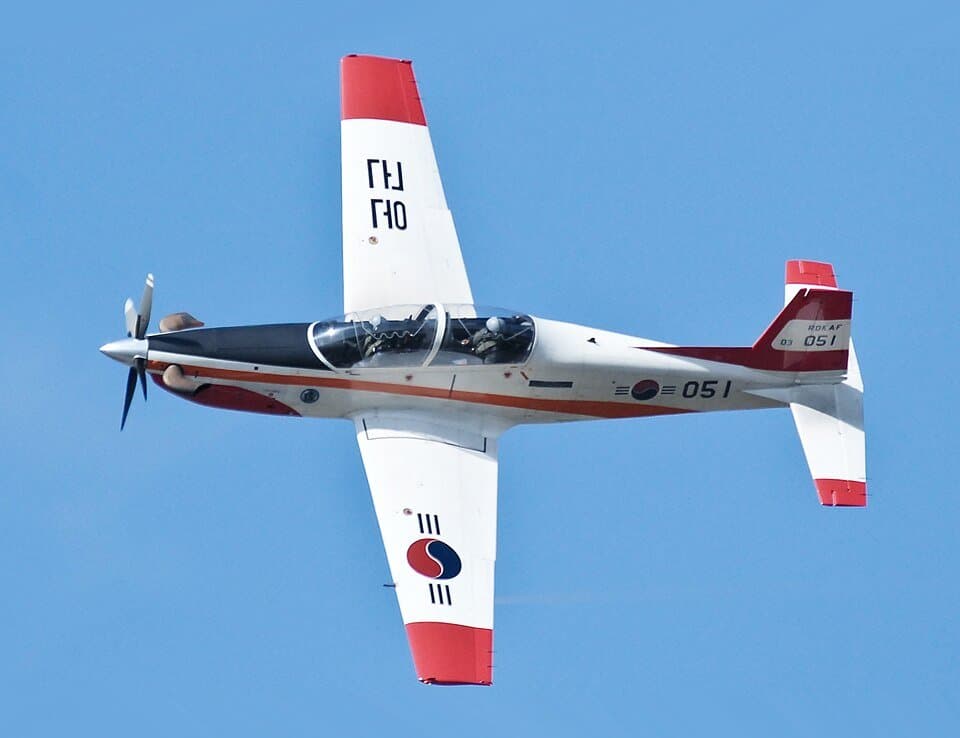
Trainer aircraftIn service
Basic trainer and light attack aircraft
KAI KT-1 Woongbi is a basic trainer and light attack aircraft originating in South Korea. It was built by Korea Aerospace Industries. Reported operators include Republic of Korea Air Force Indonesian Air Force Turkish Air Force Peruvian Air Force Senegalese Air Force.
 South Korea
Technical data
Basic trainer and light attack aircraft
South Korea
Korea Aerospace Industries
Agency for Defence Development Korea Aerospace Industries
In service
Republic of Korea Air Force Indonesian Air Force Turkish Air Force Peruvian Air Force Senegalese Air Force
186
1999–present
2000
November 1991
2
10.3 m (33 ft 10 in)
10.6 m (34 ft 9 in)
3.7 m (12 ft 2 in)
16.01 m 2 (172.3 sq ft)
True scale
Sourced dimensions beside a 1.75 m human reference.
See it in your room. Scan with your phone to open this model in 3D, then place it in your space.
Points represent sourced observations, including revisions. Revisions on the same effective date are not separate inventory events. Ranges appear in the table and are not plotted as exact points.
| Observation / report period | Value | Source | Claim state |
|---|---|---|---|
| 28 Sept 2026 | 2 people | Wikipedia contributors | superseded |
| 28 Sept 2026 | 2 people | Wikipedia contributors | superseded |
| 28 Sept 2026 | 2 people | Wikipedia contributors | superseded |
| 28 Sept 2026 | 2 people | Wikipedia contributors | superseded |
| 28 Sept 2026 | 2 people | Wikipedia contributors | superseded |
| 28 Sept 2026 | 2 people | Wikipedia contributors | superseded |
| 28 Sept 2026 | 2 people | Wikipedia contributors | superseded |
| 28 Sept 2026 | 2 people | Wikipedia contributors | superseded |
| 28 Sept 2026 | 2 people | Wikipedia contributors | approved |
1,910 kg (4,211 lb)
2,540 kg (5,600 lb)
3,311 kg (7,300 lb) (and Maximum Landing Weight)with external stores
551 L (146 US gal; 121 imp gal) in two wing tanks with provision for two 189 L (50 US gal; 42 imp gal) drop-tanks on the inboard pylons
1 × Pratt & Whitney Canada PT6A-62 turboprop engine, 708.4 kW (950.0 hp)
644 km/h (400 mph, 348 kn) at 4,570 m (14,993 ft)
1,333 km (828 mi, 720 nmi) at 7,620 m (25,000 ft) with max internal fuel (30 minutes reserve)
2,070 km (1,290 mi, 1,120 nmi) at 6,100 m (20,013 ft) with max internal and external fuel (30 minutes reserve)
<4 hours at 6,100 m (20,013 ft) with max internal fuel (30 minutes reserve)
11,580 m (37,990 ft)
17.78 m/s (3,500 ft/min) at sea level, clean
7
root: NACA 63-218 ; tip: NACA 63-212
408 kg (899 lb)
4-bladed Hartzell HC-E4N-2/E9512CB-1, 2.44 m (8 ft 0 in) diameter constant-speed fully feathering reversible propeller
132 km/h (82 mph, 71 kn) flaps down
648 km/h (403 mph, 350 kn)
+ 7 - 3.5 (aerobatic, clean)
206.8 kg/m 2 (42.4 lb/sq ft) with external stores
0.2137 kW/kg (0.1300 hp/lb)with external stores
Reference text from Wikipedia contributors, used under CC BY-SA 4.0.
KAI KT-1 Woongbi equipment records. Variants, orders and quantities are shown as reported in each inventory source; coverage is incomplete.
 Indonesia
Reported count for KAI KT-1 Woongbi · KT-1B. Service scope: Indonesian Air Force; does not replace a national total. 1 distinct quantity component(s) from the same source list; shared rowspan cells counted once. Explicit source inventory scope: active; no other stock status or total inferred. Count column(s): in service: 16. Origin: South Korea. The listed variants/roles are the scope, not an immediately deployable count. Explicitly named source subset; this is not a whole-family total and does not cover other listed designs. Dates are the count-cell citations' stated source period (2026), not the article revision. 2026 cited source edition. Edition or publication years do not claim an exact inventory census day.
 Peru
Air Force exact named equipment holdings: KT-1P. Active, operational-reserve and training units excluding equipment in store; November 2025 IISS assessment. Named service only; no parent-force or national total inferred. Source role: AIRCRAFT / TRG. Original estimates, ranges, reporting names, reserve, lease and employment scopes retained; nested included counts are not added. Missile-system quantities mean launchers, not rounds. No readiness, crew, carried weapon, payload, factory-production or future order count inherited.
 Senegal
Air Force exact named equipment holdings: KA-1S*. Active, operational-reserve and training units excluding equipment in store; November 2025 IISS assessment. Named service only; no parent-force or national total inferred. Source role: AIRCRAFT / TRG. Original estimates, ranges, reporting names, reserve, lease and employment scopes retained; nested included counts are not added. Missile-system quantities mean launchers, not rounds. No readiness, crew, carried weapon, payload, factory-production or future order count inherited.
South KoreaAir Force exact named equipment holdings: KT-1. Active, operational-reserve and training units excluding equipment in store; November 2025 IISS assessment. Named service only; no parent-force or national total inferred. Source role: AIRCRAFT / TRG. Original estimates, ranges, reporting names, reserve, lease and employment scopes retained; nested included counts are not added. Missile-system quantities mean launchers, not rounds. No readiness, crew, carried weapon, payload, factory-production or future order count inherited.
 Türkiye
Reported count for KT-1 Woongbi · KT-1T. Service scope: Turkish Air Force aircraft; does not replace a national total. 1 distinct quantity component(s) from the same source list; shared rowspan cells counted once. Explicit source inventory scope: active; no other stock status or total inferred. Count column(s): in service: 40. Origin: South Korea. The listed variants/roles are the scope, not an immediately deployable count. Dates are the count-cell citations' stated source period (2025), not the article revision. 2025 cited publication year. Edition or publication years do not claim an exact inventory census day.
Republic of Korea Air Force Indonesian Air Force Turkish Air Force Peruvian Air Force Senegalese Air Force
Equipment reference ↗Air Force exact named equipment holdings: KA-1. Active, operational-reserve and training units excluding equipment in store; November 2025 IISS assessment. Named service only; no parent-force or national total inferred. Source role: AIRCRAFT / ISR. Original estimates, ranges, reporting names, reserve, lease and employment scopes retained; nested included counts are not added. Missile-system quantities mean launchers, not rounds. No readiness, crew, carried weapon, payload, factory-production or future order count inherited.
Keep exploring
Trainer and light attack aircraft
 BrazilCompare with KAI KT-1 Woongbi
Basic/advanced trainer and light attack aircraft
 ItalyCompare with KAI KT-1 Woongbi
Basic/advanced trainer aircraft Light attack aircraft
Compare with KAI KT-1 WoongbiBasic trainer and ground attack aircraft
BrazilCompare with KAI KT-1 Woongbi Advanced trainer and light attack aircraft
ItalyCompare with KAI KT-1 Woongbi Light attack and advanced trainer aircraft
Compare with KAI KT-1 Woongbi