FORCETALLY
Loading the evidence…
Preparing your view.


Preparing your view.
TanksIn service
Main battle tank
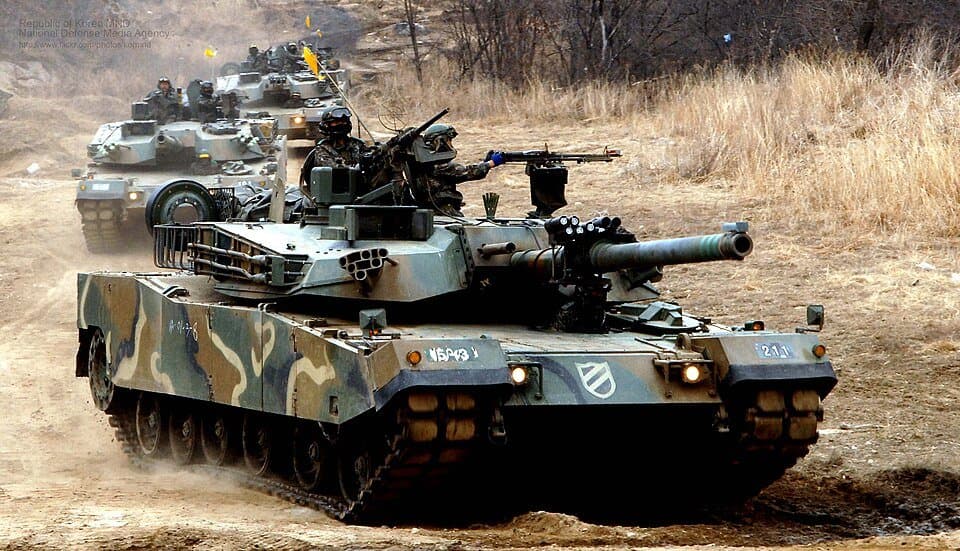
K1 tank is a main battle tank originating in South Korea. It was built by Hyundai Precision Industry (1985–2000) Hyundai Mobis (2000–2001) Rotem Co., Ltd. (2001–2007) Hyundai Rotem (2007–present).
 South Korea
K1 tank
대한민국 국군 Republic of Korea Armed Forces · CC BY-SA 2.0 · Resized · CC BY-SA 2.0 · Source ↗ · ModifiedMain battle tank
South Korea
K1: 1987–present K1E1: 2014–present K1A1: 2001–2024 K1A2: 2013–present
See operators
Chrysler Defense General Dynamics Land Systems Hyundai Precision Industry Agency for Defense Development
K1: 1978–1985 K1A1: 1991–1996
Hyundai Precision Industry (1985–2000) Hyundai Mobis (2000–2001) Rotem Co., Ltd. (2001–2007) Hyundai Rotem (2007–present)
K1: ₩ 2.3 billion (1994) K1A1: ₩4.4 billion (2001) K1A2: ₩6.0 billion
K1: 1987–1997 K1E1: 2013–present K1A1: 1999–2011 K1A2: 2013–2024
K1/E1: 1,027 K1A1/A2: 484
K1: 51.1 metric tons K1A1: 53.2 metric tons K1A2: 54.5 metric tons
K1: 9.67 m (gun forward) K1A1: 9.71 m (gun forward)
3.60 m
2.25 m
4
K1: Special Armor Package (SAP) K1A1: Korean Special Armor Plate (KSAP)
K1, K1E1: KM68A1 105 mm (47 rounds) K1A1, K1A2: KM256 120 mm (32 rounds), or Hyundai WIA CN03 120 mm (32 rounds)
M2 or K6 12.7x99 mm NATO HMG (commander's mount) M60D 7.62×51mm NATO GPMG (loader's mount) M60E2-1 7.62×51mm NATO GPMG (coaxial)
STX Engine / MTU Friedrichshafen MB871Ka-501 8-cylinder water-cooled turbocharged diesel engine 1,200 hp (890 kW) @ 2,600 rpm
K1: 23.4 hp/ton (17.44 kW/t) K1A1: 22.5 hp/ton (16.77 kW/t) K1A2: 22 hp/ton (16.40 kW/t)
Hyundai Transys/ ZF Friedrichshafen LSG 3000 Automatic, 4 forward, 2 reverse
Hydropneumatic (wheel 1, 2, 6), torsion bar (wheel 3, 4, 5)
460 mm (18 in) longitudinal slope: 60 % lateral slope: 30 % vertical: 1.1 m trench: 2.74 m fording: 1.2 m (without snorkel) or 2.2 m (with snorkel)
500 km (cruise)
65 km/h (40 mph) (roads) 40 km/h (25 mph) (cross-country)
Reference text from Wikipedia contributors, used under CC BY-SA 4.0.
True scale
Sourced dimensions beside a 1.75 m human reference.
Points represent sourced observations, including revisions. Revisions on the same effective date are not separate inventory events. Ranges appear in the table and are not plotted as exact points.
| Observation / report period | Value | Source | Claim state |
|---|---|---|---|
| 28 Sept 2026 | 9.67 m | Wikipedia contributors | superseded |
K1 tank equipment records. Variants, orders and quantities are shown as reported in each inventory source; coverage is incomplete.
South KoreaMarines exact named equipment holdings: K1A2; K1E1. Active, operational-reserve and training units excluding equipment in store; November 2025 IISS assessment. Named service only; no parent-force or national total inferred. Source role: ARMOURED FIGHTING VEHICLES / MBT. Original estimates, ranges, reporting names, reserve, lease and employment scopes retained; nested included counts are not added. Missile-system quantities mean launchers, not rounds. No readiness, crew, carried weapon, payload, factory-production or future order count inherited.
Reported count for K1A2. Service scope: Republic of Korea Army; does not replace a national total. 1 distinct quantity component(s) from the same source list; shared rowspan cells counted once. Explicit source inventory scope: active; no other stock status or total inferred. Count column(s): in service: 484. Origin: South Korea. The listed variants/roles are the scope, not an immediately deployable count. The components do not establish one inventory census date; the stored date is the retrieved source snapshot.
Reported count for K1A2. Service scope: Republic of Korea Army; does not replace a national total. 1 distinct count cell(s) from the same source list; shared rowspan cells counted once. Retired, wholly reserve and on-order rows are excluded; the reported count retains any explicitly mixed stock scope in the quoted row. Count column(s): in service: 484. Origin: South Korea. The listed variants/roles are the scope, not an immediately deployable count. The components do not establish one inventory census date; the stored date is the retrieved source snapshot.
 Ukraine