FORCETALLY
Loading the evidence…
Preparing your view.


Preparing your view.
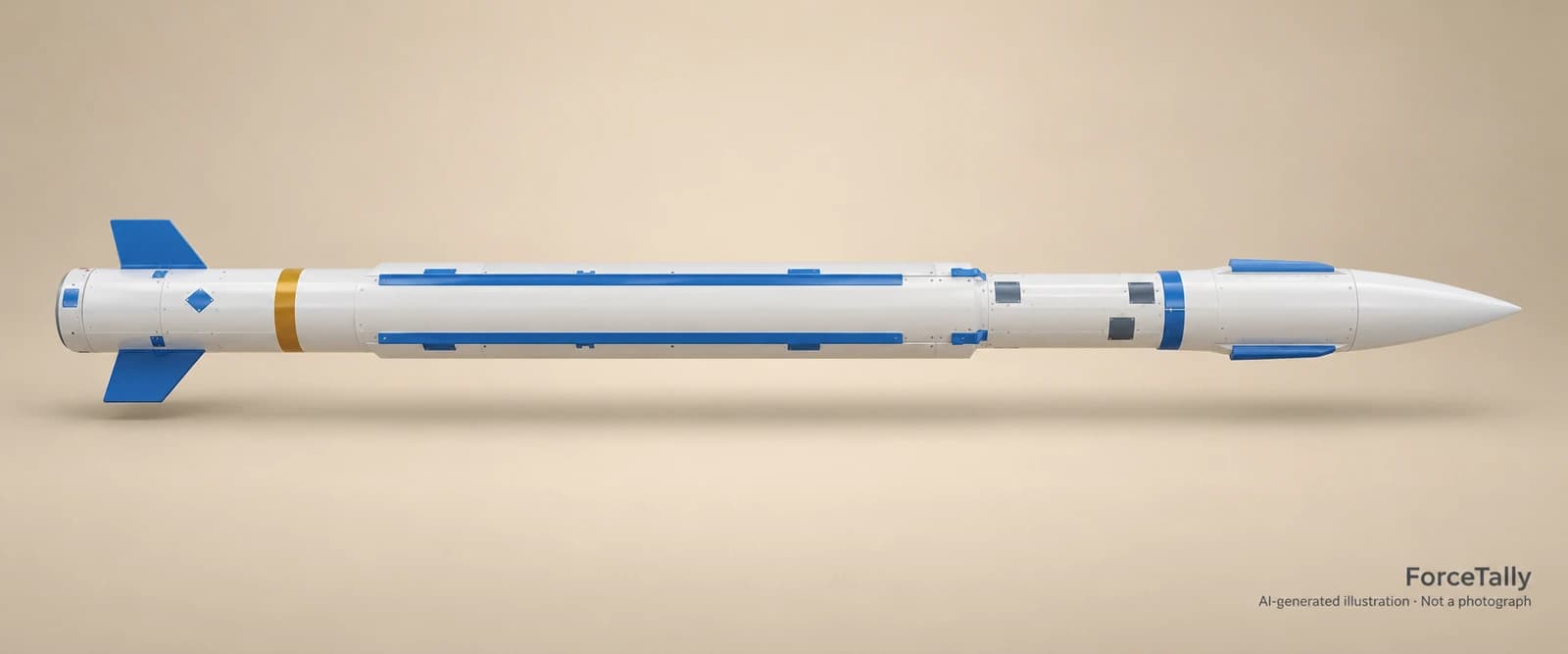
Air defenceIn service
Surface-to-air missile
K-SAAM is a surface-to-air missile originating in South Korea. It was built by LIG Defense & Aerospace Hanwha Aerospace. Reported operators include Republic of Korea Navy.
 South Korea
AI-generated illustration · Not a photograph · K-SAAM missile exhibit model at IDEX 2015, adapted from Mztourist’s licensed photograph of the complete foreground display mockup; exterior details illustrative. Exterior details are illustrative, not specification evidence.
ForceTally · AI-generated illustration · Not a photograph; adapted from Mztourist · CC BY-SA 4.0 · https://commons.wikimedia.org/wiki/File:K-SAAM_mockup_at_IDEX_2015.jpg · CC BY-SA 4.0 · AI-generated adaptation · Source ↗ · ModifiedSurface-to-air missile
South Korea
2021-present
Republic of Korea Navy
Agency for Defense Development LIG Nex1 (now LIG Defense & Aerospace ) Hanhwa Defense (now Hanwha Aerospace )
2011–2018
LIG Defense & Aerospace Hanwha Aerospace
2019–present
3.08 meters (10.1 ft)
20 km (12 mi)
Mach 2 (680 m/s; 2,500 km/h)
Fire-and-forget , infrared homing , ultra-high frequency explorer
The K-SAAM ( Korean Surface-to-Anti Air Missile ; Korean : 해궁 ; Hanja : 海弓 ; RR : Hae-gung ) is a South Korean short range ship-launched surface-to-air missile (SAM) system developed by the Agency for Defense Development (ADD), LIG Nex1 and Hanhwa Defense.
20 km (12 mi)
Fire-and-forget , infrared homing , ultra-high frequency explorer
Reference text from Wikipedia contributors, used under CC BY-SA 4.0.
True scale
Sourced dimensions beside a 1.75 m human reference.
See it in your room. Scan with your phone to open this model in 3D, then place it in your space.
K-SAAM equipment records. Variants, orders and quantities are shown as reported in each inventory source; coverage is incomplete.
 Malaysia
Reported count for K-SAAM. Service scope: Royal Malaysian Navy; does not replace a national total. 1 distinct quantity component(s) from the same source list; shared rowspan cells counted once. Explicit source inventory scope: ordered; no other stock status or total inferred. Count column(s): quantity: 48. Source counting unit(s): missiles; no conversion between equipment units. Origin: South Korea. The listed variants/roles are the scope, not an immediately deployable count. The components do not establish one inventory census date; the stored date is the retrieved source snapshot.
Keep exploring
 United States
 North Korea
 United Kingdom
 Japan