FORCETALLY
Loading the evidence…
Preparing your view.


Preparing your view.
Armoured vehiclesIn service
Light utility/combat multi-role vehicle Infantry mobility vehicle with MRAP capabilities
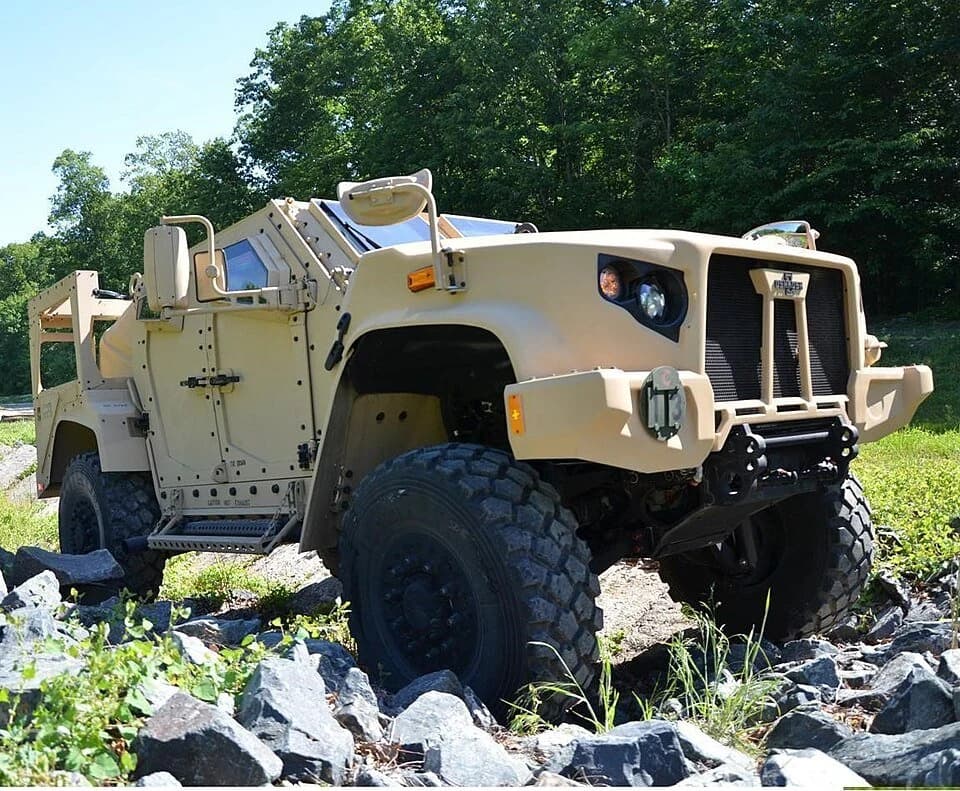
Joint Light Tactical Vehicle is a light utility/combat multi-role vehicle Infantry mobility vehicle with MRAP capabilities originating in United States. It was built by Oshkosh (JLTV A1) AM General (JLTV A2). Reported operators include United States Army United States Marine Corps United States Air Force.
 United States
Joint Light Tactical Vehicle
U.S. Army · Public domain · Resized / Converted to WebP · Public domain · Source ↗ · ModifiedTechnical data
Light utility/combat multi-role vehicle Infantry mobility vehicle with MRAP capabilities
United States
January 2019 – present
United States Army United States Marine Corps United States Air Force
Gaza war
Oshkosh
2011
Oshkosh (JLTV A1) AM General (JLTV A2)
$370,000–399,000
Contract placed 25 August 2015; first test JLTV delivered to Army in 2016. Full rate production transition approved in 2019
Over 20,000 units by mid-2023
All JLTV variants except* M1278 Heavy Guns Carrier M1279 Utility M1280 General Purpose M1281 Close Combat Weapons Carrier *L-ATV Ambulance
Curb weight: 14,000 lb (6,400 kg) Gross weight: 22,500 lb (10,200 kg)
20.5 ft (6.2 m) (nominal)
8.2 ft (2.5 m) (nominal)
8.5 ft (2.6 m) (nominal)
1 + 3 in individual seats + optional gunner (1 + 1; M1279 Utility)
Classified (A-kit/B-kit configuration)
A variety of light and medium caliber weapons, AGLs , or ATGMs can be fitted
6.6 L Gale Banks Engineering 866T V8 (based on General Motors Duramax L5P ) 400 hp (298 kW; 406 PS); 850 lb⋅ft (1,152 N⋅m)
5,100 pounds (2,300 kg) (2-door) 3,500 pounds (1,600 kg) (4-door)
Allison 2500SP 6-speed automatic
Oshkosh TAK-4i independent suspension
300 miles (480 km)
Forward Road: 70 mph (110 km/h) Off road: varies Reverse : 8 mph (13 km/h)
Power-assisted, front wheels
Joint Light Tactical Vehicle (JLTV)
Light utility/combat multi-role vehicle Infantry mobility vehicle with MRAP capabilities
United States
January 2019 – present
United States Army United States Marine Corps United States Air Force
Gaza war
Oshkosh
2011
Oshkosh (JLTV A1) AM General (JLTV A2)
$370,000–399,000
Contract placed 25 August 2015; first test JLTV delivered to Army in 2016. Full rate production transition approved in 2019
Over 20,000 units by mid-2023
All JLTV variants except* M1278 Heavy Guns Carrier M1279 Utility M1280 General Purpose M1281 Close Combat Weapons Carrier *L-ATV Ambulance
Curb weight: 14,000 lb (6,400 kg) Gross weight: 22,500 lb (10,200 kg)
20.5 ft (6.2 m) (nominal)
8.2 ft (2.5 m) (nominal)
8.5 ft (2.6 m) (nominal)
1 + 3 in individual seats + optional gunner (1 + 1; M1279 Utility)
Classified (A-kit/B-kit configuration)
A variety of light and medium caliber weapons, AGLs , or ATGMs can be fitted
6.6 L Gale Banks Engineering 866T V8 (based on General Motors Duramax L5P ) 400 hp (298 kW; 406 PS); 850 lb⋅ft (1,152 N⋅m)
5,100 pounds (2,300 kg) (2-door) 3,500 pounds (1,600 kg) (4-door)
Allison 2500SP 6-speed automatic
Oshkosh TAK-4i independent suspension
300 miles (480 km)
Forward Road: 70 mph (110 km/h) Off road: varies Reverse : 8 mph (13 km/h)
Power-assisted, front wheels
Each company delivered 22 vehicles and six trailers to Aberdeen Proving Ground , Maryland , and Yuma Proving Ground , Arizona . Previous testing had already put the vehicles through more than 400 ballistic and blast tests on armor testing samples, underbody blast testing, and more than 1,000 miles in shakedown testing. Soldiers from the Army Test and Evaluation Command and personnel from the Defense Department's Office of Test and Evaluation would begin to put the vehicles through field testing during 14 months of government performance testing. Testing was scheduled for completion by FY 2015, with a production contract to be awarded to a single vendor for almost 55,000 vehicles (49,099 Army; 5,500 Marines). In September 2013, full-pace, full-scope JLTV testing began at Aberdeen Proving Ground, Yuma, and Redstone Arsenal , Alabama .
In February 2013, Oshkosh unveiled the Utility Variant of its JLTV offer, fulfilling JLTV's requirement for a two-seat cargo vehicle. The vehicle's performance was demonstrated at the 2013 NATC Technology Rodeo at the Nevada Automotive Test Center (NATC). The Utility Variant is designed to provide mobility for loads such as containers, pallets, and break bulk cargo . It can also be outfitted as a shelter carrier to carry standard shelters for communications systems, on-board electronics, and other functions. Payload capacity is in excess of 2,300 kg (5,100 lbs). Both Oshkosh L-ATV variants have a common crew protection system, automotive systems, and the Oshkosh TAK-4i intelligent independent suspension system.
In July 2014, Oshkosh announced the L-ATV had completed 200,000 miles (320,000 km) and all requirements for reliability, availability, maintainability (RAM) testing.
The Army held theirs the previous September and October, where three tests were held as 96-hour cycles to simulate operational missions, one of which incorporated a live fire demonstration.
The L-ATV is based around Oshkosh's TAK-4i (i = intelligent) independent suspension system. Vehicles fitted with an earlier version of the system, include the Oshkosh Medium Tactical Vehicle Replacement (MTVR), Oshkosh Logistic Vehicle System Replacement , and Oshkosh MRAP All-Terrain Vehicle ( M-ATV ); the TAK-4 system has also been retro-fitted to the Force Protection Inc Cougar and BAE Systems RG-33 MRAPs. The majority of systems supplied pre-JLTV have been coil-sprung. The TAK-4i version fitted to the L-ATV remains undisclosed, but is not coil-sprung and is of the variable adjustable ride-height type with up to 20 inches (51 cm) of wheel travel, 25 percent more than the current standard.
Power output is 400 hp (298 kW; 406 PS) and 850 lb⋅ft (1,152 N⋅m) of torque.
In commercial use, power output of the standard Duramax L5P engine is currently up to 445 hp (332 kW; 451 PS) and 910 lb⋅ft (1,234 N⋅m).
According to Oshkosh literature, the ProPulse diesel-electric powertrain dramatically improves fuel economy by up to 35 percent in certain circumstances and serves as an on-board generator with enough output to power an entire airfield or hospital, generating up to 120 kW of AC power for external operations; the hybrid powertrain was not a requirement of the JLTV program.
The Oshkosh M-ATV, which was procured primarily for Afghanistan where the earlier and bigger/heavier MRAPs had mobility issues, has protection comparable to the original MRAP designs, but while smaller it still remains a relatively large vehicle. During the L-ATV design process, every component was optimized for survivability, resulting in the same level of protection in a vehicle 30 percent smaller. This resulted in a curb weight for the JLTV requirement of 14,000 lb (6,400 kg), almost one-third the weight of the heavier MRAP (4x4) models, and almost half the weight of the original MRAP models. Payload allowance for the JLTV in Combat Tactical Vehicle (CTV) configuration was four passengers and 3,500 lb (1,600 kg) of cargo, and in Combat Support Vehicle (CSV) configuration was two passengers and 5,100 lb (2,300 kg) of cargo.
M1279 Utility – The JLTV-UTL carries a two-man crew for cargo delivery and supports a payload of 5,100 lb (2,300 kg). It can be equipped with a Troop Seat Kit (TSK) to transport up to eight troops or fitted with a cargo shelter.
M1280 General Purpose – The JLTV-GP is the base vehicle that carries a four-man crew and supports a payload of 3,500 lb (1,600 kg).
In January 2022 Oshkosh unveiled a hybrid-electric Joint Light Tactical Vehicle (eJLTV) technology demonstrator that uses a ‘commercially available' lithium-ion battery. It takes the diesel engine of the JLTV about 30 minutes to charge the lithium-ion battery, and then the eJLTV can operate on battery power for approximately the same amount of time. It can export up to 115 kW of power. The hybrid electric configuration adds more than 453 kg to the vehicle's curb weight.
In May 2016, the Army confirmed a plan, suggested since late 2015, to use the JLTV for the Light Reconnaissance Vehicle (LRV) requirement. By 2020 the LRV requirement had evolved to such an extent that it excluded the JLTV, requiring a six-person crew.
The MADIS Mk1 is equipped with a Kongsberg Defense Protector RS6 remote weapon station armed with an XM914E1 30 mm chain gun , an M240 7.62 mm MG, and turret-mounted Stinger missiles .
At AUSA 2016, Oshkosh displayed a JLTV General Purpose variant equipped with an EOS R-400S-MK2 remote weapon system integrated with Orbital ATK 's M230LF 30 mm lightweight automatic chain gun .
The variants selected by Montenegro are 55 "M1280 General Purpose" to be fitted with the Elbit weapon station equipped with a 12.7×99mm NATO heavy machine gun. For the other variants, Montenegro mentions having received 10 "M1278 Heavy Guns Carrier" as of 2024. In 2024, the army announced its interest to equip four of the M1278 variant with a SAMSON 30 (Katlanit) turret. Also, in May 2023, Montenegro signed a contract with Israel for €20 million regarding the supply of Elbit 120 mm Spear Mk2 low recoil mortar systems to be installed on the JLTV (quantity unknown). Those systems are designed to be installed on the M1279 Utility variant, and therefore, with 55 in the M1280 variant and 10 in the M1278 variant, only 2 are possible with the unique order.
In August 2025, the U.S. State Department approved a $160M US Foreign Military Sale of 60 JLTVs to be accompanied by 9 JLTV cargo trailers, as well as communication equipment and other hardware. The vehicles would replace CANSOFCOM 's fleet of HMMWV under the Next Generation Fighting Vehicle project.
The Hellenic Army mentioned the potential purchase of JLTV to be equipped with various equipments as an option: In June 2022, the Hellenic Army General Staff met with representatives from Elbit Systems after showing interest in the acquisition of SPEAR 120mm mortar systems mounted on the JLTV. In April 2023, the Hellenic Army ordered Spike missiles for €370 million. As part of the variants ordered, Greece mentions the Spike NLOS . In its terrestrial use, it would be installed on the Plasan SandCat or the JLTV.
Oshkosh L-ATV in M1278 Heavy Guns Carrier JLTV configuration and fitted with an EOS R-400S-MK2 remote weapon system integrated with Orbital ATK's M230 LF 30 mm lightweight automatic chain gun
Reference text from Wikipedia contributors, used under CC BY-SA 4.0.
True scale
Sourced dimensions beside a 1.75 m human reference.
See it in your room. Scan with your phone to open this model in 3D, then place it in your space.
Points represent sourced observations, including revisions. Revisions on the same effective date are not separate inventory events. Ranges appear in the table and are not plotted as exact points.
| Observation / report period | Value | Source | Claim state |
|---|---|---|---|
| 28 Sept 2026 | 1 people | Wikipedia contributors | superseded |
| 28 Sept 2026 | 1 people | Wikipedia contributors | superseded |
| 28 Sept 2026 | 1 people | Wikipedia contributors | superseded |
| 28 Sept 2026 | 1 people | Wikipedia contributors | approved |
Joint Light Tactical Vehicle equipment records. Variants, orders and quantities are shown as reported in each inventory source; coverage is incomplete.
 Belgium
Army exact named equipment holdings: JLTV. Active, operational-reserve and training units excluding equipment in store; November 2025 IISS assessment. Named service only; no parent-force or national total inferred. Source role: ARMOURED FIGHTING VEHICLES / AUV. Original estimates, ranges, reporting names, reserve, lease and employment scopes retained; nested included counts are not added. Missile-system quantities mean launchers, not rounds. No readiness, crew, carried weapon, payload, factory-production or future order count inherited.
 Brazil
Marines exact named equipment holdings: JLTV. Active, operational-reserve and training units excluding equipment in store; November 2025 IISS assessment. Named service only; no parent-force or national total inferred. Source role: ARMOURED FIGHTING VEHICLES / AUV. Original estimates, ranges, reporting names, reserve, lease and employment scopes retained; nested included counts are not added. Missile-system quantities mean launchers, not rounds. No readiness, crew, carried weapon, payload, factory-production or future order count inherited.
 Israel
 Ivory Coast
Army exact named equipment holdings: JLTV. Active, operational-reserve and training units excluding equipment in store; November 2025 IISS assessment. Named service only; no parent-force or national total inferred. Source role: ARMOURED FIGHTING VEHICLES / AUV. Original estimates, ranges, reporting names, reserve, lease and employment scopes retained; nested included counts are not added. Missile-system quantities mean launchers, not rounds. No readiness, crew, carried weapon, payload, factory-production or future order count inherited.
 Lithuania
Army exact named equipment holdings: JLTV. Active, operational-reserve and training units excluding equipment in store; November 2025 IISS assessment. Named service only; no parent-force or national total inferred. Source role: ARMOURED FIGHTING VEHICLES / AUV. Original estimates, ranges, reporting names, reserve, lease and employment scopes retained; nested included counts are not added. Missile-system quantities mean launchers, not rounds. No readiness, crew, carried weapon, payload, factory-production or future order count inherited.
 Montenegro
Army exact named equipment holdings: JLTV. Active, operational-reserve and training units excluding equipment in store; November 2025 IISS assessment. Named service only; no parent-force or national total inferred. Source role: ARMOURED FIGHTING VEHICLES / AUV. Original estimates, ranges, reporting names, reserve, lease and employment scopes retained; nested included counts are not added. Missile-system quantities mean launchers, not rounds. No readiness, crew, carried weapon, payload, factory-production or future order count inherited.
 Netherlands
Lower-bound count for Kaaiman DXPV ( Oshkosh JLTV ) Dutch Expeditionary Patrol Vehicles. Service scope: Royal Netherlands Marine Corps; does not replace a national total. 1 distinct quantity component(s) from the same source list; shared rowspan cells counted once. Explicit source inventory scope: ordered; no other stock status or total inferred. Count column(s): quantity ordered: > 150. Origin: United States. The listed variants/roles are the scope, not an immediately deployable count. The components do not establish one inventory census date; the stored date is the retrieved source snapshot.
 North Macedonia
Army exact named equipment holdings: JLTV. Active, operational-reserve and training units excluding equipment in store; November 2025 IISS assessment. Named service only; no parent-force or national total inferred. Source role: ARMOURED FIGHTING VEHICLES / AUV. Original estimates, ranges, reporting names, reserve, lease and employment scopes retained; nested included counts are not added. Missile-system quantities mean launchers, not rounds. No readiness, crew, carried weapon, payload, factory-production or future order count inherited.
 Romania
Army exact named equipment holdings: JLTV. Active, operational-reserve and training units excluding equipment in store; November 2025 IISS assessment. Named service only; no parent-force or national total inferred. Source role: ARMOURED FIGHTING VEHICLES / AUV. Original estimates, ranges, reporting names, reserve, lease and employment scopes retained; nested included counts are not added. Missile-system quantities mean launchers, not rounds. No readiness, crew, carried weapon, payload, factory-production or future order count inherited.
 Slovakia
Army exact named equipment holdings: JLTV. Active, operational-reserve and training units excluding equipment in store; November 2025 IISS assessment. Named service only; no parent-force or national total inferred. Source role: ARMOURED FIGHTING VEHICLES / AUV. Original estimates, ranges, reporting names, reserve, lease and employment scopes retained; nested included counts are not added. Missile-system quantities mean launchers, not rounds. No readiness, crew, carried weapon, payload, factory-production or future order count inherited.
 Slovenia
Army exact named equipment holdings: JLTV. Active, operational-reserve and training units excluding equipment in store; November 2025 IISS assessment. Named service only; no parent-force or national total inferred. Source role: ARMOURED FIGHTING VEHICLES / AUV. Original estimates, ranges, reporting names, reserve, lease and employment scopes retained; nested included counts are not added. Missile-system quantities mean launchers, not rounds. No readiness, crew, carried weapon, payload, factory-production or future order count inherited.
 Ukraine United States
US Army exact named equipment holdings: JLTV. Active, operational-reserve and training units excluding equipment in store; November 2025 IISS assessment. Named service only; no parent-force or national total inferred. Source role: ARMOURED FIGHTING VEHICLES / AUV. Original estimates, ranges, reporting names, reserve, lease and employment scopes retained; nested included counts are not added. Missile-system quantities mean launchers, not rounds. No readiness, crew, carried weapon, payload, factory-production or future order count inherited.
United States Army United States Marine Corps United States Air Force
Equipment reference ↗US Marine Corps exact named equipment holdings: JLTV. Active, operational-reserve and training units excluding equipment in store; November 2025 IISS assessment. Named service only; no parent-force or national total inferred. Source role: ARMOURED FIGHTING VEHICLES / AUV. Original estimates, ranges, reporting names, reserve, lease and employment scopes retained; nested included counts are not added. Missile-system quantities mean launchers, not rounds. No readiness, crew, carried weapon, payload, factory-production or future order count inherited.
Keep exploring
Infantry mobility vehicle with MRAP capabilities
UkraineInfantry mobility vehicle with MRAP capabilities
UkraineInfantry mobility vehicle with MRAP capabilities
UkraineCompare with Joint Light Tactical Vehicle Infantry mobility vehicle with MRAP capabilities
 South AfricaCompare with Joint Light Tactical Vehicle
Infantry mobility vehicle with MRAP capabilities
 Germany
Infantry mobility vehicle with MRAP capabilities