FORCETALLY
Loading the evidence…
Preparing your view.


Preparing your view.
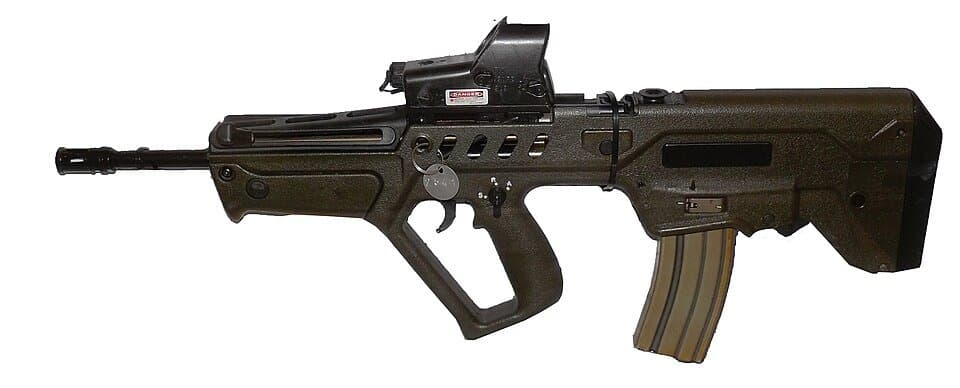
Small armsIn service
Bullpup assault rifle
IWI Tavor is a bullpup assault rifle originating in Israel. It was built by Israel Weapon Industries Also produced under IWI license by: PLR Systems , India RPC Fort (of Ukraine ). Reported operators include Angola, Azerbaijan, Brazil, Cameroon, Chad, Colombia, Chile, Cyprus, Ethiopia, Georgia, Guatemala, Honduras, India, Indonesia, Ivory Coast, Israel, Kenya, Mexico, Morocco, Nigeria, North Macedonia, Peru, Philippines, Portugal, Rwanda, Senegal, Thailand, Türkiye, Turkmenistan, Ukraine, United States, Uruguay, Vietnam, Zambia.
 Israel
Technical data
Bullpup assault rifle
Israel
2001–present
See Users
South Thailand insurgency Gaza–Israel conflict Gaza War (2008–2009) 2014 Israel–Gaza conflict Gaza war Insurgency in Jammu and Kashmir Second Nagorno-Karabakh war Colombian conflict Russo-Ukrainian War Russian invasion of Ukraine
Israel Military Industries
1995–2003
Israel Weapon Industries Also produced under IWI license by: PLR Systems , India RPC Fort (of Ukraine )
See Variants
3.27 kg (7.21 lb)
720 mm (28.3 in)
457 mm (18 in) (Tavor TAR)
5.56×45mm NATO
Long-stroke gas-operated , closed rotating bolt
750–950 rounds/min
910 m/s (2,986 ft/s)
550 m (1,804 ft)
30-round detachable box STANAG magazine (5.56×45mm NATO)
Backup iron sights and integrated Picatinny rails are provided for the Meprolight MP 21, ITL MARS with integrated laser and IR pointer, Trijicon ACOG , EOTech holographic sight, and other optical sights
Angola : Angolan Army purchase for Special Forces.
Azerbaijan : Azerbaijan purchased a number of TAR-21 for the special operations forces of the Azerbaijani Army in August 2008.
Brazil : Produced under license by Taurus for the military, but as of 2017, Taurus has never carried out a licensed production of the Tavor TAR. Small numbers are issued to soldiers in the Frontier Brigade.
Cameroon : Issued to the Special Forces of Cameroon Army.
Chad : Issued to Chadian Ground Forces since 2006.
Colombia : Used by special forces and the National Police of Colombia .
Chile : Investigations Police of Chile .
Cyprus : The Tavor Χ95 assault rifle is used by Cypriot Special Forces.
Ethiopia
Georgia : Different variants of the weapon have been acquired and issued to law enforcement, special commando and protection units of the Georgian MIA since 2001. In 2004 the TAR-21 was to replace the Soviet Kalashnikov rifle , however due to lack of funding and low purchase quantity that idea was abandoned. The construction of a manufacturing plant was also considered.
Guatemala : Guatemala's police force or PNC ( Policia Nacional Civil ) operates the TAR-21.
Honduras : The Honduran Army operates the Tavor X95.
India : In late 2002, India signed an ₹ 880 million (equivalent to ₹ 3.4 billion or US$35 million in 2023) deal with Israel Military Industries for 3,070 manufactured TAR-21s to be issued to India's special forces personnel, where its ergonomics, reliability in heat and sand might give them an edge at close quarters and deployment from inside vehicles.
Indonesia : Used by BRIMOB Police Special Forces.
Ivory Coast : Used by Ivorian Special Forces.
Israel : See: Trials and service
Kenya
Mexico : In service with the Ministry of Public Security since 2011.
Morocco : General Directorate for National Security equipped with the Tavor X95. The first Arab or North African country to use the Tavor X95 publicly.
Nigeria : The State Security Service employ it as the primary assault rifle for their close protection and tactical units replacing the Uzi .
North Macedonia : Used by Rapid Deployment Unit (Tar-21) and Special Anti-terrorist Unit – Tiger (Tavor x95) .
Peru
Philippines : Small quantities in use by special units of the Philippine Marines and Philippine Drug Enforcement Agency and one PNP SWAT team in Pasig.
Portugal : Small quantities of the TAR-21 are in use by field and intervention units of the Polícia Judiciária , like hostage negotiation teams and investigators who usually work alongside other dedicated law enforcement intervention units—the Special Operations Group (GOE) and the National Republican Guard's Special Operations Company (COE); these weapons were initially intended to equip a new unit under the command of the Polícia Judiciária resembling the GOE. The TAR-21 also participated in the competition for the new service rifle for the three branches of the Portuguese Armed Forces and the Police Special Operations Group (GOE)—a bid that also included the local production of the TAR-21 in Portugal. However, the TAR-21 was excluded from the shortlist. The competition has meanwhile been annulled, after the other contenders and both political and defence critics accused the competition of favouring the Heckler & Koch G36 .
Rwanda
Senegal : Issued to the Special Forces of the Senegal Army.
Thailand : 76,000 in use
Turkey : Used by Special Forces Command in executive protection role.
Turkmenistan
Ukraine : Yuriy Lutsenko , then head of Ministry of Internal Affairs of Ukraine , announced on October 1, 2008, that IWI and Ukrainian state-owned company RPC Fort would jointly manufacture Tavor TAR to enter service with special Ukrainian military and police units. RPC Fort had displayed working samples of Tavor TARs chambered in 5.45×39mm cartridge with Milkor 40mm UBGL grenade launchers to showcase to Ukrainian security forces officers as a means of convincing them to buy Ukrainian-made Tavor TARs for special forces units. In December 2009, a resolution was adopted to purchase the Fort 221 chambered in 5.45x39 for Ukrainian intelligence/border guard agencies, purchased in small numbers. It was subsequently adopted in 2014 for Ukrainian military and police forces. Known users include Ukrainian Spetsnaz forces and the Scorpion unit.
United States : In August 2013, IWI US announced that the Pennsylvania Capitol Police had adopted the Tavor SAR, a variant specifically designed for the U.S. market. In July 2014, it was announced that the Lakewood, New Jersey Police Department would begin to adopt the Tavor SAR, after the weapon "met the demands and requirements of the Lakewood PD for reliability, ease-of-maintenance, durability and accuracy". The Hidalgo County Sheriff's Office in Texas, operate Tavor SAR.
Uruguay : On 13 October 2021, it was reported that the Uruguayan Ministry of the Interior acquired some 200 Tavor X-95s, manufactured by IWI, for the Uruguayan National Republican Guard Directorate. Training was carried out by an instructor from IWI, brought especially to Uruguay for that purpose. The Uruguayan police also purchased thousands of Tavor rifles from IWI.
Vietnam : From 2012, the TAR-21 entered service in special units of the Vietnamese Army , equipping special forces, naval infantries and navy personnel.
Zambia : Used by the Zambian Army Special Forces Group.
The IWI Tavor , previously designated as the Tavor TAR-21 (Tavor Assault Rifle – 21st century), is an Israeli bullpup assault rifle chambered in 5.56×45mm NATO , designed and produced by Israel Weapon Industries (IWI) .
The IWI Tavor , previously designated as the Tavor TAR-21 (Tavor Assault Rifle – 21st century), is an Israeli bullpup assault rifle chambered in 5.56×45mm NATO , designed and produced by Israel Weapon Industries (IWI) . It is part of the Tavor family of rifles, which have spawned many derivatives of the original design.
The Tavor TAR-21 can also be mounted with the M203 grenade launcher , designated as the GTAR-21. A compact variant with a 380 mm (15 in) barrel is also available, designated as the CTAR-21. A designated marksman rifle variant with a folding under-barrel bipod and Trijicon ACOG 4× magnification sight was also made but later phased out in favour for the Tavor TAR Flattop.
The first Tavor X95s were issued to new recruits of a main IDF infantry brigade in 2013, replacing the M16. In 2014 the IDF announced that in the future (from as early as the end of 2014) some infantry units could start to be issued some numbers of an improved X95, which will have a longer 38 cm (15 in) barrel (instead of the original 33 cm barrel) and a lighter trigger pull.
The Tavor is primarily chambered in 5.56×45mm NATO and uses STANAG magazines , conversion kits for 9×19mm Parabellum and 5.45×39mm calibre are also available.
The IDF uses both 3.6-gram (55 gr) M193 and 4.0-gram (62 gr) M855 5.56×45mm rounds. M193 rounds are used by regular infantrymen for better terminal effects at shorter distances, while the heavier M855 is used by sharpshooters.
The Tavor barrels are made from CrMoV steel and cold-hammer-forged (CHF) on the premises of the IWI factory in Ramat HaSharon . The TAR-21 barrel is 18 inches (457 mm) in length and is chrome-lined for durability and corrosion resistance. The barrel features six grooves in a one in seven inch (178 mm) twist, or 32 calibres right hand twist rate .
IWI produces the Tavor TAR-21 in different variations as outlined below.
The Tavor TAR-21 is the standard variant with a 457 mm (18 in) long barrel.
The CTAR-21 is a compact shorter 380 mm (15 in) barrel variant intended for commandos and special forces , but has become more favoured than the standard TAR-21 throughout the IDF.
With the use of a conversion kit, the X95 can be converted from a 5.56 mm assault rifle to a 9 mm submachine gun . A suppressor can also be added to the weapon, as part of the 9 mm conversion kit. A grenade launcher can also be attached to the X95.
The IWI Tavor 7 is derived from the Tavor TAR. Essentially a battle rifle , chambered in 7.62×51mm NATO. It is fully ambidextrous, features a 432 mm (17 in) barrel with a 730 mm (28.7 in) overall length. and a 508 mm (20 in) barrel with an 806 mm (31.7 in) overall length.
Fort-221 – Ukrainian produced version of the CTAR-21 in 5.45×39 mm.
Fort-222 – Ukrainian produced version of the STAR-21 in 5.45×39 mm.
The semi-automatic Tavor Carbine (TC-21) was first made available for civilian customers to purchase in Canada from 2008. The Canadian civilian version initially shipped with the Mepro reflex sight and a slightly longer barrel to meet the Canadian requirement for non-restricted semi-automatic centrefire rifles to have a barrel length of at least 470 mm. Current versions are shipped with a full-length Picatinny rail, without optics. In Europe, the Czech company Zeleny Sport recently (December 2015) imported Israeli-made TC-21s, equipped with Mepro M5 or M21 reflex sight, which are now available for both civilian and law enforcement customers.
TSB16 : Semi-automatic version of the CTAR-21, with a 26 + 1 ⁄ 8 in (664 mm) overall length.
TSB17-9 : 9×19 mm submachine gun with a 17 in (432 mm) barrel and a 26 + 1 ⁄ 8 in (664 mm) overall length.
TSB18 : 5.56×45 mm rifle with an 18 in (457 mm) barrel and a 27 + 5 ⁄ 8 in (702 mm) overall length.
TSB18RS : 5.56×45 mm rifle with an 18 in (457 mm) barrel and a 30 in (762 mm) overall length; integrated permanent 2 + 3 ⁄ 8 in muzzle brake and a 10-round magazine to be compliant with laws of certain states. ("RS" stands for Restricted State.)
TSIDF16 : Semi-automatic version of the CTAR-21 without a full-length rail, an integrated MEPRO 21 sight, and a 26 + 1 ⁄ 8 in (664 mm) overall length; meant to be a semi-automatic replica of the CTAR-21 issued to the IDF.
Reference text from Wikipedia contributors, used under CC BY-SA 4.0.
True scale
Sourced dimensions beside a 1.75 m human reference.
See it in your room. Scan with your phone to open this model in 3D, then place it in your space.
Points represent sourced observations, including revisions. Revisions on the same effective date are not separate inventory events. Ranges appear in the table and are not plotted as exact points.
| Observation / report period | Value | Source | Claim state |
|---|---|---|---|
| 28 Sept 2026 | 0.457 m | Wikipedia contributors | superseded |
IWI Tavor equipment records. Variants, orders and quantities are shown as reported in each inventory source; coverage is incomplete.
 Angola
 Azerbaijan
 Brazil
 Cameroon
 Chad
 Chile
 Colombia
 Cyprus
 Ethiopia
 Georgia
 Guatemala
 Honduras
 India
 Indonesia Israel
 Ivory Coast
 Kenya
 Mexico
 Mongolia
 Morocco
 Nepal
 Nigeria
 North Macedonia
 Peru
 Philippines
 Portugal
 Rwanda
 Senegal
 Thailand
 Türkiye
 Turkmenistan
 Uganda
 Ukraine
 United States
 Uruguay
 Vietnam
 Zambia
Angola, Azerbaijan, Brazil, Cameroon, Chad, Colombia, Chile, Cyprus, Ethiopia, Georgia, Guatemala, Honduras, India, Indonesia, Ivory Coast, Israel, Kenya, Mexico, Morocco, Nigeria, North Macedonia, Peru, Philippines, Portugal, Rwanda, Senegal, Thailand, Türkiye, Turkmenistan, Ukraine, United States, Uruguay, Vietnam, Zambia
Equipment reference ↗ Iran
 Singapore
 France