Design and configuration
The ground launcher holds multiple interceptor canisters on an inclined frame. It can be transported separately from the radar and control equipment.1


Preparing your view.
Air defenceIn service
Short-range air defence
Iron Dome is a short-range defensive system combining a tracking radar, battle management and interceptor launchers. The system is broader than the visible canister launcher.
 Israel
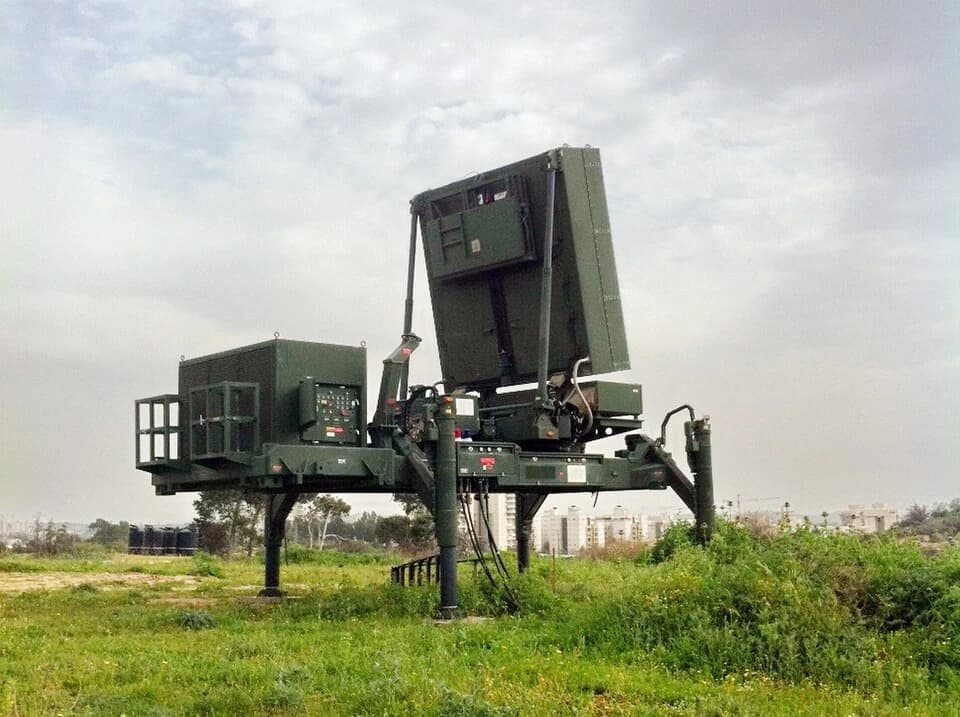
EL/M-2084 radar component used by Iron Dome; this photograph shows the radar unit, not a complete battery.
Flickr_-_Israel_Defense_Forces_-_Iron_Dome_System_Guarding_the_Skies_of_Israel.jpg : Israel Defense Forces from Israel derivative work: NatanFlayer · CC BY-SA 2.0 · Resized / optimised · CC BY-SA 2.0 · Source ↗ · ModifiedCounter rocket, artillery, and mortar (C-RAM) and short range air defence system
Israel
2011–present
Israel Defense Forces
Gaza–Israel conflict ( 2011 , 2012 , 2021 ) Operation Pillar of Defense Operation Protective Edge Sinai insurgency 2021 Israel–Palestine crisis Operation Breaking Dawn Operation Shield and Arrow Gaza war 2024 Iran–Israel conflict Twelve-Day War 2026 Iran war
Rafael Advanced Defense Systems Israel Aerospace Industries
2005
Rafael Advanced Defense Systems Israel Aerospace Industries
$50 million per battery $100,000–150,000 per interception
2011–present
10 batteries deployed (planned deployment is 15)
90 kg (200 lb)
3 m (9 ft 10 in)
160 mm (6.3 in)
Proximity fuze
Mach 2.2
Three/four launchers, each carrying 20 interceptors.
The Iron Dome ( Hebrew : כִּפַּת בַּרְזֶל , romanized : Kippat Barzel ) is an Israeli mobile all-weather air defense system , developed by Rafael Advanced Defense Systems and Israel Aerospace Industries .
The Iron Dome ( Hebrew : כִּפַּת בַּרְזֶל , romanized : Kippat Barzel ) is an Israeli mobile all-weather air defense system , developed by Rafael Advanced Defense Systems and Israel Aerospace Industries . The system is designed to intercept and destroy short-range rockets and artillery shells fired from distances of 4 to 70 kilometres (2–43 mi) away and whose trajectory would take them to an Israeli populated area. From 2011 to 2021, the United States contributed a total of US$1.6 billion to the Iron Dome defense system, with another US$1 billion approved by the US Congress in 2022.
Iron Dome was declared operational and initially deployed on 27 March 2011 near Beersheba . On 7 April 2011, the system successfully intercepted a rocket launched from Gaza for the first time. On 10 March 2012, The Jerusalem Post reported that the system shot down 90% of rockets launched from Gaza that would have landed in populated areas. In late 2012, Israel said that it hoped to increase the range of Iron Dome's interceptions, from a maximum of 70 to 250 kilometres (43–155 mi) and make it more versatile so that it could intercept rockets coming from two directions simultaneously.
During the 2006 Second Lebanon War , approximately 4,000 Hezbollah-fired rockets (the great majority of which were short-range Katyusha rockets ) landed in northern Israel, including on Haifa , the country's third largest city . The rocket barrage killed 44 Israeli civilians and caused some 250,000 Israeli citizens to evacuate and relocate to other parts of Israel while an estimated 1 million Israelis were confined in or near bomb shelters during the conflict.
To the south, more than 8,000 projectiles (estimated at 4,000 rockets and 4,000 mortar bombs) were fired indiscriminately into Israel from Gaza between 2000 and 2008, principally by Hamas . Almost all of the rockets fired were Qassams launched by 122 mm Grad launchers smuggled into the Gaza Strip, giving longer range than other launch methods. Nearly a million Israelis living in the south were within rocket range, posing a serious security threat to the country and its citizens.
The system is designed to counter short-range rockets and 155 mm artillery shells with a range of up to 70 kilometers (43 mi). According to its manufacturer, Iron Dome will operate day and night, under adverse weather conditions, and can respond to multiple threats simultaneously.
On 4 April 2012, Reuters reported that a senior Israeli official, during a briefing to a small group of journalists on condition of anonymity, predicted an increased interception range of up to 250 kilometres (160 mi), as well as more flexible aiming of Iron Dome units, thus lowering the number of batteries needed for full deployment in Israel. That would help Israel to cope with the prospect of reduced funding from the United States, while a "new round" of talks about missile-defense funding would be completed in two to three months, he anticipated. While praising American largesse, the official said US planners have asked Israel to "point out honestly where the upper limit is in terms of what can be implemented" with the Iron Dome. He said the US is "deep in (fiscal) challenges itself", so it does not want to "give money for the sake of it".
Section 227, Iron Dome Short-range Rocket Defense Program, would authorize $680.0 million for the Iron Dome system in fiscal years 2012–15 in PE 63913C for procurement of additional batteries and interceptors, and for operations and sustainment expenses.
Solid-state lasers worldwide have power levels ranging from 10 to 40 kW; to destroy a rocket safely from 15–20 km (9.3–12.4 mi) away, several low-power beams could coordinate and converge on one spot to burn through its outer shell and destroy it.
On 20 August 2011, while engaging with a volley of seven rockets fired almost simultaneously at Be'er Sheva from Gaza, one was not intercepted by the defense system, exploding in a residential area and killing one person. Brig. Gen. Doron Gavish, commander of the IAF's Air Defense Corps, said on the following day that "we said in advance that this wasn't a hermetic system," adding that the air defense units were learning on the fly and improving the performance of Iron Dome while operating it. "This is the first system of its kind anywhere in the world; it is in its first operational test; and we've already intercepted a large number of rockets targeting Israeli communities, saving many civilian lives," Gavish said.
In its petition, the Eshkol Regional Council argued that the government should be ordered to deploy the Iron Dome to protect communities between 4.5 and 7 kilometers from Gaza from rocket fire. Government-funded rocket-roof protection is in place for homes in communities within 4.5 km of Gaza, but not for structures further from the border.
While loading missiles into a launcher vehicle from a bunker at the Air Defense Network's school near kibbutz Mashabei Sadeh in the Negev , two soldiers caused twenty Tamir interceptors to fall from a height of four meters near soldiers and officers without detonating, causing no injury, but making them unserviceable.
The launches followed an earlier one in April 2012, when at least one Katyusha rocket was fired from the Sinai to Eilat.
During the 2021 Israel–Palestine crisis, over 4,300 rockets were fired at Israel by Hamas from Gaza from 11 to 21 May. In the first 24 hours of the conflict 470 rockets were fired, a much higher rate than had been attained in previous conflicts. Of the rockets, 17% were long-range attacks on Tel Aviv, again more than previously. About 680 of the rockets fired during hostilities fell short and landed in Gaza; the Iron Dome system intercepted about 90% of the rockets heading to populated areas within Israel. During the operation Iron Dome shot down a bomb-laden drone .
On 15 May 2021, Israel destroyed the 12-story al-Jalaa tower building , which housed the Gaza offices of Associated Press (AP) and Al Jazeera , with an air strike, giving one hour's notice for evacuation. Israel said that Hamas was carrying out signals intelligence (SIGINT), electronic signals intelligence (ELINT), and electronic warfare (EW) operations, including the development of an electronic system to jam the Iron Dome, from within the building.
On 10 November 2011, The Jerusalem Post reported that the US Army had expressed interest in acquiring the system, to be deployed outside forward bases in Iraq and Afghanistan that could potentially be targeted by artillery rockets . The US military had discovered 107 mm rockets in Iraq in the past. Yossi Druker, head of Rafael's Air-to-Air Directorate, said that the initial deal was valued at $100 million, but could reach several hundred million dollars over a number of years. In April 2016, Iron Dome's Tamir interceptor successfully shot down a UAV during a test firing in the United States, the system's first trial on foreign soil.
Prior to its deployment, the Iron Dome was criticized as ineffective in countering the Qassam threat for the southern city of Sderot, given the short distance—840m, half a mile, from the closest point in Sderot to Gaza —and flight time between the much-attacked city and the rocket launching pads in the Gaza Strip. Israeli defense officials insisted in 2008 that with recent improvements to Iron Dome, the system was fully able to intercept Qassams.
Reichweite ~17 km
Lenkung Trägheitsnavigationsplattform
Reference text from Wikipedia contributors, used under CC BY-SA 4.0.
True scale
Sourced dimensions beside a 1.75 m human reference.
The system in detail
The ground launcher holds multiple interceptor canisters on an inclined frame. It can be transported separately from the radar and control equipment.1
The battle-management element evaluates tracks and coordinates the selected interceptors. Public success-rate statements require their denominator and reporting period to be meaningful.1
This is the land-based system overview. Naval C-Dome and later interceptor upgrades require separate configuration records.1
Do not compare an advertised success percentage with a test result using different targets. System capacity also depends on available interceptors, sensors and replenishment.1
Points represent sourced observations, including revisions. Revisions on the same effective date are not separate inventory events. Ranges appear in the table and are not plotted as exact points.
| Observation / report period | Value | Source | Claim state |
|---|---|---|---|
| 28 Sept 2026 | 0.16 m | Wikipedia contributors | superseded |
| 28 Sept 2026 | 0.16 m | Wikipedia contributors | superseded |
| 28 Sept 2026 | 0.16 m | Wikipedia contributors | superseded |
| 28 Sept 2026 | 0.16 m | Wikipedia contributors | superseded |
| 28 Sept 2026 | 0.16 m | Wikipedia contributors | superseded |
| 28 Sept 2026 | 0.16 m | Wikipedia contributors | superseded |
| 28 Sept 2026 | 0.16 m | Wikipedia contributors | superseded |
| 28 Sept 2026 | 0.16 m | Wikipedia contributors | approved |
Iron Dome equipment records. Variants, orders and quantities are shown as reported in each inventory source; coverage is incomplete.
IsraelAir Force exact named equipment holdings: Iron Dome. Active, operational-reserve and training units excluding equipment in store; November 2025 IISS assessment. Named service only; no parent-force or national total inferred. Source role: AIR DEFENCE / Short-range. Original estimates, ranges, reporting names, reserve, lease and employment scopes retained; nested included counts are not added. Missile-system quantities mean launchers, not rounds. No readiness, crew, carried weapon, payload, factory-production or future order count inherited. Source upper bound only; no minimum or exact inventory census is reported. The endpoint is not an operational ranking count.
Keep exploring
short range air defense (SHORAD)
 Taiwan
Advanced short-range air defence system
 Germany
Short and medium range air defence system
Israelvehicle-mounted short-range air defense system ,
Self-propelled anti-aircraft gun ( very short-range air defence )
Self-propelled anti-aircraft gun ( Very short-range air defence )
 Switzerland