FORCETALLY
Loading the evidence…
Preparing your view.


Preparing your view.
Protective equipmentIn service
Body armor
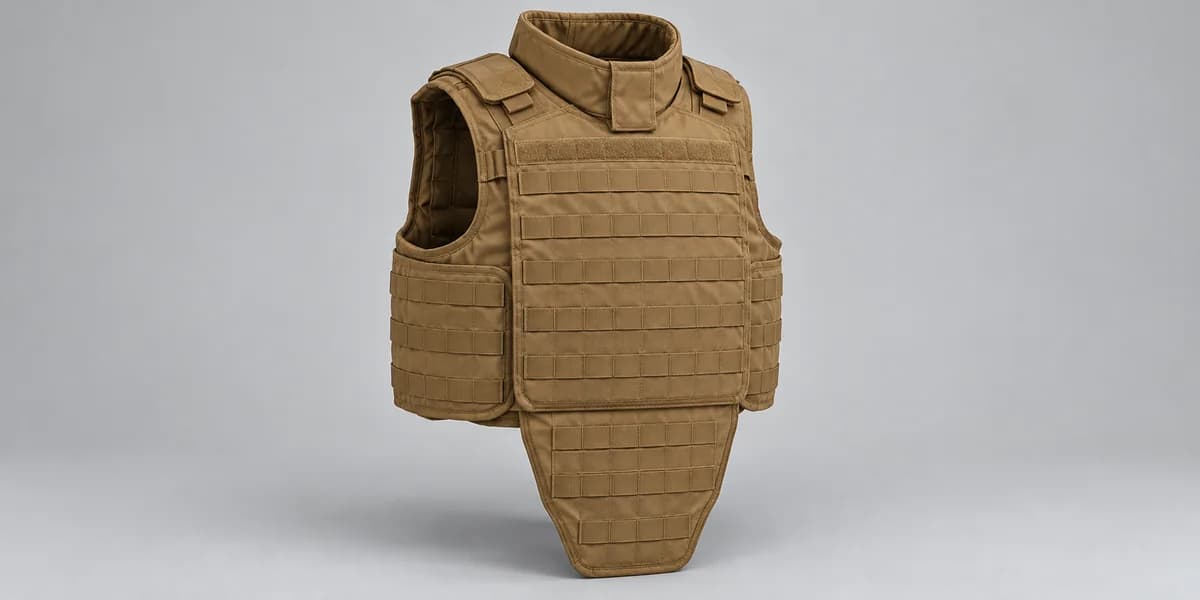
Interceptor multi-threat body armor system is a body armor originating in United States. It was built by Point Blank Body Armor (inaugural manufacturer), UNICOR (current manufacturer, since 2008). Reported operators include United States Navy U.S. Army Reserve U.S. Army (historical) U.S. Marine Corps (historical) U.S. Air Force (historical) See Users for other foreign military/law enforcement users.
 United States
AI-generated illustration · Not a photograph. Representative Interceptor OTV exterior; exterior details are illustrative.
ForceTally · AI-generated illustration · Not a photograph · AI-generated · OpenAI output terms · Source ↗ · ModifiedBody armor
United States
2000–2020
United States Navy U.S. Army Reserve U.S. Army (historical) U.S. Marine Corps (historical) U.S. Air Force (historical) See Users for other foreign military/law enforcement users
Global War on Terrorism War in Afghanistan Iraq War Second Chechen War Russo-Georgian War War in Yemen Russo-Ukrainian War
DARPA
April 1998
Point Blank Body Armor (inaugural manufacturer), UNICOR (current manufacturer, since 2008)
July 1998 – April 2020
16.4 lb (7.4 kg) (with SAPI plates used; everything in Interceptor) 8.4 lb (3.8 kg) (outer tactical vest)
Afghanistan : The Afghan National Police forces were issued a grey OTV. The Afghan military was issued with OTVs in "M81" U.S. woodland.
Albania : Woodland variants are worn by Albanian Army
Azerbaijan
Bangladesh
Bosnia and Herzegovina : Coyote brown variants are worn by the Armed Forces of Bosnia and Herzegovina as of October 2018.
Brazil : Worn by the Brazilian Marines as of 2017.
Burundi : Used by the Burundian Army as of September 2014.
Chile used by the Chilean Marines Corps during the 2000s to the early 2010s
El Salvador
Georgia : In the late 2000s, Georgian soldiers were issued the OTV in DCU's camouflage and a domestically produced woodland camouflage pattern similar to MARPAT, which were replaced by indigenously produced body armor.
Iraq : The Iraqi military uses the DCU-patterned version of the OTV in addition to an "M81" woodland-patterned one.
Kazakhstan
Lebanon : The U.S. delivered OTVs to Lebanon in 2009.
Moldova : The U.S. delivered OTVs to Moldova in 2009. Versions in woodland camouflage are used by the Moldovan Special Forces and the Moldovan 22nd Peacekeeping Battalion.
Namibia : Used by the Namibian marines as of 2016.
Pakistan : In use by the Pakistani Air Force as of 2007. The U.S. delivered additional OTVs to Pakistan in early 2009.
Philippines : The U.S. delivered OTVs to the Philippines in 2009. They are in the "M81" woodland camouflage pattern and are worn by the Philippine Army.
Saudi Arabia : Saudi Arabian soldiers wear the coyote brown IBA components.
Turkey : The U.S. delivered IBA components to Turkey in late 2008.
Ukraine : In use as of October 2015; 2,000 vests were delivered from the U.S. in 2014 and were tested.
United States : The U.S. Army and U.S. Marine Corps began being issued IBA components in 2001. Since then, the OTV component has been replaced with the IOTV for the U.S. Army and the MTV and SPC for the U.S. Marines. The U.S. Army Reserve (as of 2018), Army National Guard (as of 2020), and U.S. Navy still use the OTV, the latter aboard its warships (as of June 2017).
Yemen : The U.S. delivered OTVs to Yemen in 2010.
The Interceptor multi-threat body armor system ( IBA ) is a bullet-resistant body armor system that was used by the United States Armed Forces during the 2000s, with some limited usage into the mid-2010s.
Originally the entire IBA system weighed 16.4 pounds (7.4 kg), with the large vest weighing 8.4 pounds (3.8 kg), and two plate inserts weighing 4 pounds (1.8 kg) each. This is much lighter than the previous Ranger Body Armor fielded in Somalia which weighed 25.1 pounds (11.4 kg), as well as the PASGT/ISAPO combination, which weighed even more.
Due to the increased dangers of improvised explosive devices , newer versions of the vital plates and components have been developed. The Enhanced Small Arms Protective Inserts (ESAPIs) and Enhanced Side Ballistic Inserts (ESBIs) have become available, along with the Deltoid and Axillary Protector System (DAPS). These new systems are becoming the standard for forward deployed troops. The E-SAPI plates offer increased protection from 7.62mm armor-piercing ammunition. The ESBIs is an attachable MOLLE ballistic panel with a pouch for a 8x6 side-SAPI, for protection of the side of the torso/under the arm. DAPS consists of two ambidextrous modular components, the Deltoid (upper arm) Protector and the Axillary (underarm) Protector, and provides additional protection from fragmentary and projectiles to the upper arm and underarm areas. With the OTV, E-SAPI plates (10.9 pounds (4.9 kg)), ESBIs (7.75 pounds (3.52 kg)), DAPS (5.03 pounds (2.28 kg)) and with the neck, throat and groin protectors installed the armor is significantly heavier at 33.1 pounds (15.0 kg).
The Interceptor vest was tested to stop a 9×19mm 124-grain FMJ bullet at 1,400 feet per second (430 m/s) with minimal backface deformation, and it has a V-50 of roughly 1,525 feet per second (465 m/s). This means that the bullet in question must travel faster than 1,525 feet per second (465 m/s) for it to have more than a 50% chance of penetration. (An unlikely prospect, given the muzzle velocity of a typical 9mm handgun or submachine gun). The Interceptor cannot, however, be called a Level III-A vest, since military standards do not require protection against heavy .44 Magnum ammunition. The vest will stop lower velocity fragments and has removable neck, throat, shoulder, extended back and groin protection.
Additionally, two ceramic plates may be added to the front and back of the vest, with each capable of stopping up to three hits from the round marked on the plate. For SAPI, this is a caliber of up to 7.62×51mm M80 FMJ. For ESAPI, this is a caliber of up to 30-06 M2 AP. This performance is only guaranteed when backed by the Interceptor vest, or any other soft armor which meets military requirements for protection. SAPI and ESAPI are the most technically advanced body armor fielded by the U.S. military, and are constructed of boron carbide ceramic with a Spectra shield backing that breaks down projectiles and halts their momentum .
On 4 May 2005 the U.S. Marine Corps recalled 5,277 Interceptor OTVs made by DHB's Point Blank unit after news reports about the vests' inability to stop 9 mm bullets. In November 2005, the Marine Corps ordered 10,342 Interceptor outer tactical vests pulled from the operating forces after media reports indicated some samples tested by the manufacturer and by the U.S. Army's Aberdeen Proving Ground in Maryland failed to fully comply with ballistics standards.
Interceptor body armor United States Were issued mainly for peacekeeping operations in Iraq and Afghanistan and also used by engineer troops. Replaced by DELTA MK-I and MK-II series vests.
Interceptor body armor United States Were issued mainly for peacekeeping operations in Iraq and Afghanistan and also used by engineer troops. Replaced by DELTA MK-I and MK-II series vests.
Interceptor Body armor United States Captured from the former Afghan National Army and police.
Interceptor Body armor United States Captured from the former Afghan National Army and police.
IBA United States Standard variant in use.
IBA United States Standard variant in use.
The Interceptor Multi-Threat Body Armor Sys tem comprised two components: the outer tac tical vest and the small arms protective inserts, or “SAPI” plates. This system features removable throat and groin protectors, as well as front and back removable SAPI plates. The system pro tects from 7.62mm rounds, the round primarily used in insurgent weapons of the AK series. The system weighs 16.4 pounds: each of the two in serts weighs 4 pounds, and the outer tactical vest weighs 8.4 pounds. The Kevlar weave of the out er tactical vest stops a 9mm bullet.
Reference text from Wikipedia contributors, used under CC BY-SA 4.0.
Points represent sourced observations, including revisions. Revisions on the same effective date are not separate inventory events. Ranges appear in the table and are not plotted as exact points.
| Observation / report period | Value | Source | Claim state |
|---|---|---|---|
| 28 Sept 2026 | 7.4 kg | Wikipedia contributors | superseded |
| 28 Sept 2026 | 7.4 kg | Wikipedia contributors | approved |
Interceptor multi-threat body armor system equipment records. Variants, orders and quantities are shown as reported in each inventory source; coverage is incomplete.
 Afghanistan
 Albania
 Azerbaijan
 Bangladesh
 Bosnia and Herzegovina
 Brazil
 Burundi
 Chile
 El Salvador
 Georgia
 Iraq
 Kazakhstan
 Lebanon
 Moldova
 Namibia
 Pakistan
 Philippines
 Saudi Arabia
 Türkiye
 Ukraine United States
 Yemen
United States Navy U.S. Army Reserve U.S. Army (historical) U.S. Marine Corps (historical) U.S. Air Force (historical) See Users for other foreign military/law enforcement users
Equipment reference ↗Keep exploring
 Poland