FORCETALLY
Loading the evidence…
Preparing your view.


Preparing your view.
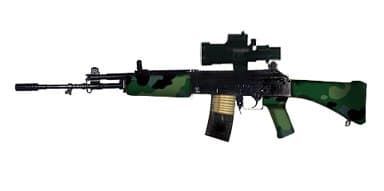
Small armsIn service
Assault rifle Light machine gun
INSAS rifle is a assault rifle Light machine gun originating in India. It was built by Ordnance Factories Board Advanced Weapons and Equipment India Limited. Reported operators include India, Bhutan, Eswatini, Kenya, Nepal, Oman.
 India
Technical data
Assault rifle Light machine gun
India
1998–present
See Operators
Kargil War Nepalese Civil War Naxalite–Maoist insurgency Insurgency in Northeast India Operation All Clear Myanmar Civil War Insurgency in Jammu and Kashmir
Armament Research and Development Establishment
1980s–1997
Ordnance Factories Board Advanced Weapons and Equipment India Limited
1994 –present
100,000 (Assault Rifles) and 6,000 (LMG) (2012) 700,000–900,000 (2019)
See Variants
4.018 kg (8.86 lb) (without magazine) 6.23 kg (13.7 lb) (LMG) 1,050 mm (41 in) (LMG) 535 mm (21.1 in) (LMG)
5.56×45mm NATO
Gas-operated , Rotating bolt
singles, 3 round burst 600–650 rounds/min (LMG)
915 m/s (3,002 ft/s )
400m (INSAS Rifle) 600 m: Point targets (INSAS LMG) 700 m: Area target (INSAS LMG)
20- or 30-round detachable box magazine
In-built iron sights , mount point for telescopic or night sight
India
Bhutan
Eswatini
Kenya
Nepal
Oman
The INSAS , or Indian Small Arms System , is a family of infantry arms consisting of an assault rifle and a light machine gun (LMG).
The first combat use of the rifle was during the Kargil War in 1999. The development of the INSAS began in the mid-1980s, when the Indian Army released a general staff qualitative requirement for a new assault rifle to replace locally produced licensed copies of the L1A1 self-loading rifles , which the Army was using since 1961. The new assault rifle was to chamber it in 5.56×45mm NATO , unlike the L1A1 SLR rifle which is chambered in 7.62×51mm NATO .
After studying several designs, the Armament Research and Development Establishment (ARDE) in Pune undertook the task of designing and developing India's first assault rifle. The development and user trials of the new rifle, INSAS, were completed by 1989 and entered into service in 1990. Originally, three variants were planned in the INSAS system: a rifle , a carbine , and a squad automatic weapon (SAW) or Light machine gun (LMG). In 1997, the rifle and the LMG went into mass production. In 1998, the first INSAS rifles were displayed at the Republic Day parade. The introduction of the rifle was delayed due to the lack of adequate 5.56×45mm ammunition, large quantities of which were bought from Israel Military Industries .
It has a manual gas regulator, similar to that of FN FAL , and a gas cutoff for launching grenades. The charging handle is on the left instead of on the bolt carrier, similar in operation to the HK33 . The fire selector is placed on the left side of the receiver above the pistol grip, it can be set to semi–auto, three round burst and full auto. To set it to safe, the selector has to be rotated all the way up, which will block the sear and prevent the rifle from firing. It has three modes of fire – semi-automatic, three-round burst and full automatic modes. The cyclic rate averages at 650 rpm. The rear sight lies on one end of the breech cover and is calibrated to 400 meters.
The INSAS assault rifle was battle-tested in the 1999 Kargil War . The three-month-long war was fought in the high altitudes of the Himalayas , where the temperature would go as low as –20 degrees Celsius. During the conflict, the rifle encountered some problems, such as occasional, often serious stoppages, cracking of the polymer magazine due to the cold weather, and some other reliability issues, such as firing in full auto when set for 3-shot burst. Similar complaints were also received from the Nepalese Army . In the Kargil war, the INSAS proved neither reliable nor satisfactory for the Army. The Indian Army, which was used to the 7.62×51mm NATO round for almost three decades, was dissatisfied with the stopping power of 5.56×45mm NATO rounds.
The standard issue rifle is produced in a select fire (semi-automatic & 3-round burst) version . A telescopic sight and a passive night sight are available for the weapon system. It has a bayonet mount and furniture featuring mounting capabilities for the ARDE Under Barrel Grenade Launcher . The rifle is equipped with an adjustable gas block regulator which, when flipped up, acts as an iron sight for a 40mm grenade launcher. The flash suppressor has a blank-firing adaptor . Additional furniture for the rifle is made, offering a folding stock. It is being replaced in Indian service by the AK-203 . The AR has four subvariants:
The Light Machine Gun (LMG) differs from the standard rifle in possessing a longer range of 700 m, as compared to a 400 m range for its assault rifle counterparts. It has a longer and heavier barrel with revised rifling and a bipod. The LMG version uses 30-round magazines and can also accept the 20-round INSAS AR magazine. This platform features select fire between semi-automatic and fully automatic. Furniture is also made for the LMG, allowing for a folding stock. The LMG will be replaced with the Negev NG-7 .
Kalantak: The Kalantak micro-assault rifle, with a range of 300 m, is for close combat and personnel defence weapon roles.
4. Length of Rifle without bayonet - 960mm
5. Length of Rifle with bayonet - 1110mm.
6. Length of Barrel - 464mm
Reference text from Wikipedia contributors, used under CC BY-SA 4.0.
True scale
Sourced dimensions beside a 1.75 m human reference.
Points represent sourced observations, including revisions. Revisions on the same effective date are not separate inventory events. Ranges appear in the table and are not plotted as exact points.
| Observation / report period | Value | Source | Claim state |
|---|---|---|---|
| 11 Oct 2026 | 0.464 m | National Cadet Corps Army Wing handbook (retained institutional copy) | approved |
INSAS rifle equipment records. Variants, orders and quantities are shown as reported in each inventory source; coverage is incomplete.
Keep exploring
Assault rifle Light machine gun Designated marksman rifle
 Myanmar
Battle rifle Light machine gun
Light machine gun Automatic rifle
 United States
Light machine gun
 Israel
Light machine gun
 Finland
Light machine gun
United States Bhutan
 Eswatini
 Kenya
 Nepal
 Oman