Design and configuration
Three hulls support a wide upper deck while the central hull carries the bow. The angular superstructure sits ahead of an unusually broad helicopter operating area.1


Preparing your view.

Warships2010–presentProfile in progress
The Independence-class littoral combat ship uses a broad trimaran hull. Its large flight deck and mission spaces distinguish it from the monohull Freedom-class LCS.
 United States
Independence-class littoral combat ship
U.S. Navy photo by Mass Communication Specialist 3rd Class Josiah J. Kunkle · Public domain · Resized · Public domain · Source ↗ · ModifiedIndependence class
Austal USA
United States Navy
N/A
Constellation class
$360 million
2008–2025
2010–present
19
19
17
2
Littoral combat ship
2,307 tons light, 3,104 tons full
418 ft (127 m)
104 ft (32 m)
14 ft (4.3 m)
CODOG system 2 × General Electric LM2500 gas turbines 2 × MTU Friedrichshafen 20V 8000 Series diesel engines 4 × diesel generators
2 × American Vulkan light weight multiple-section carbon fiber propulsion shaftlines 4 × Wärtsilä waterjets 2 × LJ150E 2 × LJ160E 2 × retractable bow-mounted azimuth thrusters
44 knots (51 mph; 81 km/h)
4,300 nautical miles (7,964 km) at 18 knots (33 km/h)
210 metric tons (206 long tons, 231 short tons)
40 core crew (8 officers, 32 enlisted) plus up to 35 mission crew
SAAB AN/SPS-77(V)1 Sea GIRAFFE 3D air and surface search radar Sperry Marine BridgeMaster E navigational radar AN/KAX-2 electro-optical sensor with TV and FLIR Northrop Grumman ICMS (Integrated Combat Management System)
ITT Corporation ES-3601 ESM system 4 × SRBOC decoy launchers for chaff and infrared decoys BAE Systems Nulka active radar decoy system
1 × BAE Systems Mk 110 57 mm gun 1 × Raytheon SeaRAM CIWS 4 × .50-cal guns (2 aft, 2 forward) 2 × 30 mm Mk44 Bushmaster II guns (part of SUW module) 8 × RGM-184A Naval Strike Missiles 24 × AGM-114L Hellfire missiles (SUW vertical launch module) Other weapons as part of mission modules
1 × MH-60R/S Seahawk 2 × MQ-8B Fire Scouts or 1 × MQ-8C Fire Scout
{"datatype": "wikibase-item", "datavalue": {"type": "wikibase-entityid", "value": {"entity-type": "item", "id": "Q30", "numeric-id": 30}}, "hash": "7f985e15819b74ed189d022e004890e66d2ae42e", "property": "P495", "snaktype": "value"}
Reference text from Wikipedia contributors, used under CC BY-SA 4.0.
The system in detail
Three hulls support a wide upper deck while the central hull carries the bow. The angular superstructure sits ahead of an unusually broad helicopter operating area.1
Mission-package and weapon installations vary by ship and date. The basic hull is only one part of the delivered mission capability.1
The Navy lists the first two ships as decommissioned while later ships remain in the class. Class service status must not be inferred from the lead ship alone.1
Compare mission equipment and actual ship configuration. Broad beam and high-speed design do not by themselves indicate the sensor or weapon capacity of a larger frigate.1
Visual reference
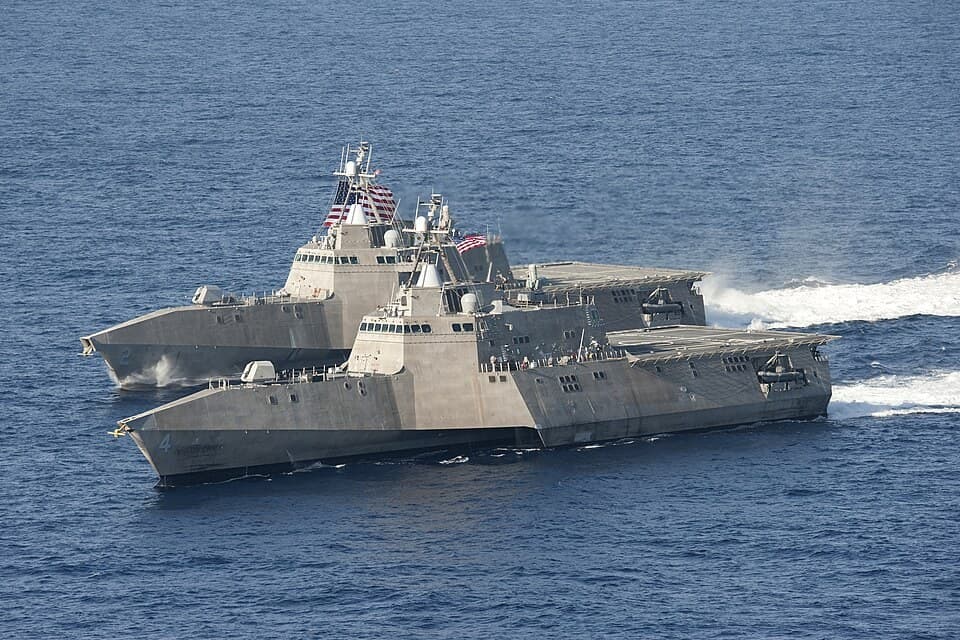
The U.S. Navy littoral combat ships USS Independence (LCS-2), back, and USS Coronado (LCS-4) underway in the Pacific Ocean. Historical equipment reference photograph. It does not establish current availability or every detail of the named variant.
U.S. Navy photo by Chief Mass Communication Specialist Keith DeVinney · Public domain · Wikimedia Commons · Public domain · Source ↗ · ModifiedIndependence class equipment records. Variants, orders and quantities are shown as reported in each inventory source; coverage is incomplete.
United StatesNaval inventory of the source class and listed configurations; excludes orders and construction. Source-year holdings, not immediately deployable strength.