FORCETALLY
Loading the evidence…
Preparing your view.


Preparing your view.
WarshipsIn service
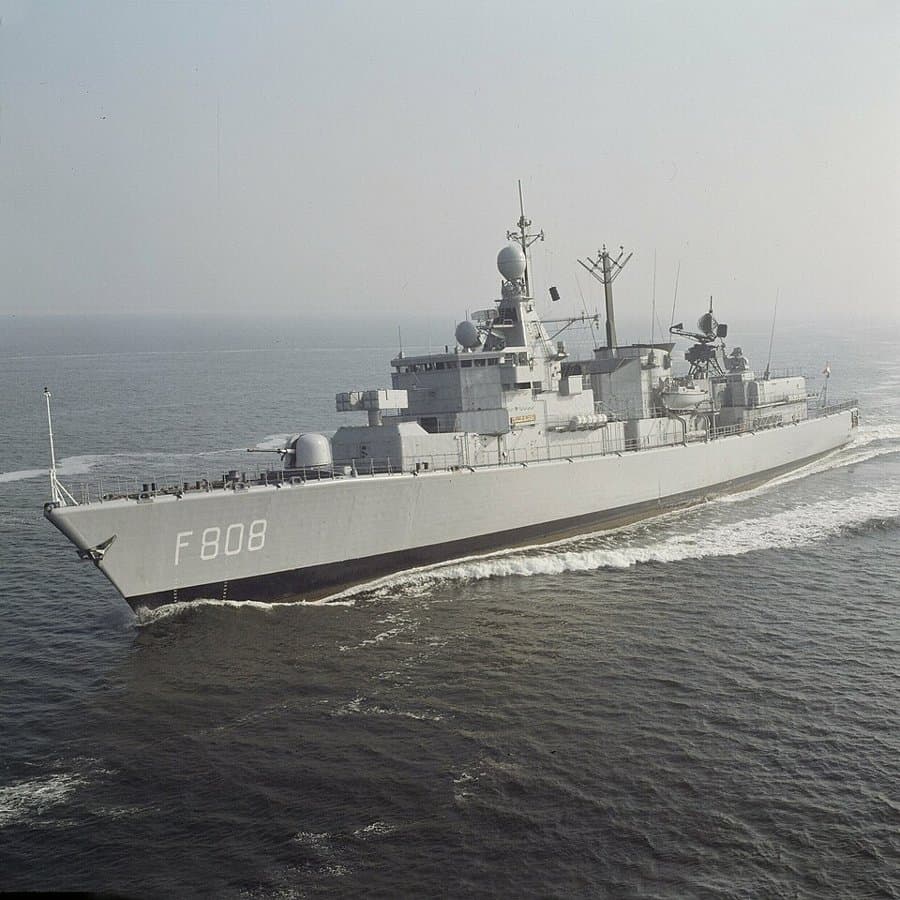
HNLMS Callenburgh (F808) ( Dutch : Hr.Ms. Callenburgh ) was a frigate of the Kortenaer class . The ship was in service with the Royal Netherlands Navy from 1979–1994. She was named after Dutch naval hero Gerard Callenburgh , and the ship's radio call sign was "PADB".
 Netherlands
HNLMS Callenburgh
Negatieven en Dia's voormalig Instituut voor Maritieme Historie · CC BY-SA 4.0 · Resized · CC BY-SA 4.0 · Source ↗ · ModifiedCallenburgh
Gerard Callenburgh
1974
KM de Schelde , Vlissingen
30 June 1975
26 March 1977
26 July 1979
1994
Sold to the Hellenic Navy, 30 March 1994
Pennant number F 808
30 March 1994
F 459
Active service
Kortenaer -class frigate
3,500 long tons (3,600 t) standard 3,800 long tons (3,900 t) full load
130 m (426 ft 6 in)
14.4 m (47 ft 3 in)
4.4 m (14 ft 5 in)
Combined gas or gas (COGOG) system: 2 × Rolls-Royce Tyne RM1C gas turbines , 4,900 shp (3,700 kW) each 2 × Rolls-Royce Olympus TM3B gas turbines , 25,700 shp (19,200 kW) each (boost) 2 shafts
20 knots (37 km/h; 23 mph) cruise 30 knots (56 km/h; 35 mph) maximum
4,700 nautical miles at 16 knots (8,700 km at 30 km/h)
176–196
2 × OTO-Melara Compatto 76 mm/62 cal. gun 2 × twin Mk46 torpedo tubes 2 × quad RGM-84 Harpoon anti-ship missile launchers 1 × 8-cell Sea Sparrow anti-aircraft missile launchers 1 × Goalkeeper in Dutch service 1 × Phalanx in Greek service
2 × Sea Lynx helicopters (1 in peacetime)
The Kortenaer ' s were 130.2 metres (427 ft 2 in) long overall and 121.8 metres (400 ft) between perpendiculars , with a beam) of 14.4 metres (47 ft 3 in) and a draft of 4.4 metres (14 ft 5 in). Displacement was 3,000 long tons (3,050 t) standard and 3,785 long tons (3,846 t) full load. The ship was powered by two 25,800 shaft horsepower (19,200 kW) Rolls-Royce Olympus TM 3B and two 4,900 shaft horsepower (3,700 kW) Rolls-Royce Tyne TM 1C gas turbines in a combined gas or gas (COGOG) arrangement, driving two propeller shafts. The Olympus engines gave a speed of 30 knots (35 mph; 56 km/h), and the Tyne cruise engines gave a speed of 20 knots (23 mph; 37 km/h).
Callenburgh ' s main anti-aircraft armament was an 8-round NATO Sea Sparrow surface-to-air missile launcher in front of the bridge. An OTO Melara 76 mm was fitted forward of the Sea Sparrow launcher, while a Goalkeeper CIWS was planned to be fitted aft, on the roof of the ship's hangar. Goalkeeper was not available when the ships were built, however, and Callenburgh was completed with a second Oto Melara 76 mm gun in its place. Eight Harpoon anti-ship missiles could be carried in two quadruple launchers, although two or four Harpoons was a more normal peacetime load-out. A hangar and fight deck were fitted to accommodate two Westland Lynx helicopters, although only one was normally carried. Close-in anti submarine armament was provided by four 324 mm tubes for US Mark 46 torpedoes . A Signaal LW-08 long-range air search radar was fitted, together with a ZW-06 surface-search radar, with WM-25 and STIR-180 fire control radars to direct the ship's armament. A Canadian SQS-505 hull-mounted sonar was fitted.
Callenburgh ' s aft Oto Melara 76 mm gun was replaced by a Bofors 40 mm anti-aircraft gun in 1982, and this, in turn, was replaced by a prototype Goalkeeper installation in September 1984. On transfer to Greece, the Goalkeeper was removed. Greece replaced it by an American Phalanx CIWS , while Agusta-Bell AB 212 helicopters replaced the Lynxes.
In the early 1970s, the Royal Netherlands Navy developed a 'Standard' frigate design to replace the destroyers of the Holland - and Friesland classes .
Reference text from Wikipedia contributors, used under CC BY-SA 4.0.
True scale
Sourced dimensions beside a 1.75 m human reference.
HNLMS Callenburgh equipment records. Variants, orders and quantities are shown as reported in each inventory source; coverage is incomplete.
Keep exploring
 Greece
 France
 South Korea
 Brazil