FORCETALLY
Loading the evidence…
Preparing your view.


Preparing your view.
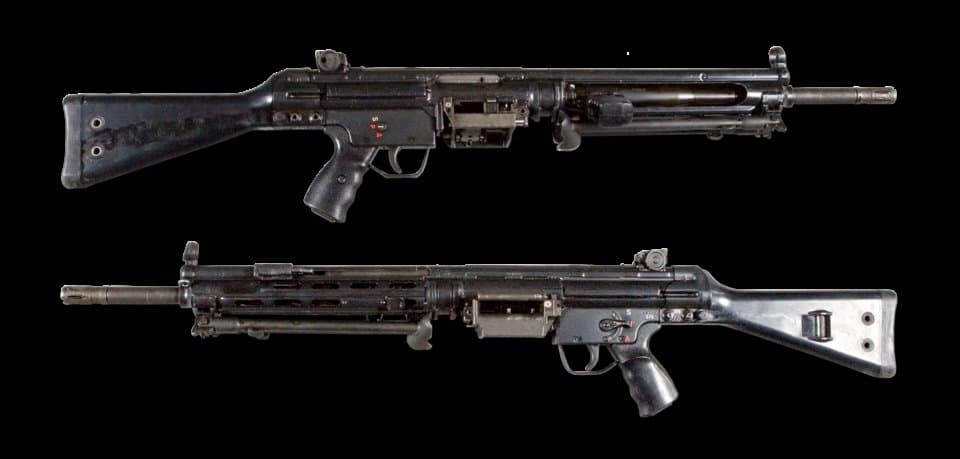
Small armsIn service
General-purpose machine gun (HK21) Light machine gun (HK23) Heavy machine gun (HK25)
Heckler & Koch HK21 is a general-purpose machine gun (HK21) Light machine gun (HK23) Heavy machine gun (HK25) originating in West Germany. It was built by Heckler & Koch Fábrica de Braço de Prata SEDENA. Reported operators include Argentina, Bangladesh, Brazil, Bolivia, Brunei, Cameroon, Croatia, Cyprus, Ecuador, El Salvador, Germany, Greece, Jordan, Kenya, Latvia, Malaysia, Mauritius, Mexico, Niger, Nigeria, Paraguay, Peru, Qatar, Senegal, Sri Lanka, South Africa, Sudan, Sweden, Thailand, Türkiye, Uganda, United Arab Emirates, United States.
Heckler & Koch HK21
Armémuseum (The Swedish Army Museum) · CC BY-SA 4.0 · Resized · CC BY-SA 4.0 · Source ↗ · ModifiedTechnical data
General-purpose machine gun (HK21) Light machine gun (HK23) Heavy machine gun (HK25)
West Germany
1961–present
See Users
Vietnam War Football War Lebanese Civil War Portuguese Colonial War Shaba II South African Border War Kurdish–Turkish conflict Salvadoran Civil War Operation Eagle Claw Sri Lankan Civil War Armed conflict for control of the favelas Boko Haram insurgency
Heckler & Koch
1961
Heckler & Koch Fábrica de Braço de Prata SEDENA
1961–1990
See Variants
HK21: 7.92 kg (17.46 lb) HK21A1: 8.30 kg (18.3 lb) HK11A1: 7.70 kg (17.0 lb) HK21E: 9.30 kg (20.5 lb) HK11E: 8.15 kg (18.0 lb) HK23E: 8.75 kg (19.3 lb) HK13E: 8 kg (18 lb) HK25: 16.30 kg (35.9 lb)
HK21: 1,021 mm (40.2 in) HK21A1, HK11A1, HK11E, HK23E, HK13E: 1,030 mm (40.6 in) HK21E: 1,140 mm (44.9 in) HK25: 1,400 mm (55.1 in)
HK21, HK21A1, HK11A1, HK11E, HK23E, HK13E: 450 mm (17.7 in) HK21E: 560 mm (22.0 in) HK25: 900 mm (35.4 in)
HK21, HK21A1, HK11A1, HK21E, HK11E: 7.62×51mm NATO HK23E, HK13E: 5.56×45mm NATO HK25: 12.7×99mm NATO
Roller-delayed blowback , closed bolt
HK21, HK21A1: 900 rounds/min HK11A1, HK21E, HK11E: 800 rounds/min HK23E, HK13E: 750 rounds/min HK25: 450 rounds/min
HK21, HK21A1, HK11A1, HK11E: 800 m/s (2,625 ft/s) HK21E: 840 m/s (2,756 ft/s) HK23E, HK13E: 910 m/s (2,986 ft/s) (using the SS109 cartridge) HK25: 915 m/s (3,002 ft/s)
100–1,200 m (109–1,312 yd) sight adjustments
M13, DM6, DM1 ammunition belt, 20-round detachable box or 50-round drum magazine (from the G3 ). An 80-round drum magazine or even a 100-round drum magazine was also available (No longer manufactured)
Rear rotary diopter drum; hooded front post
Argentina : HK23E variant used by Comandos Anfibios
Bangladesh : HK11A1 and HK21A1 variants.
Brazil : HK21E variant issued to special forces, HK21A1 variant in use by BOPE
Bolivia
Brunei : HK21A1 variant.
Cameroon : HK21 variant.
Croatia : HK21A1 variant
Cyprus
Ecuador
El Salvador
Germany
Greece : HK11A1 variant. Made under license.
Jordan : HK21E variant.
Kenya : HK21A1 variant.
Latvia : HK21E variant issued to Zemessardze National Guard units.
Malaysia : HK11A1 and HK21E variants employed by the Royal Malaysia Police and Malaysian Army during Communist Insurgency War..
Mauritius : HK21E1 variant.
Mexico : HK21A1 and HK21E variant. Made under license.
Niger : HK11 and HK21 variants.
Nigeria : HK21 variant.
Paraguay : HK21 variant.
Peru
Qatar : HK21 variant.
Senegal : HK21 variant.
Sri Lanka : HK11 and HK21 variants.
South Africa : HK21 variant used by 32nd Battalion during South African Border War.
Sudan : HK21 variant.
Sweden Trials for Home Guard only.
Thailand
Turkey : HK23E variant is employed by the Turkish Gendarmerie .
Uganda
United Arab Emirates : HK23E variant.
United States : HK21 was used by the Navy SEALs Post Vietnam war. While trialed in the early 1970s SAW trials it was not adopted by the US Navy until the formation of SEAL team 6 in the 1980s. It was also used by the Delta Force in Operation Eagle Claw .
Portugal : HK21E variant, made under license Replaced in 2019 by 5.56×45mm FN Minimi Mk3 machine guns .
The Heckler & Koch HK21 is a German 7.62×51mm NATO general-purpose machine gun , developed in 1961 by small arms manufacturer Heckler & Koch and based on the HK G3 battle rifle .
The Heckler & Koch HK21 is a German 7.62×51mm NATO general-purpose machine gun , developed in 1961 by small arms manufacturer Heckler & Koch and based on the HK G3 battle rifle . The machine gun is in use with the armed forces of several Asian, African and Latin American countries. It was also license-manufactured by Fábrica de Braço de Prata in Portugal as the m/968 and in Mexico by SEDENA as the MG21 . In the German military ( Bundeswehr ) and the federal police ( Bundespolizei ) it is designated "G8".
Thus a chambering dependent (4:1 for 7.62×51mm NATO) or (3:1 for 5.56×45mm NATO) transmission ratio is maintained (as long as the rollers move on the inclined surfaces of the barrel extension and locking piece) of the bolt carrier and locking piece relative to the bolt head; the bolt head carrier travels backwards significantly faster than the bolt head, ensuring a safe drop of pressure within the barrel prior to extraction.
The HK21 has a free-floating, heavy, quick-change barrel fitted with a slotted flash suppressor . The firearm is equipped with an iron sight line that consist of a rotary rear drum and hooded front post. The rear aperture sight is mechanically adjustable for both windage and elevation from 100 to 1,200 m (109 to 1,312 yd) in 100 m (109 yd) increments for 7.62×51mm NATO models or 100 to 1,000 m (109 to 1,094 yd) in 100 m (109 yd) increments for 5.56×45mm NATO models.
By simply swapping out several components such as the barrel, bolt and feed plate unit, the machine gun can be quickly converted to the intermediate 7.62×39mm and 5.56×45mm NATO chamberings.
In the early 1970s the HK21's design was simplified and the feed mechanism was modified. The machine gun's weight was increased, a carrying handle and a hooked buttstock with improved buffer mechanism were also added. The barrels were internally revised to polygonal rifling . Since then, the HK21 was offered in two main variants: the HK21A1 general-purpose machine gun (with a different belt feed mechanism) and the HK11A1 light machine gun. (optimized for magazine feed only). The HK11A1 proved more successful in export sales and was adopted by the Hellenic Army and several African and Asian armies. Both machine guns, as in the original HK21, can be converted to chamber the 5.56×45mm NATO round by replacing the appropriate components.
HK11E light machine gun (magazine fed, chambered in 7.62×51mm NATO)
HK13E light machine gun (magazine fed, chambered in 5.56×45mm NATO)
HK21E general-purpose machine gun (belt-fed, 7.62×51mm NATO)
The "E model" is a thoroughly revised variant aimed to improve the reliability, efficiency and service life of the HK21. For this the length of the receiver was increased by 25 mm (1.0 in) to provide additional recoil length for the bolt group. The recoil reduction improved accuracy of fire. Reinforcing bars were added to the receiver to provide additional strength and a guaranteed 60,000 rounds minimum service life. The bolt head, extractor and locking roller holder were completely redesigned as were the bolt carrier and recoil spring assembly, belt feed unit, buffer, barrel and trigger group. The redesigned belt feed mechanism transports the ammunition belt in two steps reducing stress on the feed and ammunition belt.
Compared to the older HK21A1 and HK11A1, the modernized "Export" machine guns also feature a longer barrel shroud, extended by 94 mm (3.7 in) towards the front, which also resulted in a longer sight radius; the barrel extension was modified (the HK21E also received a longer barrel); a burst fire mode was incorporated into the trigger group as the fourth selector setting (3-round burst); a polymer barrel handle was added; space for a cleaning kit was added in the grip; the rear sight was modified with an adjustable drum; a bipod with a 3-position height adjustment and 30-degree tilt mechanisms replaced the simple folding bipod; the feed mechanism was modified to provide continuous feeding (by moving the belt in two stages, during both forward and rear movement of the bolt), a forward assist for silent loading was provided and the machine guns were adapted to use NATO -standard optical sight mounts.
When employed in the light machine gun (infantry assault) role, the HK21E stores its ammunition belt in a 100-round sheet metal container, fastened to the bottom of the feed mechanism (as in the HK21A1). The ability to use Heckler & Koch G3 or STANAG (for HK23E) box or drum magazines is available with an optional feed module kit that consists of the bolt, recoil spring and belt feed module or magazine well. When employed in the belt-fed medium machine gun (fire support) role the HK21E provides a cook-off rate in excess of 1,000 rounds fired in quick succession. The shock-absorbing tripod weighs 10.5 kg (23.1 lb).
The HK23 is a belt-fed light machine gun variant, chambered in 5.56×45mm NATO cartridge.
A heavy machine gun prototype of the HK21 chambered in .50 BMG (12.7×99mm NATO) was proposed but never went into production.
An aftermarket conversion of an HK21 general purpose machinegun into a belt-fed short carbine created by gunsmiths F. J. Vollmer & Company Inc. The barrel is 8.9 inches long, has an overall length of 21 inches, weighs about 11 lbs. unloaded, and has a rate of fire of 950 to 1,000 rounds per minute. Fixed barrel models have a "Tropical" MP5-style handguard with ventilation slots. Quick-change barrel models have a four-position Picatinny Rail handguard (usually used with a vertical foregrip). It feeds from a 100-round HK21 belt box and uses either the American M13 or German DM6 disintegrating link belt. Vollmer only made 30 guns, 2 of which had quick-change barrels.
Reference text from Wikipedia contributors, used under CC BY-SA 4.0.
True scale
Sourced dimensions beside a 1.75 m human reference.
See it in your room. Scan with your phone to open this model in 3D, then place it in your space.
Points represent sourced observations, including revisions. Revisions on the same effective date are not separate inventory events. Ranges appear in the table and are not plotted as exact points.
| Observation / report period | Value | Source | Claim state |
|---|---|---|---|
| 28 Sept 2026 | 0.45 m | Wikipedia contributors | superseded |
| 28 Sept 2026 | 0.45 m | Wikipedia contributors | superseded |
| 28 Sept 2026 | 0.45 m | Wikipedia contributors | approved |
Heckler & Koch HK21 equipment records. Variants, orders and quantities are shown as reported in each inventory source; coverage is incomplete.
 Argentina
 Bangladesh
 Bolivia
 Brazil
 Brunei
 Cameroon
 Chile
 Croatia
 Cyprus
 Ecuador
 El Salvador
 Germany
 Greece
 Jordan
 Kenya
 Latvia
 Malaysia
 Mauritius
 Mexico
 Niger
 Nigeria
 Paraguay
 Peru
 Portugal
 Qatar
 Senegal
 South Africa
 Sri Lanka
 Sudan
 Sweden
 Thailand
 Türkiye
 Uganda
 United Arab Emirates
 United States
Argentina, Bangladesh, Brazil, Bolivia, Brunei, Cameroon, Croatia, Cyprus, Ecuador, El Salvador, Germany, Greece, Jordan, Kenya, Latvia, Malaysia, Mauritius, Mexico, Niger, Nigeria, Paraguay, Peru, Qatar, Senegal, Sri Lanka, South Africa, Sudan, Sweden, Thailand, Türkiye, Uganda, United Arab Emirates, United States
Equipment reference ↗ Switzerland
 China