FORCETALLY
Loading the evidence…
Preparing your view.


Preparing your view.
Bombs, grenades & minesIn service
Unguided high-capacity / general-purpose aerial bomb
FAB-500 is a unguided high-capacity / general-purpose aerial bomb originating in Soviet Union. Reported operators include India, Indonesia, Malaysia, Mali, China, Republic of China, Russia, Soviet Union, Spanish Republic, Vietnam, Venezuela.
Unguided high-capacity / general-purpose aerial bomb
Soviet Union
1931: FAB-500sv 1943: FAB-500M-43 1944: FAB-500M-44 1946: FAB-500M-46 1954: FAB-500M-54 1962: FAB-500M-62
KAB-500 ( guided bomb )
500 kilograms (1,100 lb)
2,470 millimetres (97.2 in)
400 millimetres (15.7 in)
High explosive
201 kilograms (440 lb)
India
Indonesia
Malaysia
Mali
China
Republic of China
Russia
Soviet Union
Spanish Republic
Vietnam
Venezuela
Unguided high-capacity / general-purpose aerial bomb
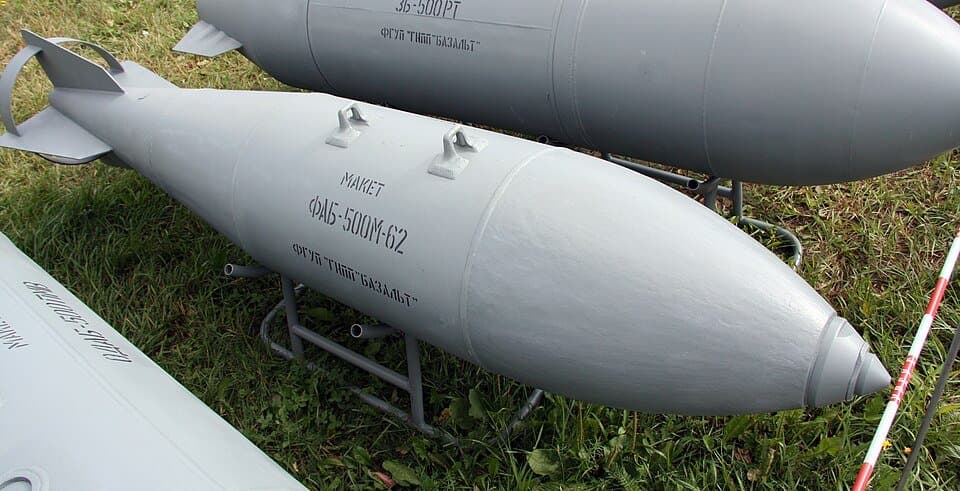
The FAB-500 ( cyrillic : ФАБ-500 , acronym for Russian : фугасная авиационная бомба , ” high-capacity aerial bomb ”) is a Soviet / Russian designation for general purpose high-explosive aerial bombs of the 500-kilogram (1,100 lb) class. Starting in 1931 with the FAB-500sv, later models are today primarily used by the Russian Aerospace Forces , former Soviet republics and customer countries.
The first model of the series began construction, together with the downscaled 250 kg FAB-250sv , in 1929. Their characteristics were similar, except that, in this bomb, the conical tail cone was welded to the cylinder of the body. Test were carried out throughout 1931, yielding satisfactory results, resulting in series production beginning immediately that year.
In early 1932, necessary changes were made for its operation and continued production. The attachment point was modified, as with the FAB 250, with a second lift eyelet behind the lift eyelet, attached to the bomb by rivets. The joint between the cylindrical body and conical tail was strengthened by increasing the length of the inner lip of the conical tail cone which passes under the cylindrical edge for improved safety. In 1933, the second lift eyelets connection was updated from a riveted one to a retaining collar clamped around the body. In 1934, the lift eyelet also had its connection strengthened by the addition of a retaining collar clamped around the body, with the stabilizing fins being connected to the tail cone by discontinuous segments of welding. In 1935 the construction was updated by reducing the weight of approximately three kilograms.
Aerial bomb development during World War II was limited. In 1943, the long welded FAB-500M-43 rolled out, and in 1944 the short stubby FAB-500M-44, which was followed by the similar FAB-500M-46 just after the war, featuring a nose ring for increased drag.
The FAB-500M-54 model was rolled out in 1954, shaped for internal carriage by heavy bombers.
The FAB-500M-62 rolled out in 1962, a low-drag bomb intended for carriage on external hardpoints on fighter bombers etc. Early models were unguided , with a single nose fuze, and compatible with most models of Soviet aircraft .
In March 2023, Russian Su-35s launched a number of FAB-500 M-62, wreckage of which indicated that they had been fitted with an UMPK , a glide kit involving pop-out wings. It is unknown whether these had an internal navigation system, or were fitted with wings simply to extend the range to up to 70 km. It also is believed that these give Russian aircraft a stand-off ability to hit Ukrainian targets without risking exposure to Ukrainian air defences.
According to a Russian milblogger cited by the Institute for the Study of War , the FAB-500 "hold[s] an explosive weight of 150 kilograms, [has] a damage radius of 250 meters, and can destroy headquarters, warehouses, and concrete and reinforced concrete objects."
Release altitude: 570–12,000 metres (1,870–39,400 ft)
Release speed: 500–1,900 kilometres per hour (311–1,180 mph)
FAB-500sv ( ФАБ-500св ) – Constructed from 1929–1931 together with the downscaled FAB-250sv . Bulted construction. Charge: 235 kilograms (518 lb) TNT ; fuze: tip + base. Length: 2,426–2,440 millimetres (95.5–96.1 in); center of mass from the tip: 751–761 millimetres (29.6–30.0 in); caliber: 449.5–452.5 millimetres (17.70–17.81 in). FAB-500sv ( model 1931 ) – weight: 507.0 kilograms (1,117.7 lb) FAB-500sv ( model 1932 ) – weight: 507.3 kilograms (1,118 lb); addition of a riveted second lift eyelet behind the main lift eyelet FAB-500sv ( model 1933 ) – weight: 509.8 kilograms (1,124 lb); second lift eyelet changed from riveted to a retaining collar around the body FAB-500sv ( model 1934 ) – weight: 511.3 kilograms (1,127 lb); lift eyelet strengthened with a retaining collar around the body FAB-500sv ( model 1935 ) – weight: 508.3 kilograms (1,121 lb); weight lowered by 3 kilograms (6.6 lb); welded tail
FAB-500M-43 ( ФАБ-500М-43 , model 1943) – long welded construction
FAB-500M-44 ( ФАБ-500М-44 , model 1944) – short welded construction
FAB-500M-46 ( ФАБ-500М-46 , model 1946) – short welded construction with a nose ring for extra air resistance
FAB-500M-54 ( ФАБ-500М-54 , model 1954) – original 1954 high-drag model intended for internal carriage in heavy bombers, featuring a ballistic ring on the nose of the bomb to act as a vortex generator to aid the bomb's stabilizers.
FAB-500M-62 ( ФАБ-500М-62 , model 1962) – low-drag 1962 model designed for external carriage on hardpoints on fighter-bombers. FAB-500M-62T ( ФАБ-500М-62Т , model 1962) – heat-resistant, capable of withstanding high-temperature aerodynamic heating, arising during flight at high speeds. Developed for the MiG-25RB . FAB-500M-62 MPK (( ФАБ-500 М-62 с МПК )
OFAB-500 ( ОФАБ-500 ) – general purpose high explosive fragmentation bomb (contains 3 x 150 kg submunitions)
{"datatype": "wikibase-item", "datavalue": {"type": "wikibase-entityid", "value": {"entity-type": "item", "id": "Q15180", "numeric-id": 15180}}, "hash": "f4c787a48bc2a8c6440a23705dd5ae24e9733452", "property": "P176", "snaktype": "value"}
Reference text from Wikipedia contributors, used under CC BY-SA 4.0.
True scale
Sourced dimensions beside a 1.75 m human reference.
See it in your room. Scan with your phone to open this model in 3D, then place it in your space.
Points represent sourced observations, including revisions. Revisions on the same effective date are not separate inventory events. Ranges appear in the table and are not plotted as exact points.
| Observation / report period | Value | Source | Claim state |
|---|---|---|---|
| 28 Sept 2026 | 0.4 m | Wikipedia contributors | superseded |
| 28 Sept 2026 | 0.4 m | Wikipedia contributors | superseded |
| 28 Sept 2026 | 0.4 m | Wikipedia contributors | approved |
FAB-500 equipment records. Variants, orders and quantities are shown as reported in each inventory source; coverage is incomplete.
India, Indonesia, Malaysia, Mali, China, Republic of China, Russia, Soviet Union, Spanish Republic, Vietnam, Venezuela
Equipment reference ↗Keep exploring
High-drag and low-drag general-purpose bomb
General-purpose bomb
 Israel
Low-drag general-purpose bomb
 United States
Low-drag general-purpose bomb
United StatesLow-drag general-purpose bomb
United StatesLow-drag general-purpose bomb
United States China
 India
 Indonesia
 Malaysia
 Mali
 Russia
 Serbia
 Taiwan
 Ukraine
 Venezuela
 Vietnam