FORCETALLY
Loading the evidence…
Preparing your view.


Preparing your view.
Combat aircraftIn service
FGA
Two-seat variant
 United States
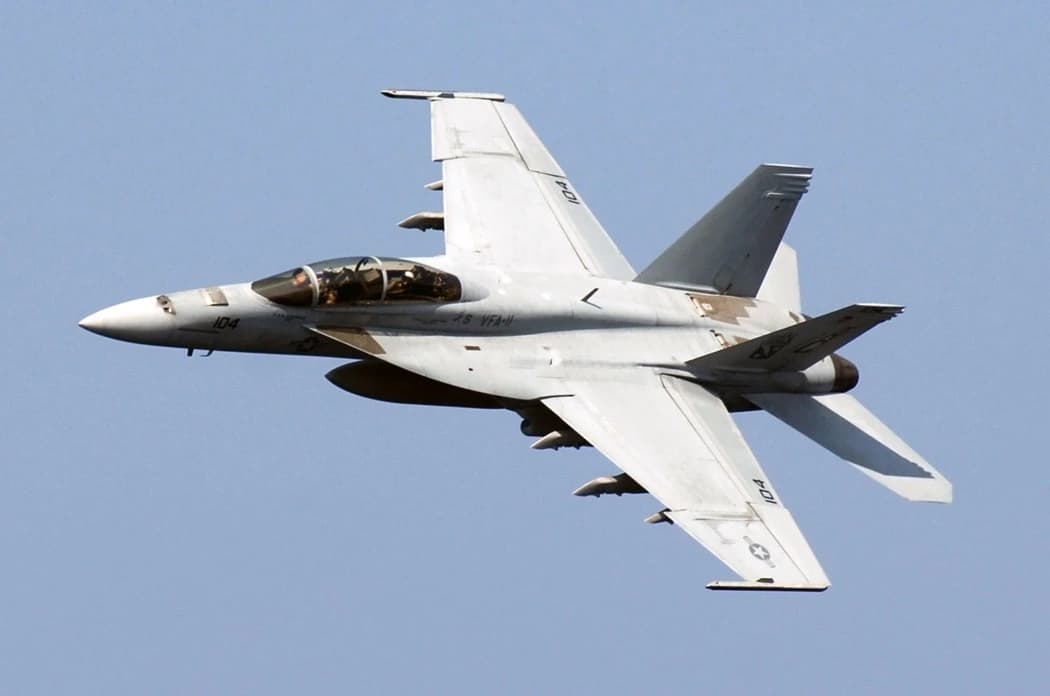
F/A-18F Super Hornet in the exact reference-pictured configuration
U.S. Navy photo by Seaman Kevin T. Murray Jr. · Public domain · Resized; original frame retained · Public domain · Source ↗ · ModifiedF/A-18F
Two-seat variant
F/A-18E: 1 (pilot), F/A-18F: 2 (pilot and weapon systems officer )
60 ft 1.25 in (18.31 m)
44 ft 8.5 in (13.62 m)
16 ft 0 in (4.88 m)
500 sq ft (46.5 m 2 )
32,081 lb (14,552 kg)
47,000 lb (21,320 kg) (equipped for fighter escort)
66,000 lb (29,937 kg)
F/A-18E: 14,700 lb (6,668 kg), F/A-18F: 13,760 lb (6,241 kg)
Up to 4 × 480 US gal (1,817 L) tanks, totaling 13,040 lb (5,915 kg), option for 2 x 515 US gal (1,949 L) conformal fuel tanks totaling an additional 7,000 lb (3,175 kg) on Block III
2 × General Electric F414-GE-400 turbofans , 13,000 lbf (58 kN) thrust each dry, 22,000 lbf (98 kN) with afterburner
Mach 1.8, 1,030 kn (1,185 mph; 1,908 km/h) clean at 40,000 ft
482 kn (555 mph, 893 km/h) fighter escort
129 kn (148 mph, 239 km/h) power-off
1,275 nmi (1,458 mi, 2,346 km) with armament of two AIM-9s
558 nmi (642 mi, 1,033 km) hi-lo-hi mission with 2× GBU-10 laser guided bombs, 1× AIM-120, 2× AIM-9, 3× drop tanks
1,800 nmi (2,070 mi, 3,330 km)
52,300 ft (15,940 m)
44,882 ft/min (228 m/s)
94.0 lb/sq ft (459 kg/m 2 ) or 127.0 lb/sq ft (620 kg/m 2 ) at max takeoff weight
0.93
7.5 g
1× 20 mm (0.787 in) M61A2 Vulcan , 412 rounds
11 (2× wingtips, 6× under-wing, and 3× under-fuselage) with a capacity of Max payload: 17,750 lb (8,050 kg). Carrier bringback payload: F/A-18E: 9,900 lb (4,491 kg), F/A-18F: 9,000 lb (4,082 kg) , with provisions to carry combinations of:
Air-to-air missiles Fighter escort: 7× AIM-120 AMRAAM and 2× AIM-9 Sidewinder or 5x AIM-120 and 4× AIM-9 or 4× AIM-174B , 3× AIM-120, and 2× AIM-9 or 4× AIM-7 Sparrow and 2× AIM-9 maximum of 2× AIM-9 and: 12× AIM-120 AMRAAM or 8× AIM-7 Sparrow Air-to-surface missiles AGM-65E/F Maverick AGM-84H/K SLAM-ER AGM-88 HARM AGM-88G AARGM-ER [being integrated] AGM-158 JASSM AGM-154 Joint Standoff Weapon (JSOW) - glide bomb AGM-84 Harpoon AGM-158C LRASM Joint Strike Missile (JSM) (to be integrated)
JDAM bombs (up to 10× GBU-32/35/38/54 or 4× GBU-31) Paveway series of laser-guided bombs Mk 80 series unguided bombs Mk-62/63/65 Quick Strike Naval mine
SUU-42A/A Flares/infrared decoy dispenser pod and chaff pod AN/ALE-50 towed decoy system pod up to 4× 480 US gal (1,800 L; 400 imp gal) drop tanks and 1× A/A42R-1 Aerial Refueling Store pod for aerial refueling. 12× ADM-141C TALD decoys AWW-13 Advanced data link pod
Hardpoints: 11 (2× wingtips, 6× under-wing, and 3× under-fuselage) with a capacity of Max payload: 17,750 lb (8,050 kg). Carrier bringback payload: F/A-18E: 9,900 lb (4,491 kg), F/A-18F: 9,000 lb (4,082 kg) , with provisions to carry combinations of:
Manufacturer Boeing, originally McDonnell Douglas
Country of Origin United States
First Flight November 1995
Length 60.3 ft (18.5 m)
Wingspan 44.9 ft (13.68 m)
Reference text from Wikipedia contributors, used under CC BY-SA 4.0.
True scale
Sourced dimensions beside a 1.75 m human reference.
Height 16 ft (4.87 m)
Empty Weight Approximately 32,000 lb
Maximum Speed Mach 1.8+
Range 1,660 nmi ferry
Combat Radius Mission dependent
Service Ceiling 50,000+ ft
Engine Type General Electric F414-GE-400 afterburning turbofan
F/A-18F Super Hornet equipment records. Variants, orders and quantities are shown as reported in each inventory source; coverage is incomplete.
United StatesNaval Aviation exact source-named AIRCRAFT / FGA F/A- 18F Super Hornet holdings. November 2025 IISS assessment. Active, operational-reserve and training inventory excluding store. Technical configuration is unverified; no parent, sibling, national total or fitted capability is inferred.
Keep exploring
Light fighter
 IranCompare with F/A-18F Super Hornet
Light fighter
IranLight fighter
United StatesCompare with F/A-18F Super Hornet Fighter-bomber
Compare with F/A-18F Super HornetFighter-bomber
 ChinaCompare with F/A-18F Super Hornet
Fighter-bomber
 CanadaCompare with F/A-18F Super Hornet