FORCETALLY
Loading the evidence…
Preparing your view.


Preparing your view.
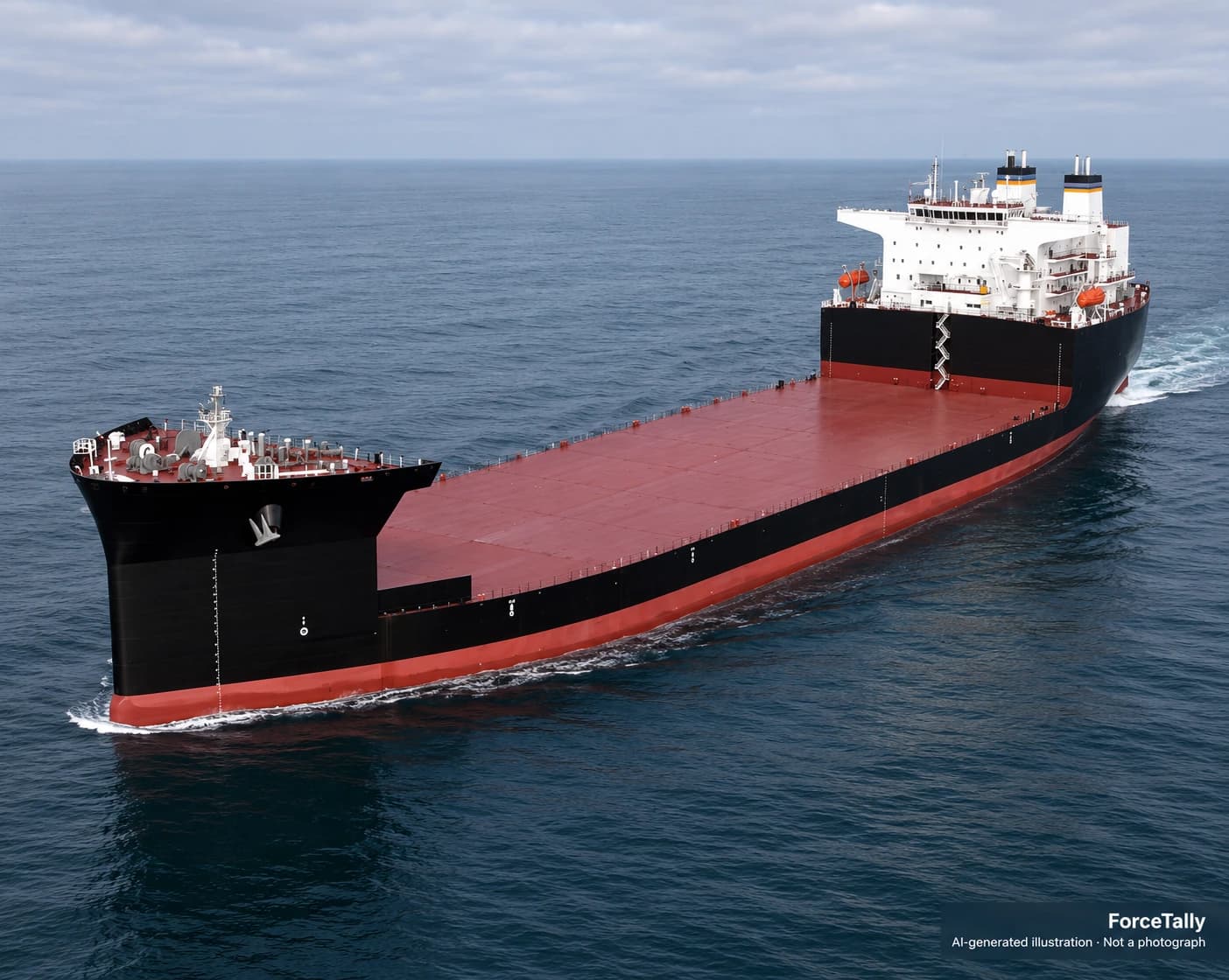
Naval support & landing craftIn service
Expeditionary Transfer Dock is documented in the equipment reference catalogue. It was built by General Dynamics National Steel and Shipbuilding Company (NASSCO). Reported operators include United States Navy.
 United States
AI-generated illustration · Not a photograph — USNS John Glenn (T-MLP-2), the source-pictured January2014 builder sea-trial configuration; representative of the Expeditionary Transfer Dock class. Exterior detail is illustrative; not engineering verified.
ForceTally · AI-generated illustration · Not a photograph · Reference: USNS John Glenn (T-MLP-2) underway in January 2014.jpg by Christopher G. Johnson, US Navy, Public domain (https://creativecommons.org/publicdomain/mark/1.0/), https://commons.wikimedia.org/wiki/File:USNS_John_Glenn_(T-MLP-2)_underway_in_January_2014.jpg. Changes: Existing vessel brought closer; distant coastline removed; disclosure added. · ForceTally · AI-generated illustration · Source ↗ · ModifiedGeneral Dynamics National Steel and Shipbuilding Company (NASSCO)
United States Navy
2012-present
2013-present
8
8
6
>60,000 metric dwt
785 ft (239 m)
164 ft (50 m)
39.37 ft (12.00 m)
4 × MAN/B&W medium speed diesels 24 MW diesel electric plant, twin screw propellers 2 MW azimuth bow thruster
>15 knots (28 km/h; 17 mph)
9,500 nautical miles (17,600 km; 10,900 mi) at 15 knots
3 LCAC
ESB variant: Hangar for 2 × CH-53 and large flight deck
A preliminary design by General Dynamics envisioned a ship that carried six LCACs, with the ability to turn around (dock, unload or load, then launch) two landing craft simultaneously from the stern. The ESDs were to host a brigade -size force, sail at 20 knots (37 km/h; 23 mph), and have a maximum range of 9,000 nautical miles (17,000 km; 10,000 mi). Each ship was to cost US$1.5 billion to build, but cutbacks to defense spending planned for the fiscal year 2011 budget forced the downscaling of the design in mid-2009.
General Dynamics identified the civilian Alaska -class oil tanker (built by the subsidiary National Steel and Shipbuilding Company ) as a suitable basis for an "ESD 'Lite'", with the design modified into a float-on/float-off vessel that could be built for US$500 million per ship. As part of the cost trade-off, the Vehicle Transfer System was scrapped in favor of skin-to-skin mooring of a host ship alongside the ESD, and the LCAC complement was reduced to three. The new design is 785 feet (239 m) long, with a beam of 164 feet (50 m), a top speed of over 15 knots (28 km/h; 17 mph), and a maximum range of 9,500 nautical miles (17,600 km; 10,900 mi). Converteam supplies an integrated power system and vessel automation system for the ESD.
Their aviation facilities include a 52,000 ft 2 (4,800 m 2 ) flight deck with landing spots for two heavy-lift transport CH-53 helicopters, as well as additional deck space for two more CH-53s.
The deck is made with two operating spots and two parking spots, plus room to store two in the hangar.
The mission deck's ability to submerge to launch landing craft was disabled and instead a crane, capable of carrying 11 metric tons (12 short tons) and moving a 41 ft (12 m) boat in up to sea state 3, carries watercraft, towed arrays, and unmanned vehicles into the water.
The United States Navy ordered T-ESB-3 in February 2012 as part of the Fiscal Year 2013 appropriation for the U.S. Department of Defense via the National Defense Sealift Fund (NDSF). The keel-laying ceremony for MKP-3 took place at the General Dynamics NASSCO shipyard in San Diego , California, on 5 November 2013.
On 19 December 2014, U.S. Navy's Naval Sea Systems Command awarded a US$498M contract to General Dynamics NASSCO for the construction of second ESB variant, the as-yet unnamed T-ESB-4. This vessel will be built at the NASSCO shipyard in San Diego, California, with a scheduled completion date of 2018.
In mid-2022, the Marine Corps announced its intent to retire the two ESD ships. Although they were cheap to buy compared to amphibious assault ships and demonstrated seabasing concepts, they are limited to connecting with sealift vessels at wave heights below three feet, and payload, fuel capacity and accommodation space were reduced to cut costs. This led to the decision to retire the ships to prioritize other vessels, such as the more successful ESBs. The proposed retirement of the two ESDs was rejected by Congress in December 2022.
An Expeditionary Transfer Dock ( ESD ), formerly the Mobile Landing Platform ( MLP ), is designed to be a semi- submersible , flexible, modular platform providing the US Navy with the capability to perform large-scale logistics movements such as the transfer of vehicles and equipment from sea to shore. These ships significantly reduce the dependency on foreign ports and provide support in the absence of port availability. The class also houses a sub-class variant called the Expeditionary Mobile Base ( ESB ), formerly the Afloat Forward Staging Base ( AFSB ).
{"datatype": "wikibase-item", "datavalue": {"type": "wikibase-entityid", "value": {"entity-type": "item", "id": "Q30", "numeric-id": 30}}, "hash": "7f985e15819b74ed189d022e004890e66d2ae42e", "property": "P495", "snaktype": "value"}
country of origin United States 0 references
country of origin United States 0 references
country of origin United States 0 references
country of origin United States 0 references
country of origin United States 0 references
country of origin United States 0 references
Besatzung 250
Displacement: 78,000 Tons (fully loaded)
L x B : 785′ (239.3M) x 164’ (50M)
34 MSC Berths
Max Cargo Water: over 100,000 gals potable
JP-5: over 590,000 gals
Propulsion: Twin screw, medium speed
Type: Diesel Electric
Speed: >15 Knots
Endurance: over 9,500 NM at 15 knots
Reference text from Wikipedia contributors, used under CC BY-SA 4.0.
True scale
Sourced dimensions beside a 1.75 m human reference.
Points represent sourced observations, including revisions. Revisions on the same effective date are not separate inventory events. Ranges appear in the table and are not plotted as exact points.
| Observation / report period | Value | Source | Claim state |
|---|---|---|---|
| 28 Sept 2026 | 50 m | Wikipedia contributors | superseded |
| 28 Sept 2026 | 50 m | Wikipedia contributors | superseded |
| 28 Sept 2026 | 50 m | Wikipedia contributors | superseded |
| 28 Sept 2026 | 50 m | Wikipedia contributors | superseded |
| 28 Sept 2026 | 50 m | Wikipedia contributors | superseded |
| 28 Sept 2026 | 50 m | Wikipedia contributors | superseded |
| 28 Sept 2026 | 50 m | Wikipedia contributors | superseded |
| 28 Sept 2026 | 50 m | Wikipedia contributors | superseded |
| 28 Sept 2026 | 50 m | Wikipedia contributors | superseded |
| 28 Sept 2026 | 50 m | Wikipedia contributors | approved |
Expeditionary Transfer Dock equipment records. Variants, orders and quantities are shown as reported in each inventory source; coverage is incomplete.
United StatesPrepositioning (PM3) exact named equipment holdings: Montford Point. Active, operational-reserve and training units excluding equipment in store; November 2025 IISS assessment. Named service only; no parent-force or national total inferred. Source role: LOGISTICS AND SUPPORT / ESD. Original estimates, ranges, reporting names, reserve, lease and employment scopes retained; nested included counts are not added. Missile-system quantities mean launchers, not rounds. No readiness, crew, carried weapon, payload, factory-production or future order count inherited.
Keep exploring
special mission-support ship
Oil spill response vessel
 Finland
Oil spill response vessel
FinlandOil spill response vessel
FinlandNaval support & landing craft
 United Kingdom
ship designed for the collection of signals and communications beyond enemy lines
 Netherlands