FORCETALLY
Loading the evidence…
Preparing your view.


Preparing your view.
Armoured vehiclesIn service
Armoured car
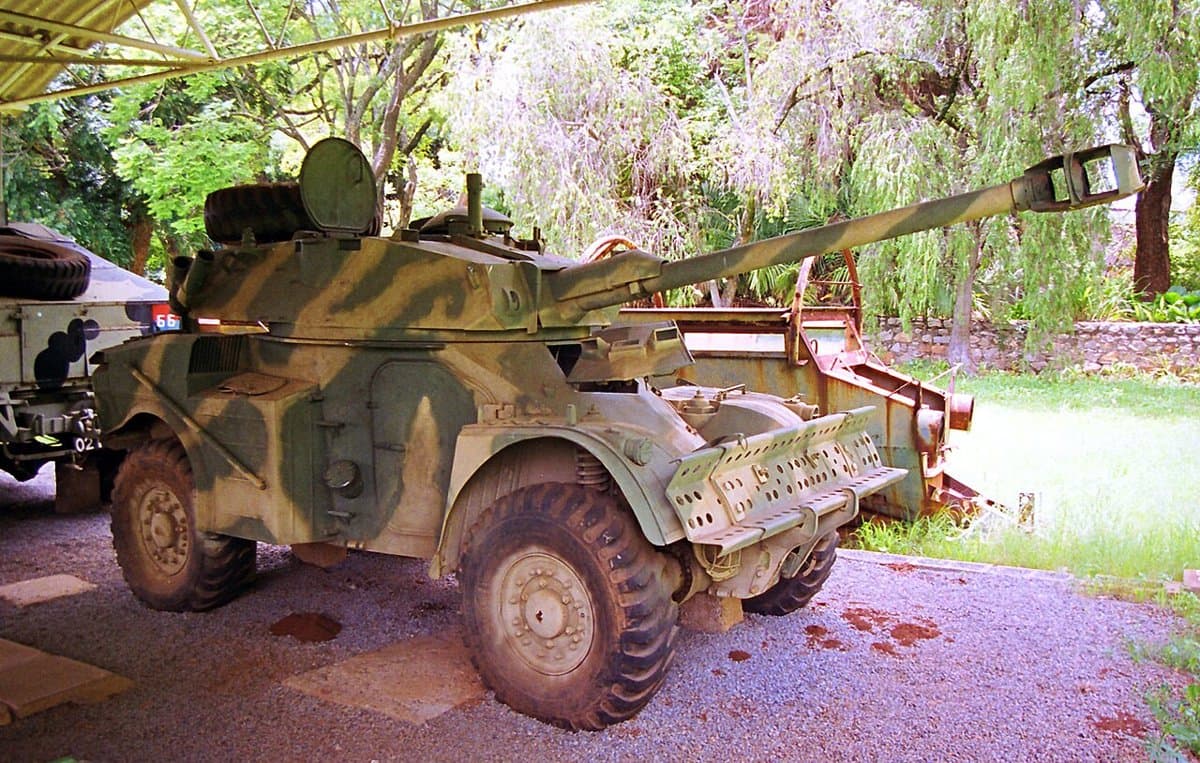
Eland armoured car is a armoured car originating in South Africa. It was built by Sandock-Austral Reumech OMC. Reported operators include Benin, Burkina Faso, Chad, Gabon, Ivory Coast, Malawi, Morocco, Sahrawi Arab Democratic Republic, Senegal, Uganda, Zimbabwe.
 South Africa
Eland armoured car
Bob Adams from George, South Africa · CC BY-SA 2.0 · Resized · CC BY-SA 2.0 · Source ↗ · ModifiedTechnical data
Armoured car
South Africa
1962–1994 (South Africa) 1967–present (other)
See Operators
Angolan Civil War Rhodesian Bush War 1981 Entumbane Uprising South African Border War Western Sahara War Second Congo War Chadian Civil War Northern Mali conflict Boko Haram insurgency
Sandock-Austral
1962
Sandock-Austral Reumech OMC
1964 – 1986
1,600
See Variants
6 tonnes (6.6 short tons ; 5.9 long tons )
5.12 m (16 ft 10 in)
2.01 m (6 ft 7 in)
True scale
Sourced dimensions beside a 1.75 m human reference.
Points represent sourced observations, including revisions. Revisions on the same effective date are not separate inventory events. Ranges appear in the table and are not plotted as exact points.
| Observation / report period | Value | Source | Claim state |
|---|---|---|---|
| 1 Oct 2026 | 3 people | Wikipedia contributors | superseded |
| 1 Oct 2026 | 3 people | Wikipedia contributors | approved |
2.5 m (8 ft 2 in)
3 (commander, driver, gunner)
90mm Denel GT-2 (29 rounds) OR 60mm K1 mortar (56 rounds)
2x 7.62mm M1919 Browning machine guns (2400 - 3800 rounds)
Chevrolet 153 2.5 L (150 in 3 ) inline 4 -cylinder water-cooled petrol
6-speed manual constant mesh
Independent 4X4 ; active trailing arms
380 mm (1 ft 3 in)
142 L (38 US gal)
450 km (280 mi)
100 km/h (62 mph)
Benin - Beninese Army : 3 Eland-90s, supplied from unidentified source in 2010. Beninese crews trained by 1er RHP , France.
Burkina Faso - Burkinabe Army : 4 Eland-90s, supplied from unidentified source in 2006.
Chad - Chadian Ground Forces : 82 refurbished Eland-90s purchased from a Belgian firm in 2007.
Gabon - Gabonese Army : 4 Eland-90s and 4 Eland-60s in service with the presidential guard.
Ivory Coast - Ivorian Gendarmerie
Malawi - Malawian Army : 13 Eland-90s purchased from the SANDF in 1994.
Morocco - Moroccan Army : 60 Eland-90s and Eland-20s delivered in 1981; provided with instructors for training the Moroccan crews.
Sahrawi Arab Democratic Republic - Polisario Front : Presumably captured from Morocco.
Senegal - Senegalese Army : 47 Eland-90s purchased from the SANDF in 2005.
Uganda - Ugandan Land Forces : 40 Eland-90s purchased prior to the Second Congo War .
Zimbabwe - Zimbabwe National Army : 16 to 28 Eland-90s inherited from the Rhodesian Army in 1980.
South Africa - South African Army : 1,268 Eland-60s and Eland-90s in active service in 1989.
South West Africa - South West African Territorial Force : At least 40 Elands provided by the SADF; deployed exclusively with 91 Brigade.
Rhodesia - Rhodesian Army and Rhodesian Air Force : Up to 60 Eland-90s and 12 Eland-60s donated by South Africa on semi-permanent loan.
Portugal - Portuguese Army : at least 32 Eland-60 loaned by South Africa for use in Angola and Mozambique .
The Eland
The Eland is an air-portable light armoured car based on the Panhard AML .
The Eland is an air-portable light armoured car based on the Panhard AML . Designed and built for long-range reconnaissance , it mounts either a 60mm (2.4 in) breech-loading mortar or a Denel GT-2 90mm (3.5 in) gun on a very compact chassis. Although lightly armoured, the vehicle's permanent 4X4 drive makes it faster over flat terrain than many tanks.
One hundred AMLs were purchased, presumably for preliminary evaluation purposes, as well as enough turrets, engines, and other associated parts for the later assembly of another 800 in South Africa.
Operated by a crew of three, each Eland was built on a small and remarkably lightweight 4X4 chassis with a height of 2.5 metres, a length of 5.12 metres, and a weight of 6 metric tons . The Eland had a maximum range of 450 kilometres and a mileage of 2 kilometres per litre. As South Africa was primarily interested in a light patrol vehicle armed for counter-insurgency purposes, most Elands were armed with the 60mm Brandt Mle CM60A1 gun-mortar, better known by its South African manufacturing code K1 and also designated in SADF service as the M2 , as well as two 7.62mm Browning machine guns . This was known as the Eland-60 .
In response to SADF inquiries concerning an AML more similar to the Saladin in terms of armament, Panhard produced the AML-90. There was substantially more firepower in the new variant: its 90mm low-pressure rifled cannon, with a range of 1,200 metres, enabled it to knock out all but the heaviest contemporary tanks. This evolved into the Eland-90 in South African service.
During a wargaming exercise designed to simulate a foreign invasion of South West Africa , the SADF found that the Eland-90 suffered from three major disadvantages: it had no trench-crossing ability, its off-road mobility was limited due to its four wheels and high ground pressure, and the 90mm cannon was ineffective against enemy armour at long range.
The armoured corps evaluated several Elands armed with 20mm and 40mm autocannons between 1971 and 1972 and finally settled on the Hispano-Suiza HS.820 as its armament of choice.
I turned to see one of our small, odd-looking Eland armoured ‘Noddy' cars with its long 90-millimetre gun barrelling towards us at almost top speed from across the chana...it turned nimbly, kicking up a cloud of dust as he came directly through our scattered line and then turned again, this time towards the tank. The little armoured car came to a quick stop right in the middle of the open ground about 80 metres from the tank, waited a couple of seconds and then fired one shot from [its] 90-millimetre with a loud bang. The shot was right on target. When the smoke drifted away the T-34's turret was lying off to one side and the open body was burning, belching dense black smoke.
Once envisaged only as a scout car, the Eland auspiciously doubled in the role of an assault gun and an ersatz tank destroyer —but its obsolescence was highlighted by several factors, namely a flammable petrol engine which was especially vulnerable to rocket-propelled grenades or mine explosions, and its limited off-road mobility. The effectiveness of the low-pressure 90mm gun against modern tanks was also questionable; during Operation Askari Eland-90s' high-explosive anti-tank shells rarely penetrated enemy T-54s without multiple hits.
The Rooikat, which had emerged from the original requirement for a larger and more effectively armed vehicle to supplant the Eland series on conventional battlefields, was much more mobile and carried a sophisticated 76mm high-velocity cannon capable of engaging armour at longer standoff ranges.
By the time FAPLA redeployed sufficient forces along its southern front to halt the SADF advance, Zulu and Foxbat had advanced over 500 kilometres and captured eighteen major towns and cities.
The Cubans planned an elaborate defence of Catengue, intending to pin the South African armoured cars on the road and strip away the supporting FNLA foot soldiers with a composite battery of 82mm mortars and Grad-P 122mm rocket artillery.
Foxbat's Elands approached within five kilometres of Catofe but did not advance any further, owing to concerns about having overextended their lines.
Elands were again mobilised by the SADF for Operation Reindeer in May 1978, a coordinated strike on three suspected PLAN training complexes in Angola. For the purposes of this operation, the SADF experimented with an integrated combat team consisting of mechanised infantry mounted in the new Ratels, backed by attached Eland-90s providing fire support as needed. Three combat teams of Ratels and Eland-90s were created for the assault on a heavily fortified PLAN camp known as the "Dombondola Complex", also code named Objective Vietnam. One troop of Eland-90s would follow the Ratels during the attack, while the other two were to redeploy on the nearby highway linking Cuamato to Chetequera, where they could intercept stragglers or potential guerrilla reinforcements. The combat teams were backed by rear echelon which included a battery of towed BL 5.5-inch Medium Guns and logistics vehicles carrying enough fuel and ammunition for the journey; these were escorted by Eland-60s in a supporting role.
Additionally, the crews raised complaints about the 90mm ammunition, which was difficult to load and resulted in stoppages due to some inefficient plastic components.
Furthermore, the use of 90mm ammunition sourced from France was discontinued and production of local 90mm ammunition optimised for the Eland was accelerated.
These concerns were addressed in the short run by mating a Ratel chassis to an Eland-90's turret and 90mm gun, creating the Ratel-90.
Its six wheels, longer operating range, and 72 stowed rounds of 90mm ammunition were also considered much more suitable for mobile bush operations.
As a consequence of this decision the combat teams advanced at a maximum speed of about 20 km/h.
When the terrain became more challenging, the advance slowed to about 10 km/h.
Their crews found themselves unable to support the mechanised assault group while fighting for their own survival, and the 90mm guns were used as extremely close range to suppress counterattacking PLAN forces.
Although Elands were vulnerable to the T-34's 85mm gun, their vastly superior mobility and the experience of SADF crews made a considerable difference.
At the end of Operation Protea , South Africa had captured over 3,000 tonnes of ammunition, overrun some 38,850 square kilometres of Angolan territory, and inflicted serious casualties on SWAPO and FAPLA. Most significantly, the SADF installed its own garrisons at Xangongo and Ongiva - leaving behind two companies detached from the South West African Territorial Force (SWATF), an Eland squadron, and the special forces of 32 Battalion . Throughout 1982 Eland-90s were a common sight on the roads around Xangongo, deterring SWAPO from reentering the town.
By 1983, FAPLA had completed an exhaustive two-year retraining and reequipment programme, greatly increasing in size, sophistication, and competence under the eye of Soviet military advisors. Luanda was spending 35% of its budget on external defence, and Mikoyan MiG-21s were beginning to disrupt the traditional South African Air Force superiority. Within five months of Protea , Cuba had committed another 7,000 troops to Angola. They also brought T-54/55 tanks, which were more formidable than the antiquated T-34.
The mediocre performance of improvised tank destroyers at Cuvelai convinced Ep van Lill, commander of 61 Mechanised, that his men could no longer be asked to fight tanks with armoured cars. Van Lill informed General Viljoen that the Eland-90 simply could not stand up to the heavier protection and armament of T-54/55s. "Tank busting" expended too much 90mm ammunition and fatigued recoil systems. As demonstrated during Askari , crew morale was also affected when ordered to take on T-55s in their vulnerable vehicles. This contradicted South African Armoured Corps (SAAC) doctrine, which was to fight tanks with tanks.
Following a failed project to increase the Ferret's firepower by the addition of a 20mm autocannon, the Rhodesian government turned to South Africa, which offered to supply RhACR with Eland-90s.
For the most part, the RhACR Eland-90s were utilised in the internal security and convoy escort role. The armoured cars were deployed at army roadblocks and frequently patrolled the borders to deter insurgent infiltrators. In the event of a conventional conflict, the Eland-90s were to be used in their secondary role of conventional reconnaissance vehicles. Their light armour protection was always a concern for the Rhodesian crews, particularly after trials proved that the Eland's hull could be penetrated by armour-piercing 7.62×39mm rounds. Problems with the clutches were also encountered, which led to all the RhACR's Elands being retrofitted with new clutches adopted from the army's Land Rover utility vehicles.
Both were destroyed by 90mm shells at two hundred metres.
After 1980, the former Rhodesian Armoured Car Regiment, now part of the Zimbabwe Armoured Corps, was reduced to a single regular squadron of Eland-90s. The Zimbabwean Ministry of Defence wanted to bring the regiment up to its pre-1980 strength of four squadrons, one to complement each of the ZNA's four infantry brigades. From 1984 onwards, the Eland-90 was largely superseded in front-line service by the heavier, six-wheeled EE-9 Cascavel , which was adopted in sufficient numbers to form the three additional armoured car squadrons. A proposal to retrofit the ZNA Elands with upgraded 90mm guns and turrets was discussed but never reached fruition. In Zimbabwean service, the armoured cars suffered from a dwindling supply of spare parts and erratic maintenance. Some were still in service as late as the Second Congo War .
Modelled after Panhard's AML HE-60-7, the Eland-60 was the first Eland variant to enter service. It is armed with twin 7.62mm machine guns on the left and a single 60mm mortar on the right. Unlike its French predecessor, only one machine gun is mounted coaxially in the turret. A second was typically carried on a pintle for anti-aircraft use. The mortar has an elevation of +75° and a depression of -11°. A single type of mortar is available: the Hotckiss-Brandt CM60A1 , produced under licence as the Model K1. It can be fired on a flat trajectory and is effective up to 300 metres in the direct role, or 1,700 metres in the indirect role. No more than 56 rounds of 60mm and 3,800 rounds of 7.62mm ammunition are carried. South African crews usually stored 44 mortar bombs per vehicle.
Modelled after Panhard's AML H-90, the Eland-90 functioned as a fire support platform and assault gun. In this role it was easy to underestimate. During combat against tanks, its biggest edge was superior mobility, although this was diminished somewhat by the lack of a stabilised cannon. The armoured cars were often decisively outranged by the Angolan tanks, and their inability to fire on the move resulted in a poor rate of engagement. Eland-90s are equipped with a Denel GT-2 90mm gun; a coaxial 7.62mm machine gun is also mounted to the left of the main armament. The GT-2 has an elevation of +15° and a depression of -8°. Turret rotation is manual and takes approximately twenty seconds. A gunner is seated on the right and has a one-piece hatch cover. The loader or commander is on the left of the gun and a single hatch cover provided for the commander. Total ammunition capacity is 29 rounds of 90mm and 2,400 rounds of 7.62mm.
The Eland-20 was a base Ratel's turret atop the Eland chassis. It is fitted with a 7.62mm machine gun and 20mm GI-2 (M963 F2) autocannon offering an elevation of +38° and a depression of -8°. The 20mm cannon has a cyclic rate of fire of 750 rounds per minute. If required, another 7.62mm machine gun can be mounted on the turret roof.
In 1994, an Eland was showcased with a turbocharged diesel four-cylinder powerpack developing 103 hp at 4,000 rpm. This was mounted on a sliding frame to facilitate easier engine removal and maintenance. Apart from the new engine, other changes were made to enhance performance in tropical climates. These included modified air conditioning and cooling systems. Reumech OMC —then a subsidiary of Vickers —marketed the design as Eland Mk7 Diesel Turbocharged , or simply "Eland Mk7 DT". An estimated 200 Mk7s were haggled from the SANDF for diesel conversion.
Several foreign companies currently offer extensive rebuild or overhaul programmes for the Eland, particularly with regards to improving engine performance and reliability. Saymar, an Israeli firm, has proposed a modified Eland with a two-litre Toyota diesel engine developing 76 kW (102 hp). Another upgrade programme is being marketed by Belgium's Sabiex International, which includes the complete refurbishment of the vehicle's transmission, electrical system, and drive train.
Like the AML, the Eland is equipped with a two-person turret. The original Eland-60 had an unusual combination of the 60mm K1 mortar and two medium, or one heavy, machine guns - a combination inspired by French experiences in the Algerian War . The mortar weighs 75 kg and is 1.8 metres long. Maximum effective range of the K1 as produced by Denel Land Systems is stated to be 1,700 metres. An Eland-60 was always present in every South African support troop due to the effectiveness of its illumination bombs during night operations.
The 90mm Denel GT-2 gun, which fires fin-stabilised high-explosive (HE) and high-explosive anti-tank (HEAT) projectiles, is heavier than that mounted in the Saladin and provides the Eland with a very potent form of armament, considering its small size and speed.
It weighs 380 kg and has a double baffle muzzle brake.
With the muzzle brake, it measures 4.1 metres in length.
South Africa began producing its own 90mm ammunition in large quantities after French high-explosive rounds were blamed for causing stoppages in Eland-90s during Operation Reindeer.
Maximum effective range of the Denel GT-2 is stated to be 2,200 metres (HE). The HEAT-T round will penetrate 320mm of armour at a zero angle of incidence or 150mm of armour at a 60° angle of incidence. A locally manufactured fin-stabilised, shaped charged, projectile was also under development in 1976. The complete round weighs 7 kg of which the projectile itself weighs 3.65 kg. The complete round is 654mm in length with the projectile being 500mm in length. This round has an m/v of 750 m/s and a maximum velocity of 760 m/s, and effective range is given as 1,200 metres.
For decades, Elands were widely deployed in lieu of tanks in the SAAC. The main danger with this policy was that crews and commanders were often forced to use them against Angolan or Cuban tanks. Whenever T-55s appeared on the battlefield, they caused anxious moments for the Eland-90. The tanks carried stabilised cannon, so they could fire on the move, whereas the Eland-90 needed to come to a stop before discharging its main gun. Firing the 90mm GT-2 while in forward motion was theoretically possible but disrupted the recoil procedure and risked catastrophic damage to the vehicle's transmission. Their inferior armament and optics meant that Elands had to close in on a tank to eliminate it, which demanded considerable skill. Where possible gunners aimed for the rear, flank, or a vulnerable margin beneath the turret front. Naturally the tank would also turn to avoid exposing its thinner armour, so expert manoeuvring was required before they could get behind a T-55 and destroy it from there.
Eland-90 troops always identified one tank as a priority target. Then, when the chance came, the Elands fired simultaneously—knocking out the tank. To avoid being hit between volleys, they had to keep moving. This protocol was derived from SADF experience fighting T-34s and later applied to T-55s. Armoured car commanders believed it wouldn't have fared well against T-62s. Eland-90s struggled in big, dense, bushes while attempting to carry out their usual tactic during Operation Askari and were hereafter deemed unfit for high intensity campaigns.
Plinthed Eland-90 in Irene
Engine : Chevrolet 153 2.5 liter, water-cooled four-cylinder inline petrol engine which produces 86hp @4600 rpm. (16.4 hp/t)
Operating Range : Road 450 km (280 mi); Cross country 240 km (149 mi)
Reference text from Wikipedia contributors, used under CC BY-SA 4.0.
Eland armoured car equipment records. Variants, orders and quantities are shown as reported in each inventory source; coverage is incomplete.
 Benin
Reported count for Eland-90. Country-wide list; no individual service specified. 1 distinct count cell(s) from the same source list; shared rowspan cells counted once. Retired, wholly reserve and on-order rows are excluded; the reported count retains any explicitly mixed stock scope in the quoted row. Count column(s): quantity: 3. Origin: South Africa. The listed variants/roles are the scope, not an immediately deployable count. The components do not establish one inventory census date; the stored date is the retrieved source snapshot.
 Burkina Faso
 Chad
Reported count for Eland-90. Service scope: Chadian Ground Forces; does not replace a national total. 1 distinct count cell(s) from the same source list; shared rowspan cells counted once. Retired, wholly reserve and on-order rows are excluded; the reported count retains any explicitly mixed stock scope in the quoted row. Count column(s): quantity: 82. Origin: South Africa. The listed variants/roles are the scope, not an immediately deployable count. The components do not establish one inventory census date; the stored date is the retrieved source snapshot.
 Gabon
 Ivory Coast
 Malawi
Army exact named equipment holdings: Eland-90. Active, operational-reserve and training units excluding equipment in store; November 2025 IISS assessment. Named service only; no parent-force or national total inferred. Source role: ARMOURED FIGHTING VEHICLES / RECCE. Original estimates, ranges, reporting names, reserve, lease and employment scopes retained; nested included counts are not added. Missile-system quantities mean launchers, not rounds. No readiness, crew, carried weapon, payload, factory-production or future order count inherited.
 Morocco
Army exact named equipment holdings: Eland. Active, operational-reserve and training units excluding equipment in store; November 2025 IISS assessment. Named service only; no parent-force or national total inferred. Source role: ARMOURED FIGHTING VEHICLES / RECCE. Original estimates, ranges, reporting names, reserve, lease and employment scopes retained; nested included counts are not added. Missile-system quantities mean launchers, not rounds. No readiness, crew, carried weapon, payload, factory-production or future order count inherited.
 Senegal
Army exact named equipment holdings: Eland-90. Active, operational-reserve and training units excluding equipment in store; November 2025 IISS assessment. Named service only; no parent-force or national total inferred. Source role: ARMOURED FIGHTING VEHICLES / RECCE. Original estimates, ranges, reporting names, reserve, lease and employment scopes retained; nested included counts are not added. Missile-system quantities mean launchers, not rounds. No readiness, crew, carried weapon, payload, factory-production or future order count inherited.
 Uganda
n People’s Defence Force exact named equipment holdings: Eland-20. Active, operational-reserve and training units excluding equipment in store; November 2025 IISS assessment. Named service only; no parent-force or national total inferred. Source role: ARMOURED FIGHTING VEHICLES / RECCE. Original estimates, ranges, reporting names, reserve, lease and employment scopes retained; nested included counts are not added. Missile-system quantities mean launchers, not rounds. No readiness, crew, carried weapon, payload, factory-production or future order count inherited.
 Zimbabwe
Reported count for Eland. Service scope: Zimbabwe National Army; does not replace a national total. 1 distinct count cell(s) from the same source list; shared rowspan cells counted once. Retired, wholly reserve and on-order rows are excluded; the reported count retains any explicitly mixed stock scope in the quoted row. Count column(s): number: 20 in service. Origin: South Africa. The listed variants/roles are the scope, not an immediately deployable count. The components do not establish one inventory census date; the stored date is the retrieved source snapshot.
Benin, Burkina Faso, Chad, Gabon, Ivory Coast, Malawi, Morocco, Sahrawi Arab Democratic Republic, Senegal, Uganda, Zimbabwe
Equipment reference ↗Reported count for Eland-90. Service scope: Army equipment; does not replace a national total. 1 distinct count cell(s) from the same source list; shared rowspan cells counted once. Retired, wholly reserve and on-order rows are excluded; the reported count retains any explicitly mixed stock scope in the quoted row. Count column(s): quantity: 40. Origin: South Africa. The listed variants/roles are the scope, not an immediately deployable count. The components do not establish one inventory census date; the stored date is the retrieved source snapshot.
Keep exploring
 United Kingdom
 Germany
 Canada