FORCETALLY
Loading the evidence…
Preparing your view.


Preparing your view.
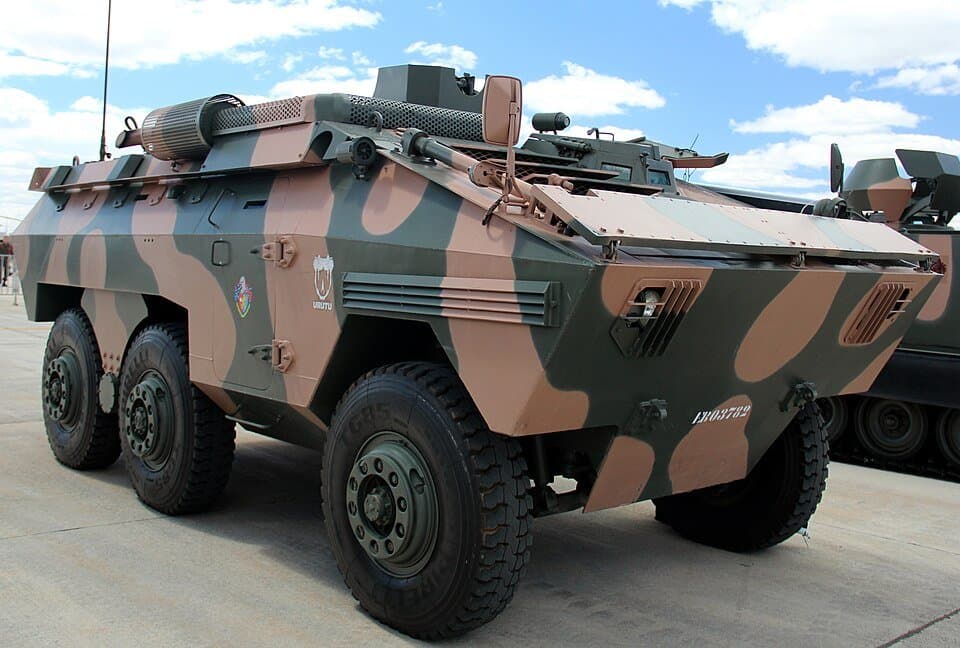
Armoured vehiclesIn service
Amphibious wheeled Armored personnel carrier
EE-11 Urutu is a amphibious wheeled Armored personnel carrier originating in Brazil. It was built by Engesa. Reported operators include Angola, Bolivia, Brazil, Colombia, Cyprus, Dubai, Ecuador, Gabon, Guyana, Iraq, Kurdistan Region, Iran, Jordan, Libya, Nigeria, Paraguay, Senegal, Suriname, Tunisia, Uruguay, Venezuela, Zimbabwe.

Amphibious wheeled Armored personnel carrier
Brazil
See Operators
Chadian–Libyan conflict Iran–Iraq War Gulf War Colombian conflict Brazilian drug war Libyan Civil War (2011) Iraqi Civil War (2014–2017) 2024 Ecuadorian conflict
José Luiz Whitaker Ribeiro
1970
Engesa
USD $149,100 (new)
1974–1990
1,719
See Variants
14 tonnes (15 short tons ; 14 long tons )
6.1 m (20 ft 0 in)
2.85 m (9 ft 4 in)
2.12 m (6 ft 11 in) (hull)
2 (driver, gunner) + 11 passengers
12.7mm M2 Browning machine gun (1,000 stowed rounds)
Detroit Diesel 6V-53T 6-cylinder water-cooled diesel 212 hp (158 kW)
18.6hp /tonne (13.8 kW/tonne)
Allison MT-643 Automatic; 4 forward and 1 reverse gears
Independent suspension with double-action telescopic shock dampers (front) Double axle boomerang with walking beams (rear)
0.38 m (1 ft 3 in)
380 litres
850 km
90 km/h (55 mph), 8 km/h (water)
Angola : 24
Bolivia : 12
Brazil : 5 M2, 50 M6 variants in service as ambulance/engineering vehicles; in process of replacement by VBTP-MR Guarani .
Colombia : 56
Cyprus : 10
Dubai : 60
Ecuador : 32
Gabon : 12
Guyana 24
Iraq : 148 Kurdistan Region
Kurdistan Region
Iran
Jordan : 82
Libya
Nigeria
Paraguay : 12
Senegal
Suriname : 15
Tunisia : 18
Uruguay : 29
Venezuela : 38
Zimbabwe : 7
Chile : 37
The EE-11 Urutu is a Brazilian amphibious armored personnel carrier .
The Urutu was the first fully amphibious armored vehicle developed in Brazil: it can propel itself through water at speeds of 8 km/h via twin propellers. Urutus proved to be extremely popular in the Middle East , particularly with Libya and Iraq , both of which purchased large numbers to complement their fleets of Cascavel armored cars. Iraq deployed its Urutus during the Iran–Iraq War , which became, in effect, a proving ground for the vehicle type. A number of specialized variants were later developed for internal security purposes, vehicle recovery, air defense, cargo transport, and medical evacuation. One hybrid variant was modified to accept the same 90 mm turret-mounted cannon as its Cascavel counterpart; this was marketed unsuccessfully to the United States Army as the Uruvel . Urutus were once operated by over thirty national armies and security forces worldwide.
The Urutu benefited greatly from the initial export success of the EE-9 Cascavel, with a number of national armies ordering both vehicle types to simplify logistics. Chile purchased 37 in 1975 to complement its preexisting Cascavel fleet; this was followed by similar orders from Libya and Iraq. By the late 1980s, both Libya and Iraq may have purchased hundreds of Urutus each, some of which were re-exported to other states and regional militant movements.
In 1980, the US Army issued a requirement for a new wheeled armored vehicle for a proposed new mobile deployment force, able to bring to bear air-portable firepower in the event of a crisis in the Middle East or Asia. In response, Engesa proposed an Urutu with a large turret ring and the same 90 mm gun as its Cascavel counterpart; this hybrid vehicle was known as the Uruvel . At least one modified Urutu was delivered to the US for trials. If the US Army adopted the Uruvel, a little over half the vehicle's production would be undertaken in the US by the FMC Corporation . In anticipation of a successful bid, FMC even purchased licenses from Engesa to manufacture both the Urutu and the Cascavel, along with their associated parts. The program was shelved during the late 1980s, and the Uruvel was not adopted by any country except Tunisia , which ordered 12.
The basic layout of all Urutu variants is the same: the driving compartment is located to the front left of the hull, with the engine compartment to the front right and the troop compartment to the immediate rear. The driver is provided with a hatch and three driving periscopes in the sharply angled vehicle glacis. Passengers may debark from doors on either side of the hull or from the rear; they are also afforded four emergency hatches in the hull roof. The troop compartment is fitted with vision blocks and firing ports as standard to allow passengers situational awareness while embarked. An Urutu's hull is composed of two distinct layers of welded ballistic steel able to resist point-blank small arms fire, including 7.62×39mm armor-piercing ammunition.
The Urutu was fitted with a 12.7mm Browning M2 heavy machine gun as standard. The machine gun is operated by a gunner seated directly behind the driver in the left of the hull. In all late production models, the gunner's station is also provided with day/night sights with five power magnification and a stadiametric rangefinder. Some of the more common Urutu variants replaced the Browning heavy machine gun with a single turret or pintle-mounted 7.62mm general-purpose machine gun. Depending on the size of the turret ring, it was also possible to fit heavier turrets carrying gun-mortars or low-pressure cannon for direct fire support.
Urutus had a very distinct hull with a sharply angled glacis; the front of the hull slopes back to just forward of the rear wheels at 60°. The hull sides are vertical until halfway to the roof line, at which point they slope slightly inwards. Hull doors are visible to the rear of the first wheel station on either side of the vehicle, although the final production run of Urutus produced by Engesa eliminated the door on the right to create a more spacious engine compartment.
Urutu Mk I : First production model to enter service with the Brazilian Army in 1975. Powered by a 174 hp (130 kW) Mercedes-Benz engine with a manual Clark transmission. This variant also lacked propellers; water propulsion was accomplished by use of the wheels.
Urutu Mk IV : The final production model introduced by Engesa, which offered the option of a 190 hp (142 kW) Mercedes-Benz OM 352 engine and an Allison AT-540 automatic gearbox. Other possible options included various Mercedes engine and Allison gearbox combinations.
Uruvel : Also known as the Urutu Armored Fire Support Vehicle , the Uruvel was developed for a US Army program during the 1980s aimed at creating a multi-purpose, air-portable wheeled armored vehicle capable of delivering direct fire support as needed. It was a baseline Urutu modified with a large turret ring to accommodate the Cockerill Mk.III 90 mm cannon and EC-90 turret of the EE-9 Cascavel. The Uruvel was first publicly unveiled in 1985; it could seat four infantrymen in addition to a driver and two-man turret crew.
EE-11 Mortar Carrier : Urutu modified with an 81 mm mortar in the troop compartment; the mortar is fired through a hatch in the hull roof. The mortar could be elevated from +40° to +80° and was designed for quick disassembly as needed. A 7.62mm general-purpose machine gun is mounted on the hull roof for self-defense.
EE-11 Anti-Tank : Urutu fitted with a one-man turret housing a 25 mm autocannon capable of firing 600 rounds per minute and a bank for TOW anti-tank guided missiles. This variant was developed for the United Arab Emirates ; it could also be fitted with MILAN anti-tank guided missiles as needed.
EE-11 Cargo Transporter : Urutu designed as a general transporter for hauling or towing heavy loads. This variant had an internal load capacity of up to 2,000 kg.
EE-11 Air Defense : Urutu carrying twin 20 mm autocannon in a French-designed Electronique Serge Dassault TA20/RA20 turret.
60mm mortar : A version that carries a 60 mm mortar, firing HE, HEAT and other munitions. The direct fire range is 300 m and indirect fire range is 2,600 m. An option is available for a 7.62 mm machine gun with 1,200 rounds, or a 12.7 mm machine gun with 600 rounds.
There were also Urutu prototypes modified to carry turrets armed with twin general-purpose machine guns, twin heavy machine guns, a single HS804 20 mm autocannon.
The Colombian Urutu derivatives shared the same transmission, electrical system, and engine of the baseline Urutu but utilized a four-wheeled chassis which eliminated the vehicle's articulated boomerang suspension. Their hulls were externally identical to that of the Urutu, retaining the same hatch and door configuration; however, the interior dimensions were different. For example, the engine compartment of the Aymara was located in the center of the hull rather than at the front and to the right like the Urutu. The prototypes were all at least five tonnes heavier than the standard Urutu and lacked amphibious capability.
EE-11 Urutu Brazil Infantry fighting vehicle 12 Armed with 20 mm gun.
Reference text from Wikipedia contributors, used under CC BY-SA 4.0.
True scale
Sourced dimensions beside a 1.75 m human reference.
See it in your room. Scan with your phone to open this model in 3D, then place it in your space.
Points represent sourced observations, including revisions. Revisions on the same effective date are not separate inventory events. Ranges appear in the table and are not plotted as exact points.
| Observation / report period | Value | Source | Claim state |
|---|---|---|---|
| 28 Sept 2026 | 2 people | Wikipedia contributors | superseded |
| 28 Sept 2026 | 2 people | Wikipedia contributors | superseded |
| 28 Sept 2026 | 2 people | Wikipedia contributors | approved |
EE-11 Urutu equipment records. Variants, orders and quantities are shown as reported in each inventory source; coverage is incomplete.
 Angola
 Bolivia
Army exact named equipment holdings: EE-11 Urutu. Active, operational-reserve and training units excluding equipment in store; November 2025 IISS assessment. Named service only; no parent-force or national total inferred. Source role: ARMOURED FIGHTING VEHICLES / APC (W). Original estimates, ranges, reporting names, reserve, lease and employment scopes retained; nested included counts are not added. Missile-system quantities mean launchers, not rounds. No readiness, crew, carried weapon, payload, factory-production or future order count inherited.
BrazilArmy exact named equipment holdings: EE-11 Urutu. Active, operational-reserve and training units excluding equipment in store; November 2025 IISS assessment. Named service only; no parent-force or national total inferred. Source role: ARMOURED FIGHTING VEHICLES / APC (W). Original estimates, ranges, reporting names, reserve, lease and employment scopes retained; nested included counts are not added. Missile-system quantities mean launchers, not rounds. No readiness, crew, carried weapon, payload, factory-production or future order count inherited.
 Colombia
Army exact named equipment holdings: EE-11 Urutu. Active, operational-reserve and training units excluding equipment in store; November 2025 IISS assessment. Named service only; no parent-force or national total inferred. Source role: ARMOURED FIGHTING VEHICLES / APC (W). Original estimates, ranges, reporting names, reserve, lease and employment scopes retained; nested included counts are not added. Missile-system quantities mean launchers, not rounds. No readiness, crew, carried weapon, payload, factory-production or future order count inherited.
 Cyprus
Reported count for EE-11 Urutu · Unknown. Service scope: Land Forces; does not replace a national total. 1 distinct count cell(s) from the same source list; shared rowspan cells counted once. Excludes retired/reserve/on-order rows. Count column(s): quantity: 10. Origin: Brazil. The listed variants/roles are the scope, not an immediately deployable count. The components do not establish one inventory census date; the stored date is the retrieved source snapshot.
 Ecuador
Army exact named equipment holdings: EE-11 Urutu. Active, operational-reserve and training units excluding equipment in store; November 2025 IISS assessment. Named service only; no parent-force or national total inferred. Source role: ARMOURED FIGHTING VEHICLES / APC (W). Original estimates, ranges, reporting names, reserve, lease and employment scopes retained; nested included counts are not added. Missile-system quantities mean launchers, not rounds. No readiness, crew, carried weapon, payload, factory-production or future order count inherited.
 Gabon
Army exact named equipment holdings: EE-11 Urutu (with 20mm gun). Active, operational-reserve and training units excluding equipment in store; November 2025 IISS assessment. Named service only; no parent-force or national total inferred. Source role: ARMOURED FIGHTING VEHICLES / IFV. Original estimates, ranges, reporting names, reserve, lease and employment scopes retained; nested included counts are not added. Missile-system quantities mean launchers, not rounds. No readiness, crew, carried weapon, payload, factory-production or future order count inherited.
 Guyana
Reported count for EE-11 Urutu. Country-wide list; no individual service specified. 1 distinct count cell(s) from the same source list; shared rowspan cells counted once. Retired, wholly reserve and on-order rows are excluded; the reported count retains any explicitly mixed stock scope in the quoted row. Count column(s): quantity: 24. Origin: Brazil. The listed variants/roles are the scope, not an immediately deployable count. Dates are the count-cell citations' stated source period (2023), not the article revision. Cited source 2023-12-15. Edition or publication years do not claim an exact inventory census day.
 Hungary
Reported count for EXPAL M-08 Combi · 60mm mortar. Service scope: Hungarian Ground Forces; does not replace a national total. 1 distinct quantity component(s) from the same source list; shared rowspan cells counted once. Explicit source inventory scope: active; no other stock status or total inferred. Count column(s): quantity in active service: 96. Origin: Spain. The listed variants/roles are the scope, not an immediately deployable count. The components do not establish one inventory census date; the stored date is the retrieved source snapshot.
 Indonesia
 Iran
 Iraq
 Jordan
Gendarmerie exact named equipment holdings: EE-11 Urutu. Active, operational-reserve and training units excluding equipment in store; November 2025 IISS assessment. Named service only; no parent-force or national total inferred. Source role: ARMOURED FIGHTING VEHICLES / APC (W). Original estimates, ranges, reporting names, reserve, lease and employment scopes retained; nested included counts are not added. Missile-system quantities mean launchers, not rounds. No readiness, crew, carried weapon, payload, factory-production or future order count inherited.
 Libya
 Nigeria
 Paraguay
Army exact named equipment holdings: EE-11 Urutu. Active, operational-reserve and training units excluding equipment in store; November 2025 IISS assessment. Named service only; no parent-force or national total inferred. Source role: ARMOURED FIGHTING VEHICLES / APC (W). Original estimates, ranges, reporting names, reserve, lease and employment scopes retained; nested included counts are not added. Missile-system quantities mean launchers, not rounds. No readiness, crew, carried weapon, payload, factory-production or future order count inherited.
 Senegal
Gendarmerie exact named equipment holdings: EE-11 Urutu. Active, operational-reserve and training units excluding equipment in store; November 2025 IISS assessment. Named service only; no parent-force or national total inferred. Source role: ARMOURED FIGHTING VEHICLES / APC (W). Original estimates, ranges, reporting names, reserve, lease and employment scopes retained; nested included counts are not added. Missile-system quantities mean launchers, not rounds. No readiness, crew, carried weapon, payload, factory-production or future order count inherited.
 Suriname
Army exact named equipment holdings: EE-11 Urutu. Active, operational-reserve and training units excluding equipment in store; November 2025 IISS assessment. Named service only; no parent-force or national total inferred. Source role: ARMOURED FIGHTING VEHICLES / APC (W). Original estimates, ranges, reporting names, reserve, lease and employment scopes retained; nested included counts are not added. Missile-system quantities mean launchers, not rounds. No readiness, crew, carried weapon, payload, factory-production or future order count inherited.
 Tunisia
National Guard exact named equipment holdings: EE-11 Urutu (anti-riot). Active, operational-reserve and training units excluding equipment in store; November 2025 IISS assessment. Named service only; no parent-force or national total inferred. Source role: ARMOURED FIGHTING VEHICLES / APC (W). Original estimates, ranges, reporting names, reserve, lease and employment scopes retained; nested included counts are not added. Missile-system quantities mean launchers, not rounds. No readiness, crew, carried weapon, payload, factory-production or future order count inherited.
 United Arab Emirates
Army exact named equipment holdings: EE-11 Urutu. Active, operational-reserve and training units excluding equipment in store; November 2025 IISS assessment. Named service only; no parent-force or national total inferred. Source role: ARMOURED FIGHTING VEHICLES / APC (W). Original estimates, ranges, reporting names, reserve, lease and employment scopes retained; nested included counts are not added. Missile-system quantities mean launchers, not rounds. No readiness, crew, carried weapon, payload, factory-production or future order count inherited.
 Uruguay
Army exact named equipment holdings: EE-11 Urutu. Active, operational-reserve and training units excluding equipment in store; November 2025 IISS assessment. Named service only; no parent-force or national total inferred. Source role: ARMOURED FIGHTING VEHICLES / APC (W). Original estimates, ranges, reporting names, reserve, lease and employment scopes retained; nested included counts are not added. Missile-system quantities mean launchers, not rounds. No readiness, crew, carried weapon, payload, factory-production or future order count inherited.
 Venezuela
Marines exact named equipment holdings: EE-11 Urutu. Active, operational-reserve and training units excluding equipment in store; November 2025 IISS assessment. Named service only; no parent-force or national total inferred. Source role: ARMOURED FIGHTING VEHICLES / APC (W). Original estimates, ranges, reporting names, reserve, lease and employment scopes retained; nested included counts are not added. Missile-system quantities mean launchers, not rounds. No readiness, crew, carried weapon, payload, factory-production or future order count inherited.
 Zimbabwe
Reported count for EE-11 Urutu. Service scope: Zimbabwe National Army; does not replace a national total. 1 distinct count cell(s) from the same source list; shared rowspan cells counted once. Retired, wholly reserve and on-order rows are excluded; the reported count retains any explicitly mixed stock scope in the quoted row. Count column(s): number: 7 in service. Origin: Brazil. The listed variants/roles are the scope, not an immediately deployable count. Dates are the count-cell citations' stated source period (2016), not the article revision. 2016 cited publication year. Edition or publication years do not claim an exact inventory census day.
Angola, Bolivia, Brazil, Colombia, Cyprus, Dubai, Ecuador, Gabon, Guyana, Iraq, Kurdistan Region, Iran, Jordan, Libya, Nigeria, Paraguay, Senegal, Suriname, Tunisia, Uruguay, Venezuela, Zimbabwe
Equipment reference ↗Reported count for EE-11 Urutu. Service scope: Brazilian Marine Corps; does not replace a national total. 1 distinct count cell(s) from the same source list; shared rowspan cells counted once. Excludes retired/reserve/on-order rows. Count column(s): number: 5. Origin: Brazil. The listed variants/roles are the scope, not an immediately deployable count. The components do not establish one inventory census date; the stored date is the retrieved source snapshot.
Keep exploring
Wheeled amphibious armored personnel carrier
Compare with EE-11 UrutuWheeled amphibious armoured personnel carrier
 RomaniaCompare with EE-11 Urutu
Amphibious wheeled Armoured personnel carrier
Compare with EE-11 UrutuWheeled amphibious armoured personnel carrier
Compare with EE-11 UrutuAmphibious armored personnel carrier
Compare with EE-11 UrutuAmphibious armored personnel carrier
 United States