Design and configuration
A high wing, four-fin tail and folding wings support shipboard operation. Catapult launch and arrested recovery distinguish the Hawkeye from larger runway-based early-warning aircraft.1


Preparing your view.
Support aircraftIn serviceProfile in progress
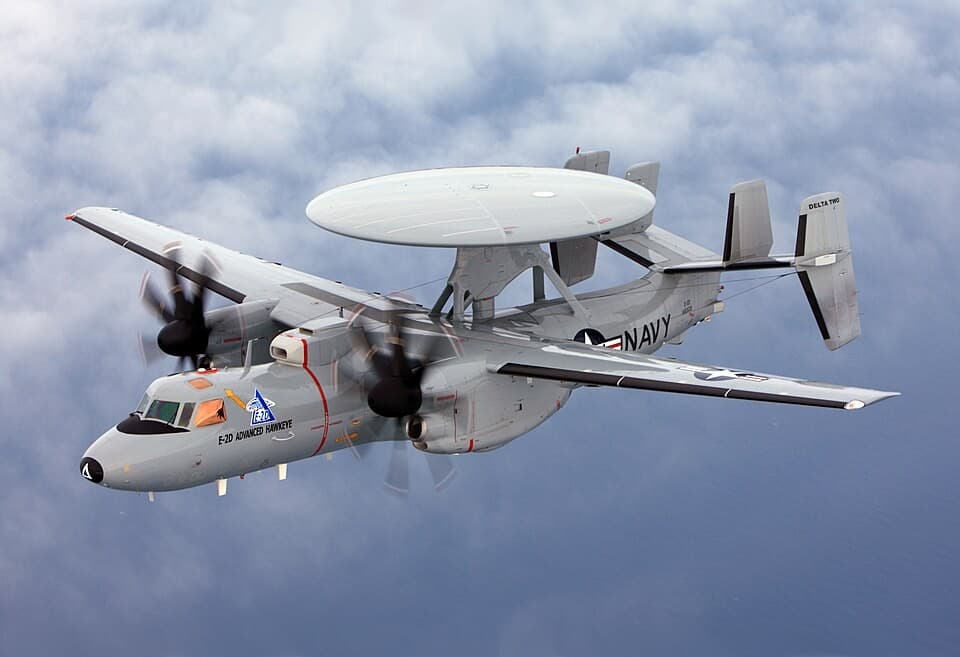
The E-2D provides airborne surveillance and battle management from aircraft carriers. Its rotating radar dome and twin turboprops give it a distinctive compact silhouette.
 United States
091209-O-0000X-002 ST. AUGUSTINE, Fla. (Dec. 9, 2009) E-2D Advanced Hawkeye aircraft conduct a test flight near St. Augustine, Fla. Historical equipment reference photograph. It does not establish current availability or every detail of the named variant.
US Navy · Public domain · Wikimedia Commons · Public domain · Source ↗ · ModifiedTechnical data
Airborne early warning and control
United States
Grumman Northrop Grumman
In service
United States Navy See § Operators
313 (total); 88 (E-2D)
1960–present
January 1964
21 October 1960
Grumman C-2 Greyhound
5: pilot, copilot, radar officer (RO), combat information center officer (CICO), aircraft control officer (ACO)
57 ft 8 + 3 ⁄ 4 in (17.596 m)
80 ft 7 in (24.56 m)
18 ft 3 + 3 ⁄ 4 in (5.582 m) : Radome could retract by 2 feet (0.6 m) to fit into the 17 ft 6 in (5.33 m) clear height hangar of Essex and Midway class carriers. Retraction function no longer used.
700 sq ft (65 m 2 )
9.15
root: NACA 63A216 ; tip: NACA 63A414
40,200 lb (18,234 kg)
43,068 lb (19,535 kg)
57,500 lb (26,082 kg)
2 × Allison/Rolls-Royce T56-A-427 (E-2C), T56-A-427A (E-2D) turboprop, 5,100 shp (3,800 kW) each
350 kn (400 mph, 650 km/h)
256 kn (295 mph, 474 km/h)
1,462 nmi (1,682 mi, 2,708 km)
6 hours (8 hours land-based)
34,700 ft (10,600 m)
72.7 lb/sq ft (355 kg/m 2 )
0.19 hp/lb (0.31 kW/kg)
The Northrop Grumman E-2 Hawkeye is an American all-weather, carrier-capable , tactical airborne early warning (AEW) aircraft.
By 1997, the US Navy intended that all front-line squadrons would be equipped, for a total of 75 Group II aircraft. Grumman merged with Northrop in 1994 and plans began on the Group II Plus, also known as the Group II/NAV upgrade. This kept the same computer and radar as the Group II while upgrading the pilot avionics, such as replacing the mechanical inertial navigation system (INS) with a more reliable and accurate laser Ring Gyroscope-driven INS, installing dual multifunction control display units (vs. one in the Group II) and integrating GPS into the weapons system. A variant of the Group II with upgrades to the mission computer and combat information center (CIC) workstations is referred to as the MCU/ACIS; these were produced in small numbers due to production of the Hawkeye 2000 soon after its introduction. All Group II aircraft had their 1960s-vintage computer processors replaced by a mission computer with the same functionality via modern computer technology, referred to as the GrIIM RePr (Group II Mission Computer Replacement Program, pronounced "grim reaper").
In August 2013, Northrop Grumman was awarded a $617 million contract for five E-2Ds until full-rate production Lot 1. In June 2014, Northrop Grumman was awarded a $3.6 billion contract to supply 25 more E-2D, for a total contracted number of 50 aircraft. 13 E-2D models had been delivered by that time. In December 2016, an E-2D flew for the first time with an aerial refueling capability. This feature allows the aircraft to double its time on station to five hours and increase total mission time from four to seven hours. The refueling modification began with the 46th plane (out of 75 planned) for delivery in late 2020, costing an additional $2 million per aircraft. The Navy plans to retrofit the feature on all previous Hawkeyes for $6 million per plane.
The E-2 is a high-wing airplane, with one Allison T56 turboprop engine (5250 shp rating) on each wing and retractable tricycle landing gear . As with all CATOBAR carrier-borne airplanes, the E-2 is equipped with a tail hook for recovery (landing) and the nose gear can attach to a shuttle of the aircraft carrier's catapults for launch (takeoff). A distinguishing feature of the Hawkeye is its 24-foot (7.3 m) diameter rotating radar dome (rotodome) that is mounted above its fuselage and wings. This carries the E-2's primary antennas for its long-range radar and IFF systems. No other carrier-borne aircraft possesses one of these. Land-based aircraft with rotodomes include the Boeing E-3 Sentry , a larger AWACS airplane operated by the U.S. Air Force and NATO air forces in large numbers. The similarly placed stationary radome of the E-2's piston-engined predecessor, the E-1 Tracer , also mandated the E-2's adoption of a modern version of the Grumman Sto-Wing folding wing system, preventing the folded wing panels from making contact with the E-2's rotodome.
The E-2 Hawkeye is a crucial component of all U.S. Navy carrier air wings ; each carrier is equipped with four Hawkeyes (five in some situations), allowing for continuous 24-hour-a-day operation of at least one E-2 and for one or two to undergo maintenance in the aircraft carrier's hangar deck at all times. Until 2005, the US Navy Hawkeyes were organized into East and West Coast wings, supporting the respective fleets. However, the East coast wing was disestablished, all aircraft were organized into a single wing based at Point Mugu, California. Six E-2C aircraft were deployed by the U.S. Navy Reserve for drug interdiction and homeland security operations until 9 March 2013, when the sole Reserve squadron, VAW-77 "Nightwolves", was decommissioned and its six aircraft sent to other squadrons.
Hawkeye 2000s first deployed in 2003 aboard USS Nimitz with VAW-117, the "Wallbangers" (formerly the "Nighthawks") and CVW-11. U.S. Navy E-2C Hawkeyes have been upgraded with eight-bladed propellers as part of the NP2000 program; the first squadron to cruise with the new propellers was VAW-124 "Bear Aces". The Hawkeye 2000 version can track over 2,000 targets simultaneously while also detecting 20,000 targets to a range greater than 400 mi (640 km) and simultaneously guide 40–100 air-to-air intercepts or air-to-surface engagements.
In 2025, several E-2D Hawkeyes from the USS Gerald Ford were deployed north of Curacao and Aruba in the Caribbean flying at 22,000 ft on 12 to 13 December 2025.
Length: 57 ft 8 + 3 ⁄ 4 in (17.596 m)
Wingspan: 80 ft 7 in (24.56 m)
Height: 18 ft 3 + 3 ⁄ 4 in (5.582 m) : Radome could retract by 2 feet (0.6 m) to fit into the 17 ft 6 in (5.33 m) clear height hangar of Essex and Midway class carriers. Retraction function no longer used.
Wing area: 700 sq ft (65 m 2 )
Empty weight: 40,200 lb (18,234 kg)
Gross weight: 43,068 lb (19,535 kg)
Max takeoff weight: 57,500 lb (26,082 kg)
Powerplant: 2 × Allison/Rolls-Royce T56-A-427 (E-2C), T56-A-427A (E-2D) turboprop, 5,100 shp (3,800 kW) each
Maximum speed: 350 kn (400 mph, 650 km/h)
Cruise speed: 256 kn (295 mph, 474 km/h)
Ferry range: 1,462 nmi (1,682 mi, 2,708 km)
Endurance: 6 hours (8 hours land-based)
Service ceiling: 34,700 ft (10,600 m)
Reference text from Wikipedia contributors, used under CC BY-SA 4.0.
The system in detail
A high wing, four-fin tail and folding wings support shipboard operation. Catapult launch and arrested recovery distinguish the Hawkeye from larger runway-based early-warning aircraft.1
An open-architecture mission system supports the crew of two pilots and three operators. Refuelling-equipped aircraft can extend persistence, but crew and aircraft limits still apply.1
NAVAIR records initial operational capability in October 2014. This profile covers E-2D rather than merging equipment from the older E-2C.1
The source labels one linear dimension as wing area, so that field needs clarification before numeric approval. Carrier compatibility and mission persistence belong alongside radar specifications.1
E-2D Advanced Hawkeye equipment records. Variants, orders and quantities are shown as reported in each inventory source; coverage is incomplete.
 Egypt
EgyptAir Force exact named equipment holdings: E-2C Hawkeye. Active, operational-reserve and training units excluding equipment in store; November 2025 IISS assessment. Named service only; no parent-force or national total inferred. Source role: AIRCRAFT / AEW&C. Original estimates, ranges, reporting names, reserve, lease and employment scopes retained; nested included counts are not added. Missile-system quantities mean launchers, not rounds. No readiness, crew, carried weapon, payload, factory-production or future order count inherited.
 France
Naval Aviation exact named equipment holdings: E-2C Hawkeye. Active, operational-reserve and training units excluding equipment in store; November 2025 IISS assessment. Named service only; no parent-force or national total inferred. Source role: AIRCRAFT / AEW&C. Original estimates, ranges, reporting names, reserve, lease and employment scopes retained; nested included counts are not added. Missile-system quantities mean launchers, not rounds. No readiness, crew, carried weapon, payload, factory-production or future order count inherited.
 Japan
JapanReported count for E-2 Hawkeye · E-2C/D. Service scope: Japan Air Self-Defense Force; does not replace a national total. 1 distinct count cell(s) from the same source list; shared rowspan cells counted once. Excludes retired/reserve/on-order rows. Count column(s): in service: 20. Origin: United States. The listed variants/roles are the scope, not an immediately deployable count. Dates are the count-cell citations' stated source period (2026), not the article revision. 2026 cited source edition. Edition or publication years do not claim an exact inventory census day.
 Taiwan
Air Force exact named equipment holdings: E-2T Hawkeye. Active, operational-reserve and training units excluding equipment in store; November 2025 IISS assessment. Named service only; no parent-force or national total inferred. Source role: AIRCRAFT / AEW&C. Original estimates, ranges, reporting names, reserve, lease and employment scopes retained; nested included counts are not added. Missile-system quantities mean launchers, not rounds. No readiness, crew, carried weapon, payload, factory-production or future order count inherited.
United StatesNaval Aviation exact named equipment holdings: E-2C Hawkeye; E-2D Hawkeye. Active, operational-reserve and training units excluding equipment in store; November 2025 IISS assessment. Named service only; no parent-force or national total inferred. Source role: AIRCRAFT / AEW&C. Original estimates, ranges, reporting names, reserve, lease and employment scopes retained; nested included counts are not added. Missile-system quantities mean launchers, not rounds. No readiness, crew, carried weapon, payload, factory-production or future order count inherited.
Reported count for Grumman E-2 Hawkeye · E-2D. Service scope: Navy; does not replace a national total. 1 distinct quantity component(s) from the same source list; shared rowspan cells counted once. Explicit source inventory scope: ordered; no other stock status or total inferred. Count column(s): in service: +3. Origin: United States. The listed variants/roles are the scope, not an immediately deployable count. The components do not establish one inventory census date; the stored date is the retrieved source snapshot.