FORCETALLY
Loading the evidence…
Preparing your view.


Preparing your view.
Combat aircraftIn service
Attack aircraft , fighter , aggressor aircraft
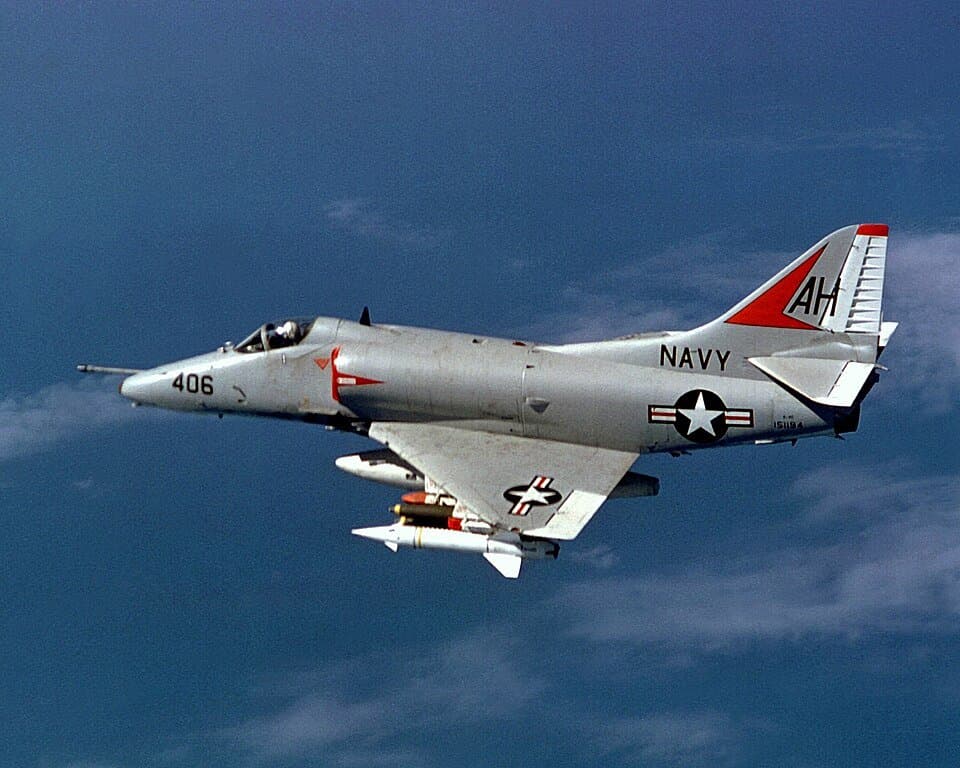
Douglas A-4 Skyhawk is a attack aircraft , fighter , aggressor aircraft originating in United States. It was built by Douglas Aircraft Company McDonnell Douglas. Reported operators include United States Navy (historical) United States Marine Corps (historical) Israeli Air Force (historical).
 United States
Douglas A-4 Skyhawk
Lt.JG Nelson, U.S. Navy · Public domain · Resized · Public domain · Source ↗ · ModifiedTechnical data
Attack aircraft , fighter , aggressor aircraft
United States
Douglas Aircraft Company McDonnell Douglas
In service with the Brazilian Navy
United States Navy (historical) United States Marine Corps (historical) Israeli Air Force (historical)
2,960
1954–1979
1 October 1956 ( 1956-10-01 )
22 June 1954 ( 1954-06-22 )
USMC (1998), U.S. Navy (2003) Israeli Air Force (2015) Royal New Zealand Air Force (2001)
Lockheed Martin A-4AR Fightinghawk McDonnell Douglas A-4G Skyhawk ST Aerospace A-4SU Super Skyhawk
1
40 ft 1.5 in (12.230 m)
True scale
Sourced dimensions beside a 1.75 m human reference.
See it in your room. Scan with your phone to open this model in 3D, then place it in your space.
Points represent sourced observations, including revisions. Revisions on the same effective date are not separate inventory events. Ranges appear in the table and are not plotted as exact points.
| Observation / report period | Value | Source | Claim state |
|---|---|---|---|
| 28 Sept 2026 | 1 people | Wikipedia contributors | superseded |
| 28 Sept 2026 | 1 people | Wikipedia contributors | superseded |
| 28 Sept 2026 | 1 people | Wikipedia contributors | superseded |
| 28 Sept 2026 | 1 people | Wikipedia contributors | superseded |
| 28 Sept 2026 | 1 people | Wikipedia contributors | superseded |
| 28 Sept 2026 | 1 people | Wikipedia contributors | superseded |
| 28 Sept 2026 | 1 people | Wikipedia contributors | approved |
27 ft 6 in (8.38 m)
15 ft 2 in (4.62 m)
260 sq ft (24 m 2 )
9,853 lb (4,469 kg)
16,216 lb (7,355 kg)
24,500 lb (11,113 kg)
1 × Pratt & Whitney J52-P-6A turbojet engine, 8,500 lbf (38 kN) thrust
585 kn (673 mph, 1,083 km/h) at sea level
1,008 nmi (1,160 mi, 1,867 km)
2,194 nmi (2,525 mi, 4,063 km)
5,750 ft/min (29.2 m/s)
2× 20 mm (0.79 in) Colt Mk 12 cannon , 100 rounds/gun
4× under-wing & 1× under-fuselage pylon stations with a capacity of 8,500 lb (3,900 kg), with provisions to carry combinations of: Rockets: 4× LAU-10 rocket pods (each with 4× 127 mm Mk 32 Zuni rockets ) Bombs: 6× Rockeye-II Mark 20 Cluster Bomb Unit (CBU) 6× Rockeye Mark 7/APAM-59 CBU Mark 80 series of unguided bombs (including 3 kg and 14 kg practice bombs) B43 nuclear bomb B57 nuclear bomb B61 nuclear bomb Other: up to 3× 370 US gallons (1,400 L ) Sargent Fletcher drop tanks for ferry flight/extended range/loitering time
root: NACA 0008-1.1-25 ; tip: NACA 0005-.825-50
+8 -3
62.4 lb/sq ft (305 kg/m 2 )
0.526 (at gross weight)
4× LAU-10 rocket pods (each with 4× 127 mm Mk 32 Zuni rockets )
6× Rockeye-II Mark 20 Cluster Bomb Unit (CBU) 6× Rockeye Mark 7/APAM-59 CBU Mark 80 series of unguided bombs (including 3 kg and 14 kg practice bombs) B43 nuclear bomb B57 nuclear bomb B61 nuclear bomb
up to 3× 370 US gallons (1,400 L ) Sargent Fletcher drop tanks for ferry flight/extended range/loitering time
Air-to-air missiles : 4× AIM-9 Sidewinder Air-to-surface missiles : 2× AGM-12 Bullpup 2× AGM-45 Shrike anti-radiation missile 2× AGM-62 Walleye TV-guided glide bomb 2× AGM-65 Maverick
The Douglas A-4 Skyhawk is a single-seat, subsonic , carrier-capable , light attack aircraft designed and produced by American aerospace manufacturer Douglas Aircraft Company , later built by McDonnell Douglas .
The Skyhawk was developed during the early 1950s on behalf of the Navy and United States Marine Corps as a replacement for the propeller-driven Douglas A-1 (AD) Skyraider . The A-4 is a compact, straightforward, and lightweight aircraft for the era; its maximum takeoff weight of 24,500 pounds (11,100 kg) was roughly half of the Navy's weight specification. The Skyhawk has a short-span, delta wing configuration and tricycle undercarriage , and is powered by a single turbojet engine. The U.S. Navy issued a contract for the aircraft on 12 June 1952. On 22 June 1954, the XA4D-1 prototype performed its maiden flight ; it went on to set a world speed record of 695.163 mph on 15 October 1955. On 1 October 1956, the Skyhawk was introduced to operational service.
The Skyhawk was designed by Douglas Aircraft's Ed Heinemann in response to a U.S. Navy (USN) call for a jet-powered attack aircraft to replace the piston engined Douglas AD Skyraider (later redesignated A-1 Skyraider). Heinemann opted for a design that would minimize its size, weight, and complexity. The result was an aircraft that weighed only half of the Navy's weight specification. It had a wing so compact that it did not need to be folded for carrier stowage. The first 500 production examples cost an average of $860,000 (equivalent to about $10,310,000 in 2025) each, less than the Navy's $1 million maximum. The diminutive Skyhawk soon received the nicknames "Scooter", "Kiddiecar", "Bantam Bomber", "Tinker Toy Bomber", and, on account of its speed and nimble performance, "Heinemann's Hot-Rod". The XA4D-1 prototype set a world speed record of 695.163 mph on 15 October 1955.
The aircraft is of conventional post-World War II design, with a low-mounted delta wing , tricycle undercarriage , and a single turbojet engine in the rear fuselage, with two air intakes on the fuselage sides. The tail is of cruciform design , with the horizontal stabilizer mounted above the fuselage. Armament consisted of two 20 mm (.79 in caliber) Colt Mark 12 cannons , one in each wing root, with 100 rounds per gun (the A-4M Skyhawk II and types based on the A-4M have 200 rounds per gun), plus a large variety of bombs, rockets, and missiles carried on a hardpoint under the fuselage centerline and hardpoints under each wing (originally one per wing, later two).
The short-span delta wing did not require the complexity of wingtip folding, saving an estimated 200 pounds (91 kg). Its spars were machined from a single forging that spanned across both wingtips. The leading edge slats were designed to drop automatically at the appropriate speed by gravity and air pressure, saving weight and space by omitting actuation motors and switches. Similarly, the main undercarriage did not penetrate the main wing spar, designed so that when retracted, only the wheel itself was inside the wing and the undercarriage struts were housed in a fairing below the wing. Thus, the wing structure was lighter with the same overall strength. The rudder was constructed of a single panel reinforced with external ribs.
The Skyhawk remained in production until 1979, with 2,960 aircraft built, including 555 two-seat trainers . The last production A-4, an A-4M of Marine squadron VMA-331 , had the flags of all nations that operated the A-4 painted on its fuselage sides.
The USN operated the A-4 in both Regular Navy and Naval Reserve light-attack squadrons (VA). Although the A-4's use as a training and adversary aircraft continued well into the 1990s, the USN began removing the aircraft from its frontline attack squadrons in 1967, with the last ones (Super Foxes of VA-55/212/164) being retired in 1976.
The Marine Corps would not take the USN's replacement, the LTV A-7 Corsair II , instead keeping Skyhawks in service with both Regular Marine Corps and Marine Corps Reserve attack squadrons (VMA) and ordering the new A-4M model. The last USMC Skyhawk was delivered in 1979, and they were used until the mid-1980s before they were replaced by the equally small, but more versatile and expensive STOVL AV-8 Harrier II .
VMA-131 , Marine Aircraft Group 49 (the Diamondbacks) retired its last four OA-4Ms on 22 June 1994. VMA-124, Marine Air Group 42 also retired the last of their A-4s in mid 1994. Trainer versions of the Skyhawk remained in USN service, however, finding a new lease on life with the advent of "adversary training", where the nimble A-4 was used as a stand-in for the Mikoyan-Gurevich MiG-17 in dissimilar air combat training (DACT). It served in that role at TOPGUN until 1999.
Lightweight and safer to land on smaller decks, Skyhawks later also played a similar role flying from Australian, Argentinean, and Brazilian upgraded World War II-surplus light ASW carriers, which were unable to operate most large, modern fighters. Primary air-to-air missile (AAM) armament consisted of the internal 20 mm (.79 in) Colt cannons and ability to carry an AIM-9 Sidewinder missile on both underwing hardpoints, later additions of two more underwing hardpoints on some aircraft made for a total capacity of four AAMs.
With renewed emphasis on air combat maneuvering (ACM) training brought on with the establishment of the Navy Fighter Weapons School ( TOPGUN ) in 1969, the availability of Skyhawks in both the Instrument RAGs and composite squadrons at the master jet bases presented a ready resource of the nimble Skyhawks that had become the TOPGUN preferred surrogate for the MiG-17. At the time, the F-4 Phantom had not performed as well as expected against the smaller North Vietnamese MiG-17 and MiG-21 opponents. TOPGUN introduced the notion of dissimilar air combat training (DACT) using modified A-4E/Fs. Modified aircraft, called "Mongoose", lost the dorsal hump, the 20 mm cannon with their ammo systems, and the external stores, although sometimes the centerline station was kept. The slats were fixed.
The surplus of former USMC Skyhawks resulted in A-4M versions being used by both VF-126 and TOPGUN. Though the A-4 was augmented by the F-5E , F-21 (Kfir) , F-16 , and F/A-18 in the adversary role, the A-4 remained a viable threat surrogate until it was retired by VF-43 in 1993 and shortly thereafter by VFC-12. The last A-4 fleet operators were VC-8, which retired its Skyhawks in 2003.
The A-4M was also operated by the Operations Maintenance Detachment in an adversary role based at NAS Dallas , Texas, for the Naval Air Reserve. Many of the aviators that flew the four jets were attached to NAS Dallas, including the Commanding Officer of the air station. The aircraft were instrumental in training and development of ACM for Naval Air Reserve fighter squadrons VF-201 and VF-202 flying the F-4 Phantom II and later the Grumman F-14 Tomcat . The unit also completed several missions involving target towing to NAS Key West, Florida; NAS Kingsville , Texas, and deployments to NAS Miramar, California and NAS Fallon, Nevada for adversary support. The detachment was under the operational command of the Commander Fleet Logistics Support Wing (CFLSW), also based at NAS Dallas.
In the late 1960s and 1970s, IAF Skyhawks were the primary ground-attack aircraft in the War of Attrition and the Yom Kippur War . During July 1969, in response to Egyptian shelling of Israeli positions in the Sinai Peninsula , air strikes were conducted against Egyptian missile sites. On 6 February 1970, Skyhawks attacked the Egyptian port of Gardaka , sinking a minelayer as a result. Furthermore, skirmishes between IAF Skyhawks and Arab aircraft of various sorts frequently occurred. In May 1970, an IAF Skyhawk piloted by Col. Ezra Dotan shot down two MiG-17s over south Lebanon (one with unguided rockets, the other with 30 mm cannon fire) even though the Skyhawk's head-up display had no "air-to-air mode". However, up to three Skyhawks were downed by Egyptian MiG-21s, plus two were downed by Soviet-piloted MiG-21s during the War of Attrition.
A special version of the A-4 was developed for the IAF, the A-4H. This variant, an evolution of the A-4E, featured improved avionics and a new J52-P-8A engine. In place of the Colt Mk.12 20 mm cannons, it was integrally armed with twin DEFA 30 mm cannons manufactured in Israel. Later modifications included an avionics hump and an extended tailpipe, the latter which gave greater protection against heat-seeking surface-to-air missiles. A total of 90 A-4Hs were delivered. In early 1973, the improved A-4N Skyhawk for Israel entered service, based on the A-4M models used by the USMC. Both models of Skyhawks carried out bombing missions in the Yom Kippur War and a considerable proportion of the tactical sorties. They also participated in Operation Peace for the Galilee, with one unit shooting down a Syrian MiG-17.
Argentina was the first foreign user of the Skyhawk and had nearly 130 A-4s delivered since 1965. The Argentine Air Force received 25 A-4Bs in 1966 and another 25 in 1970, all refurbished in the United States by Lockheed Service Co. prior to their delivery as A-4P, although they were still locally known as A-4B. They had three weapons pylons and served in the 5th Air Brigade (Spanish: V Brigada Aérea ). During 1976, 25 A-4Cs were ordered to replace the North American F-86 Sabres still in service in the 4th Air Brigade (Spanish: IV Brigada Aérea ). They were received as is and refurbished to flight status by Air Force technicians at Río Cuarto , Córdoba. The C model had five weapons pylons and could use AIM-9B Sidewinder AAMs.
The Argentine Naval Aviation also bought the Skyhawk known as A-4Q in the form of 16 A-4Bs in 1972, which unlike the Air Force's A-4Ps, were powered by 8,400 lbf (40 kN) J-65-W-20 engines and fitted to use Sidewinder AAMs. They were received in 1972 to be used mainly from the aircraft carrier ARA Veinticinco de Mayo by the 3rd Fighter/Attack Squadron (Spanish: 3ra Escuadrilla Aeronaval de Caza y Ataque ). The first combat use of Argentina's Skyhawks took place amid a military revolt during December 1975, performing a single strike against rebels in Buenos Aires .
After the war, Argentine Air Force A-4Ps and A-4Cs survivors were upgraded under the Halcón (Spanish for "falcon") program with 30 mm (1.2 in) DEFA cannons , AAMs, and other minor details, and merged into the 5th Air Brigade. All of these were withdrawn from service in 1999, and they were replaced with 36 of the much-improved Lockheed Martin OA/A-4AR Fightinghawk (rebuilt and modernised ex USMC A-4M). Several TA-4J and A-4E airframes were also delivered under the A-4AR program, mainly for spare parts use. The A-4AR was in service between the late 1990s and 2016 when the majority of the fleet was grounded for serviceability and age. A small number of airframes remained in service for limited roles. Three aircraft were lost to accidents.
Twenty A-4G Skyhawks were purchased by the Royal Australian Navy for operation from HMAS Melbourne . The aircraft were acquired in two batches of 10, in 1967 and 1971, and were primarily used to provide air defence for the fleet. Ten of the A-4Gs were destroyed in accidents, and all the survivors were sold to the Royal New Zealand Air Force in 1984.
During 2001, the three Air Combat Force squadrons (Nos. 2, 14, and 75) were disbanded and the Skyhawks were put into storage awaiting sale. They were maintained, with occasional servicing flights, and then moved to RNZAF Base Woodbourne , where they were preserved in protective latex. Draken International signed an agreement with the New Zealand government in 2012 to purchase eight A-4Ks and associated equipment for its adversary training services. Six were former RAN A-4G airframes which as carrier aircraft had logged significantly fewer flying hours. These were subsequently relocated to the U.S. at Draken's Lakeland Linder International Airport facility in Lakeland, Florida . The other A-4K aircraft were given to museums in New Zealand and Australia.
A flight of four A-4 Skyhawks was deployed to East Timor for counter-insurgency operations in a six-month combat tour in 1985–1986. During the deployment, they were based at Baucau Airport . The Skyhawks were mostly armed with 500 lb (230 kg) Mark 82 bombs . On 2 November 1987, the Indonesian Air Force launched a long-range strike mission against targets in East Timor using the Skyhawks. A flight of five A-4s, each armed with six 500 lbs Mark 82 bombs, two LAU-68 rocket pods, and two external fuel tanks, departed Iswahjudi Air Force Base in East Java for two-and-a-half-hour flight to East Timor. The flight was supported by a KC-130B Hercules for aerial refueling. The five A-4s attacked 30 designated targets in the Eastern Sector near Baucau , and then landed at Baucau Airport.
Night/adverse weather version of A4D-2, with AN/APG-53A radar , autopilot , LABS low-altitude bombing system. Wright J65 -W-20 engine with 8,200 lbf (36 kN ) of takeoff thrust; redesignated A-4C in 1962, 638 built.
Major upgrade, including new Pratt & Whitney J52-P-6A engine with 8,500 lbf (38 kN) of thrust, strengthened airframe with two more weapon pylons (for a total of five), improved avionics, with TACAN , Doppler navigation radar , radar altimeter, toss-bombing computer, and AJB-3A low-altitude bombing system. Many later upgraded with J52-P-8 engine with 9,300 lbf (41 kN) thrust; redesignated A-4E in 1962, 499 built.
Refinement of the A-4E with extra avionics housed in a hump on the fuselage spine (this feature later retrofitted to A-4Es and some A-4Cs), wing-top spoilers to reduce landing roll out, nose wheel steering, and a more powerful J52-P-8A engine with 9,300 lbf (41 kN) of thrust, later upgraded in service to the J52-P-408 with 11,200 lbf (50 kN), 147 built. Some served with the Blue Angels acrobatic team from 1973 to 1986.
A-4H
90 aircraft for the Israeli Air Force based on the A-4F. Used 30 mm (1.18 in) DEFA cannon with 150 rpg in place of U.S. 20 mm (.79 in) guns. Later, some A-4Es later locally modified to this standard. Subsequently, modified with extended jetpipes as protection against heat-seeking missiles.
A-4M Skyhawk II
Dedicated Marine version with improved avionics and more powerful J52-P-408 engine with 11,200 lbf (50 kN) thrust, enlarged cockpit, IFF system. Later fitted with Hughes AN/ASB-19 Angle Rate Bombing System (ARBS) with TV and laser spot tracker, 158 built.
TA-4G
two trainer versions of the A-4G built new, and two more modified from TA-4Fs.
TA-4H
25 trainer versions of the A-4H for Israel. Upgraded with more modern avionics.
OA-4M
40 A-4Cs and A-4Ls refurbished for Royal Malaysian Air Force , incorporating many A-4M features ( PTM stands for Peculiar to Malaysia ).
Seven trainer versions of the above. Different from most TA-4 trainers with a common cockpit for the student and instructor pilot, these were essentially rebuilt with a 28 in (710 mm) fuselage plug inserted into the front fuselage and a separate bulged cockpit (giving better all-round visibility) for the instructor seated behind the student pilot.
Length: 40 ft 1.5 in (12.230 m)
Wingspan: 27 ft 6 in (8.38 m)
Height: 15 ft 2 in (4.62 m)
Wing area: 260 sq ft (24 m 2 )
Empty weight: 9,853 lb (4,469 kg)
Gross weight: 16,216 lb (7,355 kg)
Max takeoff weight: 24,500 lb (11,113 kg)
Powerplant: 1 × Pratt & Whitney J52-P-6A turbojet engine, 8,500 lbf (38 kN) thrust
Maximum speed: 585 kn (673 mph, 1,083 km/h) at sea level
Range: 1,008 nmi (1,160 mi, 1,867 km)
Ferry range: 2,194 nmi (2,525 mi, 4,063 km)
Rate of climb: 5,750 ft/min (29.2 m/s)
Guns: 2× 20 mm (0.79 in) Colt Mk 12 cannon , 100 rounds/gun
Hardpoints: 4× under-wing & 1× under-fuselage pylon stations with a capacity of 8,500 lb (3,900 kg), with provisions to carry combinations of: Rockets: 4× LAU-10 rocket pods (each with 4× 127 mm Mk 32 Zuni rockets ) Bombs: 6× Rockeye-II Mark 20 Cluster Bomb Unit (CBU) 6× Rockeye Mark 7/APAM-59 CBU Mark 80 series of unguided bombs (including 3 kg and 14 kg practice bombs) B43 nuclear bomb B57 nuclear bomb B61 nuclear bomb Other: up to 3× 370 US gallons (1,400 L ) Sargent Fletcher drop tanks for ferry flight/extended range/loitering time
The A-4 is a compact, straightforward, and lightweight aircraft for the era; its maximum takeoff weight of 24,500 pounds (11,100 kg) was roughly half of the Navy's weight specification.
First Flight (XA4D-1) 22 June 1954 (A-4A) 14 August 1954
CREW: one: pilot
Length 41.71 ft (12.72 m)
Wingspan 27.50 ft (8.38 m)
Height 14.98 ft (4.57 m)
Powerplant (A-4F) one Pratt & Whitney J52-8A turbojet (A-4M) one Pratt & Whitney J52-408 turbojet (A-4S-1) one General Electric F404-100D turbofan
Thrust (A-4F) 9,300 lb (41.37 kN) (A-4M) 11,200 lb (49.82 kN) (A-4S-1) 10,800 lb (48.04 kN)
Service Ceiling 40,000 ft (12,190 m)
Range typical: 800 nm (1,480 km) ferry: 1,790 nm (3,310 km)
CREW: one: pilot
PROPULSION: Powerplant (A-4F) one Pratt & Whitney J52-8A turbojet (A-4M) one Pratt & Whitney J52-408 turbojet (A-4S-1) one General Electric F404-100D turbofan Thrust (A-4F) 9,300 lb (41.37 kN) (A-4M) 11,200 lb (49.82 kN) (A-4S-1) 10,800 lb (48.04 kN)
Reference text from Wikipedia contributors, used under CC BY-SA 4.0.
Douglas A-4 Skyhawk equipment records. Variants, orders and quantities are shown as reported in each inventory source; coverage is incomplete.
 Argentina
Air Operations Command exact named equipment holdings: A-4 (A-4AR) Skyhawk (of which 6†). Active, operational-reserve and training units excluding equipment in store; November 2025 IISS assessment. Named service only; no parent-force or national total inferred. Source role: AIRCRAFT / ATK. Original estimates, ranges, reporting names, reserve, lease and employment scopes retained; nested included counts are not added. Missile-system quantities mean launchers, not rounds. No readiness, crew, carried weapon, payload, factory-production or future order count inherited.
 Brazil
ian Navy active-fleet directory holdings of A-4KU. Count column(s): active: 3. Origin: unstated. Exact sum of the retained Active column for this named family only. Excludes storage, orders and the separately listed aircraft roles; not a readiness measure.
United States Navy (historical) United States Marine Corps (historical) Israeli Air Force (historical)
Equipment reference ↗Keep exploring
Attack aircraft Fighter-bomber
 FranceCompare with Douglas A-4 Skyhawk
Fighter aircraft
 United KingdomCompare with Douglas A-4 Skyhawk
Fighter aircraft
Compare with Douglas A-4 SkyhawkFighter aircraft
Compare with Douglas A-4 SkyhawkFighter aircraft
Compare with Douglas A-4 SkyhawkFighter aircraft
Compare with Douglas A-4 Skyhawk