FORCETALLY
Loading the evidence…
Preparing your view.


Preparing your view.
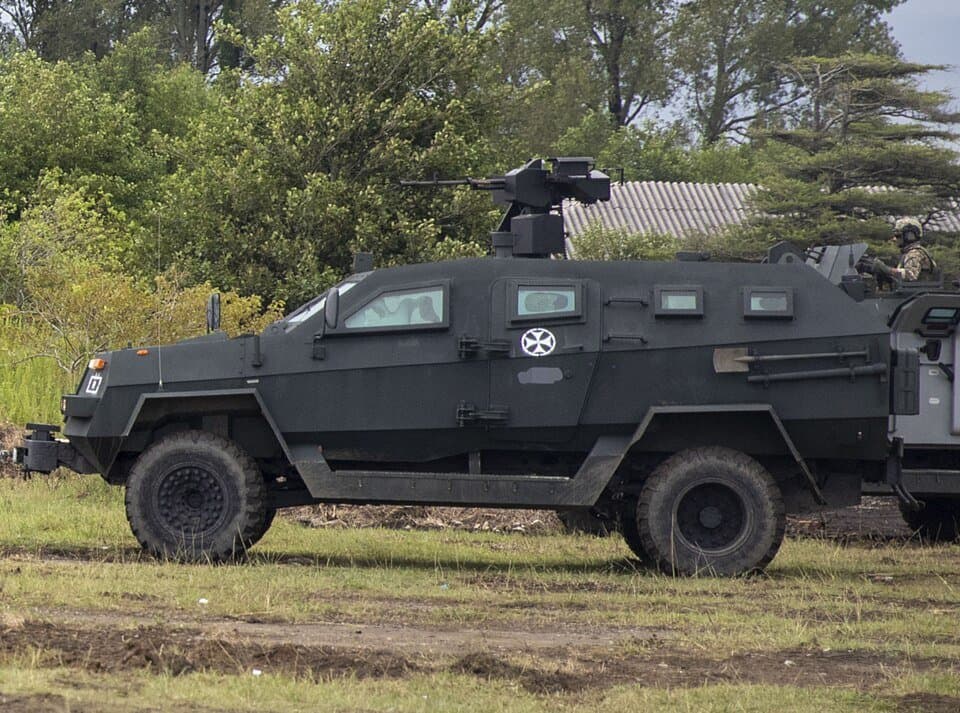
Armoured vehiclesIn service
Armoured Reconnaissance and Transport vehicle
Didgori-2 is an armoured reconnaissance and transport vehicle originating in Georgia. It was built by Scientific Technical Center Delta.
 Georgia
Technical data
Armoured Reconnaissance and Transport vehicle
Georgia
2011–present
Operators
Yemeni civil war (2014–present)
Scientific Technical Center Delta
Scientific Technical Center Delta
first batch in 2011 included 15 vehicles
8059 kg (combat weight 8855 kg)
3(2)+6(7)
7.62×51 mm M134 Minigun or 12.7×108 mm NSV machine gun Optional: RCWS with twinned 12.7 mm and secondary 7.62 mm machineguns
twin turbocharged V8 engine 351 hp
wheeled 4×4
True scale
Sourced dimensions beside a 1.75 m human reference.
Points represent sourced observations, including revisions. Revisions on the same effective date are not separate inventory events. Ranges appear in the table and are not plotted as exact points.
| Observation / report period | Value | Source | Claim state |
|---|---|---|---|
| 1 Nov 2026 | 2.18 m | www.armyrecognition.com | approved |
500 km
120 km/h maximum speed on paved roads 80 km/h off-road 50 km/h with damaged tires
Georgia - 40 Didgoris were acquired by the Georgian Defense Forces in 2020.
Saudi Arabia - Up to 100 Didgoris are in service of the Saudi Arabian Army . The AMEV modification took part in an extensive two year-long Saudi Arabia tender, eliminating eight foreign competitors and their counterparts in the process - including US and Poland. As a result, a US$40 million contract was signed in 2015 for more than 100 vehicles of various configurations. The first batch - 12 vehicles, exclusively for medevac purposes, has been delivered in January 2016. Three Didgoris were lost in the Yemen conflict since 2016.
Indonesia - An undisclosed number of the AMEV BISON variant were delivered to the Indonesian Mobile Brigade Corps in 2019 and 2020.
Democratic Republic of Congo : In 2015, the Democratic Republic of Congo placed an order for 12 Didgori armored vehicles from Georgia, manufactured by the State Military Scientific-Technical Center “Delta”. However, the deal was not finalized. Officials from the Ministry of Defence of Georgia later stated that the terms of the agreement were not satisfactory, leading to its cancellation.
The max. speed on paved roads is 120–140 km/h and reduced to 80 km/h on terrain. Acceleration from 0–100 km/h is achieved in 22 seconds. The cruising range at 60 km/h is 500 km. Each unit has at least one 20-litre fuel can in reserve. The vehicle can operate at temperatures ranging from -32 °C to +55 °C and remains unaffected by heavy meteorological conditions. The wheels consist of Hutchinson 12r20 mpt80 type tyres which have a run flat capability of 50 km at 50 km/h.
The Didgori has 400 mm ground clearance and is able to climb slopes at a 60% gradient and drive along a transverse slope of 40%. The vehicle base version is not amphibious – although such a variant is an option, but can move in up to 1 m deep water.
On 27 August 2014, Georgia participated with a MedEvac prototype in a tender for armoured personnel carriers hosted by the Ministry of Defence of Saudi Arabia. The tests were carried out mostly in the Arabian desert but also urban areas and included movement on different altitudes - mountains, various types of terrain and gradients, weather conditions, under extreme stress and maximum weight burden at top speed. The trials culminated in a 40 km simulated fully loaded evacuation at maximum speed.
The standard main armament consists of a M134 minigun mount, open turret drive shafts rotational unit - external or air flow. The firing rate can be adjusted from 300 to 6,000 rounds per minute. Total mount weight is 22.7 kg without the ammunition feed system. Primary ordnance is the 7.62×51mm NATO . Ammunition capacity can range from 1,500 (total weight 58 kg) to 4,500 (total weight 134 kg) rounds. Optionally the standard armament can be a 12.7×108 mm DShK or NSV machine gun .
The latest variants have DRWS-1 remote weapon stations equipped with twinned 12.7 mm machineguns and one 7.62 mm lmg attached. Alternatively grenade launchers, ATGMs and short range low-altitude air defence weapons can be fitted on the vehicle.
A 28 minute long combat footage from 2016 in Yemen demonstrated that a Didgori was capable of withstanding direct hits from rocket-propelled grenades and machine gun fire, which forced the ambushing Houthi fighters to get very close to the vehicle in order to destroy it. The Didgori reportedly remained operational after it was caught in a mine detonation. However its front suspension eventually broke off from the chassis when hurriedly trying to leave the battlefield on jumpy terrain, likely as a result of the sustained blast damage.
The crew seats are specially designed to disperse blasts. Didgoris are equipped with run-flat tires , enabling them to drive on with damaged tires a distance of 50 km at 50 km/h maximum speed. Additionally, a central tire inflation system can be installed to further increase their survivability. All four wheel flanges are ballistic.
Armament One 7.62mm or 12.7mm machine gun or 40 mm automatic grenade launcher.
Country users Georgia
Designer Country Georgia
Accessories Gun ports, radio mount, self-recovery winch, tools, fire extinguisher system, rear camera, thermal camera, night vision, NBC protection system and run flat tire system
Crew 2 + 5 soldiers
Armor Steel armour protection STANAG 4569 Level 3 a
Weight 8,007 kg empty - 8,611kg combat
Speed 120 km/h
Range 500 km a a a
Dimensions Length: 6.12 m; Width: 2.35 m; Height: 2.18 m
Length: 6.12 m; Width: 2.35 m; Height: 2.18 m
Length: 6.12 m; Width: 2.35 m; Height: 2.18 m
Length: 6.12 m; Width: 2.35 m; Height: 2.18 m
Reference text from Wikipedia contributors, used under CC BY-SA 4.0.
Didgori-2 equipment records. Variants, orders and quantities are shown as reported in each inventory source; coverage is incomplete.
Keep exploring
Armoured reconnaissance vehicle Fire support vehicle
 France
Armored reconnaissance vehicle
 Serbia
Armoured fighting vehicle Armoured reconnaissance vehicle
FranceReconnaissance armoured fighting vehicle
 United States
Amphibious armoured reconnaissance vehicle
 Poland
Wheeled reconnaissance vehicle , Armoured car
France Indonesia
 Saudi Arabia