FORCETALLY
Loading the evidence…
Preparing your view.


Preparing your view.
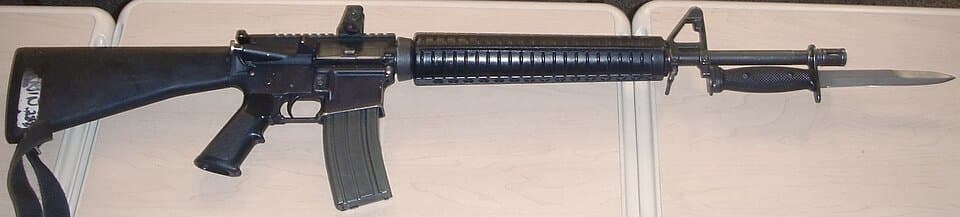
Small armsIn service
Assault rifle
Colt Canada C7 is a assault rifle originating in Canada. It was built by Diemaco (1982–2005) Colt Canada (2005–present). Reported operators include Botswana, Canada, Denmark, Iceland, Netherlands, Norway, Romania, Ukraine, United Kingdom.
 Canada
Colt Canada C7
Comm at English Wikipedia ( Original text: Comm ( talk ) ) · Public domain · Resized · Public domain · Source ↗ · ModifiedAssault rifle
Canada
1984–present
See Users
Rwandan Civil War Yugoslav Wars Somali Civil War Sierra Leone Civil War War in Afghanistan Iraq War Syrian civil war War in Iraq (2013–2017) Russian invasion of Ukraine
Diemaco (1982–2005) Colt Canada (2005–present)
1982–present
250,000+
3.3 kg (7.3 lb) (C7, unloaded) 2.68 kg (5.9 lb) (C8, unloaded)
1,006 mm (39.6 in) (C7/C7A1/C7A2 stock extended) 929.8 mm (36.61 in) (C7A2 stock collapsed)
508 mm (20.0 in)
5.56×45mm NATO
Gas-operated , closed rotating bolt , Stoner bolt and carrier piston
700–950 rounds/min
945 m/s (3,100 ft/s) (C7) 870 m/s (2,900 ft/s) (C8)
400 m (440 yd) (iron sights) 550 m (600 yd) (magnifying optical sight)
3,000 m (3,280 yd) (C7) 2,350 m (2,570 yd) (C8)
STANAG magazine
Iron sights C79 optical sight
Botswana : MRR15.7M and MRR11.6S Modular Rail Rifle used by the Botswana Defence Force .
Canada : Used by the Canadian Forces and law enforcement agencies including the Royal Canadian Mounted Police , Vancouver Police Department, Halifax Regional Police, Dryden Police, Halton ERT, the Ontario Provincial Police , Royal Newfoundland Constabulary , Sûreté du Québec , York Regional Police and Emergency Task Force (TPS) . It is also used by the Correctional Service of Canada .
Denmark The entirety of the Danish M/95 rifle family were developed on the C7/8 platform M/95 (C7), M/96 (C8), M/04 (LSW) and M/10 (C8IUR) In August 2025, contract signed to acquire C8 MMRs as the GV M/25.
Iceland : Used by the Iceland Crisis Response Unit
Netherlands : Used by the Military of the Netherlands .
Norway : In use with Forsvarets Spesialkommando ( Norwegian Army ) and Marinejegerkommandoen ( Royal Norwegian Navy ). Also in use with select agencies within the Norwegian Police , including Delta , the Royal Police Escort and the Norwegian Police Security Service .
Romania : In use with Detașamentul Special de Protecție și Intervenție
Ukraine : Significant quantity of C7A2 were seen in the hands of Ukrainian forces during the Russian invasion of Ukraine . Some C8s/C8 SFWs used by Ukrainian SOF under the SSO. The rifles are actively being used with the Ukrainian Ground Forces, primarily with the 3rd Separate Assault Brigade and 47th Mechanized Brigade, both now part of the 3rd Army Corps. Rifles were also observed with Azov National Guard Brigade, and the Unmanned Systems Forcesʼ 14th Regiment.
United Kingdom : C8SFW, C8IUR, and C8MRR Carbines are used by the British Army and SAS and are the standard-issues rifle of the Royal Marines under the designation of L119A1, L119A2 and L119A3. Supplemented in usage by the KS-1 since 2023 in the Royal Marines and Ranger Regiment.
Afghanistan : Donated weapons from Canada were previously used by the Afghan National Army , but the weapons were later returned to Canada in favour of American weapons.
The C8SFW is in service with the Norwegian Special Operations Forces as their standard rifle, as the more recently introduced HK416 does not feature a "heavy profile barrel" as the C8SFW.
Diemaco changed the trapdoor in the buttstock to allow easier access to a small storage compartment inside the stock, and a 13 mm (0.5 in) spacer is available to adjust stock length and length of pull to user preference. For the furniture Diemaco chose Fiberlite nylon-reinforced polymer suitable for CRBN decontamination and cold weather use at −68 °C (−90 °F). The carrying handle and rear sight assembly on top of the Diemaco C7 receiver features the most noticeable external difference between American M16A2s and C7s. Diemaco C7s use a modified pre-M16A2 style two aperture L-type flip rear and front post iron sight line featuring two combat settings. An approximately 0.070 in (1.8 mm) diameter aperture rear sight is used for normal firing situations for target distances up to 400 m (440 yd). A second larger approximately 0.200 in (5.1 mm) diameter aperture battle sight is used as a ghost ring for short range quick target engagement and during limited visibility.
The wing guards protected front sight was changed to a slimmer tapered round post of approximately 0.050 in (1.3 mm) diameter. C7 iron sights are normally zeroed with the normal use rear aperture sight at 300 m (330 yd) with SS109 / M855 /C77 ammunition. The rear sight can be zeroed for windage in 2.8 cm or 0.28 mrad increments at 100 m, when used with a 502 mm (19.8 in) rifle length sight radius. Elevation adjusting can be zeroed in 3.5 cm or 0.35 mrad increments at 100 m. Not so apparent is Diemaco's use of 1 in 178 mm (7 in) rifling twist hammer-forged chrome-lined barrel and chamber units with a slightly reducing bore diameter over the length of the rifling to increase longevity and accuracy.
These features were introduced as the Canadians originally wished to use a heavy barrel profile instead of the M16A2 profile. Diemaco developed a different mounting system from Colt for the Canadian M203 grenade launcher variant for the C7 rifle family and the bolt and bolt carrier were produced from stronger materials. Diemaco optimized the rifle for using 5.56×45mm NATO C77 cartridge L109 ball and the C78 cartridge longer L110 tracer projectiles by using a redesigned buffer assembly, thus making the extended feed ramps later introduced in the Colt M4 carbine unnecessary. The Canadian C7 was initially issued with Maple Leaf embossed Thermold polymer STANAG magazines . As the polymer failed in the Canadian weather and with age, the C7A1 was introduced with US-sourced aluminum STANAG magazines. The C7 has a cyclic rate of fire of around 700–900 rounds per minute (RPM).
The mount can use traditional iron sights or the ELCAN C79 Optical Sight 3.4×28 optical sight, both of which can be adjusted for individual eye relief. The optical sight was designed for the C9 light machine gun and includes horizontal and vertical mil-bars used for range determination and deflection, and a tritium glow-in-the-dark aiming post rather than the traditional crosshairs . The 3.4× is powerful enough to properly see targets at the maximum accurate range of 550 m (600 yd), though like most magnified optical sights it is prone to criticism for creating tunnel vision in close quarters situations.
Within an eight-man section, six soldiers will normally carry a C7A2: the section commander and second in command, two grenadiers and two riflemen, with only the machine gunners carrying a C9A2 LMG. The C7A2 is considered a "mid-life" upgrade for the C7 family. The addition of the TRIAD rail mount has made it easier for soldiers to attach accessories such as laser designator and tactical lights. Many A2s are also seen with folding grips from Cadex Inc. under the handguards which can store 2 CR123 batteries .
This variant will require the use of the Colt Canada M203A1 with a different mounting system due to the new aluminium quad-rail handguard. Since Colt Canada developed and released the MRR (Modular Rail Rifle) that uses a monolithic upper receiver with the Magpul M-LOK attachment system, the Canadian Armed Forces (CAF) might be heading in that direction instead, along with a shorter, 18.6-inch (470 mm) barrel, instead of the standard 20-inch (508 mm) barrel, and straight gas tube with a low-profile gas block The possibility of using integrated suppressors is also something that is being looked into. A shorter charging-handle latch will be used instead of the very long C7A2 latch, which gets caught on equipment and vests, causing the latch to bend and break the charging-handle.
The Colt Canada C8 carbine range are carbine variants of the C7 family, and are mechanically and visually very similar to the Colt Model 723 M16A2 carbine . Colt made the initial C8s for Canadian Forces as the Colt Model 725. The C8 has a 368 mm (14.5 in) A1 profile barrel like the Colt Model 653 M16A1 carbine, but with a 1 in 178 mm (7 in) rifling twist appropriate for adequately stabilizing the 5.56×45mm NATO C77 cartridge L109 ball and the C78 cartridge longer L110 tracer projectiles and the design improvements featured on C7 assault rifles. The C8 has a cyclic rate of fire of around 750–950 rounds per minute (RPM).
C8 iron sights are normally zeroed with the normal use rear aperture sight at 250 m (273 yd) with SS109 / M855 /C77 ammunition. The rear sight can be zeroed for windage in 3.8 cm or 0.38 mrad increments at 100 m, when used with a 367 mm (14.45 in) carbine length sight radius. Elevation can be zeroed in 4.7 cm or 0.47 mrad increments at 100 m. Once the iron sight line is zeroed, the front sight post and rear sight should not be moved.
The C8A1 (Diemaco C8FT) is essentially a C8 carbine with a C7A1 flat-top upper receiver; the carbine having a 368-millimetre (14.5 in) barrel versus the 508-millimetre (20.0 in) barrel typically seen on the C7.
The C8A2 carbine is very similar to the C8, but having a cold-hammer forged heavy 368-millimetre (14.5 in) barrel, as opposed to the 368 mm (14.5 in) pencil-profile barrel previously used and a flat-top upper receiver.
The Special Forces Weapon (SFW) features a longer, 410-millimetre (16.1 in) barrel of a significantly heavier profile than the C8A1 and a rail adapter system (RAS) handguard. The SFW operating system is more copiously gassed when compared to the standard C8A1 to enhance reliability in the presence of heavy fouling or icing at the expense of moving the bolt and bolt carrier faster and harder against the accordingly adapted buffer assembly, resulting in a free recoil increase. It is designed to provide a fire support capability in carbine form. A sleeve, called the Simon Sleeve, is slipped over the end of the barrel and is retained by the compensator and its crush washer. It is used to mount standard issued C7 Nella bayonet , CAN bayonet 2000/2005 and M203A1 grenade launcher.
The front sight base is strengthened for mounting of the Heckler & Koch AG-C/EGLM grenade launcher. The mass, muzzle velocity and effective range are stated as 3.4 kg (7.5 lb), 895 m/s (2,936 ft/s) and 550 m (601 yd). The C8SFW is in service with the Norwegian Special Operations Forces as their standard rifle, as the more recently introduced HK416 does not feature a "heavy profile barrel" as the C8SFW. The United Kingdom Special Forces (UKSF) adopted a C8SFW variant, under the designation "L119A1". In 2014, the UKSF upgraded to the "L119A2", which features a custom integrated upper receiver (IUR). The Royal Marines Commando have also begun to phase out the L85A2/L85A3 as their main rifle in favour of the L119.
The C8FTHB was quickly replaced by the C8A3, which features the same 400 mm (15.7 in) cold-hammer forged barrel and flat-top upper receiver as the C8FTHB as well as all the mid-life upgrades that appeared on the C7A2 such as the green furniture, ambidextrous charging-handle latch, magazine release and selector lever. It also includes the TRIAD I rail for the C8, which has one slot less than the C7 TRIAD I, to accommodate the M203A1 sight.
Two additional C8 variants exist. The C8CQB is similar to the American Mark 18 Mod 0 CQBR , having a 254-millimetre (10.0 in) or 295-millimetre (11.6 in) heavy barrel and a Vortex Flash Hider made by Smith Enterprise Inc. The smaller Personal Defense Weapon (PDW) variant has an overall length of 530 mm (20.7 in) with its stock fully retracted. It has a 145 mm (5.7 in) barrel and the receiver has been shortened by 42 mm (1.65 in).
Colt and Diemaco also paired up to develop a squad automatic weapon variant of the series. The Diemaco Light Support Weapon (LSW) features an enlarged straight gas tube and an almost 1 inch thick heavy barrel to make the barrel less susceptible for overheating and hence increase the sustained or effective rate of fire capability. The LSW can only fire automatically and uses a proprietary Diemaco hydraulic buffer assembly. The LSW has a boxy square handguard with a carrying handle and a vertical foregrip that can be used as a monopod .
The LSW was made with no bayonet lug until 2001 due to the original bipod . A new bipod attaches to the same barrel yoke as the carrying handle and front grip, so current LSWs are made with a bayonet lug. Unlike many M16 variants, it fires from an open bolt , necessitating the removal of the forward assist for operating safety. It was the only weapon in the Diemaco product line to feature an M16A2-type fully adjustable rear sight, allowing the rear sight to be dialed in for specific range settings between 300 and 800 meters and to allow windage adjustments without the need of a tool or cartridge.
Diemaco's C7/C8 family also marketted designated marksman rifle variants, the C7CT and C8CT, with CT being short for Custom Tactical. These accurized C7/C8 variants are designed to provide accurate engagement up to 600 m (660 yd), while providing system commonality to other fielded weapons. They have two-stage match triggers and weighted stocks to counterbalance the heavy 508 mm (20.0 in) or 410 mm (16 in) free-floating barrel surrounded by a tubular forestock. A removable bipod, rails for designators, sling, etc. attach to that forestock. A special, distinctive pistol grip is fitted and the C7-style buttstock can be adjusted with shims. Sound suppressors are usually fitted. The rifle is designed as a sniper spotter weapon or a police containment weapon. The CT series weapons meet or exceed all applicable military standards including: reliability in all environmental and operational conditions, accuracy, lethality, maintainability in field conditions and safety.
Colt Canada introduced the MRR, or Modular Rail Rifle, in 2015 and released it for sale to the market in 2016. It is essentially a monolithic upper receiver with Magpul's M-LOK attachment system for accessories. The rifles are offered with 11.6, 14.5, 15.7 and 18.6 in (290, 370, 400 and 470 mm) barrels. The 11.6 in (290 mm) version features a shorter handguard. As of late 2016, the 14.5 in (370 mm) variant is offered only to law enforcement and the military.
In 2010 the Danish DALO(Defence Acquisition and Logistics Organization) ordered an improved version of the M/96 and M/95 from Colt Canada under the Danish designation M/10, which Colt Canada designated the C8 IUR . It features a 401 mm (15.8 in) free floating barrel, fully ambidextrous controls, flip up iron sights, a collapsible buttstock with more positions, and the Integrated Upper Receiver (IUR).
After a selection process and trials program starting in 1991, the Netherlands purchased over 53,000 C7A1, C8A1 and LOAW weapons (C7 with polymer Thermold STANAG magazines in March 1994). The most commonly used version in the Netherlands Armed Forces was the C7 with iron sights. The Royal Netherlands Navy ordered only weapons fitted with magnifying sighting systems to fulfil its 500 m (550 yd) effective range requirement. The 11 Luchtmobiele Brigade (Airmobile Brigade), consisting of 11 Infantry Battalion Garderegiment Grenadiers en Jagers , 12 Infantry Battalion Regiment Van Heutsz and 13 Infantry Battalion Regiment Stoottroepen Prins Bernhard uses the C7A1, and the C8A1 (Diemaco C8FT) was mainly used by the Korps Commandotroepen , the paratroopers of the Luchtmobiele Brigade (one company per battalion), the Korps Mariniers and most of the recon units of the various combat units, including the Forward Air Controllers and the reconnaissance units of the cavalry and the artillery. The Korps Mariniers also uses the LSW, which is locally known as LOAW.
Use of the C8 has expanded to include, among others, the SAS and SBS , the Special Forces Support Group , the Pathfinder Platoon of 16 Air Assault Brigade , Royal Military Police Close Protection teams and MoD Police . Most weapons are now fitted with Knights Armaments Rail Adapter System handguards (that hold zero on the top and the bottom rails) and Picatinny rail flat-top upper receivers. The muzzle velocity and effective range are stated as 895 m/s (2,936 ft/s) and 550 m (601 yd) with a 400 mm (15.7") barrel and 790 m/s (2,592 ft/s) and 250 m (273 yd) with a 254 mm (10.0") CQB barrel.
Most users fit Trijicon ACOG 4×32 sights with CQB reflex attachment, but other sights are used. Various lasers, lights, foregrips and other attachments are used. Surefire 4-prong flash hiders are generally fitted, and suppressors are available. The standard Canadian bayonet is issued but rarely used. Coloured furniture is becoming commonplace. The United Kingdom prefers polymer magazines to metal ones on grounds of weight and reliability and has now standardised on these for all C8 and operational SA80 users, with well over a million magazines purchased. Many weapons are fitted with the L17A1 underslung 40 mm grenade launcher (UGL), the UK designation for the Heckler & Koch AG-C/EGLM. Detachable shoulder stocks are available for stand-alone use of the UGL.
In July 2013, the British Ministry of Defence contracted Colt Canada for a £2.8 million mid-life upgrade of the L119A1 carbines used by the United Kingdom Special Forces. Subsequently, from 2014 the L119A1 was upgraded to the L119A2. There are two L119A2 variants: The standard Carbine with a 400 mm (15.7 in) barrel and CQB (Close Quarter Battle) with a 254 mm (10.0 in) barrel. The CQB variant has seen the most widespread use. Both L119A2 variants feature a custom integrated upper receiver (IUR) with rails that hold zero all around, a lighter profile barrel, straight gas tubes , Geissele trigger, SureFire 4-prong flash hider, a tan coloured Magpul 6 position collapsible CRT buttstock, Ergo pistol grip, and ambidextrous controls.
Reference text from Wikipedia contributors, used under CC BY-SA 4.0.
True scale
Sourced dimensions beside a 1.75 m human reference.
Points represent sourced observations, including revisions. Revisions on the same effective date are not separate inventory events. Ranges appear in the table and are not plotted as exact points.
| Observation / report period | Value | Source | Claim state |
|---|---|---|---|
| 28 Sept 2026 | 3.3 kg | Wikipedia contributors | superseded |
| 28 Sept 2026 | 3.3 kg | Wikipedia contributors | approved |
| 28 Sept 2026 | 3.3 kg | Wikipedia contributors | superseded |
| 28 Sept 2026 | 3.3 kg | Wikipedia contributors | superseded |
| 28 Sept 2026 | 3.3 kg | Wikipedia contributors | superseded |
| 28 Sept 2026 | 3.3 kg | Wikipedia contributors | superseded |
| 28 Sept 2026 | 3.3 kg | Wikipedia contributors | superseded |
Colt Canada C7 equipment records. Variants, orders and quantities are shown as reported in each inventory source; coverage is incomplete.
Botswana, Canada, Denmark, Iceland, Netherlands, Norway, Romania, Ukraine, United Kingdom
Equipment reference ↗ Botswana
 Denmark
 Iceland
 Netherlands
 Norway
 Romania
 Ukraine
 United Kingdom