Design and configuration
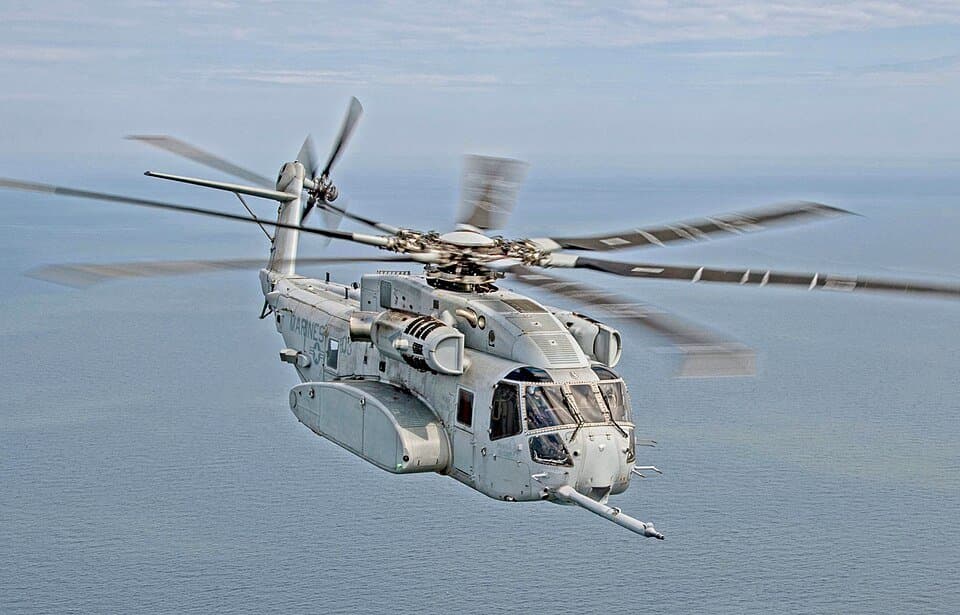
Three engines, a seven-blade main rotor and large side sponsons define the aircraft. Folding provisions support shipboard stowage; the full rotor-swept envelope is much larger.1


Preparing your view.
HelicoptersIn productionProfile in progress
The CH-53K is a new-build heavy-lift helicopter for ship-to-shore and land logistics. It replaces the CH-53E role while adding new propulsion, controls and a wider cabin.
 United States
Sikorsky CH-53K King Stallion
Lance Cpl. Elias E. Pimentel III cropped by FOX 52 · Public domain · Resized · Public domain · Source ↗ · ModifiedNo check recorded yet.
No check recorded yet.
No check recorded yet.
No check recorded yet.
No check recorded yet.
Heavy transport helicopter
United States
Sikorsky Aircraft
In production
United States Marine Corps
19 (circa early 2023)
22 April 2022 (IOC)
27 October 2015
Sikorsky CH-53E Super Stallion
4
30 passengers or troops, 24 casualty litters, or 35,000 lb (15,876 kg) payload
99 ft (30 m) rotor and tail un-folded
17 ft 6 in (5.33 m) fuselage
28 ft 4.9 in (8.659 m) rotor and tail un-folded
43,878 lb (19,903 kg)
88,000 lb (39,916 kg) with external load
2,286 US gal (1,903 imp gal; 8,650 L) internal in two cells per sponson (15,545 lb (7,051 kg)) 2,400 US gal (2,000 imp gal; 9,100 L) auxiliary internal in three cabin tanks (16,320 lb (7,403 kg))
3 × General Electric T408 (GE38-1B) turboshaft engines, 7,500 shp (5,600 kW) each
170 kn (200 mph, 310 km/h)
460 nmi (530 mi, 850 km)
110 nmi (130 mi, 200 km)
16,000 ft (4,900 m) ISA
30 ft (9.1 m)
8 ft 7.2 in (2.6 m)
6 ft 6 in (2.0 m)
Reference text from Wikipedia contributors, used under CC BY-SA 4.0.
The system in detail
Three engines, a seven-blade main rotor and large side sponsons define the aircraft. Folding provisions support shipboard stowage; the full rotor-swept envelope is much larger.1
Fly-by-wire controls and a digital cockpit support load handling. The cabin accommodates military pallets and vehicles while external lift uses a separate load configuration.1
NAVAIR gives both maximum external lift and a lower high/hot mission load. These figures describe different conditions and must remain separately labelled.1
Compare external load at equal radius, elevation and temperature. The largest lift number alone does not establish useful transport capacity on a particular route.1
Visual reference
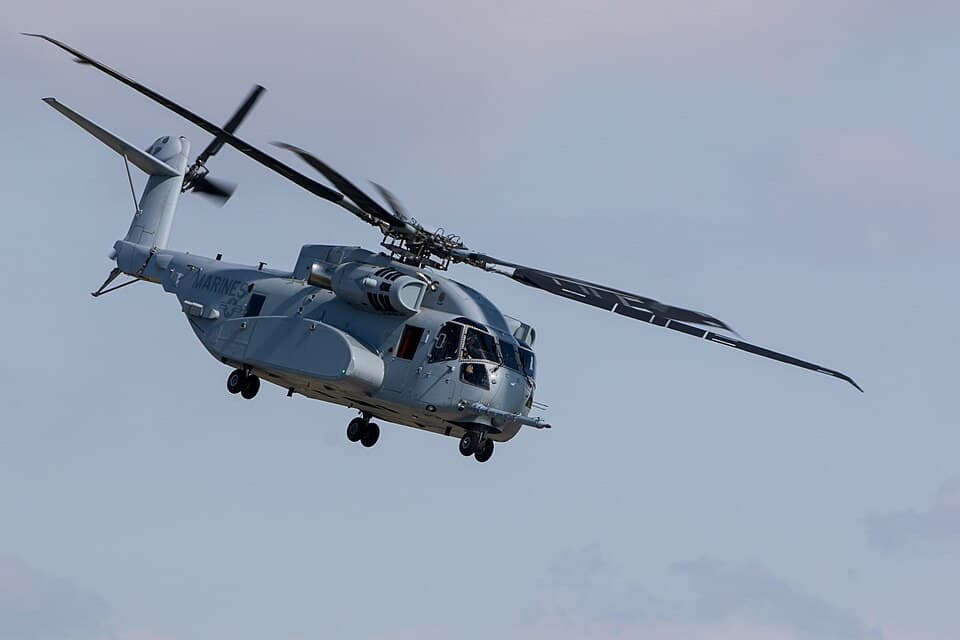
Sikorsky CH-53K King Stallion, ILA 2018 Historical equipment reference photograph. It does not establish current availability or every detail of the named variant.
Matti Blume · CC BY-SA 4.0 · Wikimedia Commons · CC BY-SA 4.0 · Source ↗ · ModifiedCH-53K King Stallion equipment records. Variants, orders and quantities are shown as reported in each inventory source; coverage is incomplete.
United StatesDirectory active-fleet estimate for the source types CH-53K, grouped under CH-53K King Stallion. Sums only the listed service and role rows; includes training and special-mission versions where explicitly listed. Excludes the separate Ordered column, aircraft in storage, aircraft undergoing or awaiting upgrades, and the directory's other exclusions. This is the dated directory coverage of these types, not a complete owned-fleet census or a readiness count.
Reported count for CH-53K King Stallion. Service scope: Marine Corps; does not replace a national total. 1 distinct quantity component(s) from the same source list; shared rowspan cells counted once. Explicit source inventory scope: active; no other stock status or total inferred. Count column(s): in service: 11. Origin: USA. The listed variants/roles are the scope, not an immediately deployable count. The components do not establish one inventory census date; the stored date is the retrieved source snapshot.