FORCETALLY
Loading the evidence…
Preparing your view.


Preparing your view.
Armoured vehiclesIn service
MPAV
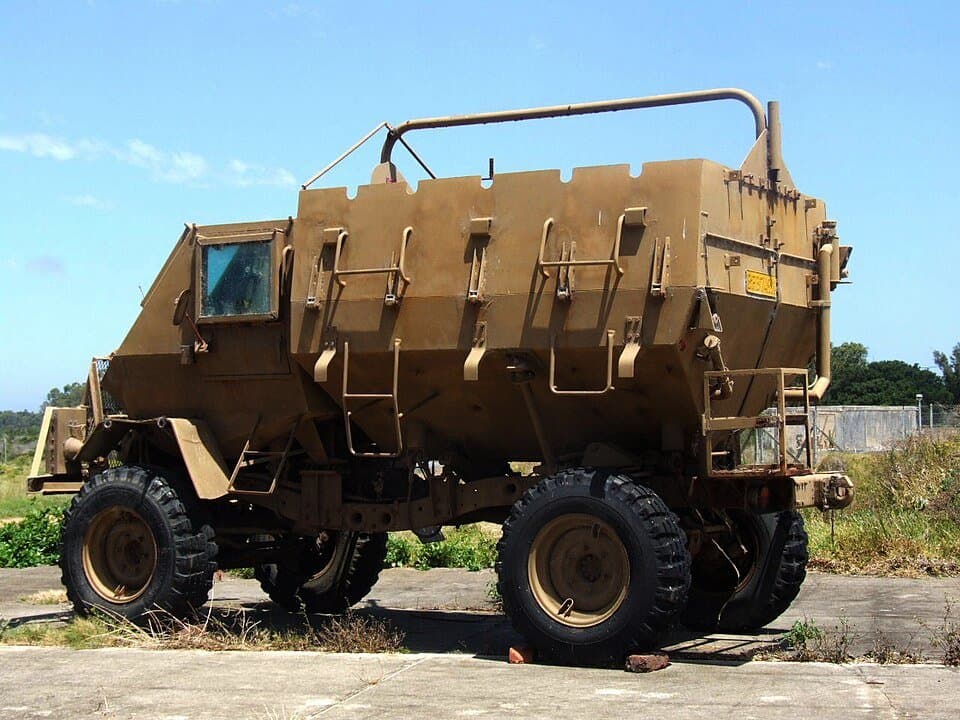
Buffel is a mPAV originating in South Africa. Reported operators include Malawi, Sri Lanka, Uganda, United Nations Mission in South Sudan, Zambia, United Nations Multidimensional Integrated Stabilization Mission in Mali.
 South Africa
Buffel
Bob Adams from George, South Africa · CC BY-SA 2.0 · Resized · CC BY-SA 2.0 · Source ↗ · ModifiedMPAV
South Africa
Council for Scientific and Industrial Research
6.14 t
5.1 m (16.73 ft)
2.05 m (6.73 ft)
2.95 m (9.68 ft)
1+10
Optional M1919A4 / FN MAG 7.62 mm MG
4×4 wheeled
1000 km (620 mi)
Road 96 km/h (60 mph) Off-road 30 km/h (19 mph)
Malawi : 1; Rhino variant.
Sri Lanka : 47; other variants produced as the Unicorn and Unibuffel .
Uganda : 55; 20 in service with the army and 35 in service with the national police.
United Nations Mission in South Sudan : 3
Zambia : 1; Rhino variant.
United Nations Multidimensional Integrated Stabilization Mission in Mali ; nine Unibuffels were deployed to Mail under urgent operational requirements for peacekeeping operations in Mali.
South Africa : Formerly around 2,400 in service; all retired and replaced by the Mamba .
United Nations Transition Assistance Group : 1
Zimbabwe : Possibly inherited from Rhodesia .
The Buffel (English: Buffalo ) is an infantry mobility vehicle used by the South African Defence Force during the South African Border War .
The Buffel (English: Buffalo ) is an infantry mobility vehicle used by the South African Defence Force during the South African Border War . The Buffel was also used as an armoured fighting vehicle and proved itself in this role. It replaced the older Bedford RL -based Hippo APC and itself was replaced by the Mamba from 1995 in South Africa, but remains in use elsewhere, notably Sri Lanka.
Land mine protection was provided by the V-shaped hull underneath these compartments, which quite effectively deflected the blast. The troop compartment contained two plastic tanks in the V-shape beneath the floor: a 200-litre fuel tank and a 100-litre water tank. The water tank provided drinking water to the occupants by means of a tap at the rear of the vehicle.
In order to help dissipate the energy from hitting a mine, the large tyres were sometimes filled with water, adding about 500 kg per wheel to the vehicle weight.
Buffel Mk IIB - Cargo carrier. The SA Army ordered 57 of these in the early 1980s. Payload capacity stated as 2.637 tons.
Armament 1 x single or double 5.56 mm or 7.62mm pintle-mounted machine gun forward right and/or rear left
Propulsion Atlas Diesel OM352 6-cylinder water cooled engine 125 hp (20.4 hp/t) at 2800 rpm.
Crew: Mark 1 = 1+10 Mark 2 = 1+8
Armament: (1) or (2) 5.56mm or 7.62mm machine guns
Manufactured by: ARMSCOR (Armaments Corporation of South Africa); Chassis : Mercedes Benz UNIMOG Model 416/162 series
Buffel South Africa West Germany 31 (originally bought south africa buffeles Mrap numbers unknown ) Mine-protected APC
Buffel Infantry mobility vehicle South Africa 20
Buffel Infantry mobility vehicle South Africa 1 INS Rhino variant.
Reference text from Wikipedia contributors, used under CC BY-SA 4.0.
True scale
Sourced dimensions beside a 1.75 m human reference.
Points represent sourced observations, including revisions. Revisions on the same effective date are not separate inventory events. Ranges appear in the table and are not plotted as exact points.
| Observation / report period | Value | Source | Claim state |
|---|---|---|---|
| 28 Sept 2026 | 2.95 m | Wikipedia contributors | superseded |
Buffel equipment records. Variants, orders and quantities are shown as reported in each inventory source; coverage is incomplete.
 Malawi
 Sri Lanka
Army exact named equipment holdings: Buffel. Active, operational-reserve and training units excluding equipment in store; November 2025 IISS assessment. Named service only; no parent-force or national total inferred. Source role: ARMOURED FIGHTING VEHICLES / APC (W). Original estimates, ranges, reporting names, reserve, lease and employment scopes retained; nested included counts are not added. Missile-system quantities mean launchers, not rounds. No readiness, crew, carried weapon, payload, factory-production or future order count inherited.
 Uganda
n People’s Defence Force exact named equipment holdings: Buffel. Active, operational-reserve and training units excluding equipment in store; November 2025 IISS assessment. Named service only; no parent-force or national total inferred. Source role: ARMOURED FIGHTING VEHICLES / APC (W). Original estimates, ranges, reporting names, reserve, lease and employment scopes retained; nested included counts are not added. Missile-system quantities mean launchers, not rounds. No readiness, crew, carried weapon, payload, factory-production or future order count inherited.
 Zambia
Reported count for Buffel. Service scope: Zambian Army; does not replace a national total. 1 distinct count cell(s) from the same source list; shared rowspan cells counted once. Retired, wholly reserve and on-order rows are excluded; the reported count retains any explicitly mixed stock scope in the quoted row. Count column(s): quantity: 1. Origin: South Africa. The listed variants/roles are the scope, not an immediately deployable count. The components do not establish one inventory census date; the stored date is the retrieved source snapshot.
Malawi, Sri Lanka, Uganda, United Nations Mission in South Sudan, Zambia, United Nations Multidimensional Integrated Stabilization Mission in Mali
Equipment reference ↗Reported count for Buffel. Service scope: Army equipment; does not replace a national total. 1 distinct count cell(s) from the same source list; shared rowspan cells counted once. Retired, wholly reserve and on-order rows are excluded; the reported count retains any explicitly mixed stock scope in the quoted row. Count column(s): quantity: 20. Origin: South Africa. The listed variants/roles are the scope, not an immediately deployable count. Dates are the count-cell citations' stated source period (2000), not the article revision. Cited source 2000-12-20. Edition or publication years do not claim an exact inventory census day.
 United States
 Egypt
 Namibia