FORCETALLY
Loading the evidence…
Preparing your view.


Preparing your view.
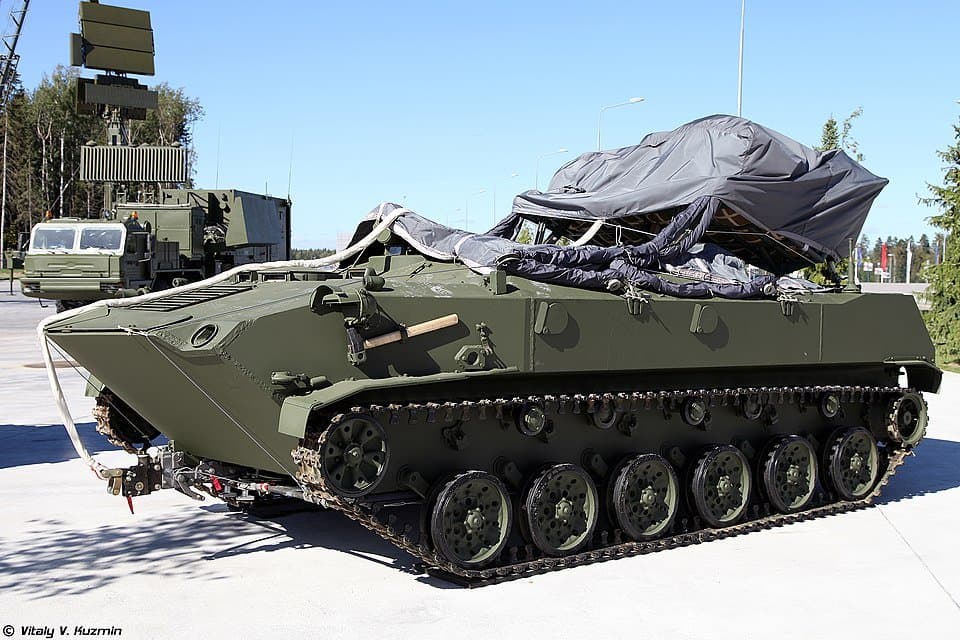
Armoured vehiclesIn service
Airborne Amphibious Multi-Purpose Tracked Armoured Personnel Carrier
BTR-D is a airborne Amphibious Multi-Purpose Tracked Armoured Personnel Carrier originating in Soviet Union / Russia. It was built by Volgograd Tractor Factory. Reported operators include Moldova, Russia, Ukraine, Uzbekistan.
 Soviet Union / Russia
Airborne Amphibious Multi-Purpose Tracked Armoured Personnel Carrier
Soviet Union / Russia
1974–present
See Operators
Soviet–Afghan War Transnistrian War First Chechen War Second Chechen War Russo-Ukrainian war
Volgograd Tractor Factory
Early 1970–1974
Volgograd Tractor Factory
1974 – ? (out of production)
See Variants
8 tonnes 8.5 tonnes (combat weight)
6.74 m (22.1 ft)
2.94 m
1.67 m
3 (commander, driver and bow machine gunner) (+ 10 troops)
15 mm at 78° upper hull front
Pintle-mounted automatic grenade launchers ( AGS-17 , AGS-30 or AGS-57) and/or machine guns ( PKM , 6P41 , " Utyos "," Kord "or”(Type 920G Tucha 81 mm smoke grenade launching system)”.
2×7.62 mm PKB bow general purpose machine guns (2,000 rounds)
5D-20 6-cylinder 4-stroke V-shaped liquid cooled 15.9-litre diesel 245 hp (180 kW) at 2,600 rpm
30.1 hp/tonne (22.5 kW/tonne) 28.4 hp/tonne (21.3 kW/tonne) (loaded with equipment)
torsion-bar
Adjustable 100 mm to 450 mm
300 l
500 km (road) 116 km (water)
61 km/h (road) 35 km/h (cross country) 10 km/h (swimming)
Moldova – 9 BTR-D as of 2024.
Russia – 550 BTR-D in active service as of 2024. At least 106 BTR-D have been visually confirmed lost (by Russian side) so far in the 2022 Russian invasion of Ukraine .
Ukraine – 30 in the Ukrainian Airborne Forces as of 2024, with 40 in service in 1995, 42 in 2000 and 44 in 2005. At least 3 BTR-D have been visually confirmed lost (by Ukrainian side) so far in the 2022 Russian invasion of Ukraine .
Uzbekistan – 50 in 2024. 70 were in service in 1995, 50 in 2000 and 2005.
Soviet Union – Passed on to successor states.
Belarus – 117 in 1995, 22 in 2000, 2003 and 2005. None recorded in service as of 2024.
The BTR-D is a Soviet airborne multi-purpose tracked armoured personnel carrier .
While the BTR-D is based on the BMD-1, it is 60 cm longer and lacks a turret. Instead, it has a small flat superstructure with a hatch on top.
The BTR-D is powered by the same engine as the BMD-1. Its suspension is longer because the entire vehicle has been lengthened by 60cm. Because of this, the vehicle has six roadwheels on each side instead of five. It has five return rollers on each side unlike the BMD-1, which has four.
With the turret removed, the troop compartment was enlarged and can carry up to ten equipped soldiers. It's also linked with the crew compartment in the front. There are two firing ports in the sides and one in the rear, two of which are for RPK-74 light machine guns.
BTR-DG (Ob'yekt 925G) – Cargo variant without bow machine guns, firing ports and periscopes.
This equipment includes a light collapsible crane stored on the roof of the personnel compartment, which can be traversed through 180°, a recovery winch, a combination spade and dozer blade, a generator, towing equipment, electric welding system, tools and ready use spares.
One of the 7.62 mm bow PKT tank machine guns was eliminated.
This entered service in 1989 in very small numbers.
It is used to launch Yakovlev Pchela-1T UAVs for reconnaissance or jamming at ranges up to 60 km.
BMD-1KSh "Soroka" (Ob'yekt 926) (KSh stands for komandno-shtabnaya – command and staff) – an airborne command post equipped with the R-123M , R-111 and R-130M or R-134 radio sets, as well as an AB1 portable 1 kW generator, the TNA-3 navigation system, folding CLOTHES HORSE type antennae around the superstructure and two slim antenna masts.
R-440-ODB "Kristall-BDS" – A BTR-D converted into an airborne satellite communications vehicle with a R-440 system with a range of 15,000 km.
Located over the turret front sights were visors hinged in the centre. 2S9 Nona-S (Ob'yekt 925S) – An airborne self-propelled mortar, armed with a 120 mm 2A60 mortar.
BTR-ZD Soviet Union 23 mm 8
Reference text from Wikipedia contributors, used under CC BY-SA 4.0.
True scale
Sourced dimensions beside a 1.75 m human reference.
See it in your room. Scan with your phone to open this model in 3D, then place it in your space.
Points represent sourced observations, including revisions. Revisions on the same effective date are not separate inventory events. Ranges appear in the table and are not plotted as exact points.
| Observation / report period | Value | Source | Claim state |
|---|---|---|---|
| 28 Sept 2026 | 3 people | Wikipedia contributors | superseded |
| 28 Sept 2026 | 3 people | Wikipedia contributors | superseded |
| 28 Sept 2026 | 3 people | Wikipedia contributors | approved |
BTR-D equipment records. Variants, orders and quantities are shown as reported in each inventory source; coverage is incomplete.
 Azerbaijan
Number column of the Wikipedia list table under "Armored personnel carrier". The list's own wording applies; it is a compiled secondary source, not an official census.
 Moldova
Army exact named equipment holdings: BTR-D. Active, operational-reserve and training units excluding equipment in store; November 2025 IISS assessment. Named service only; no parent-force or national total inferred. Source role: ARMOURED FIGHTING VEHICLES / APC (T). Original estimates, ranges, reporting names, reserve, lease and employment scopes retained; nested included counts are not added. Missile-system quantities mean launchers, not rounds. No readiness, crew, carried weapon, payload, factory-production or future order count inherited.
RussiaAirborne Forces exact named equipment holdings: BTR-D. Active, operational-reserve and training units excluding equipment in store; November 2025 IISS assessment. Named service only; no parent-force or national total inferred. Source role: ARMOURED FIGHTING VEHICLES / APC (T). Original estimates, ranges, reporting names, reserve, lease and employment scopes retained; nested included counts are not added. Missile-system quantities mean launchers, not rounds. No readiness, crew, carried weapon, payload, factory-production or future order count inherited.
 Tajikistan
 Ukraine
Airborne Assault Troops exact named equipment holdings: BTR-D. Active, operational-reserve and training units excluding equipment in store; November 2025 IISS assessment. Named service only; no parent-force or national total inferred. Source role: ARMOURED FIGHTING VEHICLES / APC (T). Original estimates, ranges, reporting names, reserve, lease and employment scopes retained; nested included counts are not added. Missile-system quantities mean launchers, not rounds. No readiness, crew, carried weapon, payload, factory-production or future order count inherited.
 Uzbekistan
Army exact named equipment holdings: BTR-D. Active, operational-reserve and training units excluding equipment in store; November 2025 IISS assessment. Named service only; no parent-force or national total inferred. Source role: ARMOURED FIGHTING VEHICLES / APC (T). Original estimates, ranges, reporting names, reserve, lease and employment scopes retained; nested included counts are not added. Missile-system quantities mean launchers, not rounds. No readiness, crew, carried weapon, payload, factory-production or future order count inherited.
Keep exploring
Tracked Amphibious Armoured Personnel Carrier
Compare with BTR-DAmphibious tracked armoured personnel carrier
 FinlandCompare with BTR-D
Amphibious tracked armoured personnel carrier
Compare with BTR-DAmphibious armoured personnel carrier Multi-purpose armored vehicle
Compare with BTR-DAmphibious Armoured personnel carrier
 ThailandCompare with BTR-D
6×6 amphibious armoured personnel carrier
FinlandCompare with BTR-D