FORCETALLY
Loading the evidence…
Preparing your view.


Preparing your view.
Trainer aircraftIn service
Advanced trainer
Boeing–Saab T-7 Red Hawk is a advanced trainer originating in United States/Sweden. It was built by Boeing / Saab. Reported operators include United States Air Force.
 United States /
 Sweden
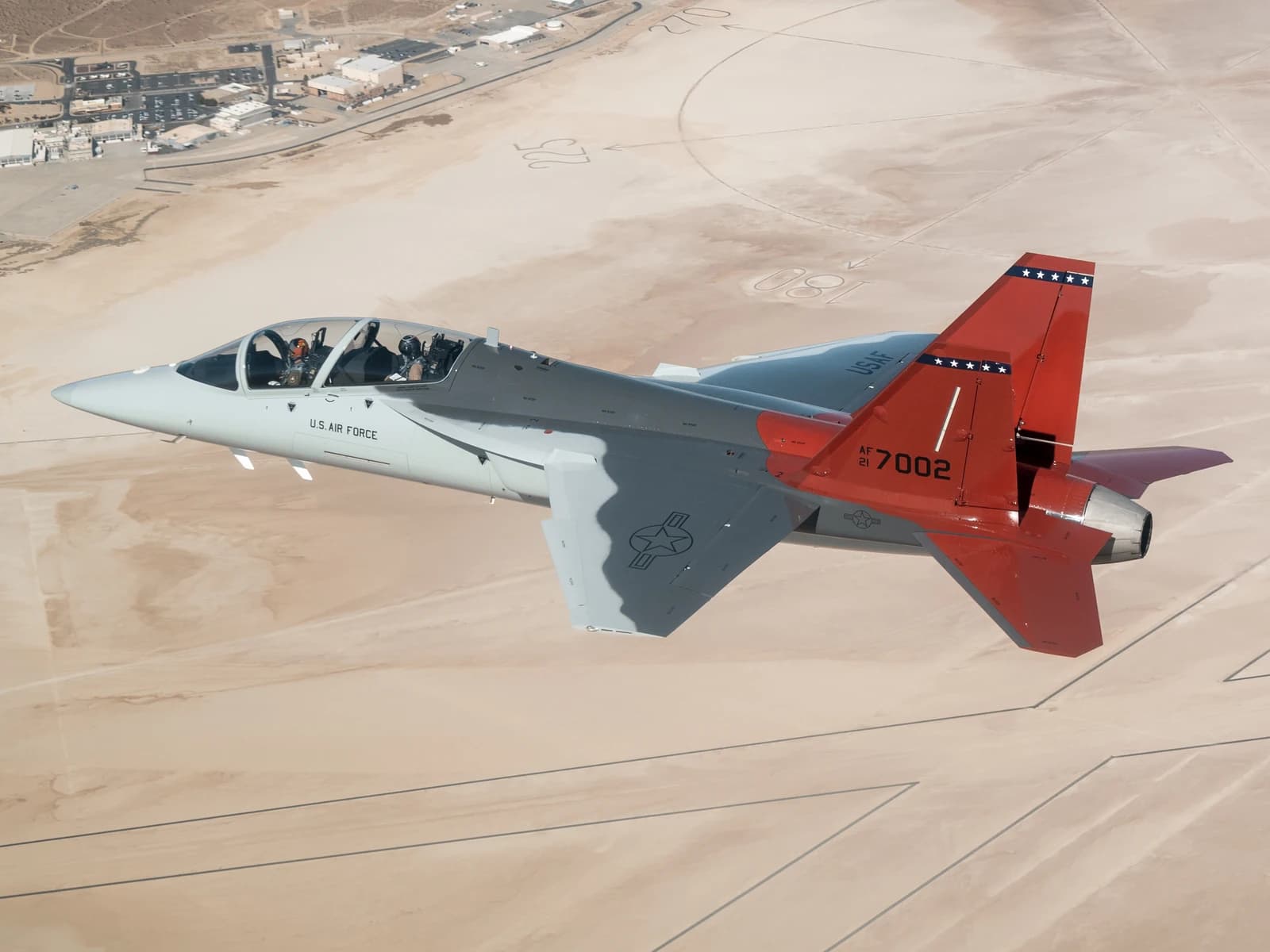
Boeing–Saab T-7 Red Hawk — exact own-article reference photograph
Air Force photo by Bryce Bennett · Public domain · Resized, original frame retained · Public domain · Source ↗ · ModifiedAdvanced trainer
United States/Sweden
Boeing / Saab
United States Air Force
2 prototypes, and 3 engineering and manufacturing development aircraft
2021–present
20 December 2016
2: pilot and instructor/passenger
46 ft 11 in (14.30 m)
30 ft 7 in (9.32 m)
13 ft 6 in (4.11 m)
18,000 lb (8,165 kg)
22,000 lb (9,979 kg)
4,500 pounds (2,000 kg)
1 × General Electric F404 -GE-103 afterburning turbofan, 11,000 lbf (49 kN) thrust dry, 17,200 lbf (77 kN) with afterburner
Mach 0.975
990 nmi (1,140 mi, 1,830 km)
50,000 ft (15,000 m)
8 g
The Boeing–Saab T-7 Red Hawk , initially known as the Boeing T-X (later Boeing–Saab T-X ), is an American–Swedish transonic advanced jet trainer produced by Boeing with Saab .
The USAF's Air Education and Training Command (AETC) began developing the requirements for a replacement for the supersonic Northrop T-38 Talon as early as 2003. Originally, the replacement trainer was expected to enter service around 2020. A fatigue failure of a T-38C killed its two-person crew in 2008, and the USAF advanced the target date of initial operational capability (IOC) to 2017.
Saab has developed new software for the T-7 to help provide for cheaper and faster development. The T-7A employed digital engineering that went from development to the first test flight within 36 months. The T-7A has an advanced and digitized production line that takes only 30 minutes to splice the aft section with the wings. The digital build process allows technicians to build the aircraft with minimal tooling and drilling during the assembly process. The first T-7A was rolled out on 28 April 2022.
Length: 46 ft 11 in (14.30 m)
Wingspan: 30 ft 7 in (9.32 m)
Height: 13 ft 6 in (4.11 m)
Empty weight: 18,000 lb (8,165 kg)
Gross weight: 22,000 lb (9,979 kg)
Fuel capacity: 4,500 pounds (2,000 kg)
Powerplant: 1 × General Electric F404 -GE-103 afterburning turbofan, 11,000 lbf (49 kN) thrust dry, 17,200 lbf (77 kN) with afterburner
Range: 990 nmi (1,140 mi, 1,830 km)
Service ceiling: 50,000 ft (15,000 m)
g limits: 8 g
Максимальная взлётная масса: 5500 кг
T-7 Red Hawk Boeing / Saab USA Jet Trainer Manned 2028 (planned) 2 Replacement for the T-38 Talon . The first five test aircraft will be production representative. 351 planned.
Reference text from Wikipedia contributors, used under CC BY-SA 4.0.
True scale
Sourced dimensions beside a 1.75 m human reference.
Points represent sourced observations, including revisions. Revisions on the same effective date are not separate inventory events. Ranges appear in the table and are not plotted as exact points.
| Observation / report period | Value | Source | Claim state |
|---|---|---|---|
| 28 Sept 2026 | 4.11 m | Wikipedia contributors | superseded |
Boeing–Saab T-7 Red Hawk equipment records. Variants, orders and quantities are shown as reported in each inventory source; coverage is incomplete.
United StatesReported count for T-7 Red Hawk. Service scope: Air Force; does not replace a national total. 1 distinct count cell(s) from the same source list; shared rowspan cells counted once. Retired, wholly reserve and on-order rows are excluded; the reported count retains any explicitly mixed stock scope in the quoted row. Count column(s): inventory: 2. Origin: USA. The listed variants/roles are the scope, not an immediately deployable count. Dates are the count-cell citations' stated source period (2024), not the article revision. Cited source 2024-03-13. Edition or publication years do not claim an exact inventory census day.
Keep exploring
 Taiwan
 Iran
 United Kingdom
 Italy