FORCETALLY
Loading the evidence…
Preparing your view.


Preparing your view.
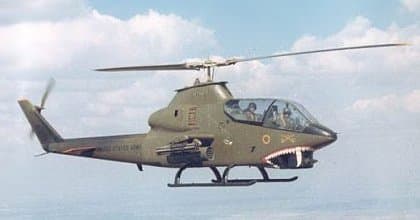
HelicoptersIn service
Attack helicopter
Bell AH-1 Cobra is a attack helicopter originating in United States. It was built by Bell Helicopter. Reported operators include United States Army (historical) Japan Ground Self-Defense Force Republic of Korea Army Royal Jordanian Air Force.
 United States
Technical data
Attack helicopter
United States
Bell Helicopter
In service
United States Army (historical) Japan Ground Self-Defense Force Republic of Korea Army Royal Jordanian Air Force
1,116
1967–2019
1967
7 September 1965
2001 (US Army)
Bell UH-1 Iroquois
Bell AH-1 SeaCobra/SuperCobra Bell 309 KingCobra
2; one pilot, one co-pilot/gunner (CPG)
53 ft (16 m) including rotors
44 ft 5 in (13.5 m)
10 ft 4 in (3.15 m) stub wings
13 ft 6 in (4.11 m)
5,810 lb (2,635 kg)
9,500 lb (4,309 kg)
1 × Lycoming T53-L-13 turboshaft , 1,100 hp (820 kW)
44 ft 0 in (13.4 m)
1,520 sq ft (141 m 2 )
NACA 0009.3 mod
149 kn (171 mph, 276 km/h)
190 kn (220 mph, 350 km/h)
310 nmi (360 mi, 570 km)
11,400 ft (3,500 m)
1,230 ft/min (6.2 m/s)
The Bell AH-1 Cobra is a single-engined attack helicopter developed and manufactured by the American rotorcraft manufacturer Bell Helicopter .
While some officials within the Pentagon, particularly those within the US Army, had recognized the potential value of purpose-built armed rotary aircraft as early as 1962 and were keen to see such a vehicle developed promptly, the issue was complicated in part due to inter-service politics. The United States Air Force (USAF) largely held the opinion that most forms of US military aircraft should be operated only by their service, and that the US Army would be intruding into their domain by developing a complex armed aerial combatant, and ought to be largely restricted to transport aircraft. Meanwhile, some Army officials were concerned that the USAF did not take the close air support (CAS) mission as seriously as it ought to, and that response times of 30 minutes or more for fixed-wing aircraft would be unacceptable.
Bell had been investigating helicopter gunships since the late 1950s, paying particular attention to the Algerian War , in which French forces mounted weapons on helicopters to fight the growing insurgency. The company created a mockup of its D-255 helicopter gunship concept, named "Iroquois Warrior". The Iroquois Warrior was planned to be a purpose-built attack aircraft based on UH-1B components with a new, slender airframe and a two-seat, tandem cockpit. It featured a grenade launcher in a ball turret on the nose, a 20 mm belly-mounted gun pod, and stub wings for mounting rockets or SS.10 anti-tank missiles.
The Army's solution to the shortcomings of the Sioux Scout was to launch the Advanced Aerial Fire Support System (AAFSS) competition. This called for a heavily armed helicopter capable of at least 200 miles per hour (320 km/h). A total of seven companies, including Bell, opted to respond to the requirement. It was out of the AAFSS program that the Lockheed AH-56 Cheyenne emerged, a heavy attack helicopter with high speed capability. During testing, it proved to be too sophisticated and costly, and was ultimately canceled in 1972 after ten years of development. In its place, the Advanced Attack Helicopter program was launched. Under this initiative, the Army sought a conventional attack helicopter with a greater level of survivability.
As the Vietnam War proceeded, pressure accumulated in favor of the Model 209. Attacks on US forces were increasing and, by the end of June 1965, there were already 50,000 US ground troops in Vietnam. 1965 was also the deadline for AAFSS selection, but the program would become stuck in technical difficulties and political bickering. The US Army needed an interim gunship for Vietnam and it approached five separate companies with its request to provide a quick solution. Submissions came in for armed variants of the Boeing-Vertol ACH-47A , Kaman HH-2C Tomahawk , Piasecki 16H Pathfinder , Sikorsky S-61 , and the Bell 209.
During April 1966, Bell's submission emerged victorious in an evaluation against the other rival helicopters. The US Army promptly signed the first production contract, ordering an initial batch of 110 aircraft. By the end of the year, rapid follow-on orders had increased this to 500 Cobras. Bell added "Cobra" to the UH-1's Huey nickname to produce its HueyCobra name for the 209. The Army applied the Cobra name to its AH-1G designation for the helicopter. The Bell 209 demonstrator was used for the next six years to test weapons and fit of equipment. An additional use for the demonstrator was participating in marketing initiatives. It was also modified to match the AH-1 production standard by the early 1970s. The demonstrator was retired to the Patton Museum at Fort Knox , Kentucky and converted to approximately its original appearance.
Typically, the Cobra would avoid hovering at any point in an active engagement; instead, emphasis was placed on maintaining speed and mobility. The gunner often fired the chin-mounted cannon with the intention of suppressing hostile targets in between barrages of 2.75-inch rockets, held in pods upon the stub wings, which were fired by the back-seater. It was unusual for Cobras to operate alone; instead, two or more would be dispatched and teamwork encouraged, leading to hunter-killer tactics being used to flush out and eliminate ground targets. Pairings with other helicopters, such as the Bell OH-58 Kiowa scout helicopter, were also common occurrences. Radio communications were handled by the gunner. Regardless of mission profile, low altitude flying was commonplace.
By June 1967, the first AH-1G HueyCobras had been delivered. Originally designated as UH-1H, the "A" for attack designation was soon adopted and when the improved UH-1D became the UH-1H, the HueyCobra became the AH-1G. The AH-1 was initially considered a variant of the H-1 line, resulting in the G series letter.
On 12 September 1968, Capt. Ronald Fogleman was flying an F-100 Super Sabre when the aircraft was shot down and he ejected 200 miles (320 km) north of Bien Hoa. Fogleman became the only pilot to be rescued by holding on to an Army AH-1G's deployed gun-panel door. Bell built 1,116 AH-1Gs for the U.S. Army between 1967 and 1973, and the Cobras chalked up over a million operational hours in Vietnam; the number of Cobras in service peaked at 1,081. In 1971 during Operation Lam Son 719 in Southeastern Laos , 26 U.S. Army AH-1Gs were destroyed and 158 sustained some level of damage. Out of nearly 1,110 AH-1s that were delivered between 1967 and 1973, approximately 300 were lost to a combination of combat and accidents during the conflict. Approximately one third of this number were operational or non-combat losses.
The U.S. Marine Corps also operated the AH-1G Cobra in Vietnam for a short time before acquiring the twin-engine AH-1J Cobras . The AH-1Gs had been adopted by the Marines as an interim measure, a total of 38 helicopters having been transferred from the U.S. Army to the Marines in 1969.
By 2013, Pakistan reportedly operated a fleet of 35 AH-1F helicopters. Maintaining these aircraft has been difficult, but possible through commercial channels. Additionally, the US government provided $750,000 (~$993,036 in 2024) through 2013 to update the existing AH-1F/S Cobra fleet. However, controversy over how much of this funding has actually been spent on Pakistan's Cobras has also been present throughout the 2010s. Turkey has also become a key supplier of spare parts for the Cobra, often free of cost, to Pakistan. During the 2010s, Pakistan lost a total of three aircraft in separate incidents.
Pakistan repeatedly sought the Bell AH-1W SuperCobra from the US to supplement and replace its current AH-1 Cobras. Attempts to acquire the AH-1Z Viper or AH-64E Apache from the US were rejected, so Pakistan turned to buying other foreign attack helicopters. Possible candidates have included the Turkish T129 , the Chinese CAIC Z-10 , and the Russian Mi-35 Hind . In November 2014, Russia approved the sale of Mi-35M helicopters to Pakistan. In April 2015, China delivered three Z-10s to Pakistan. During the same month, the US Department of State approved the sale of 15 AH-1Zs and associated equipment to Pakistan. During October 2017, the T129 was also reported to be a contender for further orders.
The Florida Division of Forestry also acquired three AH-1Ps from the US Army. These are called Bell 209 "Firesnakes" and are equipped to carry a water/fire retardant system.
Original AH-1G prototype with retractable skid landing gear. This model number is also used by the FAA for the civilian registration of former U.S. Army AH-1s used in firefighting service.
AH-1G HueyCobra
Initial 1966 production model gunship for the U.S. Army, with one 1,400 shp (1,000 kW ) Avco Lycoming T53-13 turboshaft.
JAH-1G HueyCobra
TH-1G HueyCobra
The Spanish Navy purchased eight new-build AH-1Gs, designating the type the "Z-14". These were equipped with the M35 20 mm cannon system, and were used to support coastal patrol boats. Four of these were lost in accidents. The remaining helicopters were retired in 1985 with three sent back to the US, and one kept in storage in Spain.
AH-1G powered by a T53-L-703 engine without TOW system.
The baseline AH-1S is an AH-1Q upgraded with a 1,800 shp (1,300 kW) T53-L-703 turboshaft engine. The AH-1S is also referred to as the "Improved AH-1S", "AH-1S Modified", or "AH-1S(MOD)" prior to 1988. (Prior to 1988, all upgraded aircraft were referred to as variants of the AH-1S.)
98 production aircraft with the Enhanced Cobra Armament System (ECAS) featuring the M97A1 armament subsystem with a three-barreled M197 20 mm cannon. The AH-1E is also referred to as the "Upgunned AH-1S", or "AH-1S(ECAS)" prior to 1988. These improvements are considered Step 2 of the AH-1S upgrade program. AH-1E aircraft included the M147 Rocket Management Subsystem (RMS) to fire 2.75-inch (70 mm) rockets.
143 production aircraft and 387 converted AH-1G Cobras. The AH-1F incorporates all Step 1 and 2 upgrades to the AH-1S. It also featured Step 3 upgrades: a head-up display, a laser rangefinder, an infrared jammer mounted above the engine exhaust, and an infrared suppressing engine exhaust system, and the M143 Air Data Subsystem (ADS). The AH-1F is also referred to as the "Modernized AH-1S", "AH-1S Modernized Cobra", or "AH-1S(MC)" prior to 1988.
Experimental all-weather version based on the AH-1G single-engine and AH-1J twin-engine designs. Two Bell 309s were produced; the first was powered by a PWC T400-CP-400 Twin-Pac engine set and the second was powered by a Lycoming T55-L-7C engine.
Length: 53 ft (16 m) including rotors
Fuselage length: 44 ft 5 in (13.5 m)
Width: 10 ft 4 in (3.15 m) stub wings
Height: 13 ft 6 in (4.11 m)
Empty weight: 5,810 lb (2,635 kg)
Max takeoff weight: 9,500 lb (4,309 kg)
Powerplant: 1 × Lycoming T53-L-13 turboshaft , 1,100 hp (820 kW)
Main rotor diameter: 44 ft 0 in (13.4 m)
Main rotor area: 1,520 sq ft (141 m 2 )
Maximum speed: 149 kn (171 mph, 276 km/h)
Never exceed speed : 190 kn (220 mph, 350 km/h)
Range: 310 nmi (360 mi, 570 km)
Service ceiling: 11,400 ft (3,500 m)
Rate of climb: 1,230 ft/min (6.2 m/s)
2 × 7.62 mm (0.308 in) multi-barrel Miniguns , or 2 × M129 40 mm grenade launchers , or one of each, in the M28 turret . (When one of each was mounted, the minigun was mounted on the right side of the turret, due to feed requirements.)
2.75 in (70 mm) rockets – 7 rockets mounted in the M158 launcher or 19 rockets in the M200 launcher
M18 7.62 mm Minigun pod or XM35 armament subsystem with XM195 20 mm cannon
Reference text from Wikipedia contributors, used under CC BY-SA 4.0.
True scale
Sourced dimensions beside a 1.75 m human reference.
See it in your room. Scan with your phone to open this model in 3D, then place it in your space.
Points represent sourced observations, including revisions. Revisions on the same effective date are not separate inventory events. Ranges appear in the table and are not plotted as exact points.
| Observation / report period | Value | Source | Claim state |
|---|---|---|---|
| 28 Sept 2026 | 4.11 m | Wikipedia contributors | superseded |
Bell AH-1 Cobra equipment records. Variants, orders and quantities are shown as reported in each inventory source; coverage is incomplete.
 Bahrain
Air Force exact named equipment holdings: AH-1F Cobra; AH-1E Cobra. Active, operational-reserve and training units excluding equipment in store; November 2025 IISS assessment. Named service only; no parent-force or national total inferred. Source role: HELICOPTERS / ATK. Original estimates, ranges, reporting names, reserve, lease and employment scopes retained; nested included counts are not added. Missile-system quantities mean launchers, not rounds. No readiness, crew, carried weapon, payload, factory-production or future order count inherited.
 Japan
Ground Self-Defense Force exact named equipment holdings: AH-1S Cobra. Active, operational-reserve and training units excluding equipment in store; November 2025 IISS assessment. Named service only; no parent-force or national total inferred. Source role: HELICOPTERS / ATK. Original estimates, ranges, reporting names, reserve, lease and employment scopes retained; nested included counts are not added. Missile-system quantities mean launchers, not rounds. No readiness, crew, carried weapon, payload, factory-production or future order count inherited.
 Jordan
Air Force exact named equipment holdings: AH-1F Cobra (17 more in store, offered for sale). Active, operational-reserve and training units excluding equipment in store; November 2025 IISS assessment. Named service only; no parent-force or national total inferred. Source role: HELICOPTERS / ATK. Original estimates, ranges, reporting names, reserve, lease and employment scopes retained; nested included counts are not added. Missile-system quantities mean launchers, not rounds. No readiness, crew, carried weapon, payload, factory-production or future order count inherited.
 Kenya
Air Force exact named equipment holdings: AH-1F Cobra. Active, operational-reserve and training units excluding equipment in store; November 2025 IISS assessment. Named service only; no parent-force or national total inferred. Source role: HELICOPTERS / ATK. Original estimates, ranges, reporting names, reserve, lease and employment scopes retained; nested included counts are not added. Missile-system quantities mean launchers, not rounds. No readiness, crew, carried weapon, payload, factory-production or future order count inherited.
 Pakistan
Army exact named equipment holdings: AH-1F/S Cobra. Active, operational-reserve and training units excluding equipment in store; November 2025 IISS assessment. Named service only; no parent-force or national total inferred. Source role: HELICOPTERS / ATK. Original estimates, ranges, reporting names, reserve, lease and employment scopes retained; nested included counts are not added. Missile-system quantities mean launchers, not rounds. No readiness, crew, carried weapon, payload, factory-production or future order count inherited.
 Philippines
Dated directory active-fleet estimate for AH-1F, grouped under Bell AH-1 Cobra. Only the explicitly listed service/role Active cells are included. Ordered, stored and upgrade aircraft are excluded. This is the directory coverage of these source types, not a national total, complete owned-fleet census or readiness count.
 South Korea
Army exact named equipment holdings: AH-1F Cobra. Active, operational-reserve and training units excluding equipment in store; November 2025 IISS assessment. Named service only; no parent-force or national total inferred. Source role: HELICOPTERS / ATK. Original estimates, ranges, reporting names, reserve, lease and employment scopes retained; nested included counts are not added. Missile-system quantities mean launchers, not rounds. No readiness, crew, carried weapon, payload, factory-production or future order count inherited.
 Thailand
Army exact named equipment holdings: AH-1F Cobra. Active, operational-reserve and training units excluding equipment in store; November 2025 IISS assessment. Named service only; no parent-force or national total inferred. Source role: HELICOPTERS / ATK. Original estimates, ranges, reporting names, reserve, lease and employment scopes retained; nested included counts are not added. Missile-system quantities mean launchers, not rounds. No readiness, crew, carried weapon, payload, factory-production or future order count inherited.
 Türkiye
Army exact named equipment holdings: AH-1S Cobra; AH-1P Cobra. Active, operational-reserve and training units excluding equipment in store; November 2025 IISS assessment. Named service only; no parent-force or national total inferred. Source role: HELICOPTERS / ATK. Original estimates, ranges, reporting names, reserve, lease and employment scopes retained; nested included counts are not added. Missile-system quantities mean launchers, not rounds. No readiness, crew, carried weapon, payload, factory-production or future order count inherited.
United States Army (historical) Japan Ground Self-Defense Force Republic of Korea Army Royal Jordanian Air Force
Equipment reference ↗Reported count for Bell AH-1 Cobra. Service scope: Japan Ground Self-Defense Force; does not replace a national total. 1 distinct count cell(s) from the same source list; shared rowspan cells counted once. Retired, wholly reserve and on-order rows are excluded; the reported count retains any explicitly mixed stock scope in the quoted row. Count column(s): quantity: 71. Origin: United States Japan. The listed variants/roles are the scope, not an immediately deployable count. Dates are the count-cell citations' stated source period (2025), not the article revision. 2025 cited source edition. Edition or publication years do not claim an exact inventory census day.
Keep exploring
Attack helicopter
United StatesCompare with Bell AH-1 Cobra Attack helicopter
United StatesCompare with Bell AH-1 Cobra Attack helicopter
United StatesCompare with Bell AH-1 Cobra Attack helicopter
Compare with Bell AH-1 CobraAttack helicopter
Compare with Bell AH-1 CobraAttack helicopter
 IndiaCompare with Bell AH-1 Cobra