Design and configuration
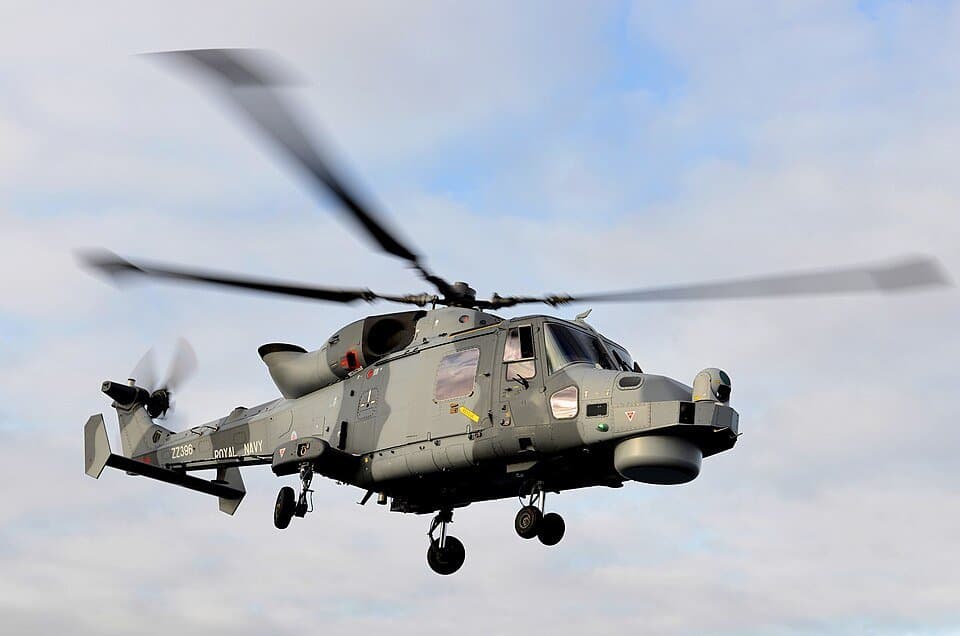
A four-blade main rotor, wheeled landing gear and angular fuselage develop the Lynx lineage. Folded and rotor-turning dimensions describe different storage and operating envelopes.1


Preparing your view.
HelicoptersIn serviceProfile in progress
The AW159 Wildcat is a compact helicopter for maritime and battlefield roles. Its small cabin and shipboard provisions suit missions different from larger transport helicopters.
 United Kingdom /
 Italy
Utility , SAR and ASuW helicopter
United Kingdom , Italy
AgustaWestland Leonardo
In service
British Army Royal Navy Republic of Korea Navy Philippine Navy
2009–present
29 August 2014 (AH1)
12 November 2009
Westland Super Lynx
2 pilots
6 passengers, including door gunner
15.24 m (50 ft 0 in)
3.73 m (12 ft 3 in)
3,300 kg (7,275 lb)
6,000 kg (13,228 lb)
2 × LHTEC CTS800-4N turboshaft, 1,015 kW (1,361 hp) each
12.8 m (42 ft 0 in)
311 km/h (193 mph, 168 kn)
777 km (483 mi, 420 nmi)
963 km (598 mi, 520 nmi)
Two hours and 15 minutes (Four hours and 30 minutes with auxiliary fuel tanks)
128.7 m 2 (1,385 sq ft)
Powerplant 2 x LHTEC CTS800-4N Turboshafts with FADEC
Reference text from Wikipedia contributors, used under CC BY-SA 4.0.
The system in detail
A four-blade main rotor, wheeled landing gear and angular fuselage develop the Lynx lineage. Folded and rotor-turning dimensions describe different storage and operating envelopes.1
The manufacturer lists optional radar, defensive aids, communications and anti-submarine equipment. A rescue hoist, cargo hook and auxiliary tanks support other mission arrangements.1
This is a programme reference, not a claim that every land or naval Wildcat has the same sensors. The customer mission installation must be identified for detailed comparisons.1
Range and endurance depend on the listed mass and power conditions. Optional sonar, weapons or fuel tanks change the remaining cabin and payload capacity.1
Visual reference
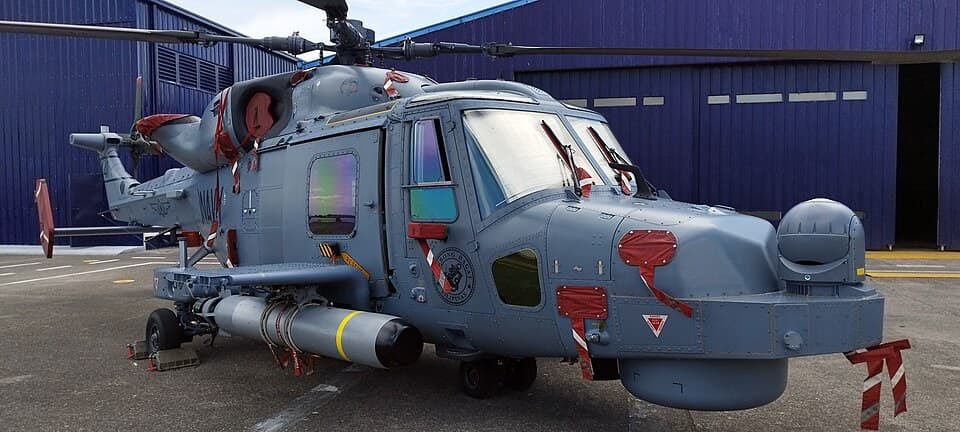
An AW159 Wildcat Helicopter of the Philippine Navy (PN) taken at the Philippine Fleet Defense Expo (PFDX) 2023 Historical equipment reference photograph. It does not establish current availability or every detail of the named variant.
rhk111 · CC BY-SA 4.0 · Wikimedia Commons · CC BY-SA 4.0 · Source ↗ · ModifiedAW159 Wildcat equipment records. Variants, orders and quantities are shown as reported in each inventory source; coverage is incomplete.
 Philippines
Naval Aviation exact named equipment holdings: AW159 Wildcat. Active, operational-reserve and training units excluding equipment in store; November 2025 IISS assessment. Named service only; no parent-force or national total inferred. Source role: HELICOPTERS / ASW. Original estimates, ranges, reporting names, reserve, lease and employment scopes retained; nested included counts are not added. Missile-system quantities mean launchers, not rounds. No readiness, crew, carried weapon, payload, factory-production or future order count inherited.
 South Korea
Naval Aviation exact named equipment holdings: AW159 Wildcat. Active, operational-reserve and training units excluding equipment in store; November 2025 IISS assessment. Named service only; no parent-force or national total inferred. Source role: HELICOPTERS / ASW. Original estimates, ranges, reporting names, reserve, lease and employment scopes retained; nested included counts are not added. Missile-system quantities mean launchers, not rounds. No readiness, crew, carried weapon, payload, factory-production or future order count inherited.
United KingdomTotal reported rotary-wing holdings of the named platforms, including aircraft outside the effective forward fleet. Not an active-only or readiness count. Platforms included: Wildcat AH Mk1; Wildcat HMA Mk2 [Note 13].
British Army Royal Navy Republic of Korea Navy Philippine Navy
Equipment reference ↗