FORCETALLY
Loading the evidence…
Preparing your view.


Preparing your view.
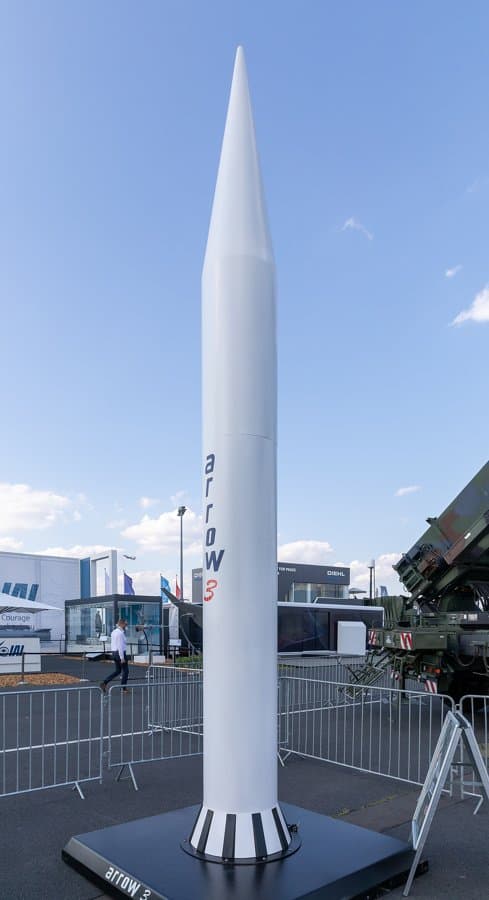
Air defenceIn service
Exoatmospheric anti-ballistic missile Potential anti-satellite weapon
Arrow 3 is a exoatmospheric anti-ballistic missile Potential anti-satellite weapon originating in Israel United States. It was built by Israel Aerospace Industries , Boeing.
 Israel /
 United States
Exoatmospheric anti-ballistic missile Potential anti-satellite weapon
Israel United States
Israel Germany
2024 Iran–Israel conflict Red Sea crisis Twelve-Day War
Israel Aerospace Industries
Israel Aerospace Industries , Boeing
2017–present
Two-stage
> 100 km
Hypersonic
Inertial navigation system (INS) gimbaled seeker
Thrust vectoring
Rapid launch fortified underground silos
Germany
The Arrow 3 or Hetz 3 ( Hebrew : חֵץ 3 , pronounced [ˈχet͡s] or pronounced [ˈħet͡s] ) is an exoatmospheric anti-ballistic missile , jointly funded, developed and produced by Israel and the United States.
The Arrow 3 or Hetz 3 ( Hebrew : חֵץ 3 , pronounced [ˈχet͡s] or pronounced [ˈħet͡s] ) is an exoatmospheric anti-ballistic missile , jointly funded, developed and produced by Israel and the United States. Undertaken by Israel Aerospace Industries (IAI) and Boeing , it is overseen by the Israeli Ministry of Defense's " Homa " ( Hebrew : חומה , pronounced [χoma] , " rampart ") administration and the U.S. Missile Defense Agency . It provides exo-atmospheric interception of ballistic missiles (during the space-flight portion of their trajectory), including intercontinental ballistic missiles (ICBMs) carrying nuclear, chemical, biological or conventional warheads. With divert motor capability, its kill vehicle can switch directions dramatically. It can also be adapted for an anti-satellite role: it has sensors that can pivot 90 degrees in order to detect approaching satellites. The missile's reported flight range is up to 2,400 km (1,500 mi).
IAI began preliminary tests of the Arrow 3 in 2011. The company will not specify what tests were performed, but they are part of the preparations for a full fly-out test. On 23 January 2012, the Israeli Ministry of Defense released photographs and video of the recent successful fly-out tests from Palmachim Airbase . During the tests, a model of the interceptor missile was launched in order to check the starting and propulsion system, as well as other tracking sensors.
On 25 February 2013, a fly-out test of the Arrow 3 was conducted from Palmachim Airbase. The launch tested the missile control and engines. According to a senior defense source, the missile obtained hypersonic speed, and reached an altitude of 100 km (62 mi), entering space. It followed various objects, such as stars , and gained further altitude. Its engine stopped after six minutes.
Arrow 3 should be able to intercept ballistic missiles, especially those carrying weapons of mass destruction , at altitudes of over 100 km (62 mi), and in greater ranges. It could also be ship-based. Arrow 3 is faster than the Arrow 2 and slightly smaller, weighing nearly half.
An Arrow 3 battery is expected to intercept salvos of more than five ballistic missiles within 30 seconds. Arrow 3 can be launched into an area of space before it is known where the target missile is going. When the target and its course are identified, the Arrow interceptor is redirected using its thrust-vectoring nozzle to close the gap and conduct a "body-to-body" interception.
The Arrow 3 or Hetz 3 ( Hebrew : חֵץ 3 , pronounced [ˈχet͡s] or pronounced [ˈħet͡s] ) is an exoatmospheric anti-ballistic missile , jointly funded, developed and produced by Israel and the United States. Undertaken by Israel Aerospace Industries (IAI) and Boeing , it is overseen by the Israeli Ministry of Defense's " Homa " ( Hebrew : חומה , pronounced [χoma] , " rampart ") administration and the U.S. Missile Defense Agency . It provides exo-atmospheric interception of ballistic missiles (during the space-flight portion of their trajectory), including intercontinental ballistic missiles (ICBMs) carrying nuclear, chemical, biological or conventional warheads. With divert motor capability, its kill vehicle can switch directions dramatically. It can also be adapted for an anti-satellite role: it has sensors that can pivot 90 degrees in order to detect approaching satellites. The missile's reported flight range is up to 2,400 km (1,500 mi).
Reference text from Wikipedia contributors, used under CC BY-SA 4.0.
Arrow 3 equipment records. Variants, orders and quantities are shown as reported in each inventory source; coverage is incomplete.
 Germany
Reported Arrow air-defence system holding at battery/fire-unit level. This does not count individual Arrow 3 interceptor missiles, launchers or the planned complete network. Specialist-reported holdings; not an independently audited readiness count.
Reported count for Arrow 3 / Arrow 3 C2. Service scope: equipment of the German Air Force; does not replace a national total. 2 distinct quantity component(s) from the same source list; shared rowspan cells counted once. Explicit source inventory scope: ordered; no other stock status or total inferred. Count column(s): number: + 1 / number: + 1. Origin: Israel United States. The listed variants/roles are the scope, not an immediately deployable count. The components do not establish one inventory census date; the stored date is the retrieved source snapshot.
Keep exploring
Long-range surface-to-air missile Anti-satellite weapon Anti-ballistic missile
 China
Anti-ballistic missile
Mobile anti-ballistic missile system
United StatesSurface-to-air / anti-ballistic missile
Surface-to-air / anti-ballistic missile
Mobile surface-to air / anti-ballistic missile system
 Russia