FORCETALLY
Loading the evidence…
Preparing your view.


Preparing your view.
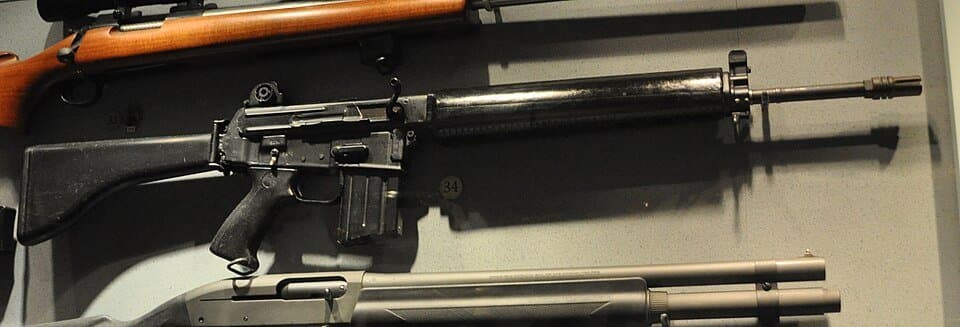
Small armsIn service
Assault rifle Semi-automatic rifle (AR-180)
ArmaLite AR-18 is a assault rifle Semi-automatic rifle (AR-180) originating in United States. It was built by ArmaLite (U.S.) Howa (Japan) Elisco Tool / Eagle Arms (Philippines) Sterling Armaments Company (UK). Reported operators include Botswana, Eswatini, Haiti, Malaysia, United States of America, Pahlavi Iran.
 United States
ArmaLite AR-18
Darkhelmet322 at English Wikipedia · CC BY-SA 3.0 · Resized · CC BY-SA 3.0 · Source ↗ · ModifiedAssault rifle Semi-automatic rifle (AR-180)
United States
See Users
Communist insurgency in Malaysia Lebanese Civil War The Troubles Mexican drug war
Arthur Miller Eugene Stoner (AR-16)
1963
ArmaLite (U.S.) Howa (Japan) Elisco Tool / Eagle Arms (Philippines) Sterling Armaments Company (UK)
1969–1985
1,171 (AR-18) 21,478 (AR-180)
AR-18K AR-18S AR-180 AR-180B Foreign derivatives based upon the AR-18 include the Singaporean SAR-80 , Singaporean/British SAR-87 and the Japanese Howa Type 89 Bullpup adaptations include Australian Bushmaster M17S
6.7 lb (3.0 kg) (empty) 7.18 lb (3.3 kg) (loaded w/20 rd. magazine)
38 in (970 mm)
18.25 in (464 mm) (6-groove rifling)
5.56×45mm NATO
Short-stroke piston , rotating bolt
750 rounds/min
3,250 ft/s (991 m/s)
20, 30, or 40-round detachable box magazine, STANAG magazines (AR-18B)
Iron sights or removable 3× scope
Botswana : Cited as part of their National Inventory by Jane's as of 1986.
Eswatini
Haiti
Malaysia : Used by VAT 69 Commando during early phases of the Communist insurgency in Malaysia (1968–1989) .
United States of America : Los Angeles Police Department SWAT (Full Auto AR-18, AR-18S, and AR-180) Notably used during the 1974 shootout with the Symbionese Liberation Army . Also used by New Orleans Police Department during the New Orleans Sniper Case .
Pahlavi Iran : Tested at least two AR-18s for consideration to the Imperial Iranian Army, but was never adopted.
The ArmaLite-18 (AR-18) is a gas-operated rifle chambered for 5.56×45mm NATO ammunition . The AR-18 was designed at ArmaLite in California by Arthur Miller, Eugene Stoner , George Sullivan, and Charles Dorchester in 1963 as an alternative to the Colt AR-15 design, a variant of which had just been selected by the U.S. military as the M16 .
Soon after the adoption of the 7.62×51mm NATO M14 rifle in 1957, the U.S.
The ArmaLite AR-15 was a scaled-down version of the 7.62mm AR-10 , which had appeared too late to be a serious contender against the M14 for adoption by the US Army.
Its competitor was the Winchester .224 Light Rifle, a "Carbine" Williams prototype carbine design in a .22 high velocity round which was similar to, but not interchangeable with, the .223 Remington (5.56×45mm).
The ArmaLite AR-16 appeared in the later 1950s. The AR-16, a 7.62mm NATO selective-fire rifle, was Eugene Stoner 's final design for ArmaLite. The AR-16 and its predecessor, the AR-12 were designed by Stoner in response to demands by the military forces of smaller, less developed nations for a less expensive, yet state-of-the-art selective-fire military rifle that unlike the AR-10 and AR-15, could be produced inexpensively of heavy-gauge sheet metal using automatic screw machines, lathes, and presses. The AR-12 originally featured a direct-impingement (DI) gas operation system, but this was changed to a more conventional short-stroke gas piston in the AR-16 after ArmaLite sold the production rights to the DI system to Colt Firearms. The AR-16 had a short, 15-inch barrel, hinged wooden butt, and weighed 8.75 pounds empty; only three examples were built. Eugene Stoner left ArmaLite in 1961, shortly before Fairchild divested itself of ownership.
The U.S. military's later adoption of the AR-15 gave legitimacy to its 5.56mm cartridge, and ArmaLite sought to develop a competing design chambered in 5.56mm that did not infringe on the Colt license agreement. With Stoner gone, it was decided to scale down the AR-16, and ArmaLite's new chief designer, Arthur Miller, embarked on the project. The resulting 5.56mm design appeared in 1963 and was named the AR-18. Miller later received U.S. patent 3,246,567 for the rifle in 1969.
Overall, the new AR-18 rifle is much more conventional than previous ArmaLite designs, although it uses the relatively new stamped steel construction from its predecessor, the AR-16. Despite being pioneered by the Germans during WW2 in weapons such as the MP 44 , and later adopted for the Soviet AKM , the use of stamped and welded sheet metal components was still uncommon in the manufacture of military rifles in the West in the early 1960s, which had, until then, largely retained the use of traditional machined forgings. Compared to the smooth lines of the AR-15, which had demonstrably finer tolerances in parts fit, the AR-18 faced criticism over its stamped and welded construction. However, the rifle proved to be both reliable and very accurate at all ranges up to 460 metres (500 yards). Its simple construction promised significantly reduced production costs, and allowed it to be license-produced locally on less advanced machinery, potentially reducing dependence on foreign manufacturers.
The bolt itself is of similar configuration to the AR-15 with seven radial locking lugs engaging corresponding recesses in the barrel extension, and the extractor in place of the eighth lug.
The British Ministry of Defence (MOD) tested the AR-18 in March 1966, and found the design unsatisfactory in performance during mud and sand trials.
However, American procurement officials were not interested in acquiring yet another 5.56 mm service rifle.
An Irish rebel song , " Little Armalite ", focuses on the role played by the AR-18 in the Provisional Irish Republican Army campaign . The Armalite company reportedly bought 1000 copies of a recording for its salesmen to distribute. The 1980s Republican political strategy of parallel political and paramilitary campaigns was also christened the " Armalite and ballot box strategy ".
The AR-180 is capable of semi-automatic fire only and was externally identical in appearance to the AR-18 with one exception; the selector has only two positions, omitting the third "AUTO" position found on the AR-18. There are minor differences between the variants; to select "FIRE" on the Howa rifles the selector lever must be pivoted 180 degrees from "SAFE" so it is pointing forward towards the muzzle (where "AUTO" would be on a selective-fire rifle), while on the Sterling rifles, the "SEMI" position is the same as the "SEMI" position on a selective-fire rifle; 90 degrees from "SAFE" with the selector lever pointing down. Towards the end of AR-180 production at ArmaLite's Costa Mesa shop in 1972, some unused AR-18 lowers were used to assemble AR-180s. The "SEMI" and "AUTO" positions were scrubbed and the "AUTO" position was relabeled "FIRE". The selector lever on these particular rifles would have to be pivoted 180 degrees from "SAFE" to "FIRE" the same way as Howa manufactured rifles.
Sterling also manufactured small numbers of a short version, the AR-18S. This version uses the same basic mechanism and folding butt, but has a 257 mm (10.1 in) barrel and a length of 765 mm (30.1 in) with the butt extended. The shortened barrel is fitted with a cone-shaped flash suppressor to address the additional muzzle flash resulting from the short barrel. Some examples have an additional pistol grip fitted to the underside of the handguard.
A 2.75 × 20 mm telescopic sight was available but few were sold. Early-production models are marked in meters rather than yards and have a different reticle. It is marked "ArmaLite", and has a quick-detachable, see-through mount that attaches to an integral dovetail spot-welded to the top of the receiver. The mount could also feasibly be used with other scopes if they had a 1-inch diameter tube.
AR-18 LSW - Light Support Weapon (LSW) prototype with a quick barrel change capability and completed a calibre conversion to 7.62×39mm
In 2019 Brownells, Inc. released the BRN-180 complete upper assembly, a new take on the AR-180 design built around the AR-18 short-stroke piston system. The BRN-180 is designed to be fitted to mil-spec AR-15 lower receivers and unlike standard AR-15s the BRN-180 can be fired with the stock folded. The BRN-180 comes with an adjustable gas block and a free-floating modular handguard and is available in 18.5, 16 and 10.5 in (470, 410 and 270 mm) barrel lengths.
ArmaLite AR-18 5.56×45mm Assault rifle United States
Reference text from Wikipedia contributors, used under CC BY-SA 4.0.
True scale
Sourced dimensions beside a 1.75 m human reference.
See it in your room. Scan with your phone to open this model in 3D, then place it in your space.
Points represent sourced observations, including revisions. Revisions on the same effective date are not separate inventory events. Ranges appear in the table and are not plotted as exact points.
| Observation / report period | Value | Source | Claim state |
|---|---|---|---|
| 28 Sept 2026 | 0.464 m | Wikipedia contributors | superseded |
ArmaLite AR-18 equipment records. Variants, orders and quantities are shown as reported in each inventory source; coverage is incomplete.
Botswana, Eswatini, Haiti, Malaysia, United States of America, Pahlavi Iran
Equipment reference ↗Keep exploring
Assault rifle Semi-automatic rifle (SBC-1, SS1-C)
 Indonesia
Assault rifle Semi-automatic rifle Carbine
United StatesAssault rifle Carbine Semi-automatic rifle
United StatesSemi-automatic rifle
United StatesSemi-automatic rifle
United StatesSemi-automatic rifle
United States Botswana
 Eswatini
 Haiti
 Malaysia