Design and configuration
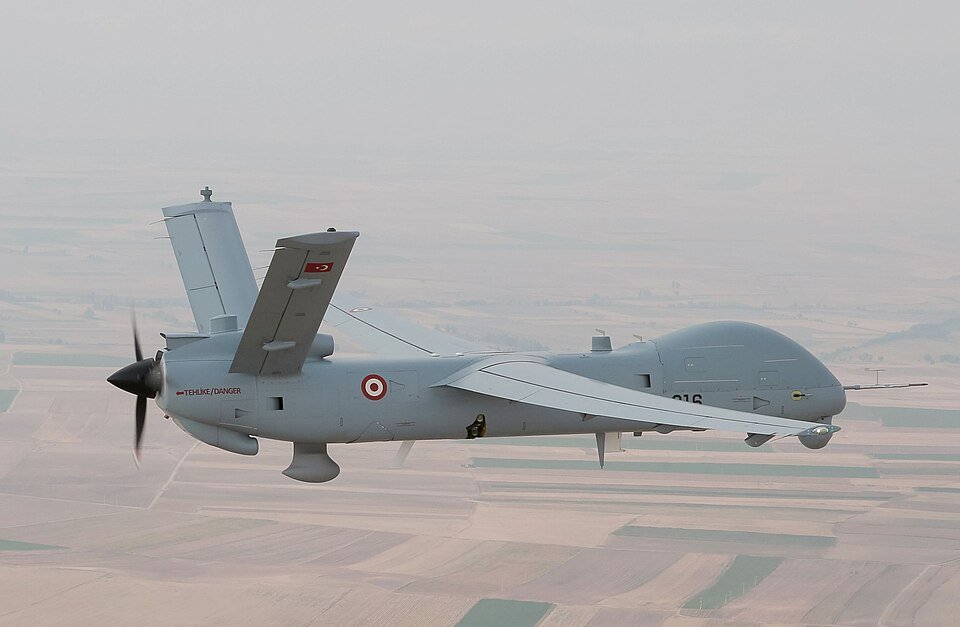
The airframe uses retractable landing gear and a V-tail. The prominent upper fuselage fairing accommodates communications equipment associated with beyond-line-of-sight control.1


Preparing your view.
Drones & UAVsIn serviceProfile in progress
ANKA-S is the satellite-linked member of the ANKA unmanned-aircraft programme. A rear propeller and long wing support medium-altitude observation and other payload tasks.
 Turkey
Technical data
The system in detail
The airframe uses retractable landing gear and a V-tail. The prominent upper fuselage fairing accommodates communications equipment associated with beyond-line-of-sight control.1
Turkish Aerospace lists electro-optical, radar, signals-intelligence and relay options. Their inclusion in the product catalogue does not mean every aircraft carries them simultaneously.1
The current ANKA page supplies programme figures. ANKA-S installation details should remain separate from ANKA III, which is a different flying-wing aircraft.1
The advertised link ranges are not endurance distances. Compare sensor mass, electrical demand and the actual communications installation alongside flight performance.1
Visual reference
Unmanned combat aerial vehicle
Turkey
Turkish Aerospace Industries
In service
Turkish Air Force General Directorate of Security (Turkey)
102
2010 - present
16 July 2010
30 December 2010
TAI Aksungur
0 on board
8.6 m (28 ft 3 in)
350 kg (772 lb)
1 × 170 hp (130 kW) TEI-PD170
~217 kilometres per hour (117 kn)
~204 kilometres per hour (110 kn)
30,000 ft (9,144 m)
Up to 30 hours
17.5 m (57 ft 5 in)
1,700 kg (3,750 lb)
3-bladed propeller
Diesel and JP-8 jet fuel
Line-of-sight propagation : > 250 kilometres (155 mi) Satellite Communications (SATCOM): > 2,500 kilometres (1,553 mi)
> 250 kilometres (155 mi)
> 2,500 kilometres (1,553 mi)
Reference text from Wikipedia contributors, used under CC BY-SA 4.0.
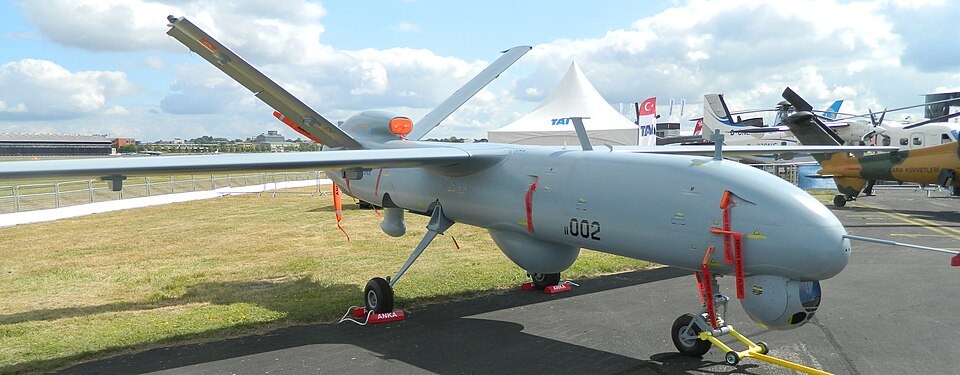
TAI Anka UAV on display at 2014 Farnborough Air Show Historical equipment reference photograph. It does not establish current availability or every detail of the named variant.
MilborneOne · CC BY-SA 4.0 · Wikimedia Commons · CC BY-SA 4.0 · Source ↗ · ModifiedANKA equipment records. Variants, orders and quantities are shown as reported in each inventory source; coverage is incomplete.
 Chad
ChadNumber column of the Wikipedia list table under "UAV". The list's own wording applies; it is a compiled secondary source, not an official census.
 Kazakhstan
Reported count for TAI Anka · Anka-S. Country-wide list; no individual service specified. 1 distinct count cell(s) from the same source list; shared rowspan cells counted once. Retired, wholly reserve and on-order rows are excluded; the reported count retains any explicitly mixed stock scope in the quoted row. Count column(s): quantity: 3. Origin: Turkey. The listed variants/roles are the scope, not an immediately deployable count. Dates are the count-cell citations' stated source period (2024), not the article revision. 2024 cited source edition. Edition or publication years do not claim an exact inventory census day.
 Libya
LibyaReported count for TAI Anka-S. Service scope: Libyan Air Force; does not replace a national total. 1 distinct count cell(s) from the same source list; shared rowspan cells counted once. Retired, wholly reserve and on-order rows are excluded; the reported count retains any explicitly mixed stock scope in the quoted row. Count column(s): quantity: 12. Origin: Turkey. The listed variants/roles are the scope, not an immediately deployable count. The components do not establish one inventory census date; the stored date is the retrieved source snapshot.
 Malaysia
Reported count for TAI Anka · Anka-S. Service scope: Royal Malaysian Air Force; does not replace a national total. 1 distinct count cell(s) from the same source list; shared rowspan cells counted once. Retired, wholly reserve and on-order rows are excluded; the reported count retains any explicitly mixed stock scope in the quoted row. Count column(s): in service: 3. Origin: Turkey. The listed variants/roles are the scope, not an immediately deployable count. Dates are the count-cell citations' stated source period (2025), not the article revision. Cited source 2025-08-17; Cited source 2025-06-06. Edition or publication years do not claim an exact inventory census day.
 Pakistan
 Tunisia
Reported count for TAI Anka · Anka S. Service scope: Tunisian Air Force; does not replace a national total. 1 distinct count cell(s) from the same source list; shared rowspan cells counted once. Retired, wholly reserve and on-order rows are excluded; the reported count retains any explicitly mixed stock scope in the quoted row. Count column(s): in service: 6. Origin: Turkey. The listed variants/roles are the scope, not an immediately deployable count. Dates are the count-cell citations' stated source period (2023), not the article revision. Cited source 2023-05-24. Edition or publication years do not claim an exact inventory census day.
TürkiyeReported count for TAI Anka · B / S. Service scope: Turkish Air Force aircraft; does not replace a national total. 1 distinct count cell(s) from the same source list; shared rowspan cells counted once. Retired, wholly reserve and on-order rows are excluded; the reported count retains any explicitly mixed stock scope in the quoted row. Count column(s): in service: 36. Origin: Turkey. The listed variants/roles are the scope, not an immediately deployable count. Dates are the count-cell citations' stated source period (2022), not the article revision. Cited source 2022-06-07. Edition or publication years do not claim an exact inventory census day.
 Uzbekistan
Turkish Air Force General Directorate of Security (Turkey)
Equipment reference ↗Reported count for TAI Anka · Anka-B / TAI Anka · Anka-S. Service scope: Turkish Naval Forces; does not replace a national total. 2 distinct count cell(s) from the same source list; shared rowspan cells counted once. Retired, wholly reserve and on-order rows are excluded; the reported count retains any explicitly mixed stock scope in the quoted row. Count column(s): quantity: 4 / quantity: 4. Origin: Turkey. The listed variants/roles are the scope, not an immediately deployable count. The components do not establish one inventory census date; the stored date is the retrieved source snapshot.