FORCETALLY
Loading the evidence…
Preparing your view.


Preparing your view.
Radar & sensorsIn service
weapon-locating radar
AN/TPQ-36 Firefinder radar is documented in the equipment reference catalogue. It was built by Northrop Grumman. Reported operators include Australia, Chile, Netherlands, Portugal, Pakistan, Spain, Sri Lanka, Türkiye, Ukraine, United States.
 United States
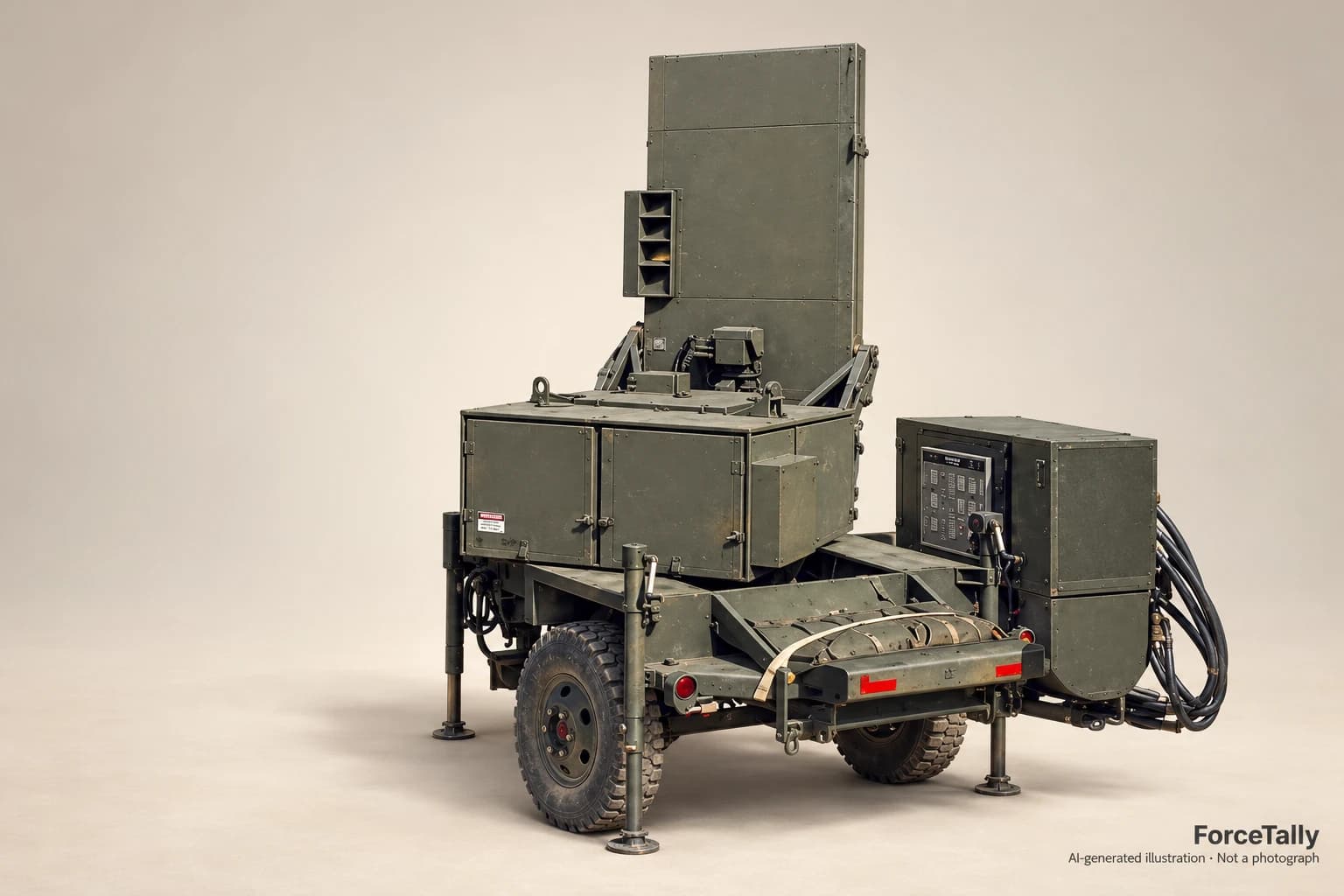
AI-generated illustration · Not a photograph · AN/TPQ-36 Firefinder radar — illustrated source-pictured deployed radar and wheeled trailer assembly in Serbia. Exterior details are illustrative, not specification evidence.
ForceTally · AI-generated illustration · Not a photograph · Adapted from US Air Force · Public domain · OpenAI output terms · Source ↗ · ModifiedAustralia : Used by Australian Defence Force
Chile : Used by Chilean Army
Netherlands : Used by Royal Netherlands Army
Portugal : Used by Portuguese Army ( 5th Artillery Regiment )
Pakistan : Used by Pakistan Army .
Spain : Used by Spanish Army
Sri Lanka : Used by Sri Lankan Army
Turkey : Used by Turkish Land Forces
Ukraine : Two units delivered by US Army in 2015. Five units delivered by the Netherlands Ministry of Defence in March 2022, during the 2022 Russian invasion of Ukraine . Ten units delivered by US Army on April 13, 2022, three more deliveries on May 19, during the 2022 Russian invasion of Ukraine .
United States : Used by United States Army , United States Marine Corps
AN/TPQ-36 Firefinder weapon locating system is a transportable radar developed in the mid-late 1970s by Hughes Aircraft Company , manufactured by Northrop Grumman and ThalesRaytheonSystems .
AN/TPQ-36 Firefinder weapon locating system is a transportable radar developed in the mid-late 1970s by Hughes Aircraft Company , manufactured by Northrop Grumman and ThalesRaytheonSystems . After testing the system achieved initial operational capability (IOC) in May 1982. The Pathfinder is a " weapon-locating radar ", designed to detect and track incoming mortar, artillery and rocket fire determining the point of origin for counter-battery fire . It is currently in service at battalion and higher levels in the United States Army , United States Marine Corps , Australian Army , Portuguese Army , Turkish Army , Armed Forces of Ukraine , and the Chilean Army . It is typically trailer-mounted and towed.
The AN/TPQ-36 is a passive electronically scanned array (PESA) electronically steered radar, meaning the radar antenna does not actually move while in operation. The radar antenna may however be moved manually if required. The system may also be operated in a friendly fire mode to determine the accuracy of counterbattery return fire, or for conducting radar registration or mean point of impact calibrations for friendly artillery.
Its maximum range is 15 miles (24 km) with an effective range of 11 miles (18 km) for artillery and 15 miles (24 km) for rockets. Its azimuth sector is 90°. It operates in the X-band at 32 frequencies. Peak transmitted power is 23 kW, min.
Its maximum range is 15 miles (24 km) with an effective range of 11 miles (18 km) for artillery and 15 miles (24 km) for rockets. Its azimuth sector is 90°. It operates in the X-band at 32 frequencies. Peak transmitted power is 23 kW, min.
Its maximum range is 15 miles (24 km) with an effective range of 11 miles (18 km) for artillery and 15 miles (24 km) for rockets. Its azimuth sector is 90°. It operates in the X-band at 32 frequencies. Peak transmitted power is 23 kW, min.
Its maximum range is 15 miles (24 km) with an effective range of 11 miles (18 km) for artillery and 15 miles (24 km) for rockets. Its azimuth sector is 90°. It operates in the X-band at 32 frequencies. Peak transmitted power is 23 kW, min.
Its maximum range is 15 miles (24 km) with an effective range of 11 miles (18 km) for artillery and 15 miles (24 km) for rockets. Its azimuth sector is 90°. It operates in the X-band at 32 frequencies. Peak transmitted power is 23 kW, min.
Its maximum range is 15 miles (24 km) with an effective range of 11 miles (18 km) for artillery and 15 miles (24 km) for rockets. Its azimuth sector is 90°. It operates in the X-band at 32 frequencies. Peak transmitted power is 23 kW, min.
Its maximum range is 15 miles (24 km) with an effective range of 11 miles (18 km) for artillery and 15 miles (24 km) for rockets. Its azimuth sector is 90°. It operates in the X-band at 32 frequencies. Peak transmitted power is 23 kW, min.
AN/TPQ-36 Firefinder weapon locating system is a transportable radar developed in the mid-late 1970s by Hughes Aircraft Company , manufactured by Northrop Grumman and ThalesRaytheonSystems .
Engineering development of the TPQ-36 began October 1973. Although full scale production was approved in December 1977, the system did not achieve full scale production until August 1978. Low rate initial production (LRIP) began in December 1976 ending in February 1981. Total crew size required for missions and operational requirements for extended periods was initially estimated at 8 personnel.
Its maximum range is 15 miles (24 km) with an effective range of 11 miles (18 km) for artillery and 15 miles (24 km) for rockets. Its azimuth sector is 90°. It operates in the X-band at 32 frequencies. Peak transmitted power is 23 kW, min.
It features permanent storage for 99 targets, has a field exercise mode and uses a digital data interface.
AN/TPQ-36 Firefinder United States Counter-battery radar Raytheon 1996 10
Reference text from Wikipedia contributors, used under CC BY-SA 4.0.
Points represent sourced observations, including revisions. Revisions on the same effective date are not separate inventory events. Ranges appear in the table and are not plotted as exact points.
| Observation / report period | Value | Source | Claim state |
|---|---|---|---|
| 1 Oct 2026 | 23 kW | Wikipedia contributors | superseded |
| 1 Oct 2026 | 23 kW | Wikipedia contributors | superseded |
| 1 Oct 2026 | 23 kW | Wikipedia contributors | superseded |
| 1 Oct 2026 | 23 kW | Wikipedia contributors | approved |
AN/TPQ-36 Firefinder radar equipment records. Variants, orders and quantities are shown as reported in each inventory source; coverage is incomplete.
 Australia
 Chile
 Jordan
 Netherlands
 Pakistan
 Portugal
 Singapore
Reported count for AN/TPQ-36 Firefinder. Service scope: Singapore Army; does not replace a national total. 1 distinct count cell(s) from the same source list; shared rowspan cells counted once. Retired, wholly reserve and on-order rows are excluded; the reported count retains any explicitly mixed stock scope in the quoted row. Count column(s): quantity: 20. Origin: United States. The listed variants/roles are the scope, not an immediately deployable count. The components do not establish one inventory census date; the stored date is the retrieved source snapshot.
 South Korea
Reported count for AN/TPQ-36 Firefinder. Service scope: Republic of Korea Army; does not replace a national total. 1 distinct count cell(s) from the same source list; shared rowspan cells counted once. Retired, wholly reserve and on-order rows are excluded; the reported count retains any explicitly mixed stock scope in the quoted row. Count column(s): quantity: 10. Origin: United States. The listed variants/roles are the scope, not an immediately deployable count. Dates are the count-cell citations' stated source period (2014), not the article revision. Cited source 2014-12-15. Edition or publication years do not claim an exact inventory census day.
 Spain
 Sri Lanka
 Thailand
 Türkiye
 Ukraine United States
Australia, Chile, Netherlands, Portugal, Pakistan, Spain, Sri Lanka, Türkiye, Ukraine, United States
Equipment reference ↗ India
 Sweden
 Germany