Design and configuration
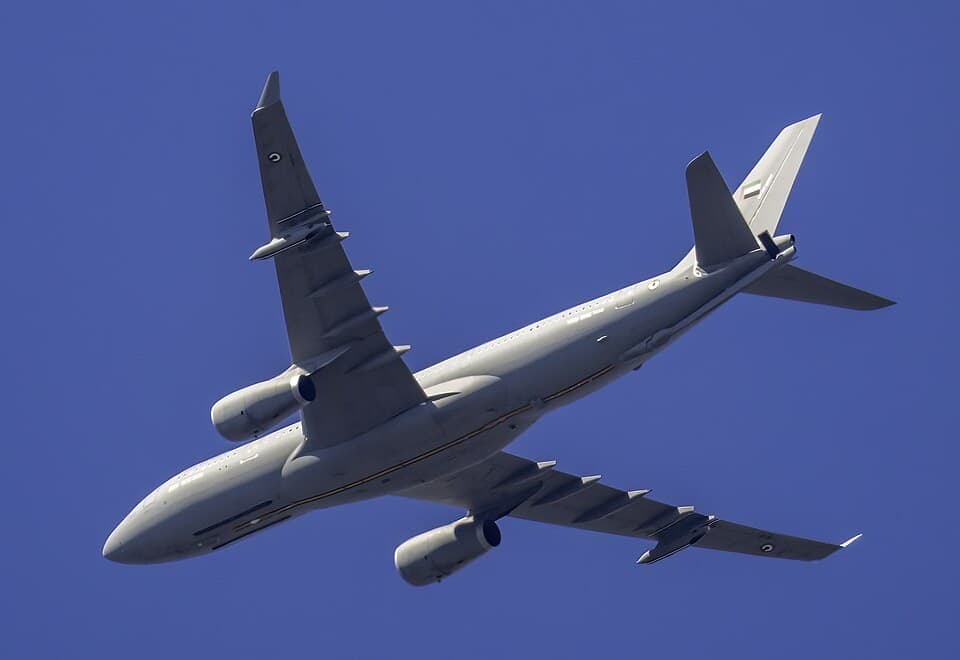
Two underwing engines and a swept low wing define the baseline A330-derived airframe. Refuelling equipment and communications installations differ between national fleets.1


Preparing your view.
Support aircraftIn serviceProfile in progress
The A330 MRTT adapts a widebody airliner for aerial refuelling and transport. Its large fuel capacity supports receiver aircraft while the cabin can retain passenger or medical functions.
United Arab Emirates Air Force Airbus A330 MRTT approaching Washington Dulles International Airport, from Maryland Historical equipment reference photograph. It does not establish current availability or every detail of the named variant.
Acroterion · CC BY-SA 4.0 · Wikimedia Commons · CC BY-SA 4.0 · Source ↗ · ModifiedTechnical data
Voyager KC2/3 KC-30 KC-330 Cygnus CC-330 Husky
Multi-role tanker / transport
Airbus Defence and Space
In service
French Air and Space Force Royal Air Force Royal Netherlands Air and Space Force See Operators section for others
66 delivered as of 28 February 2026 91 ordered as of 3 August 2026
2007–present
1 June 2011
15 June 2007
Airbus A330
Airbus CC-330 Husky EADS/Northrop Grumman KC-45
A330 MRTT+
2 pilots 1 AAR (additional crews when used on transport, medical or other types of missions)
125,000 kg (276,000 lb)
233,000 kg (514,000 lb)
58.80 m (192 ft 11 in)
17.40 m (57 ft 1 in)
60.30 m (197 ft 10 in)
362.0 m 2 (3,897 sq ft)
111,000 kg (245,000 lb)
2 × Rolls-Royce Trent 772B 2 × 316 kN (71,000 lbf)
870 km/h (540 mph; 470 kn)
8,700 nmi (16,100 km; 10,000 mi)
12,500 m (41,000 ft)
Crew 2 pilots 1 AAR (additional crews when used on transport, medical or other types of missions)
Empty weight 125,000 kg (276,000 lb) N/A
MTOW 233,000 kg (514,000 lb) 251,000 kg (553,000 lb)
Length 58.80 m (192 ft 11 in) 58.38 m (191 ft 6 in)
Height 17.40 m (57 ft 1 in) 17.39 m (57 ft 1 in)
Wingspan 60.30 m (197 ft 10 in) 64.00 m (210 ft 0 in)
Wing area 362.0 m 2 (3,897 sq ft) 372 m 2 (4,000 sq ft)
Fuel capacity 111,000 kg (245,000 lb) 139.09 m 3 (4,912 ft 3 ) (111,800 to 116,800 kg (246,500 to 257,500 lb))
Engines 2 × Rolls-Royce Trent 772B 2 × 316 kN (71,000 lbf) Rolls-Royce Trent 7000 320 kN (72,000 lbf)
2 × General Electric CF6 (80E1A3 or E1A4B variants) 320 kN (72,000 lbf)
2 × Pratt & Whitney PW 4168A 2 × 305 kN (69,000 lbf)
Fuel offload (various mission scenarios) 70,000 kg (150,000 lb) at 1,250 nmi (2,320 km; 1,440 mi) from base, with 1 hours on station N/A
65,000 kg (143,000 lb) at 1,000 nmi (1,900 km; 1,200 mi) from base, with 2 hours on station
50,000 kg (110,000 lb) at 1,000 nmi (1,900 km; 1,200 mi) from base, with 4 hours on station
Ferry flight support of 4 fighter aircraft on a 2,800 nmi (5,200 km; 3,200 mi) flight
Refuelling pods (under wings) 2 × Cobham 905E Used to refuel transport aircraft with a probe ( A400M , C295 ) Maximum fuel flow: 1,300 kg/min (2,900 lb/min) Hose length: 25.90 m (85.0 ft) Operating envelope: 185 to 350 kn (343 to 648 km/h; 213 to 403 mph) N/A
Under-fuselage refuelling units 1 × Cobham 805E FRU Used to refuel transport aircraft with a probe ( A400M , C295 ) Maximum fuel flow: 1,800 kg/min (4,000 lb/min) Hose length: 25.90 m (85.0 ft) Operating envelope: 185 to 350 kn (343 to 648 km/h; 213 to 403 mph) N/A
Refuelling boom (under fuselage) 1 × Airbus Military ARBS Used to refuel aircraft equipped with a receptacle Maximum fuel flow: 3,600 kg/min (7,900 lb/min) Operating envelope: 180 to 325 kn (333 to 602 km/h; 207 to 374 mph) N/A
Payload (non-fuel) 45,000 kg (99,000 lb) of which 37,000 kg (82,000 lb) in the cargo bay N/A
Transport capacity Two lower deck cargo compartments (forward and aft / rear bulk area) 27 LD3 , or 8 pallets (NATO 2.23 m (88 in)×2.74 m (108 in) Two lower deck cargo compartments (forward and aft / rear bulk area) 27 LD3 , or 8 pallets (NATO 2.23 m (88 in)×2.74 m (108 in)
Passenger capacity Up to 300 passengers Germany: 267 Singapore: 266 , United Kingdom: 291 N/A
Medical configzration capacity 6 intensive care beds + 34 patient beds 20 medical staff seats 100 passengers N/A
Cruise speed 870 km/h (540 mph; 470 kn) 870 km/h (540 mph; 470 kn)
Ferry range 8,700 nmi (16,100 km; 10,000 mi) N/A
Service ceiling 12,500 m (41,000 ft) N/A
The Airbus A330 Multi Role Tanker Transport ( MRTT ) is a European aerial refueling and military transport aircraft based on the civilian Airbus A330 .
The A330 MRTT has a maximum fuel capacity of 111,000 kg (245,000 lb) without the use of additional fuel tanks, leaving space for 45,000 kg (99,000 lb) of additional cargo. The A330 MRTT's wing has common structure with the four-engine A340-200/-300 with reinforced mounting locations and provision for fuel piping for the A340's outboard engines. The A330 MRTT's wing therefore requires little modification to use these hardpoints for the wing refuelling pods .
The A330 MRTT cabin can be modified to carry up to 380 passengers in a single-class configuration, allowing a complete range of configurations from maximised troop transport to complex customisation suitable for VIP and guest missions. Available configurations include 300 passengers in a single class and 266 passengers in two classes. The A330 MRTT can also be configured to perform Medical Evacuation (Medevac) missions; up to 130 standard stretchers can be carried. The main deck cargo configuration allows carriage of standard commercial containers and pallets, military, ISO and NATO pallets (including seats) and containers, and military equipment and other large items which are loaded through a cargo door. Like the A330-200, the A330 MRTT includes two lower deck cargo compartments (forward and aft) and a bulk area capability. The cargo hold has been modified to be able to transport up to eight military pallets in addition to civilian unit load devices (ULDs).
Designated as KC-30A, the RAAF A330 MRTTs are equipped with both an Aerial Refuelling Boom System (ARBS) and two Cobham 905E under-wing refuelling pods. They are powered by two General Electric CF6-80E1A3 engines and are configured to carry up to 270 passengers plus 34,000 kilograms of cargo. Australia initially arranged to procure four MRTTs with an option to obtain a fifth; this option for a fifth was exercised to allow for two simultaneous deployments of two aircraft, the fifth being for contingency coverage. Australian KC-30As are operated by No. 33 Squadron RAAF , based at RAAF Base Amberley near Brisbane in Queensland.
The refit cost £10m but was claimed to save roughly £775,000 annually compared to charter flights.
In February 2012, Singapore expressed interest in the A330 MRTT to replace its four Boeing KC-135s. In February 2014, the Republic of Singapore Air Force (RSAF) selected the MRTT over the Boeing KC-46 , signing for six aircraft. All are fitted with Trent 772B engines and configured for a maximum capacity of 266 passengers or 37,000 kilograms (82,000 lb) of cargo, as well as a maximum fuel weight of 111,000 kilograms (245,000 lb).
The first MRTT arrived in Singapore on 14 August 2018 in a special livery. It made its first public appearance at the RSAF's 50th anniversary parade on 1 September 2018. The RSAF's six MRTTs attained full operational capability (FOC) on 20 April 2021 and currently fly with the 112 Squadron at Changi Air Base (East) in Singapore.
On 19 December 2017, NATO partnered with Israel's Elbit Systems to provide J-Music electronic countermeasures systems to the fleet. Having considered joining the initiative for some time, the Czech Republic joined as the sixth member during October 2019. In September 2020, Luxembourg committed to an extra 1,000 hours and to provide funding for a ninth MRTT via an existing contract option.
In April 2021, Airbus was declared the only qualified supplier to replace Canada's RCAF CC-150 Polaris refuelling and VIP transport aircraft, beating out Boeing's KC-46 Pegasus. In July 2022, a $102M deal was finalised to acquire two used A330-200s from the International Airfinance Corporation for passenger/cargo-only use expected to be converted into MRTTs by Airbus in the future; it was anticipated that up to four more MRTTs would be acquired, for a total of six aircraft. This total was revised in July 2023 to nine, with the fleet being made up of five conversions and four newly manufactured MRTTs in a contract worth C$ 3.6 billion. The A330 MRTTs are designated CC-330 Husky by the RCAF, and the first passenger/cargo-only aircraft was delivered on 31 August 2023 in Ottawa.
On 10 September 2012, an A330 MRTT's refuelling boom detached in flight at an altitude of 27,000 ft (8,200 m) in Spanish airspace. The boom separated cleanly at a mechanical joint and fell to the ground, while the tanker landed safely in Getafe without any injuries. The fault was attributed to a conflict between the backup boom hoist (fitted to the UAE-destined MRTTs) and the primary boom retraction mechanism, as well as to the test conducted. Airbus later explained that the malfunction was not possible under ordinary operating conditions, and that procedures had been implemented to avoid similar incidents in the future. Following the incident, the Instituto Nacional de Técnica Aeroespacial , Spain's airworthiness authority, issued precautionary restrictions to other users of boom-equipped A330s.
On 9 February 2014, a Royal Air Force A330 MRTT Voyager carrying 189 passengers and 9 crew from RAF Brize Norton to Camp Bastion suddenly lost 4,440 ft (1,350 m) of altitude in 27 seconds and reaching a maximum descent rate of 15,000 ft/min (4,600 m/min) while the co-pilot was out of the cockpit. The sudden descent caused several injuries to passengers and crew, some of whom struck the ceiling of the aircraft. The co-pilot returned to the cockpit, regained control, and the aircraft diverted to Incirlik Air Base and landed without further incident. The incident resulted in the grounding of the entire RAF Voyager fleet for 12 days until it was determined that the event was caused by the captain's improperly stowed DSLR camera being jammed between the captain's armrest and the side-stick, forcing the stick forward when the captain adjusted his seat forward.
Reference text from Wikipedia contributors, used under CC BY-SA 4.0.
A330 MRTT equipment records. Variants, orders and quantities are shown as reported in each inventory source; coverage is incomplete.
 Australia
Air Force exact named equipment holdings: A330 MRTT (KC-30A). Active, operational-reserve and training units excluding equipment in store; November 2025 IISS assessment. Named service only; no parent-force or national total inferred. Source role: AIRCRAFT / TKR/TPT. Original estimates, ranges, reporting names, reserve, lease and employment scopes retained; nested included counts are not added. Missile-system quantities mean launchers, not rounds. No readiness, crew, carried weapon, payload, factory-production or future order count inherited.
The system in detail
Two underwing engines and a swept low wing define the baseline A330-derived airframe. Refuelling equipment and communications installations differ between national fleets.1
Boom and hose-and-drogue options address different receiver types. Passenger and cargo layouts are configurable; the published maximum payload remains subject to aircraft weight and fuel limits.1
These figures concern the conventional A330 MRTT in the cited 2023 brochure. The newer MRTT+ has a different engine and wing configuration and is not merged into this record.1
Compare offload at a stated radius and endurance. The maximum fuel load is an airframe capacity, not a guarantee of how much fuel can be transferred on every mission.1
Visual reference
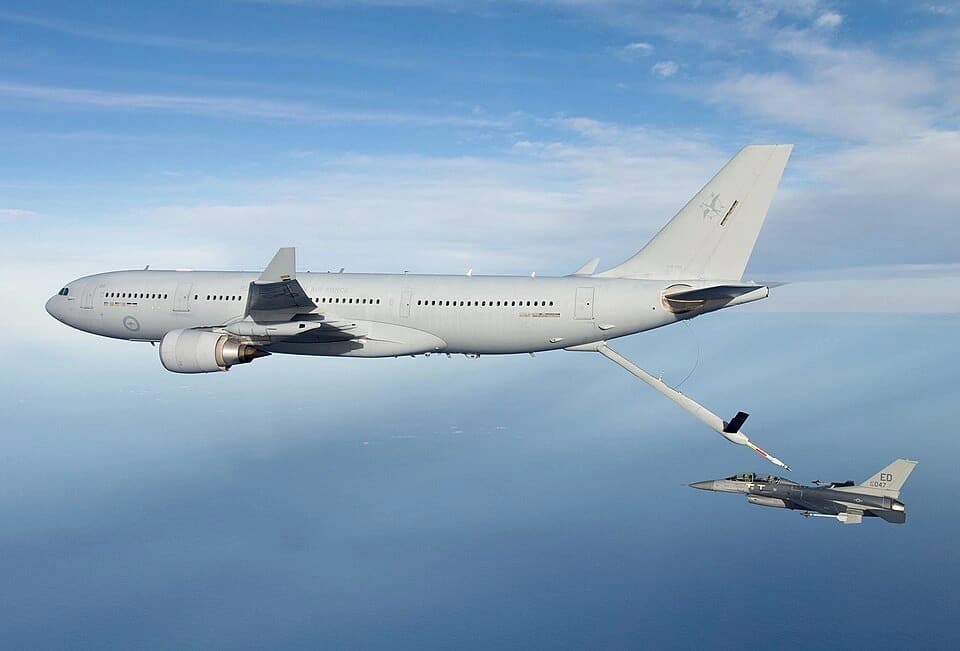
Royal Australian Air Force KC-30 A39-002 refuelling a US Air Force F-16; Airbus A330 MRTT class representative.
U.S. Air Force photo by Christian Turner · Public domain · Resized / WebP display copy · Public domain · Source ↗ · Modified Brazil
Air Force exact named equipment holdings: A330 (to be converted to A330 MRTT). Active, operational-reserve and training units excluding equipment in store; November 2025 IISS assessment. Named service only; no parent-force or national total inferred. Source role: AIRCRAFT / PAX. Original estimates, ranges, reporting names, reserve, lease and employment scopes retained; nested included counts are not added. Missile-system quantities mean launchers, not rounds. No readiness, crew, carried weapon, payload, factory-production or future order count inherited.
 Canada
Royal Canadian Air Force (RCAF) exact named equipment holdings: A330 (CC-330) (VIP). Active, operational-reserve and training units excluding equipment in store; November 2025 IISS assessment. Named service only; no parent-force or national total inferred. Source role: AIRCRAFT / PAX. Original estimates, ranges, reporting names, reserve, lease and employment scopes retained; nested included counts are not added. Missile-system quantities mean launchers, not rounds. No readiness, crew, carried weapon, payload, factory-production or future order count inherited.
 France
Air and Space Force exact named equipment holdings: A330 (VIP). Active, operational-reserve and training units excluding equipment in store; November 2025 IISS assessment. Named service only; no parent-force or national total inferred. Source role: AIRCRAFT / PAX. Original estimates, ranges, reporting names, reserve, lease and employment scopes retained; nested included counts are not added. Missile-system quantities mean launchers, not rounds. No readiness, crew, carried weapon, payload, factory-production or future order count inherited.
Air Strategic Forces Command exact named equipment holdings: A330 MRTT. Active, operational-reserve and training units excluding equipment in store; November 2025 IISS assessment. Named service only; no parent-force or national total inferred. Source role: AIRCRAFT / TKR/TPT. Original estimates, ranges, reporting names, reserve, lease and employment scopes retained; nested included counts are not added. Missile-system quantities mean launchers, not rounds. No readiness, crew, carried weapon, payload, factory-production or future order count inherited.
Air and Space Force exact named equipment holdings: A330 MRTT. Active, operational-reserve and training units excluding equipment in store; November 2025 IISS assessment. Named service only; no parent-force or national total inferred. Source role: AIRCRAFT / TKR/TPT. Original estimates, ranges, reporting names, reserve, lease and employment scopes retained; nested included counts are not added. Missile-system quantities mean launchers, not rounds. No readiness, crew, carried weapon, payload, factory-production or future order count inherited.
Reported count for Airbus A330 MRTT Phénix · A330-200 MRTT. Service scope: Air Force; does not replace a national total. 1 distinct quantity component(s) from the same source list; shared rowspan cells counted once. Explicit source inventory scope: ordered; no other stock status or total inferred. Count column(s): in service: +2. Origin: Spain France Germany. The listed variants/roles are the scope, not an immediately deployable count. The components do not establish one inventory census date; the stored date is the retrieved source snapshot.
 Germany
Reported count for Airbus A330 MRTT Multi-Role Tanker Transport · A330-200 MRTT. Service scope: Aircraft of the German Air Force; does not replace a national total. 1 distinct quantity component(s) from the same source list; shared rowspan cells counted once. Explicit source inventory scope: ordered; no other stock status or total inferred. Count column(s): in service: +3. Origin: France Germany Spain United Kingdom. The listed variants/roles are the scope, not an immediately deployable count. The components do not establish one inventory census date; the stored date is the retrieved source snapshot.
Reported count for A330 MRTT MEDEVAC kit · A330 MRTT. Service scope: Aircraft of the German Air Force; does not replace a national total. 1 distinct count cell(s) from the same source list; shared rowspan cells counted once. Excludes retired/reserve/on-order rows. Count column(s): in service: 1. Origin: European Union. The listed variants/roles are the scope, not an immediately deployable count. The components do not establish one inventory census date; the stored date is the retrieved source snapshot.
 Nigeria
Air Force exact named equipment holdings: A330. Active, operational-reserve and training units excluding equipment in store; November 2025 IISS assessment. Named service only; no parent-force or national total inferred. Source role: AIRCRAFT / PAX. Original estimates, ranges, reporting names, reserve, lease and employment scopes retained; nested included counts are not added. Missile-system quantities mean launchers, not rounds. No readiness, crew, carried weapon, payload, factory-production or future order count inherited.
 Saudi Arabia
Air Force exact named equipment holdings: A330 MRTT. Active, operational-reserve and training units excluding equipment in store; November 2025 IISS assessment. Named service only; no parent-force or national total inferred. Source role: AIRCRAFT / TKR/TPT. Original estimates, ranges, reporting names, reserve, lease and employment scopes retained; nested included counts are not added. Missile-system quantities mean launchers, not rounds. No readiness, crew, carried weapon, payload, factory-production or future order count inherited.
 Singapore
Air Force exact named equipment holdings: A330 MRTT. Active, operational-reserve and training units excluding equipment in store; November 2025 IISS assessment. Named service only; no parent-force or national total inferred. Source role: AIRCRAFT / TKR/TPT. Original estimates, ranges, reporting names, reserve, lease and employment scopes retained; nested included counts are not added. Missile-system quantities mean launchers, not rounds. No readiness, crew, carried weapon, payload, factory-production or future order count inherited.
 South Korea
Air Force exact named equipment holdings: A330 MRTT. Active, operational-reserve and training units excluding equipment in store; November 2025 IISS assessment. Named service only; no parent-force or national total inferred. Source role: AIRCRAFT / TKR/TPT. Original estimates, ranges, reporting names, reserve, lease and employment scopes retained; nested included counts are not added. Missile-system quantities mean launchers, not rounds. No readiness, crew, carried weapon, payload, factory-production or future order count inherited.
 Spain
Air & Space Force exact named equipment holdings: A330 (to be converted to MRTT). Active, operational-reserve and training units excluding equipment in store; November 2025 IISS assessment. Named service only; no parent-force or national total inferred. Source role: AIRCRAFT / PAX. Original estimates, ranges, reporting names, reserve, lease and employment scopes retained; nested included counts are not added. Missile-system quantities mean launchers, not rounds. No readiness, crew, carried weapon, payload, factory-production or future order count inherited.
Air & Space Force exact named equipment holdings: A330 MRTT. Active, operational-reserve and training units excluding equipment in store; November 2025 IISS assessment. Named service only; no parent-force or national total inferred. Source role: AIRCRAFT / TKR/TPT. Original estimates, ranges, reporting names, reserve, lease and employment scopes retained; nested included counts are not added. Missile-system quantities mean launchers, not rounds. No readiness, crew, carried weapon, payload, factory-production or future order count inherited.
 Sweden
Reported count for A330 MRTT MEDEVAC kit · –. Service scope: Swedish Air Force; does not replace a national total. 1 distinct count cell(s) from the same source list; shared rowspan cells counted once. Excludes retired/reserve/on-order rows. Count column(s): in service: 1. Origin: European Union. The listed variants/roles are the scope, not an immediately deployable count. The components do not establish one inventory census date; the stored date is the retrieved source snapshot.
 United Arab Emirates
Air Force exact named equipment holdings: A330 MRTT. Active, operational-reserve and training units excluding equipment in store; November 2025 IISS assessment. Named service only; no parent-force or national total inferred. Source role: AIRCRAFT / TPT/TKR. Original estimates, ranges, reporting names, reserve, lease and employment scopes retained; nested included counts are not added. Missile-system quantities mean launchers, not rounds. No readiness, crew, carried weapon, payload, factory-production or future order count inherited.
 United Kingdom
Reported count for Airbus Voyager. Service scope: Royal Air Force; does not replace a national total. 1 distinct quantity component(s) from the same source list; shared rowspan cells counted once. Explicit source inventory scope: active; no other stock status or total inferred. Count column(s): in service: 14. Origin: Airbus (European, Multinational). The listed variants/roles are the scope, not an immediately deployable count. Dates are the count-cell citations' stated source period (2025), not the article revision. Cited source 2025-10-30. Edition or publication years do not claim an exact inventory census day.
French Air and Space Force Royal Air Force Royal Netherlands Air and Space Force See Operators section for others
Equipment reference ↗ Denmark
 India
 Italy
 Luxembourg
 Netherlands