FORCETALLY
Loading the evidence…
Preparing your view.


Preparing your view.
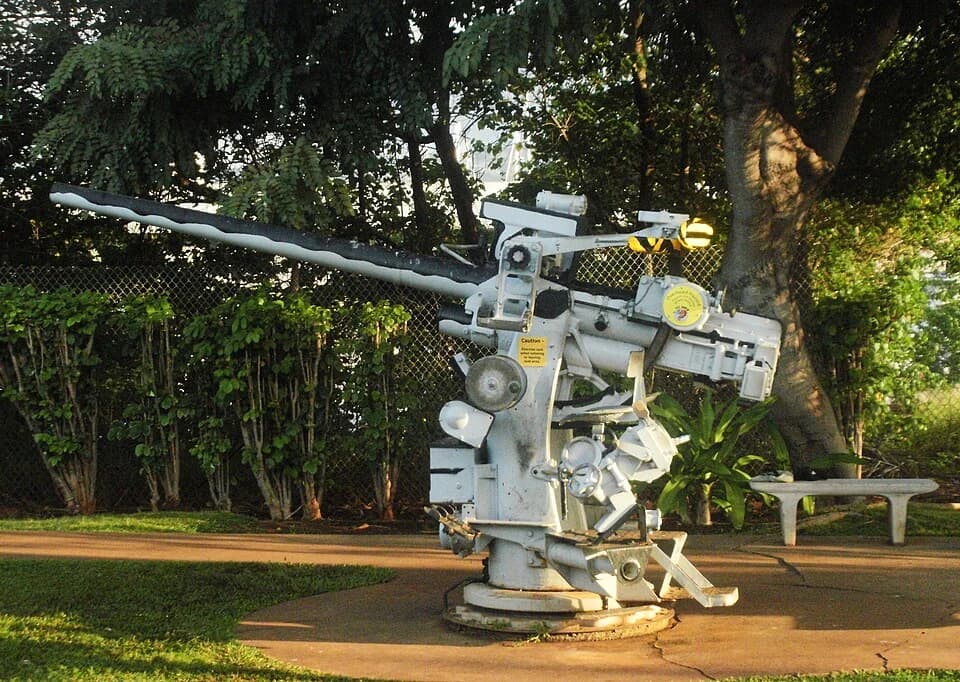
Naval gunsIn service
Naval gun
3-inch/50-caliber gun is a naval gun originating in United States. Reported operators include US Navy.
 United States
Naval gun
United States
1900–1990 (US Navy)
US Navy
Mark 2 : 1898 * Mark 10 : 1915 * Mark 22 : 1944
1900–1948
Marks 2, 3, 5, 6, 8, 10, 17, 18, 19, 20, 21, and 22
Mark 2 : 2,086 pounds (946 kg) (with breech) Mark 21 : 1,760 pounds (800 kg)
Mark 2 : 153.8 inches (3.91 m) Mark 21 : 159.7 inches (4.06 m)
Mark 2 : 150 inches (380 cm) bore (50 calibers ) Mark 21 : 150.3 inches (382 cm) bore (50 calibres)
complete round: 24 lb (11 kg); projectile weight: 13 lb (5.9 kg) projectile types: AP , AA (with VT proximity fuze), HE, Illumination
3-inch (76 mm)
Pedestal Mount : -10° to +15° AA Mount : -10° to +85°
360°
Mark 2 : 15 – 20 rounds per minute Mark 22 : 45 – 50 rounds per minute with autoloader
2,700 ft/s (820 m/s)
14,600 yd (13,400 m) at 43° elevation 30,400 ft (9,300 m) AA ceiling
Peep-site and Optical telescope
The 3-inch/50-caliber gun (spoken "three-inch fifty-caliber") in United States naval gun terminology indicates the gun fired a projectile 3 inches (76 mm) in diameter, and the barrel was 50 calibers long (barrel length is 3 in × 50 = 150 in or 3.8 m). Different guns (identified by Mark numbers) of this caliber were used by the U.S. Navy and U.S. Coast Guard from 1900 through to 1990 on a variety of combatant and transport ship classes.
The US Navy's first 3-inch/50- caliber gun (Mark 2) was an early model with a projectile velocity of 2,100 feet (640 m) per second. Low-angle (single-purpose/non-anti-aircraft) mountings for this gun had a range of 7,000 yards (6,400 m) at the maximum elevation of 15 degrees. The gun entered service around 1900 with the Bainbridge -class destroyers , and was also fitted to Connecticut -class battleships . By World War II , these guns were found only on a few Coast Guard cutters and defensively equipped merchant ships .
Low-angle 3 inch/50-caliber guns (Marks 3, 5, 6, and 19) were originally mounted on ships built from the early 1900s through the early 1920s and were carried by submarines, auxiliaries, and merchant ships during World War II. These guns fired the same 2,700-foot-per-second (820 m/s) ammunition used by the following dual-purpose Marks, but with range limited by the maximum elevation of the mounting. These were built-up guns with a tube, partial-length jacket, hoop and vertical sliding breech block.
These dual-purpose guns were " quick-firing ", meaning that they used fixed ammunition, with powder case and projectile permanently attached, and handled as a single unit weighing 34 pounds (15 kg), as opposed to older guns and/or heavier guns, in which the shell and powder are handled and loaded separately, which reduces the weight of each handled component, but slows the loading process. The shells alone weighed about 13 pounds (5.9 kg), including an explosive bursting charge of 0.81 pounds (0.37 kg) for anti-aircraft (AA) rounds or 1.27 pounds (0.58 kg) for high-capacity (HC) rounds, the remainder of the weight being the steel casing. Maximum range was 14,600 yards (13,400 m) at 45 degrees elevation and ceiling was 29,800 feet (9,100 m) at 85 degrees elevation. Useful life expectancy was 4300 effective full charges (EFC) per barrel.
During the final year of the Second World War , it was found that multiple hits from Oerlikon 20 mm cannon and Bofors 40 mm guns were often unable to shoot down high-speed Japanese kamikaze aircraft at short ranges before they hit Allied ships; the 3-inch/50-caliber gun was adopted as a more powerful replacement for these weapons.
The 3-inch/50-caliber gun (Mark 22) was a semiautomatic anti-aircraft weapon with a power-driven automatic loader and was fitted as single and twin mounts. The single mount was to be exchanged for a twin 40 mm antiaircraft gun mount, and the twin 3-inch/50 for a quadruple 40 mm mount, on Essex -class aircraft carriers , and Allen M. Sumner and Gearing -class destroyers . Although intended as a one-for-one replacement for the 40 mm mounts, the new 3-inch (76 mm) mounts were heavier than expected, and on most ships, the mounts could only replace Bofors guns on a two-for-three basis. The mounts were of the dual purpose, open-base-ring type and the right and left gun assemblies were identical. The mounts used a common power drive that could train at a rate of 30 degrees/second and elevate from 15 degrees to 85 degrees at a rate of 24 degrees/second. The cannon was fed automatically from an on-mount magazine which was replenished by two loaders on each side of the cannon.
With proximity fuze and fire-control radar , a twin 3-inch/50 mount firing 50 rounds per minute per barrel was considered more effective than a quad Bofors 40 mm gun against subsonic aircraft, but relatively ineffective against supersonic jets and cruise missiles . Destroyers that were modernized during the Fleet Rehabilitation and Modernization (FRAM) program of the 1960s had their 3-inch (76 mm) guns removed. Experimentation with an extended range variant the fully automatic 3"/70 Mark 26 gun was abandoned as shipboard surface-to-air missiles were developed. The United States Navy considered contemporary 5-inch/38-caliber guns and 5-inch/54-caliber Mark 42 guns more effective against surface targets. In 1992, the 3-inch/50-caliber main battery on USCGC Storis was removed and was supposedly the last 3-inch/50-caliber gun in service aboard any US warship, although US Navy Charleston -class amphibious cargo ships retained their forward mounts until USS El Paso (LKA-117) was decommissioned in 1994. The gun is still in service on warships of the Philippine Navy .
Destroyer escorts were a relative late-comer with production commencing in 1942 and were all mass-produced. They were quick to build and entered service in 1943. Later war-time classes had a main armament of two 5-inch/38 , APD conversions had one such gun. Separation into classes is a result of different propulsion systems used and whether or not torpedoes were carried. 3 guns per vessel probably all manually loaded Mark 21 or Mark 22 65 Evarts (diesel-electric, short hull, no torpedoes) 102 Buckley (turbo-electric, 3 torpedoes) 37 converted to APDs after commissioning, all 3-inch guns removed 72 Cannon (diesel-electric, 3 torpedoes) 85 Edsall (geared diesel, 3 torpedoes) 78 Captain -class frigates 32 of 97 Evarts and 46 of 148 Buckley converted before commissioning, all 3-inch guns retained 75 Tacoma -class frigates (3 guns per ship) essentially a destroyer escort with a merchant hull and triple expansion steam engines) 21 Colony -class frigates (3 guns per ship) 21 of 96 Tacoma in Royal Navy service
Patrol boats of less than 1000 tons, some of which were wooden boats . These minesweepers were equipped with anti-submarine warfare equipment and their designs are closely related to the submarine chasers. Submarine chasers can be characterized as smaller, cheaper, coastal waters destroyer escorts. All ships in this group used diesel propulsion. 2 Raven -class minesweepers (1 per boat) 343 PC-461 -class submarine chasers (1 or 2 per boat) 123 Admirable -class minesweepers (1 per boat) 68 PCE-842 -class patrol crafts (1 per boat 95 Auk -class minesweepers (1 per boat) 481 YMS-1 -class yard minesweepers (1 per boat)
The example on display was made by Continental Can Co. Inc. Chicago, ILL in 1943.
The museum's other example was made by G.M. Corp. Fisher Body Div in 1942 and is now at Fagen Fighters WWII Museum in Granite Falls, Minnesota.
The 3"/50 was used on virtually every US Naval ship in WWII and the Cold War era.
They remained in limited use until the early 1990s on some smaller US Naval vessels and a few are still in use in other navies and as shore mounted salute guns.
The 3"/50 was primarily an anti-aircraft gun on larger ships and was the main gun on Destroyer Escorts and other smaller vessels.
In Naval nomenclature 3-inch/50 Caliber means the barrel has a 3" bore diameter and the barrel is 50 caliber diameters long ie 3"x 50" or 150" long.
Duel purpose refers to the cannon being used for both direct fire and anti-aircraft use. Quick Firing refers to the ammunition projectile and case being "fixed" together in one piece so that loading is quick.
Calibre 3 pouces ( 76 mm )
Calibre 3 pouces ( 76 mm )
重量 Mark 2 : 2,086磅(946公斤) (附後膛) Mark 21 : 1,760磅(800公斤)
槍管 长度 Mark 2 : 150英寸(380厘米) bore (50 calibres ) Mark 21 : 150.3英寸(382厘米) bore (50 calibres)
重量 Mark 2 : 2,086磅(946公斤) (附後膛) Mark 21 : 1,760磅(800公斤)
槍管 长度 Mark 2 : 150英寸(380厘米) bore (50 calibres ) Mark 21 : 150.3英寸(382厘米) bore (50 calibres)
Reference text from Wikipedia contributors, used under CC BY-SA 4.0.
True scale
Sourced dimensions beside a 1.75 m human reference.
The example on display was made by Continental Can Co. Inc. Chicago, ILL in 1943.
The museum's other example was made by G.M. Corp. Fisher Body Div in 1942 and is now at Fagen Fighters WWII Museum in Granite Falls, Minnesota.
3-inch/50-caliber gun equipment records. Variants, orders and quantities are shown as reported in each inventory source; coverage is incomplete.
 Thailand
 United Kingdom
 Italy
 Sweden
 France