FORCETALLY
Loading the evidence…
Preparing your view.


Preparing your view.
Technical data
Points represent sourced observations, including revisions. Revisions on the same effective date are not separate inventory events. Ranges appear in the table and are not plotted as exact points.
| Observation / report period | Value | Source | Claim state |
|---|---|---|---|
| 28 Sept 2026 | 120 mm | Wikipedia contributors | superseded |
| 28 Sept 2026 | 120 mm | Wikipedia contributors | superseded |
| 28 Sept 2026 | 120 mm | Wikipedia contributors | superseded |
| 28 Sept 2026 | 120 mm | Wikipedia contributors | superseded |
| 28 Sept 2026 | 120 mm | Wikipedia contributors | superseded |
| 28 Sept 2026 | 120 mm | Wikipedia contributors | superseded |
| 28 Sept 2026 | 120 mm | Wikipedia contributors | superseded |
| 28 Sept 2026 | 120 mm | Wikipedia contributors | superseded |
| 28 Sept 2026 | 120 mm | Wikipedia contributors | superseded |
| 28 Sept 2026 | 120 mm | Wikipedia contributors | superseded |
| 28 Sept 2026 | 120 mm | Wikipedia contributors | superseded |
| 28 Sept 2026 | 120 mm | Wikipedia contributors | approved |
Heavy Mortar
France
16–18.7 kg (35–41 lb)
120 mm
10 rounds per minute (maximum) 4 rounds per minute (sustained)
8,140 m (8,900 yd) with standard projectile 12,850 m (14,050 yd) with rocket-assisted projectile
17 km (19,000 yd) with Precision Extended Range Munition (PERM)
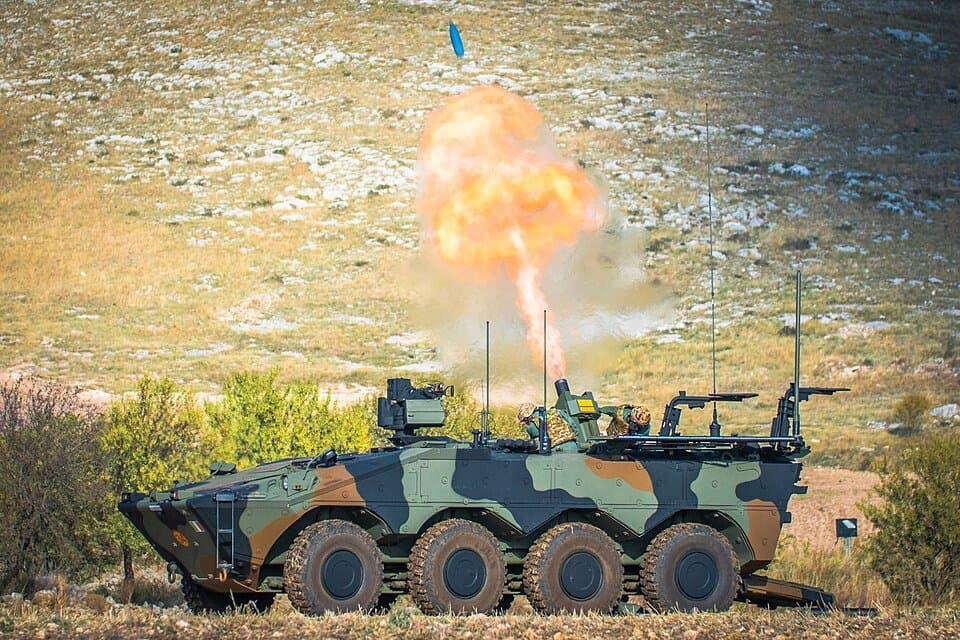
The 2R2M ( Rifled Recoiled Mounted Mortar ) is a vehicle-mounted, rifled 120 mm heavy mortar produced by Thales of France.
The 2R2M ( Rifled Recoiled Mounted Mortar ) is a vehicle-mounted, rifled 120 mm heavy mortar produced by Thales of France.
The 2R2M is in service with 5 nations.
The 2R2M ( Rifled Recoiled Mounted Mortar ) is a vehicle-mounted, rifled 120 mm heavy mortar produced by Thales of France. It is derived from the MO-120-RT towed mortar. The 2R2M is in service with 5 nations.
The US Marine Corps Warfighting Laboratory (MCWL) started a Concept Demonstrator project in 1997. They wanted a "mortar in a box," that is a weapon that could be remotely emplaced and fired unattended on a future battlefield. In late 1997, MCWL accepted a proposal by the army's Program Manager, Mortars (PM Mortars) and Armament Research, Development, and Engineering Command (ARDEC) at Picatinny Arsenal , New Jersey to design and build a firing system to fulfill the design objectives. An early requirement was that the system had to be a 120 mm system to give sufficient lethality and range. Ultimately, the design team picked parts of the French Thomson-Daimler Armements (TDA) experimental 2R2M mortar because it had a usable power driven traverse and elevation in addition to a loading system. Its 120 mm rifled ammunition promised greater accuracy and range.
The project was initiated in 2002, but, not long afterwards, TDA dropped out of the project because of issues concerning sharing of design information and their price, and when Marine Corps Systems Command made it known that it would be looking for an "off the shelf, commercial system" for the EFSS requirement, the system specifications for the Dragon Fire II were de-scoped to Concept Demonstrator and the budget was reduced. ARDEC contracted with General Dynamics to design the new electric actuators for elevation, traverse, loading and firing and despite some difficulties in that contract, the finished Dragon Fire II, now known as the XM-326 120mm Automated Mortar, was rolled out at Rock Island Arsenal in September 2005.
The new Dragon Fire II was half the weight of the first Dragon Fire, 1,565 kg (3,450 lb) versus over 3,175 kg (7,000 lb). It was capable of receiving a fire mission over its on-board radio, processing the fire mission, aiming the weapon, loading and firing in any direction within 18 seconds. The Dragon Fire II was incorporated into testing with the Counter Rockets, Artillery, and Mortars (C-RAM) project while it was still undergoing engineering and safety tests at Yuma Proving Ground . It fired in support of C-RAM's demonstrations and was responsive and accurate, with most rounds landing within a circular error probable (CEP) of 15 m (49 ft) at a range of 5,600 m (18,400 ft).
The Dragon Fire mortar system can be deployed mounted in an LAV-25 , towed by a HMMWV , or air deployed by CH-53 Sea Stallion helicopter or V-22 Osprey . Fixing the weapon in an LAV does not require a separate mount; its towing carriage can be converted to an LAV mount in five minutes. After deployment, the crew can control the weapon system from a remote station. In operation, it is designed to be fully automatic: loading, computing firing solutions, aiming and firing automatically. From an unloaded condition, the weapon is capable of loading, completing a firing solution, aiming, and firing the first round within 18 seconds of receiving an order. The weapon is also capable of being operated manually in the event of failure of an automatic system. Because the Dragon Fire II contains its own GPS positioning system and pointing system (the Honeywell 5000HG Ring Laser Gyro) and on-board SINCGARS FM radio, it was also capable of controlling other like weapons, with the potential of one designated "Master Gun" controlling multiple other Dragon Fire Mortars in a synchronized manner.
The Dragon Fire system is designed to be able to use all NATO types of rifled and smoothbore 120 mm mortar ammunition. However, the USMC awarded Raytheon a contract to design, develop and demonstrate a new 120 mm long-range, guided-mortar munition for use with the M327 mortar. The new Precision Extended Range Munition (PERM) is expected to be ready for a live-fire demonstration by the summer of 2015. The 120 mm rifled mortar PERM round will give the EFSS a reach of 17 kilometres (11 mi), with a CEP of 20 m (66 ft). The prototype PERM rounds have a GPS antenna and small fins, canards , that provide lift and extend the range of the weapon. The Marine Corps acquisition program performed a shoot-off of the prototype mortar rounds developed by Raytheon and ATK . In December 2015, the Marine Corps awarded a five-year contract to Raytheon Missile Systems to deliver about 4,300 rounds. Each round, weighing 16 kg (35 lbs) each, costs $18,000 each, about $16,000 more than the non-precision rounds.
The Brazilian Army is looking for a 120mm mortar system to be integrated to the Guarani 6×6 . The competitors include: SRAMS by ST Kinetics Patria NEMO RUAG Cobra Elbit Cardom 120
The 2R2M ( Rifled Recoiled Mounted Mortar ) is a vehicle-mounted, rifled 120 mm heavy mortar produced by Thales of France.
Poids du canon et de l'affût 1,4 t
Servants 4 servants
Reference text from Wikipedia contributors, used under CC BY-SA 4.0.
2R2M mortar equipment records. Variants, orders and quantities are shown as reported in each inventory source; coverage is incomplete.
 Italy
Reported count for VBM Freccia with 2R2M mortar. Service scope: Italian Army; does not replace a national total. 1 distinct count cell(s) from the same source list; shared rowspan cells counted once. Excludes retired/reserve/on-order rows. Count column(s): quantity: 35. Origin: Italy. The listed variants/roles are the scope, not an immediately deployable count. The components do not establish one inventory census date; the stored date is the retrieved source snapshot.
 Malaysia
Army exact named equipment holdings: ACV-S. Active, operational-reserve and training units excluding equipment in store; November 2025 IISS assessment. Named service only; no parent-force or national total inferred. Source role: ARTILLERY / SP 120mm. Original estimates, ranges, reporting names, reserve, lease and employment scopes retained; nested included counts are not added. Missile-system quantities mean launchers, not rounds. No readiness, crew, carried weapon, payload, factory-production or future order count inherited.
 Oman
Reported count for 2R2M. Service scope: Royal Army of Oman; does not replace a national total. 1 distinct count cell(s) from the same source list; shared rowspan cells counted once. Retired, wholly reserve and on-order rows are excluded; the reported count retains any explicitly mixed stock scope in the quoted row. Count column(s): quantity: 6. Origin: France. The listed variants/roles are the scope, not an immediately deployable count. The components do not establish one inventory census date; the stored date is the retrieved source snapshot.
 France
 Finland