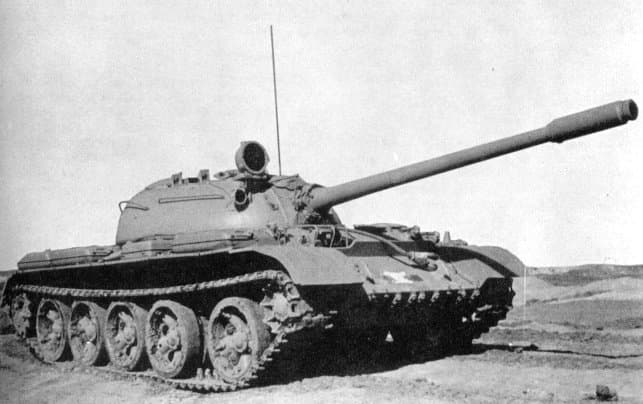
Credit
From US Army Field Manual 100-2-3 - The Soviet Army; Troops Organisation and Equipment · Public domain · Resized · Public domain · Source ↗ · Modified


Preparing your view.


At a glance
T-54/T-55larger figure on 0 of 1
Type 15 tanklarger figure on 1 of 1
Counts only measures both sources give with the same scope. A larger figure is not a better system.
Measured figures
Configuration
| Specification | T-54/T-55 | Type 15 tank |
|---|---|---|
| Type | Medium tank (Warsaw Pact designation) Main battle tank (NATO designation)[source] | Light tank[source] |
| Place of origin | Soviet Union[source] | China[source] |
| In service | 1948–present[source] | — |
| Used by | See Operators[source] | See Operators[source] |
| Wars |
Operational; Operational range
Single sourceOperational; with extra tanks (on unpaved roads)
Single source325 kilometres (202 mi), 610 kilometres (380 mi) with extra tanks (on unpaved roads)[source]
Operational; without external fuel drums
Single source469 kilometres (291 mi)(without external fuel drums)[source]
late versions
Single sourceModel V-55(V-54) V-12 water-cooled. 38.88-litre diesel up to
Single sourceModel V-55(V-54) V-12 water-cooled. 38.88-litre diesel 500 horsepower (373 kW) up to 800 horsepower (600 kW) (late versions)[source]
8V132电控 涡轮增压 柴油發動機
Single source8V132电控 涡轮增压 柴油發動機 650 kW(883.75马力)[source]8V132电控 涡轮增压 柴油發動機
Bars compare reported quantities only. A larger figure does not make a system better; configurations and test conditions differ.
See Service History[source] |
| — |
| Designer | KMDB (T-54) OKB-520 (T-54A and later)[source] | 201st Research Institute[source] |
|---|
| Designed | 1945–1958[source] | — |
|---|
| Manufacturer | KhPZ , UVZ (Soviet Union) Bumar-Łabędy (Poland) ZTS Martin (Czechoslovakia)[source] | Jianglu Electromachinery Baotou Tank Plant[source] |
|---|
| Unit cost | US$ 200,000 (export price to Egypt , 1956–1972)[source] | — |
|---|
| Produced | 1946–1981 (Soviet Union) 1956–1979 (Poland) 1957–1983 (Czechoslovakia) 1958-1985 (China)[source] | — |
|---|
| No. built | 96,500–100,000+ est., including: More than 35,000 T-54 and More than 27,500 T-55 (by Soviet Union) 13,000 Type-59/69/79 (by China) 11,000 T-54/55 (by Czechoslovakia) 10,000 T-54/55 (by Poland)[source] | 1000+[source] |
|---|
| Variants | See Operators and variants section below[source] | — |
|---|
| Armour | 205 mm turret front 130 mm turret sides 60 mm turret rear 30 mm turret roof 120 mm hull front at 60° (100 mm after 1949) 79 mm hull upper sides 20 mm hull lower sides 60 mm at 0° hull rear 20 mm hull bottom 33–16 mm hull roof[source] | — |
|---|
| Main armament | D-10T 100 mm rifled gun (43 rounds)[source] | — |
|---|
| Secondary armament | 7.62 mm SGMT coaxial machine gun, (12.7 mm DShK heavy machine gun)[source] | Remotely operated weapon station armed with coaxial 12.7mm machine gun and QLZ-04 automatic grenade launcher[source] |
|---|
| Power/weight | 14.6 horsepower per metric ton (10.9 kW/t)[source] | 30.30 hp/tonne 27.8 hp/tonne (Enhanced armor package installed)[source] |
|---|
| Transmission | Mechanical ( synchromesh ), 5 forward, 1 reverse gears[source] | — |
|---|
| Suspension | Torsion bar[source] | Hydropneumatic suspension[source] |
|---|
| Ground clearance | 0.425 m (16.7 in)[source] | — |
|---|
| Fuel capacity | 580 L internal, 320 L external (less on early T54), 400 L jettisonable rear drums[source] | — |
|---|
| Role | series of Soviet medium tanks introduced in the years following the Second World War[source] | — |
|---|
| Source measurement | In 1943, the Kharkiv Morozov Machine Building Design Bureau revived the prewar T-34M development project and produced the T-44 . Thanks to a space-efficient torsion bar suspension , a novel transverse engine mount, and the removal of the hull machine-gunner's crew position, the T-44 had a cross-country performance at least as good as the T-34, but with substantially superior armour and a much more powerful 85 mm gun.[source]T-54/T-55 · Development history / Predecessors: T-34 and T-44; only the objects and conditions stated in this passage By the time the T-44 was ready for production, the T-34 had also been modified to fit the same gun. Although the T-44 was superior in most other ways, by this time, T-34 production was in full swing and the massive numbers of T-34s being built offset any advantage to smaller numbers of a superior design. The T-44 was produced in only small numbers, with around 200 completed in 1945. Instead, the designers continued to use the design as the basis for further improvements to guns, experimenting with a 122 mm design but later deciding that a 100 mm gun was a better alternative.[source]T-54/T-55 · Development history / Predecessors: T-34 and T-44; only the objects and conditions stated in this passage Efforts to fit the 100 mm gun to the T-44 demonstrated that small changes to the design would greatly improve the combination. The main issue was a larger turret ring, which suggested slightly enlarging the hull. A prototype of the new design, about 40 centimetres (16 in) longer and only 10 cm wider, was completed in 1945. This model looked almost identical to the original T-44, albeit with a larger gun.[source]T-54/T-55 · Development history / Prototypes; only the objects and conditions stated in this passage Production of the initial series of T-54s began slowly as 1,490 modifications were made. The Red Army received a tank that was superior to World War II designs and theoretically better than the newest tanks of potential opponents. The 100 mm gun fired BR-412 series full-calibre APHE ammunition, which had superior penetration ability when compared to the T-34 that it replaced.[source]T-54/T-55 · Development history / T-54; only the objects and conditions stated in this passage The serial production version, designated T-54-1, differed from the second T-54 prototype. It had thicker hull armour (80 mm on the sides, 30 mm on the roof and 20 mm on the bottom). As production ramped up, quality problems emerged. Production was stopped and an improved T-54-2 ( Ob'yekt 137R) version was designed. Several changes were made and a new turret was fitted. The new dome-shaped turret with flat sides was inspired by the turret from the IS-3 heavy tank; it is similar to the later T-54 turret but with a distinctive overhang at the rear. It also had a shorter bustle.[source]T-54/T-55 · Development history / T-54; only the objects and conditions stated in this passage The fender machine guns were removed in favour of a single bow-mounted machine gun. The transmission was modernised and the track was widened to 580 mm. The T-54-2 entered production in 1949, at Stalin Ural Tank Factory No. 183 (Uralvagonzavod). In 1951, a second modernization was made, designated T-54-3 ( Ob'yekt 137Sh), which had a new turret without side undercuts, and the new TSh-2-22 telescopic gunner's sight instead of the TSh-20. The tank featured the TDA smoke-generating system. A command version was built, the T-54K ( komandirskiy ), with a second R-113 radio.[source]T-54/T-55 · Development history / T-54; only the objects and conditions stated in this passage At the beginning of the 1950s, the personnel of the OKB-520 design bureau of the Stalin Ural Tank Factory No. 183 (Uralvagonzavod) had been changed considerably. Morozov was replaced by Kolesnikow, who in turn was replaced by Leonid N. Kartsev in March 1953. The first decision of the new designer was to fit the 100 mm D-10T tank gun with the STP-1 "Gorizont" vertical stabilizer. The new tank gun received the designation D-10TG and was fitted into the T-54's turret.[source]T-54/T-55 · Development history / T-54 / T-54A and T-54B; only the objects and conditions stated in this passage The new tank received night vision equipment for the driver and was designated T-54A ( Ob'yekt 137G). Originally, this had a small muzzle counter-weight, which was later replaced with a fume extractor . It was equipped with an OPVT wading snorkel , the TSh-2A-22 telescopic sight, TVN-1 infrared driver's periscope and IR headlight, a new R-113 radio, multi-stage engine air filter and radiator controls for improved engine performance, an electrical oil pump, a bilge pump, an automatic fire extinguisher and extra fuel tanks.[source]T-54/T-55 · Development history / T-54 / T-54A and T-54B; only the objects and conditions stated in this passage The tank officially entered production in 1954 and service in 1955. It served as a basis for the T-54AK command tank, with an additional R-112 radio set (front line tanks were equipped with an R-113 radio set), TNA-2 navigational device, ammunition load for the main gun decreased by 5 rounds and the AB-1-P/30 charging unit, which was produced in small numbers. In October 1954 a T-54A tank, designated as T-54M ( Ob'yekt 139) served as a testbed for new D-54T and D-54TS 100 mm smoothbore guns and "Raduga" and "Molniya" stabilization systems, which were later used in the T-62. These were not completely successful, so further T-55 development continued to use the D-10 series guns. It was fitted with a V-54-6 engine developing 581 hp (433 kW). It never went into production.[source]T-54/T-55 · Development history / T-54 / T-54A and T-54B; only the objects and conditions stated in this passage A new version, based on T-54A, designated T-54B ( Ob'yekt 137G2), was designed in 1955. It was fitted with a new 100 mm D-10T2S tank gun with STP-2 "Tsyklon" 2-plane stabilizer. It entered production in 1957. During the last four months of production, the new tanks were equipped with an L-2 "Luna" infrared searchlight, a TPN-1-22-11 IR gunner's sight, and an OU-3 IR commander's searchlight. Modern APFSDS ammunition was developed, dramatically enhancing the penetrative performance of the gun to keep it competitive with NATO armour developments. T-54B served as the basis for the T-54BK command tank, which had the same additional equipment as the T-54AK command tank.[source]T-54/T-55 · Development history / T-54 / T-54A and T-54B; only the objects and conditions stated in this passage Trials with nuclear weapons showed that a T-54 could survive a 2–15 kt nuclear charge at a range of more than 300 metres (980 ft) from the epicentre, but the crew had a chance of surviving at a minimum of 700 metres (2,300 ft). It was decided to create an NBC (nuclear, biological, and chemical) protection system which would start working 0.3 seconds after detecting gamma radiation.[source]T-54/T-55 · Development history / T-55; only the objects and conditions stated in this passage The task of creating a basic PAZ ( Protivoatomnaya Zashchita ) NBC protection system offering protection against the blast of a nuclear weapon and (radioactive) particulate filtration, but not against external gamma radiation or gas, was given to the KB-60 design bureau in Kharkiv and was completed in 1956. The documentation was sent to Uralvagonzavod. It was decided to increase the tank's abilities by changing its construction and introducing new production technologies. Those changes were initially tested on the T-54M ( Ob'yekt 139).[source]T-54/T-55 · Development history / T-55; only the objects and conditions stated in this passage The tank was fitted with the new V-55 12-cylinder four-stroke one-chamber, 38.88-litre water-cooled diesel engine developing 581 hp (433 kW). Engine power was increased by raising the pressure of the fuel delivery and charging degree. The designers planned to introduce a heating system for the engine compartment and MC-1 diesel fuel filter. The engine was to be started pneumatically using an AK-150S charger and an electric starter. This eliminated the need for the tank to carry a tank filled with air. To allow easier access during maintenance and repairs, it was decided to change hatches over the engine compartment. To increase the operational range, 300 litres (66 imp gal; 79 US gal) fuel tanks were added to the front of the hull, increasing the overall fuel capacity to 680 litres (150 imp gal; 180 US gal).[source]T-54/T-55 · Development history / T-55; only the objects and conditions stated in this passage The ammunition load for the main gun was increased from 34 to 45, with 18 shells stored in so-called "wet containers" located in hull fuel tanks (the concept for which came from Kartsev's cancelled Ob'yekt 140 ). The ammunition load included high explosive-fragmentation and anti-tank rounds and designers also planned to introduce the BK5M high-explosive anti-tank (HEAT) rounds which penetrated 390 millimetres (15 in) thick armour. The TPKU commander's vision device was replaced by either the TPKUB or TPKU-2B. The gunner received a TNP-165 vision device.[source]T-54/T-55 · Development history / T-55; only the objects and conditions stated in this passage The loader's hatch-mounted 12.7 mm DShK anti-aircraft heavy machine gun was dropped, because it was deemed worthless against high-performance jets. The tank was supposed to have the "Rosa" fire protection system. The tank had a thicker turret casting, an improved two-plane gun stabilization system from the T-54B and night vision fighting equipment. To balance the weight of the new equipment, the armour on the back of the hull was thinned slightly.[source]T-54/T-55 · Development history / T-55; only the objects and conditions stated in this passage The T-55 was superior to the IS-2 , IS-3 and T-10 heavy tanks in many respects, including the gun's rate of fire (at least four compared to fewer than three rounds per minute). Despite somewhat thinner frontal turret armour (200 millimetres (7.9 in) instead of 250 millimetres (9.8 in)), it compared favourably with the IS-3, due to its improved antitank gun and better mobility. Heavy tanks soon fell from favour.[source]T-54/T-55 · Development history / T-55; only the objects and conditions stated in this passage The cameras allowed battlefield observation and firing during daytime at ranges between 1.5 and 2 kilometres (0.93 and 1.24 mi). Because of the low quality of the equipment, the trials gave negative results. At the beginning of the 1960s, the OKB-29 design bureau in Omsk adapted the tank to use a GTD-3T gas turbine engine developing 700 hp (522 kW). One T-55 tank fitted with this gas turbine engine passed trials but was deemed unsatisfactory, and the design did not go into production.[source]T-54/T-55 · Development history / T-55; only the objects and conditions stated in this passage The Omsk OKB-29 group tested three experimental T-55 tanks (designated Ob'yekt 612) between 1962 and 1965 that were fitted with an automatic gearbox controlled by electro-hydraulic systems. The trials found that such gearboxes were prone to frequent breakdowns in tanks. At the same time, the Ob'yekt 155ML, a T-55 fitted with a launcher for three 9M14 " Malyutka " (NATO code: AT-3 Sagger) ATGMs mounted on the rear of the turret, was tested. Along with standard tanks, a flamethrower -armed version was designed (designated TO-55 ( Ob'yekt 482)) and produced until 1962. It was fitted with 460-litre tanks filled with flammable liquid instead of the frontal wet ammunition rack. The flamethrower replaced the coaxial machine gun. This was a much better way to mount a flamethrower than in the experimental Ob'yekt 483, based on the T-54 tank, where the flamethrower replaced the main gun. TO-55 flamethrower tanks were withdrawn from service in 1993.[source]T-54/T-55 · Development history / T-55; only the objects and conditions stated in this passage The tank was equipped with a full PAZ/FVU chemical filtration system. The coaxial 7.62 mm SGMT machine gun was replaced by a 7.62 mm PKT machine gun . The hull was lengthened from 6.04 m to 6.2 m. The hull machine gun was removed, making space for six more main gun rounds. These changes increased the weight of the vehicle to 38 tonnes.[source]T-54/T-55 · Development history / T-55 / T-55A; only the objects and conditions stated in this passage In its long service life, the T-55 has been upgraded many times. Early T-55s were fitted with a new TSh-2B-32P sight. In 1959, some tanks received mountings for the PT-55 mine clearing system or the BTU/BTU-55 plough. In 1967, the improved 3BM-8 APDS round, which could penetrate 275 mm thick armour at a range of 2 km, was introduced. In 1970, new and old T-55 tanks had the loader's hatch modified to mount the 12.7 mm DShK machine gun , to deal with the threat of attack helicopters. Starting in 1974, T-55 tanks received the KTD-1 or KTD-2 laser rangefinder in an armoured box over the mantlet of the main gun, and the R-123 or R-123M radio set. Simultaneously, efforts were made to modernize and increase the lifespan of the drive train.[source]T-54/T-55 · Development history / T-54/T-55 upgrades; only the objects and conditions stated in this passage During production, the T-55A was frequently modernised. In 1965, a new track was introduced that could be used for between 2,000 km and 3,000 km, which was twice the range of the old track. It needed a new drive sprocket, with 14 teeth instead of 13. Since 1974, T-55A tanks were equipped with a KTD-1 "Newa" rangefinder and a TSzS-32PM sight. All T-55A tanks were equipped with the TPN-1-22-11 night sight. The R-113 radio set was replaced by a R-123 radio set. Late production models had rubber side skirts and a driver's windshield for use during longer stints.[source]T-54/T-55 · Development history / T-54/T-55 upgrades; only the objects and conditions stated in this passage A wide array of upgrades in different price ranges are provided by many manufacturers in different countries, intended to bring the T-54/55 up to the abilities of newer MBTs, at a lower cost. Upgrades include new engines, explosive reactive armour , new main armament such as 120 mm or 125 mm guns, active protection systems, and fire control systems with range-finders or thermal sights. These improvements make it a potent main battle tank (MBT) for the low-end budget, even to this day.[source]T-54/T-55 · Development history / T-54/T-55 upgrades; only the objects and conditions stated in this passage The Soviet-made 100 mm gun was replaced with the American M68 105 mm rifled gun fitted with a thermal sleeve.[source]T-54/T-55 · Development history / T-54/T-55 upgrades; only the objects and conditions stated in this passage The T-54 and T-55 tanks are outwardly similar and difficult to distinguish visually. Soviet tanks were factory-overhauled every 7,000 km and usually given minor technology updates. Many states have added or modified the tank's equipment; India, for example, affixed fake fume extractors to its T-54s and T-55s so that its gunners would not confuse them with Pakistani Type 59s.[source]T-54/T-55 · Description; only the objects and conditions stated in this passage The older T-54 can be distinguished from the T-55 by a dome-shaped ventilator on the front right of the turret and a driver-operated SGMT 7.62 mm machine gun mounted to fire through a tiny hole in the centre of the hull's front. Early T-54s lacked a gun fume extractor, had an undercut at the turret's rear, and a distinctive "pig-snout" gun mantlet.[source]T-54/T-55 · Description; only the objects and conditions stated in this passage The low turret profile of the tanks prevents them from depressing their main guns by more than 5° since the breech would strike the ceiling when fired, which limits the ability to cover terrain by fire from a hull-down position on a reverse slope. As with most tanks of that generation , the internal ammunition supply is not shielded, increasing the risk that any enemy penetration of the fighting compartment could cause a catastrophic secondary explosion. The T-54 lacked NBC protection and a turret basket, which meant that crewmen had to physically rotate and keep up with a rotating turret as the hull they stood in didn't move with the turret. Additionally, early models also lacked gun stabilisation. Most of these problems were corrected in the otherwise largely identical T-55 tank.[source]T-54/T-55 · Description / Advantages and drawbacks; only the objects and conditions stated in this passage T-54-1 production was slow at first, as only 3 vehicles were built in 1946 and 22 in 1947. 285 T-54-1 tanks were built in 1948 by Stalin Ural Tank Factory No. 183 (Uralvagonzavod); by then it had completely replaced T-44 production at Uralvagonzavod, and Kharkiv Diesel Factory No. 75 (KhPZ). Production was stopped because of a low level of production quality and frequent breakdowns. The T-54-2 entered production in 1949 at Uralvagonzavod, which produced 423 tanks by the end of 1950. It replaced the T-34 in production at the Omsk Factory No. 183 in 1950. In 1951, over 800 T-54-2 tanks were produced. The T-54-2 remained in production until 1952. The T-54A was produced between 1955 and 1957. The T-54B was produced between 1957 and April 1959. The T-55 was produced by Uralvagonzavod between 1958 and 1962. The T-55K command tank was produced in 1959. The TO-55 ( Ob'yekt 482) flamethrower tank was produced until 1962.[source]T-54/T-55 · Production history / Soviet Union; only the objects and conditions stated in this passage Soviet T-54 tanks first saw combat in the Hungarian Revolution in 1956 and a few were successfully knocked out by the defending anti-Soviet Hungarian resistance fighters and rebels using Molotov cocktails and several anti-tank guns. The local anti-Soviet revolutionaries delivered one captured T-54A to the British Embassy in Budapest , the analyses and studies of which helped and spurred the development of the Royal Ordnance L7 105 mm tank gun .[source]T-54/T-55 · Service history / Soviet Union and successors; only the objects and conditions stated in this passage During the 1967 Six-Day War , U.S.-supplied M48 Patton tanks, British Centurion tanks, and even upgraded World War II–era 75 mm M-50 and 105 mm armed M-51 Super Shermans faced T-55s. This mix of Israeli tanks, combined with superior planning of operations and superior airpower, proved to be more than capable of dealing with the T-54/T-55 series.[source]T-54/T-55 · Service history / Middle East; only the objects and conditions stated in this passage By the 1973 Yom Kippur War , the T-54A and T-55's guns were losing their competitive effectiveness relative to the 105 mm Royal Ordnance L7 gun mounted in Israeli Centurion Mk V and M60A1 tanks. Israeli tanks fitted with the L7 105mm gun suffered greatly from the new Soviet HEAT 3BК5 ammunition fired by the T-55s. During the entire war, 1,063 Israeli tanks were disabled (more than half of them Centurions), about 600 of which were destroyed or captured. Some 35 Israeli Centurions were captured by Egypt, dozens more were captured by Syria, Iraq and four by Jordan. On the other hand, 2,250 Arab tanks were disabled (including 33 Jordanian Centurions, 18 of them destroyed ), 1,274 of them were completely destroyed or captured (643 tanks were lost in the north and 631 were lost in the south )[source]T-54/T-55 · Service history / Middle East; only the objects and conditions stated in this passage Israel captured many from Egypt in 1967, along with a few T-55s from Syria , and kept some of them in service. They were upgraded with a 105 mm NATO-standard L7 or M68, a US version of the L7, replacing the old Soviet 100 mm D-10, and a General Motors diesel replacing the original Soviet diesel engine. The Israelis designated these Tiran-5 medium tanks, and they were used by reserve units until the early 1990s. Most of these were then sold to assorted Third World countries, some of them in Latin America, and the rest were heavily modified, converted into the Achzarit heavy armoured personnel carrier .[source]T-54/T-55 · Service history / Middle East; only the objects and conditions stated in this passage The PAVN/LASV and the ARVN engaged each other with tanks for the first time during Operation Lam Son 719 in February 1971. During that battle, 17 M41 Walker Bulldog light tanks of the ARVN's 1st Armoured Brigade claimed to have destroyed 22 PAVN tanks, a total of 6 T-54s and 16 PT-76 light amphibious tanks, at no loss to themselves, but their friendly units lost 5 M41s and 25 armoured personnel carriers (APCs), mainly M113 APCs.[source]T-54/T-55 · Service history / Vietnam War; only the objects and conditions stated in this passage On Easter Sunday, 2 April 1972, the newly activated ARVN 20th Tank Regiment , comprising approximately 57 M48A3 Patton main battle tanks (note that ARVN regiments were equivalent to US battalions , and ARVN squadrons were comparable to US companies or troops ) received reports from friendly intelligence units of a large PAVN armoured column moving towards Dong Ha , the largest South Vietnamese city near the Vietnamese DMZ located on the 17th Parallel . At about noontime, the tank crewmen of the ARVN's 1st Squadron observed enemy armour moving south along Highway 1 towards Dong Ha and promptly concealed their tanks on high ground with a good vantage point against their enemy. Waiting for the PAVN tank column to close to between 2500 and 3000 meters, the 90mm main guns of the Patton tanks opened fire and quickly destroyed nine PT-76s and two T-54s. The surviving PAVN armour, unable to locate their enemy's positions, hastily turned about and withdrew shortly afterwards.[source]T-54/T-55 · Service history / Vietnam War; only the objects and conditions stated in this passage On 9 April 1972, all three squadrons of the 20th Tank Regiment (57 M48 tanks) fought hard against enemy armour, firing upon PAVN tanks accompanied by large masses of infantry, again while occupying the strategically important high ground. This time, similarly, the Pattons opened fire at approximately 2800 meters. A few answering shots from the T-54s fell short and the PAVN tanks began to scatter after suffering considerable losses and heavy casualties. By the end of the day, the 20th claimed to destroy sixteen T-54s and captured one Type 59 at no loss to themselves. (The PAVN confirmed six tanks were destroyed or damaged ) On 27 April, heralded by massive artillery attacks, a new PAVN offensive began against ARVN positions. The barrage was quickly followed by violent attacks by PAVN infantry and a T-54 tank. By 2 May, the 20th Tank Regiment had lost all of their tanks to enemy fire. During the first month of the First Battle of Quảng Trị , all ARVN M48 Pattons (100 tanks) were lost.[source]T-54/T-55 · Service history / Vietnam War; only the objects and conditions stated in this passage T-54/T-55s began appearing in Southern Africa in the late 1970s, when many emerging Marxist states, particularly Angola and Mozambique , were bolstered with modern Soviet military hardware. The T-55's dependability and ruggedness proved well-suited to the local combat environments. Survivability of opposing medium-armour vehicles deployed by UNITA and the South African Defence Force (SADF) against late model MBTs used in the Angolan Civil War remained a major concern throughout that conflict. Angolan Army T-54s were first blooded during Operation Askari , in 1981. At least five were subsequently destroyed in encounters with South African Eland or Ratel-90 armoured cars, and some were captured. Soviet sources confirm that many T-55s were penetrated by an Eland's 90 mm low-pressure gun. Nevertheless, multiple HEAT rounds were needed to guarantee sufficient damage against a T-55's frontal arc and SADF anti-tank teams forced to operate in platoons accordingly.[source]T-54/T-55 · Service history / Angola; only the objects and conditions stated in this passage During the Battle of Cuito Cuanavale , another three T-55s of Angola's 21st Brigade were shot out by Ratel IFVs armed with ZT3 Ingwe ATGMs near the Lomba River. On 9 November 1987, an engagement between South African and Angolan tanks occurred when thirteen Olifant Mk1As eliminated two T-55s in a nine-minute skirmish. T-55s again participated in a critical engagement near Cuito Cuanavale on 14 February 1988, when Cuba's 3rd Tank Battalion counter-attacked to spare Angola's 16th Brigade virtual annihilation by 61 Mechanised Infantry Battalion Group and the 4th South African Infantry Battalion . Six T-55s were lost (three to RPGs, three to Olifants and one more was damaged), but the attack blunted the South African advance, safeguarding the cohesion of the Angolan line. Cuban and Soviet sources maintain that they destroyed ten Olifant tanks and twelve Ratels, while South African and Western sources maintain that only one Olifant and one Ratel were damaged, and one Ratel destroyed.[source]T-54/T-55 · Service history / Angola; only the objects and conditions stated in this passage Battle of Basantar , also known as the Battle of Barapind (4–16 December 1971), was one of the vital battles fought as part of the Indo-Pakistani War of 1971 in the western sector of India. India had destroyed close to 46 M48 tanks and losing only 10 tanks in the process.[source]T-54/T-55 · Service history / India and Pakistan; only the objects and conditions stated in this passage Ukrainian soldiers trained with 28 M-55S tanks delivered in October 2022 by Slovenia. The Model M-55S is a heavily reinforced tank that has been updated with a NATO L7 105 mm gun, upgraded armour protection, a digital ballistic computer, an upgraded engine and new tracks. In December 2022 the volunteer 47th Assault Brigade was equipped with 28 M-55S. On 14 July 2023, an M-55S received a direct hit into the upper armour by a 152 mm guided Krasnopol Russian artillery shell. The tank and crew survived due to reactive armour upgrades. A few days later on 22 July, a second Ukrainian M-55S took a direct hit west of Kreminna and exploded.[source]T-54/T-55 · Service history / Russo-Ukrainian War; only the objects and conditions stated in this passage On 21–22 March 2023, photos and videos of a Russian military train with T-54s and T-54Bs appeared on social media. Images of T-55 in Ukraine first emerged in April 2023 confirming their deployment by the Russian armed forces. On 19 June, footage of a Russian T-54/55 converted into a remote-controlled VBIED being destroyed by Ukrainian forces near Marinka, Donetsk Oblast was released.[source]T-54/T-55 · Service history / Russo-Ukrainian War; only the objects and conditions stated in this passage As of February 2026, Russia is visually confirmed to have suffered 24 T-54/55 losses (2 T-54-3M, 3 T-54B, 10 T-55A, 1 T-55A Obr. 1981, and 8 unknown T-54/55).[source]T-54/T-55 · Service history / Russo-Ukrainian War; only the objects and conditions stated in this passage | — |
|---|
| Engine | — | Electronically controlled diesel engine 8V132 with fully-automatic transmission 1[source] |
|---|
| Status | — | The Type 15 ( Chinese : 15式轻型坦克 ; pinyin : yīwǔ shì qīngxíng tǎnkè , also designated ZTQ15 ), codenamed the Black Panther ( Chinese : 黑豹 ; pinyin : hēi bào ), is a Chinese third generation light tank family operated by the People's Liberation Army Ground Force , People's Liberation Army Navy Marine Corps , and People's Liberation Army Air Force Airborne Corps [source] |
|---|
| Reported operators | — |
|
|---|