Credit
From US Army Field Manual 100-2-3 - The Soviet Army; Troops Organisation and Equipment · Public domain · Resized · Public domain · Source ↗ · Modified


Preparing your view.
At a glance
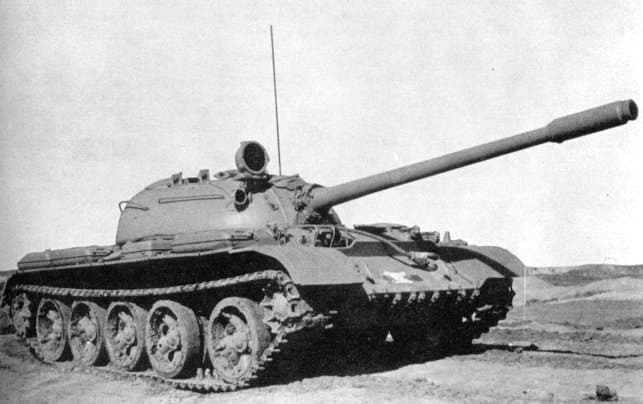
T-54/T-55larger figure on 1 of 5
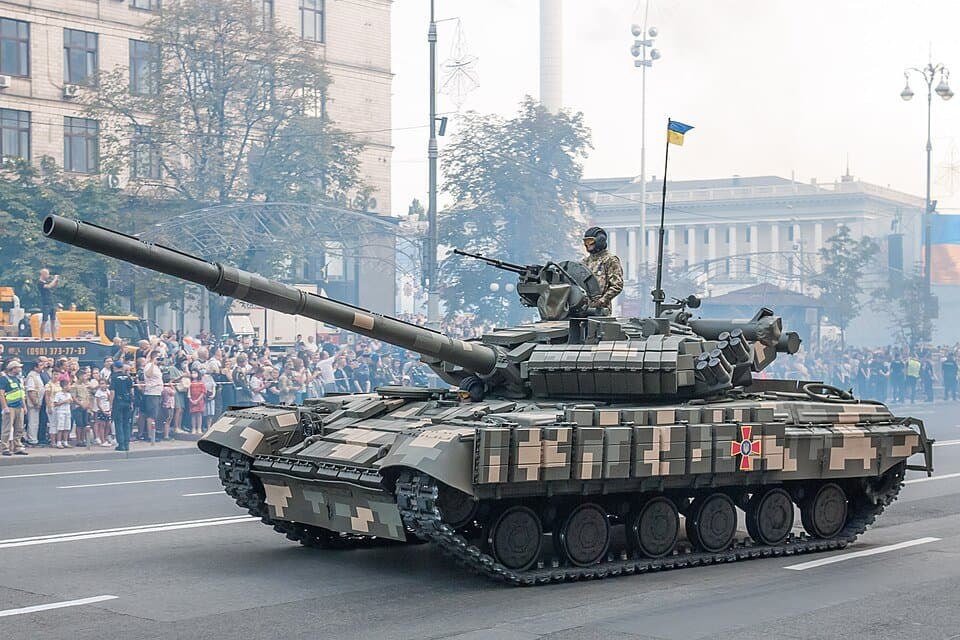
T-64larger figure on 4 of 5
True scale
Side by side. From every angle. A human reference for perspective.
3.15 MB · Loads when you open it| Model | Length | Width / span | Height |
|---|---|---|---|
| T-54/T-55 | ≈ 9 m | ≈ 3.37 m (Width) | ≈ 2.4 m |
| T-64 | ≈ 9.22 m | ≈ 3.41 m (Width) | ≈ 2.17 m |
Scaled uniformly to the sourced length of 9 m. Thin antennas or poles standing above the body were pressed down to it, so they do not set the height; the height was fitted to the sourced 2.4 m; the width was fitted to the sourced 3.37 m. Not an official model or a measured survey.
ForceTally · All rights reserved
Scaled uniformly to the sourced length of 9.225 m. Thin antennas or poles standing above the body were pressed down to it, so they do not set the height; the height was fitted to the sourced 2.172 m; the width was fitted to the sourced 3.415 m. Not an official model or a measured survey.
ForceTally · All rights reserved
The human reference is a generic 1.75 m figure. Models describe external size, not combat performance.
Measured figures
Gun forward
Single source9.00 m (29 ft 6 in) with gun forward[source]
Gun forward
Configuration
| Specification | T-54/T-55 | T-64 |
|---|---|---|
| Type | Medium tank (Warsaw Pact designation) Main battle tank (NATO designation)[source] | Main battle tank[source] |
| Place of origin | Soviet Union[source] | Soviet Union[source] |
| In service | 1948–present[source] | 1966–present[source] |
| Used by | See Operators[source] | See Operators |
Counts only measures both sources give with the same scope. A larger figure is not a better system.
9.225 m (30 ft 3.2 in) (gun forward)[source]
Operational; Operational range
Single sourceOperational; with extra tanks (on unpaved roads)
Single source325 kilometres (202 mi), 610 kilometres (380 mi) with extra tanks (on unpaved roads)[source]
Operational; Operational range
Single sourceOperational; with external tanks
Single sourcelate versions
Single sourceModel V-55(V-54) V-12 water-cooled. 38.88-litre diesel up to
Single sourceModel V-55(V-54) V-12 water-cooled. 38.88-litre diesel 500 horsepower (373 kW) up to 800 horsepower (600 kW) (late versions)[source]
5TDF 5-cylinder diesel 13.6 litre
Single source5TDF 5-cylinder diesel 13.6 litre 700 hp (522 kW)[source]
Bars compare reported quantities only. A larger figure does not make a system better; configurations and test conditions differ.
| Wars | See Service History[source] | Transnistria War Angolan Civil War Russo-Ukrainian War War in Donbas Russo-Ukrainian war Kamwina Nsapu rebellion[source] |
|---|
| Designer | KMDB (T-54) OKB-520 (T-54A and later)[source] | KMDB[source] |
|---|
| Designed | 1945–1958[source] | 1951–1962[source] |
|---|
| Manufacturer | KhPZ , UVZ (Soviet Union) Bumar-Łabędy (Poland) ZTS Martin (Czechoslovakia)[source] | Malyshev Factory[source] |
|---|
| Unit cost | US$ 200,000 (export price to Egypt , 1956–1972)[source] | — |
|---|
| Produced | 1946–1981 (Soviet Union) 1956–1979 (Poland) 1957–1983 (Czechoslovakia) 1958-1985 (China)[source] | 1963–1987[source] |
|---|
| No. built | 96,500–100,000+ est., including: More than 35,000 T-54 and More than 27,500 T-55 (by Soviet Union) 13,000 Type-59/69/79 (by China) 11,000 T-54/55 (by Czechoslovakia) 10,000 T-54/55 (by Poland)[source] | ≈13,000[source] |
|---|
| Variants | See Operators and variants section below[source] | — |
|---|
| Armour | 205 mm turret front 130 mm turret sides 60 mm turret rear 30 mm turret roof 120 mm hull front at 60° (100 mm after 1949) 79 mm hull upper sides 20 mm hull lower sides 60 mm at 0° hull rear 20 mm hull bottom 33–16 mm hull roof[source] | Glass-reinforced plastic sandwiched between layers of steel. ERA plates on later versions Hull & turret – 370 mm to 440 mm vs APFSDS 500 mm to 575 mm vs HEAT[source] |
|---|
| Main armament | D-10T 100 mm rifled gun (43 rounds)[source] | 125 mm smoothbore gun 2A26(M/M-1) (T-64A), 125 mm smoothbore gun D-81T (aka 2A46)[source] |
|---|
| Secondary armament | 7.62 mm SGMT coaxial machine gun, (12.7 mm DShK heavy machine gun)[source] | 7.62 mm PKMT coaxial machine gun, 12.7 mm NSVT anti-aircraft machine gun[source] |
|---|
| Power/weight | 14.6 horsepower per metric ton (10.9 kW/t)[source] | 18.4 hp/tonne (13.7 kW/ton)[source] |
|---|
| Transmission | Mechanical ( synchromesh ), 5 forward, 1 reverse gears[source] | — |
|---|
| Suspension | Torsion bar[source] | Torsion bar[source] |
|---|
| Ground clearance | 0.425 m (16.7 in)[source] | — |
|---|
| Fuel capacity | 580 L internal, 320 L external (less on early T54), 400 L jettisonable rear drums[source] | — |
|---|
| Role | series of Soviet medium tanks introduced in the years following the Second World War[source] | — |
|---|
| Source measurement | In 1943, the Kharkiv Morozov Machine Building Design Bureau revived the prewar T-34M development project and produced the T-44 . Thanks to a space-efficient torsion bar suspension , a novel transverse engine mount, and the removal of the hull machine-gunner's crew position, the T-44 had a cross-country performance at least as good as the T-34, but with substantially superior armour and a much more powerful 85 mm gun.[source]T-54/T-55 · Development history / Predecessors: T-34 and T-44; only the objects and conditions stated in this passage By the time the T-44 was ready for production, the T-34 had also been modified to fit the same gun. Although the T-44 was superior in most other ways, by this time, T-34 production was in full swing and the massive numbers of T-34s being built offset any advantage to smaller numbers of a superior design. The T-44 was produced in only small numbers, with around 200 completed in 1945. Instead, the designers continued to use the design as the basis for further improvements to guns, experimenting with a 122 mm design but later deciding that a 100 mm gun was a better alternative.[source]T-54/T-55 · Development history / Predecessors: T-34 and T-44; only the objects and conditions stated in this passage Efforts to fit the 100 mm gun to the T-44 demonstrated that small changes to the design would greatly improve the combination. The main issue was a larger turret ring, which suggested slightly enlarging the hull. A prototype of the new design, about 40 centimetres (16 in) longer and only 10 cm wider, was completed in 1945. This model looked almost identical to the original T-44, albeit with a larger gun.[source]T-54/T-55 · Development history / Prototypes; only the objects and conditions stated in this passage Production of the initial series of T-54s began slowly as 1,490 modifications were made. The Red Army received a tank that was superior to World War II designs and theoretically better than the newest tanks of potential opponents. The 100 mm gun fired BR-412 series full-calibre APHE ammunition, which had superior penetration ability when compared to the T-34 that it replaced.[source]T-54/T-55 · Development history / T-54; only the objects and conditions stated in this passage The serial production version, designated T-54-1, differed from the second T-54 prototype. It had thicker hull armour (80 mm on the sides, 30 mm on the roof and 20 mm on the bottom). As production ramped up, quality problems emerged. Production was stopped and an improved T-54-2 ( Ob'yekt 137R) version was designed. Several changes were made and a new turret was fitted. The new dome-shaped turret with flat sides was inspired by the turret from the IS-3 heavy tank; it is similar to the later T-54 turret but with a distinctive overhang at the rear. It also had a shorter bustle.[source]T-54/T-55 · Development history / T-54; only the objects and conditions stated in this passage The fender machine guns were removed in favour of a single bow-mounted machine gun. The transmission was modernised and the track was widened to 580 mm. The T-54-2 entered production in 1949, at Stalin Ural Tank Factory No. 183 (Uralvagonzavod). In 1951, a second modernization was made, designated T-54-3 ( Ob'yekt 137Sh), which had a new turret without side undercuts, and the new TSh-2-22 telescopic gunner's sight instead of the TSh-20. The tank featured the TDA smoke-generating system. A command version was built, the T-54K ( komandirskiy ), with a second R-113 radio.[source]T-54/T-55 · Development history / T-54; only the objects and conditions stated in this passage At the beginning of the 1950s, the personnel of the OKB-520 design bureau of the Stalin Ural Tank Factory No. 183 (Uralvagonzavod) had been changed considerably. Morozov was replaced by Kolesnikow, who in turn was replaced by Leonid N. Kartsev in March 1953. The first decision of the new designer was to fit the 100 mm D-10T tank gun with the STP-1 "Gorizont" vertical stabilizer. The new tank gun received the designation D-10TG and was fitted into the T-54's turret.[source]T-54/T-55 · Development history / T-54 / T-54A and T-54B; only the objects and conditions stated in this passage The new tank received night vision equipment for the driver and was designated T-54A ( Ob'yekt 137G). Originally, this had a small muzzle counter-weight, which was later replaced with a fume extractor . It was equipped with an OPVT wading snorkel , the TSh-2A-22 telescopic sight, TVN-1 infrared driver's periscope and IR headlight, a new R-113 radio, multi-stage engine air filter and radiator controls for improved engine performance, an electrical oil pump, a bilge pump, an automatic fire extinguisher and extra fuel tanks.[source]T-54/T-55 · Development history / T-54 / T-54A and T-54B; only the objects and conditions stated in this passage The tank officially entered production in 1954 and service in 1955. It served as a basis for the T-54AK command tank, with an additional R-112 radio set (front line tanks were equipped with an R-113 radio set), TNA-2 navigational device, ammunition load for the main gun decreased by 5 rounds and the AB-1-P/30 charging unit, which was produced in small numbers. In October 1954 a T-54A tank, designated as T-54M ( Ob'yekt 139) served as a testbed for new D-54T and D-54TS 100 mm smoothbore guns and "Raduga" and "Molniya" stabilization systems, which were later used in the T-62. These were not completely successful, so further T-55 development continued to use the D-10 series guns. It was fitted with a V-54-6 engine developing 581 hp (433 kW). It never went into production.[source]T-54/T-55 · Development history / T-54 / T-54A and T-54B; only the objects and conditions stated in this passage A new version, based on T-54A, designated T-54B ( Ob'yekt 137G2), was designed in 1955. It was fitted with a new 100 mm D-10T2S tank gun with STP-2 "Tsyklon" 2-plane stabilizer. It entered production in 1957. During the last four months of production, the new tanks were equipped with an L-2 "Luna" infrared searchlight, a TPN-1-22-11 IR gunner's sight, and an OU-3 IR commander's searchlight. Modern APFSDS ammunition was developed, dramatically enhancing the penetrative performance of the gun to keep it competitive with NATO armour developments. T-54B served as the basis for the T-54BK command tank, which had the same additional equipment as the T-54AK command tank.[source]T-54/T-55 · Development history / T-54 / T-54A and T-54B; only the objects and conditions stated in this passage Trials with nuclear weapons showed that a T-54 could survive a 2–15 kt nuclear charge at a range of more than 300 metres (980 ft) from the epicentre, but the crew had a chance of surviving at a minimum of 700 metres (2,300 ft). It was decided to create an NBC (nuclear, biological, and chemical) protection system which would start working 0.3 seconds after detecting gamma radiation.[source]T-54/T-55 · Development history / T-55; only the objects and conditions stated in this passage The task of creating a basic PAZ ( Protivoatomnaya Zashchita ) NBC protection system offering protection against the blast of a nuclear weapon and (radioactive) particulate filtration, but not against external gamma radiation or gas, was given to the KB-60 design bureau in Kharkiv and was completed in 1956. The documentation was sent to Uralvagonzavod. It was decided to increase the tank's abilities by changing its construction and introducing new production technologies. Those changes were initially tested on the T-54M ( Ob'yekt 139).[source]T-54/T-55 · Development history / T-55; only the objects and conditions stated in this passage The tank was fitted with the new V-55 12-cylinder four-stroke one-chamber, 38.88-litre water-cooled diesel engine developing 581 hp (433 kW). Engine power was increased by raising the pressure of the fuel delivery and charging degree. The designers planned to introduce a heating system for the engine compartment and MC-1 diesel fuel filter. The engine was to be started pneumatically using an AK-150S charger and an electric starter. This eliminated the need for the tank to carry a tank filled with air. To allow easier access during maintenance and repairs, it was decided to change hatches over the engine compartment. To increase the operational range, 300 litres (66 imp gal; 79 US gal) fuel tanks were added to the front of the hull, increasing the overall fuel capacity to 680 litres (150 imp gal; 180 US gal).[source]T-54/T-55 · Development history / T-55; only the objects and conditions stated in this passage The ammunition load for the main gun was increased from 34 to 45, with 18 shells stored in so-called "wet containers" located in hull fuel tanks (the concept for which came from Kartsev's cancelled Ob'yekt 140 ). The ammunition load included high explosive-fragmentation and anti-tank rounds and designers also planned to introduce the BK5M high-explosive anti-tank (HEAT) rounds which penetrated 390 millimetres (15 in) thick armour. The TPKU commander's vision device was replaced by either the TPKUB or TPKU-2B. The gunner received a TNP-165 vision device.[source]T-54/T-55 · Development history / T-55; only the objects and conditions stated in this passage The loader's hatch-mounted 12.7 mm DShK anti-aircraft heavy machine gun was dropped, because it was deemed worthless against high-performance jets. The tank was supposed to have the "Rosa" fire protection system. The tank had a thicker turret casting, an improved two-plane gun stabilization system from the T-54B and night vision fighting equipment. To balance the weight of the new equipment, the armour on the back of the hull was thinned slightly.[source]T-54/T-55 · Development history / T-55; only the objects and conditions stated in this passage The T-55 was superior to the IS-2 , IS-3 and T-10 heavy tanks in many respects, including the gun's rate of fire (at least four compared to fewer than three rounds per minute). Despite somewhat thinner frontal turret armour (200 millimetres (7.9 in) instead of 250 millimetres (9.8 in)), it compared favourably with the IS-3, due to its improved antitank gun and better mobility. Heavy tanks soon fell from favour.[source]T-54/T-55 · Development history / T-55; only the objects and conditions stated in this passage The cameras allowed battlefield observation and firing during daytime at ranges between 1.5 and 2 kilometres (0.93 and 1.24 mi). Because of the low quality of the equipment, the trials gave negative results. At the beginning of the 1960s, the OKB-29 design bureau in Omsk adapted the tank to use a GTD-3T gas turbine engine developing 700 hp (522 kW). One T-55 tank fitted with this gas turbine engine passed trials but was deemed unsatisfactory, and the design did not go into production.[source]T-54/T-55 · Development history / T-55; only the objects and conditions stated in this passage The Omsk OKB-29 group tested three experimental T-55 tanks (designated Ob'yekt 612) between 1962 and 1965 that were fitted with an automatic gearbox controlled by electro-hydraulic systems. The trials found that such gearboxes were prone to frequent breakdowns in tanks. At the same time, the Ob'yekt 155ML, a T-55 fitted with a launcher for three 9M14 " Malyutka " (NATO code: AT-3 Sagger) ATGMs mounted on the rear of the turret, was tested. Along with standard tanks, a flamethrower -armed version was designed (designated TO-55 ( Ob'yekt 482)) and produced until 1962. It was fitted with 460-litre tanks filled with flammable liquid instead of the frontal wet ammunition rack. The flamethrower replaced the coaxial machine gun. This was a much better way to mount a flamethrower than in the experimental Ob'yekt 483, based on the T-54 tank, where the flamethrower replaced the main gun. TO-55 flamethrower tanks were withdrawn from service in 1993.[source]T-54/T-55 · Development history / T-55; only the objects and conditions stated in this passage The tank was equipped with a full PAZ/FVU chemical filtration system. The coaxial 7.62 mm SGMT machine gun was replaced by a 7.62 mm PKT machine gun . The hull was lengthened from 6.04 m to 6.2 m. The hull machine gun was removed, making space for six more main gun rounds. These changes increased the weight of the vehicle to 38 tonnes.[source]T-54/T-55 · Development history / T-55 / T-55A; only the objects and conditions stated in this passage In its long service life, the T-55 has been upgraded many times. Early T-55s were fitted with a new TSh-2B-32P sight. In 1959, some tanks received mountings for the PT-55 mine clearing system or the BTU/BTU-55 plough. In 1967, the improved 3BM-8 APDS round, which could penetrate 275 mm thick armour at a range of 2 km, was introduced. In 1970, new and old T-55 tanks had the loader's hatch modified to mount the 12.7 mm DShK machine gun , to deal with the threat of attack helicopters. Starting in 1974, T-55 tanks received the KTD-1 or KTD-2 laser rangefinder in an armoured box over the mantlet of the main gun, and the R-123 or R-123M radio set. Simultaneously, efforts were made to modernize and increase the lifespan of the drive train.[source]T-54/T-55 · Development history / T-54/T-55 upgrades; only the objects and conditions stated in this passage During production, the T-55A was frequently modernised. In 1965, a new track was introduced that could be used for between 2,000 km and 3,000 km, which was twice the range of the old track. It needed a new drive sprocket, with 14 teeth instead of 13. Since 1974, T-55A tanks were equipped with a KTD-1 "Newa" rangefinder and a TSzS-32PM sight. All T-55A tanks were equipped with the TPN-1-22-11 night sight. The R-113 radio set was replaced by a R-123 radio set. Late production models had rubber side skirts and a driver's windshield for use during longer stints.[source]T-54/T-55 · Development history / T-54/T-55 upgrades; only the objects and conditions stated in this passage A wide array of upgrades in different price ranges are provided by many manufacturers in different countries, intended to bring the T-54/55 up to the abilities of newer MBTs, at a lower cost. Upgrades include new engines, explosive reactive armour , new main armament such as 120 mm or 125 mm guns, active protection systems, and fire control systems with range-finders or thermal sights. These improvements make it a potent main battle tank (MBT) for the low-end budget, even to this day.[source]T-54/T-55 · Development history / T-54/T-55 upgrades; only the objects and conditions stated in this passage The Soviet-made 100 mm gun was replaced with the American M68 105 mm rifled gun fitted with a thermal sleeve.[source]T-54/T-55 · Development history / T-54/T-55 upgrades; only the objects and conditions stated in this passage The T-54 and T-55 tanks are outwardly similar and difficult to distinguish visually. Soviet tanks were factory-overhauled every 7,000 km and usually given minor technology updates. Many states have added or modified the tank's equipment; India, for example, affixed fake fume extractors to its T-54s and T-55s so that its gunners would not confuse them with Pakistani Type 59s.[source]T-54/T-55 · Description; only the objects and conditions stated in this passage The older T-54 can be distinguished from the T-55 by a dome-shaped ventilator on the front right of the turret and a driver-operated SGMT 7.62 mm machine gun mounted to fire through a tiny hole in the centre of the hull's front. Early T-54s lacked a gun fume extractor, had an undercut at the turret's rear, and a distinctive "pig-snout" gun mantlet.[source]T-54/T-55 · Description; only the objects and conditions stated in this passage The low turret profile of the tanks prevents them from depressing their main guns by more than 5° since the breech would strike the ceiling when fired, which limits the ability to cover terrain by fire from a hull-down position on a reverse slope. As with most tanks of that generation , the internal ammunition supply is not shielded, increasing the risk that any enemy penetration of the fighting compartment could cause a catastrophic secondary explosion. The T-54 lacked NBC protection and a turret basket, which meant that crewmen had to physically rotate and keep up with a rotating turret as the hull they stood in didn't move with the turret. Additionally, early models also lacked gun stabilisation. Most of these problems were corrected in the otherwise largely identical T-55 tank.[source]T-54/T-55 · Description / Advantages and drawbacks; only the objects and conditions stated in this passage T-54-1 production was slow at first, as only 3 vehicles were built in 1946 and 22 in 1947. 285 T-54-1 tanks were built in 1948 by Stalin Ural Tank Factory No. 183 (Uralvagonzavod); by then it had completely replaced T-44 production at Uralvagonzavod, and Kharkiv Diesel Factory No. 75 (KhPZ). Production was stopped because of a low level of production quality and frequent breakdowns. The T-54-2 entered production in 1949 at Uralvagonzavod, which produced 423 tanks by the end of 1950. It replaced the T-34 in production at the Omsk Factory No. 183 in 1950. In 1951, over 800 T-54-2 tanks were produced. The T-54-2 remained in production until 1952. The T-54A was produced between 1955 and 1957. The T-54B was produced between 1957 and April 1959. The T-55 was produced by Uralvagonzavod between 1958 and 1962. The T-55K command tank was produced in 1959. The TO-55 ( Ob'yekt 482) flamethrower tank was produced until 1962.[source]T-54/T-55 · Production history / Soviet Union; only the objects and conditions stated in this passage Soviet T-54 tanks first saw combat in the Hungarian Revolution in 1956 and a few were successfully knocked out by the defending anti-Soviet Hungarian resistance fighters and rebels using Molotov cocktails and several anti-tank guns. The local anti-Soviet revolutionaries delivered one captured T-54A to the British Embassy in Budapest , the analyses and studies of which helped and spurred the development of the Royal Ordnance L7 105 mm tank gun .[source]T-54/T-55 · Service history / Soviet Union and successors; only the objects and conditions stated in this passage During the 1967 Six-Day War , U.S.-supplied M48 Patton tanks, British Centurion tanks, and even upgraded World War II–era 75 mm M-50 and 105 mm armed M-51 Super Shermans faced T-55s. This mix of Israeli tanks, combined with superior planning of operations and superior airpower, proved to be more than capable of dealing with the T-54/T-55 series.[source]T-54/T-55 · Service history / Middle East; only the objects and conditions stated in this passage By the 1973 Yom Kippur War , the T-54A and T-55's guns were losing their competitive effectiveness relative to the 105 mm Royal Ordnance L7 gun mounted in Israeli Centurion Mk V and M60A1 tanks. Israeli tanks fitted with the L7 105mm gun suffered greatly from the new Soviet HEAT 3BК5 ammunition fired by the T-55s. During the entire war, 1,063 Israeli tanks were disabled (more than half of them Centurions), about 600 of which were destroyed or captured. Some 35 Israeli Centurions were captured by Egypt, dozens more were captured by Syria, Iraq and four by Jordan. On the other hand, 2,250 Arab tanks were disabled (including 33 Jordanian Centurions, 18 of them destroyed ), 1,274 of them were completely destroyed or captured (643 tanks were lost in the north and 631 were lost in the south )[source]T-54/T-55 · Service history / Middle East; only the objects and conditions stated in this passage Israel captured many from Egypt in 1967, along with a few T-55s from Syria , and kept some of them in service. They were upgraded with a 105 mm NATO-standard L7 or M68, a US version of the L7, replacing the old Soviet 100 mm D-10, and a General Motors diesel replacing the original Soviet diesel engine. The Israelis designated these Tiran-5 medium tanks, and they were used by reserve units until the early 1990s. Most of these were then sold to assorted Third World countries, some of them in Latin America, and the rest were heavily modified, converted into the Achzarit heavy armoured personnel carrier .[source]T-54/T-55 · Service history / Middle East; only the objects and conditions stated in this passage The PAVN/LASV and the ARVN engaged each other with tanks for the first time during Operation Lam Son 719 in February 1971. During that battle, 17 M41 Walker Bulldog light tanks of the ARVN's 1st Armoured Brigade claimed to have destroyed 22 PAVN tanks, a total of 6 T-54s and 16 PT-76 light amphibious tanks, at no loss to themselves, but their friendly units lost 5 M41s and 25 armoured personnel carriers (APCs), mainly M113 APCs.[source]T-54/T-55 · Service history / Vietnam War; only the objects and conditions stated in this passage On Easter Sunday, 2 April 1972, the newly activated ARVN 20th Tank Regiment , comprising approximately 57 M48A3 Patton main battle tanks (note that ARVN regiments were equivalent to US battalions , and ARVN squadrons were comparable to US companies or troops ) received reports from friendly intelligence units of a large PAVN armoured column moving towards Dong Ha , the largest South Vietnamese city near the Vietnamese DMZ located on the 17th Parallel . At about noontime, the tank crewmen of the ARVN's 1st Squadron observed enemy armour moving south along Highway 1 towards Dong Ha and promptly concealed their tanks on high ground with a good vantage point against their enemy. Waiting for the PAVN tank column to close to between 2500 and 3000 meters, the 90mm main guns of the Patton tanks opened fire and quickly destroyed nine PT-76s and two T-54s. The surviving PAVN armour, unable to locate their enemy's positions, hastily turned about and withdrew shortly afterwards.[source]T-54/T-55 · Service history / Vietnam War; only the objects and conditions stated in this passage On 9 April 1972, all three squadrons of the 20th Tank Regiment (57 M48 tanks) fought hard against enemy armour, firing upon PAVN tanks accompanied by large masses of infantry, again while occupying the strategically important high ground. This time, similarly, the Pattons opened fire at approximately 2800 meters. A few answering shots from the T-54s fell short and the PAVN tanks began to scatter after suffering considerable losses and heavy casualties. By the end of the day, the 20th claimed to destroy sixteen T-54s and captured one Type 59 at no loss to themselves. (The PAVN confirmed six tanks were destroyed or damaged ) On 27 April, heralded by massive artillery attacks, a new PAVN offensive began against ARVN positions. The barrage was quickly followed by violent attacks by PAVN infantry and a T-54 tank. By 2 May, the 20th Tank Regiment had lost all of their tanks to enemy fire. During the first month of the First Battle of Quảng Trị , all ARVN M48 Pattons (100 tanks) were lost.[source]T-54/T-55 · Service history / Vietnam War; only the objects and conditions stated in this passage T-54/T-55s began appearing in Southern Africa in the late 1970s, when many emerging Marxist states, particularly Angola and Mozambique , were bolstered with modern Soviet military hardware. The T-55's dependability and ruggedness proved well-suited to the local combat environments. Survivability of opposing medium-armour vehicles deployed by UNITA and the South African Defence Force (SADF) against late model MBTs used in the Angolan Civil War remained a major concern throughout that conflict. Angolan Army T-54s were first blooded during Operation Askari , in 1981. At least five were subsequently destroyed in encounters with South African Eland or Ratel-90 armoured cars, and some were captured. Soviet sources confirm that many T-55s were penetrated by an Eland's 90 mm low-pressure gun. Nevertheless, multiple HEAT rounds were needed to guarantee sufficient damage against a T-55's frontal arc and SADF anti-tank teams forced to operate in platoons accordingly.[source]T-54/T-55 · Service history / Angola; only the objects and conditions stated in this passage During the Battle of Cuito Cuanavale , another three T-55s of Angola's 21st Brigade were shot out by Ratel IFVs armed with ZT3 Ingwe ATGMs near the Lomba River. On 9 November 1987, an engagement between South African and Angolan tanks occurred when thirteen Olifant Mk1As eliminated two T-55s in a nine-minute skirmish. T-55s again participated in a critical engagement near Cuito Cuanavale on 14 February 1988, when Cuba's 3rd Tank Battalion counter-attacked to spare Angola's 16th Brigade virtual annihilation by 61 Mechanised Infantry Battalion Group and the 4th South African Infantry Battalion . Six T-55s were lost (three to RPGs, three to Olifants and one more was damaged), but the attack blunted the South African advance, safeguarding the cohesion of the Angolan line. Cuban and Soviet sources maintain that they destroyed ten Olifant tanks and twelve Ratels, while South African and Western sources maintain that only one Olifant and one Ratel were damaged, and one Ratel destroyed.[source]T-54/T-55 · Service history / Angola; only the objects and conditions stated in this passage Battle of Basantar , also known as the Battle of Barapind (4–16 December 1971), was one of the vital battles fought as part of the Indo-Pakistani War of 1971 in the western sector of India. India had destroyed close to 46 M48 tanks and losing only 10 tanks in the process.[source]T-54/T-55 · Service history / India and Pakistan; only the objects and conditions stated in this passage Ukrainian soldiers trained with 28 M-55S tanks delivered in October 2022 by Slovenia. The Model M-55S is a heavily reinforced tank that has been updated with a NATO L7 105 mm gun, upgraded armour protection, a digital ballistic computer, an upgraded engine and new tracks. In December 2022 the volunteer 47th Assault Brigade was equipped with 28 M-55S. On 14 July 2023, an M-55S received a direct hit into the upper armour by a 152 mm guided Krasnopol Russian artillery shell. The tank and crew survived due to reactive armour upgrades. A few days later on 22 July, a second Ukrainian M-55S took a direct hit west of Kreminna and exploded.[source]T-54/T-55 · Service history / Russo-Ukrainian War; only the objects and conditions stated in this passage On 21–22 March 2023, photos and videos of a Russian military train with T-54s and T-54Bs appeared on social media. Images of T-55 in Ukraine first emerged in April 2023 confirming their deployment by the Russian armed forces. On 19 June, footage of a Russian T-54/55 converted into a remote-controlled VBIED being destroyed by Ukrainian forces near Marinka, Donetsk Oblast was released.[source]T-54/T-55 · Service history / Russo-Ukrainian War; only the objects and conditions stated in this passage As of February 2026, Russia is visually confirmed to have suffered 24 T-54/55 losses (2 T-54-3M, 3 T-54B, 10 T-55A, 1 T-55A Obr. 1981, and 8 unknown T-54/55).[source]T-54/T-55 · Service history / Russo-Ukrainian War; only the objects and conditions stated in this passage | The T-64 is a Soviet tank manufactured in Kharkiv , and designed by Alexander Morozov . The tank was introduced in the early 1960s. It was a more advanced counterpart to the T-62 : the T-64 served in tank divisions, while the T-62 supported infantry in motor rifle divisions. It introduced advanced features for its time such as composite armour , a compact engine and transmission, and a 125-mm smoothbore gun equipped with a carousel type autoloader to allow the crew to be reduced to three so the tank could be smaller and lighter. In spite of being armed and armoured like a heavy tank , the T-64 weighed only 38 tonnes (42 short tons ; 37 long tons ).[source]T-64 · Lead; only the objects and conditions stated in this passage The T-64 was the first Soviet tank to use an autoloader for its 125-mm gun, allowing one crew member's position to be omitted and helping to keep the size and weight of the tank down. Tank crewmen would joke that the designers had finally caught up with their unofficial hymn, Three Tankers , a song written to commemorate the crewmen fighting in the Battle of Khalkhin Gol , in 3-man BT-5 tanks in 1939.[source]T-64 · Overview; only the objects and conditions stated in this passage The T-64 also pioneered other Soviet tank technology: the T-64A model of 1967 introduced the 125-mm smoothbore gun, and the T-64B of 1976 would be able to fire an anti-tank guided missile through its gun barrel. Soviet military planners considered the T-64 the first of the third-generation tanks and the first main battle tank .[source]T-64 · Overview; only the objects and conditions stated in this passage Studies for the design of a new battle tank started in 1951. The KB-60M team was formed at the Kharkiv design bureau of the Kharkiv transport machine-building factory No. 75 named for Malyshev ( Russian : конструкторское бюро Харьковского завода транспортного машиностроения No. 75 им. Малышева ) by engineers coming back from Nizhniy Tagil , with Morozov at its head.[source] |
|---|
| Former operator · UNITA | — | UNITA[source] |
|---|
| Former operator · Soviet Union | — | Soviet Union[source] |
|---|
| Former operator · Belarus | — | Belarus[source] |
|---|
| Former operator · Kazakhstan | — | Kazakhstan[source] |
|---|
| Reported operators | — |
|
|---|
500 km (310 mi), 700 km (430 mi) with external tanks[source]
The tank would be armed with the D-54TS and would have frontal armour of 120 mm. As it did not present a clear superiority in combat characteristics when compared to the T-55 , which was entering active service, Morozov decided that production was not yet ready given the project's drawbacks. However, studies conducted on the Object 430U, featuring a 122 mm gun and 160 mm of armour, demonstrated that the tank had the potential to carry the firepower and armour of a heavy tank on to a medium tank chassis. A new project was consequently started, the Object 432.[source]T-64 · Development history / Object 430; only the objects and conditions stated in this passage
The gun fitted on this new tank was a 115 mm D-68 (2A21). This was a potentially risky decision to replace the human loader by an electro-hydraulic automatic system, since the technology was new to Russian designers. The crew was reduced to three, which allowed a considerable reduction in internal volume and external visible silhouette, and consequently in weight, from 36 tonnes (obyekt 430) to 30.5 tonnes. The height dropped by 76 mm.[source]T-64 · Development history / Object 432; only the objects and conditions stated in this passage
The arrival of the British 105 mm L7 gun and the US M68 variant of it, fitted to the Centurion and M60 tanks, forced the team to adopt composite armour. The recently created process was called "K combination" by Western armies: this protection consisted of an aluminium alloy layer between two high strength steel layers. As a consequence, the weight of the prototype rose eventually to 34 tonnes. But, as the engine was now a 700 hp (515 kW) 5TDF (also locally designed), its mobility remained superior to that of the T-62 . The obyekt 432 was ready in September 1962 and production started in October 1963 in the Kharkiv plant. On 30 December 1966, it entered service as the T-64.[source]T-64 · Development history / Object 432; only the objects and conditions stated in this passage
The new 125 mm D-81T gun, from the Perm weapons factory, was fitted to the tank.[source]T-64 · Development history / T-64A; only the objects and conditions stated in this passage
This gun was a scaled-up version of the 115 mm smoothbore cannon from the T-62.[source]T-64 · Development history / T-64A; only the objects and conditions stated in this passage
The larger size of the 125 mm ammunition meant that less could be carried inside the T-64, and with a fourth crewman loader taking up space as well, the tank would only have a 25-round capacity.[source]T-64 · Development history / T-64A; only the objects and conditions stated in this passage
the radio by mounting a R-123M[source]T-64 · Development history / T-64A; only the objects and conditions stated in this passage
night vision with a TBN-4PA for the driver and a TNP-165A for the tank leader. His post was transformed by mounting a small stabilised turret with an anti-aircraft NSVT 12.7 mm × 108 machine gun, electrically guided through an optical PZU-5 sight, and fed with 300 rounds. It could be used from within the tank so that the tank leader could avoid being exposed (as on previous tanks). The possibility of mounting a KMT-6 anti-mine system was also added.[source]T-64 · Development history / T-64A; only the objects and conditions stated in this passage
A derived version appeared at the same time, designed for the commanding officer and named T-64AK. It comprised a R-130M radio with a 10 m telescopic antenna, which could be used only in a static position as it required shrouds, an artillery aiming circle PAB-2AM and TNA-3 navigation station; all of these could be powered by an auxiliary petrol generator.[source]T-64 · Development history / T-64A; only the objects and conditions stated in this passage
The majority of T-64As were further modernised after 1981, by mounting a six smoke grenade -launcher 81 mm 902A on each side of the gun, and by replacing the gill plates by a rubber skirt for a longer life. Some of them seem to have been fitted with reactive bricks (as the T-64AV) after 1985, or even with laser TPD-K1 telemeters instead of the optical TPD-2-49 optical coincidence rangefinder (1981). Almost all T-64s were modernised into T-64R, between 1977 and 1981, by reorganising external storage and snorkels, similar to the T-64A.[source]T-64 · Development history / T-64A; only the objects and conditions stated in this passage
From 1961, an alternative to the Object 432 was studied, with a 12 V-cylinder V-45 engine: the Object 436. Three prototypes were tested in 1966 in the Chelyabinsk factory. The order was to develop a model derived from the 434 with the same engine given to the Object 438, later renamed as the Object 439. Four tanks of this type were built and tested in 1969, which showed the same mobility as the production version, but mass production was not started. They served as a basis for the design of the T-72 engine compartment.[source]T-64 · Development history / T-64B; only the objects and conditions stated in this passage
At the beginning of the 1970s, the design team was trying to improve the tank further. The T-64A-2M study in 1973, with its more powerful engine and its reinforced turret, served as a basis for two projects:[source]T-64 · Development history / T-64B; only the objects and conditions stated in this passage
Object 476 with a 6TD 1000 hp (735 kW) engine which served as a model for the T-80 combat compartment.[source]T-64 · Development history / T-64B; only the objects and conditions stated in this passage
Its ford capacity reaches 1.8 m without equipment. The T-64B had the ability to fire the new 9M112 "Kobra" radio-guided missile (NATO code " AT-8 Songster "). The vehicle then carries 8 missiles and 28 shells. The missile control system is mounted in front of the commander's small turret and has many changes. The T-64B1 carries only 37 shells and has 2,000 7.62 mm rounds, against 1,250 for the T-64B.[source]T-64 · Development history / T-64B; only the objects and conditions stated in this passage
T-64BM2 with a 57DFM 850-hp (625 kW) engine, a new 1A43U fire control, a new 6ETs43 loader and the ability to fire the 9M119 missile (NATO code " AT-11 Sniper ").[source]T-64 · Development history / Modernisation in Ukraine; only the objects and conditions stated in this passage
The two variants are also protected by Kontakt-5 modular reactive armour , able to resist kinetic energy projectiles, as opposed to the first models which were efficient only against high-explosive anti-tank (HEAT) shaped charge ammunition. Those two variants could also be fitted with the 6TDF 1,000 hp (735 kW) engine.[source]T-64 · Development history / Modernisation in Ukraine; only the objects and conditions stated in this passage
T-64BM Bulat Ukrainian army on use modernization, incorporating Nizh (Knife) reactive armour that offers better performance dealing with tandem warheads than the Soviet Kontakt-5, new Ukrainian-made 125 mm KBA3 gun, TO1-KO1ER night sight and capability of firing the Ukrainian Kombat tandem-warhead anti-tank guided missile.[source]T-64 · Development history / Modernisation in Ukraine; only the objects and conditions stated in this passage
In 2010, the Kharkiv Malyshev Factory upgraded ten T-64B tanks (originally produced in Kharkiv in 1980) to T-64BM Bulat standard, and a further nineteen were delivered in 2011. These twenty-nine tanks were upgraded under a ₴200 million ($25.1M) contract signed in April 2009. As of October 2011, the Ukrainian Army has 76 T-64BM Bulat in service. According to Malyshev Factory chief engineer Konstantin Isyak, the T-64BM Bulat is armoured to the level of modern tanks. It has Nizh (Knife) reactive armour, and Varta active protection system. The Bulat weighs 45 tonnes (44 long tons), and with its 850 hp (630 kW) 5TDFM multi-fuel diesel engine can travel at 70 km/h (43 mph), with a range of 385 km (239 mi). It retains the 125 mm smoothbore gun with an autoloader for 28 rounds, some of which can be guided missiles. It has a 12.7 mm AA machinegun, and a 7.62 mm coaxial machinegun.[source]T-64 · Development history / Modernisation in Ukraine; only the objects and conditions stated in this passage
A 2019 modernization program with TPN-1TPV thermal sight, 1A43U fire-control system, 1H46M sight for the Kombat ATGM, Lybid-2 radios, Basalt battlefield information system, raised turret ring, improved KhSChVK Nizh reactive armour, armour shield above the commander's cupola, 12 mm armour for external fuel tanks, anti-RPG screens beside the engine compartment, and new 1000-hp 6TD-1 engine and transmission (new 5TD engines were no longer manufactured). This was conducted at the Kharkiv Armoured-Vehicle Plant (KhBTZ), with the engine compartment enlarged for the new engine by the Malyshev Factory (ZIM). Upgraded tanks were field tested in April 2021, and several were paraded in the August Independence Day parade.[source]T-64 · Development history / Modernisation in Ukraine; only the objects and conditions stated in this passage
In 2019, Ukroboronprom reported that the Kharkiv Armoured Plant (KhBTZ) had delivered over 100 updated tanks to the Ukrainian Armed Forces. The upgraded tanks included new thermal imaging for all crew, remove Luna infrared searchlight, include TPN-1-TPV Ukrainian night sight in place of TPN1-49-23, Nizh reactive armour modules designed for bolt-on replacement on T-64BV turrets, SN-4215 networked satellite navigation unit, and Lybid K-2RB digital radio (under license from Motorola) providing secure communications with a 70 km range. In August 2019, Ukroboronprom announced the Lviv Armoured Plant (LBTZ) had also started modernizing T-64s to the 2017 standard.[source]T-64 · Development history / Modernisation in Ukraine; only the objects and conditions stated in this passage
In early 2022 Ukroboronprom was reported to be testing another modernization of the T-64BV, ordered by the Ministry of Defence of Ukraine. The tank has "new third-generation surveillance and sighting units" and is equipped with a new 12.7mm Snipex Laska K-2 heavy machine gun. It features "new up-to-date radio stations" and additional "navigation, internal and external communication systems which fully meets NATO standards." The exterior fuel tanks are now also protected by 12mm steel plates.[source]T-64 · Development history / Modernisation in Ukraine; only the objects and conditions stated in this passage
Sources differ on the initial production date of the tank that is set between 1963 and 1967, but it is established that the T-64 formally entered service with the Soviet army in 1967 and was publicly revealed in 1970. The T-64 was KMDB's high-technology offering, intended to replace the IS-3 and T-10 heavy tanks in independent tank battalions. Meanwhile, the T-72 was intended to supersede the T-55 and T-62 in equipping the bulk of the Soviet tank and mechanised forces, as well as for export partners and east-block satellite states.[source]T-64 · Production history; only the objects and conditions stated in this passage
The T-64 introduced a new autoloader, which is still used on all T-64s currently in service, as well as all variants of the T-80 except the Ukrainian T-84 -120. T-64 prototypes and the first several hundred examples produced had the same 115 mm smoothbore gun as the T-62; the T-64A and subsequent full-scale production variants had the 125 mm gun.[source]T-64 · Production history; only the objects and conditions stated in this passage
Ob'yekt 430 (1957) – Prototype with D-10T 100-mm gun, 120 mm armour , 4TPD 580 hp (427 kW) engine, 36 tonnes.[source]T-64 · Production history / Models; only the objects and conditions stated in this passage
Ob'yekt 430U – Project, equipped with a 122-mm gun and 160 mm of armour.[source]T-64 · Production history / Models; only the objects and conditions stated in this passage
T-64 or Ob'yekt 432 (1961) – Prototype with a D-68 115-mm gun, then initial production version with the same features, about 600 tanks produced.[source]T-64 · Production history / Models; only the objects and conditions stated in this passage
T-64R ( remontirniy , rebuilt) or Ob'yekt 432R – T-64s rebuilt between 1977 and 1981 with equipment from the T-64A. Retained 115-mm gun.[source]T-64 · Production history / Models; only the objects and conditions stated in this passage
T-64A or Ob'yekt 434 – 125-mm gun, "gill" armour skirts, a modified sight, and suspension on the fourth road wheel.[source]T-64 · Production history / Models; only the objects and conditions stated in this passage
T-64T (1963) – Experimental version with a GTD-3TL 700 hp (515 kW) gas turbine .[source]T-64 · Production history / Models; only the objects and conditions stated in this passage
T-64AK or Ob'yekt 446 (1972) – Command version, with a R-130M radio and its 10 m (33 ft) telescoping antenna, a TNA-3 navigation system, without antiaircraft machine gun, carrying 38 rounds of main gun ammunition.[source]T-64 · Production history / Models; only the objects and conditions stated in this passage
T-64B or Ob'yekt 447A (1976) – Fitted with redesigned armour, 1A33 fire control system, 9K112-1 "Kobra" ATGM system (NATO code "AT-8 Songster"), TPN-1-49-23 sight, 2A46-2 gun, 2E26M stabiliser and 6ETs40 loader. Later B/BV models have more modern systems 1A33-1, TPN-3-49, 2E42 and a 2A46M-1 gun. From 1985 the T-64B was fitted with stronger glacis armour; older tanks were upgraded with a 16-mm armour plate. Tanks equipped with the 1,000 hp 6TD engine are known as T-64BM .[source]T-64 · Production history / Models; only the objects and conditions stated in this passage
T-64BV – Features "Kontakt-1" reactive armour and "Tucha" 81-mm smoke grenade launchers on the left of the turret.[source]T-64 · Production history / Models; only the objects and conditions stated in this passage
T-64BM2 or Ob'yekt 447AM-2 – "Kontakt-5" reactive armour, rubber protection skirts, 1A43U fire control, 6ETs43 loader and able to fire the 9K119 missile (NATO code "AT-11A Sniper"), 5TDFM 850 hp (625 kW) engine.[source]T-64 · Production history / Models; only the objects and conditions stated in this passage
T-64U , T-64BM Bulat , or Ob'yekt 447AM-1 – Ukrainian modernisation, bringing the T-64B to the standard of the T-84 . Fitted with Nizh reactive armour, 9K120 Refleks missile (NATO code AT-11 Sniper), 1A45 Irtysh fire control, TKN-4S commander's sight, PZU-7 antiaircraft machine-gun sight, TPN-4E Buran-E night vision, 6TDF 1,000-hp (735 kW) engine. T-64U is one of 2 variants of the modernization program in 1990s, while Bulat is the most recent modernization from 2004.[source]T-64 · Production history / Models; only the objects and conditions stated in this passage
T-64B1M – T-64B1 equipped with the 1,000-hp 6TD engine, redesigned turret and improved armour. Modernization program from 1970s (resulted in T-64AM, AKM, BM and B1M; BM is not the same as T-64BM "Bulat" from 2004). Never entered mass production.[source]T-64 · Production history / Models; only the objects and conditions stated in this passage
T-64BK and T-64B1K or Ob'yekt 446B – Command versions, with an R-130M radio and its 10-m telescoping antenna, a TNA-3 navigation system and AB-1P/30 APU, without antiaircraft machine gun, carrying 28 shells.[source]T-64 · Production history / Models; only the objects and conditions stated in this passage
BREM-64 or Ob'yekt 447T – Armoured recovery vehicle with a light 2.5-tonne crane, dozer blade, tow bars, welding equipment, etc. Only a small number were built.[source]T-64 · Production history / Models; only the objects and conditions stated in this passage
1972 redesign, fire control improvement (TPD-2-49 and TPN-1-49-23), inclusion of the NSVT machine gun on an electrical turret, R-123M radio.[source]T-64 · Production history / Models / Modernisations; only the objects and conditions stated in this passage
BMPV-64 – Heavy infantry fighting vehicle, based on the chassis of the T-64 but with a completely redesigned hull with a single entry hatch in the rear. Armament consists of a remote-controlled 30mm autocannon and 7.62 mm machine gun. Combat weight is 34.5 tons. The first prototype was ready in 2005.[source]T-64 · Production history / Models / Variants; only the objects and conditions stated in this passage
BMPT-K-64 – This variant is not tracked but has a new suspension with 4 axles, similar to the Soviet BTR series. The vehicle is powered by a 5TDF-A/700 engine and has a combat weight of 17.7 tons. It is fitted with a RCWS and can transport 3+8 men. Prototype only.[source]T-64 · Production history / Models / Variants; only the objects and conditions stated in this passage
BMPT-64 "Strazh" (Cyrillic: Страж , translates to guardian) – Fire support vehicle armed with 2 30mm autocannons , 2 PK machine guns , 4 ATGM-launchers and one AG-17 grenade launcher, developed by Zhytomyr Armoured Plant .[source]T-64 · Production history / Models / Variants; only the objects and conditions stated in this passage
BMPT Azovets – One-off Ukrainian heavy infantry fighting vehicle equipped with Stugna ATGMs and 23mm GSh-23 autocannons. It was built by the Azov Engineering Group in 2015.[source]T-64 · Production history / Models / Variants; only the objects and conditions stated in this passage
BAT-2 – Fast combat engineering vehicle with the engine, lower hull and "small roadwheels" suspension of the T-64. The 40-ton tractor sports a very large, all axis adjustable V-shaped hydraulic dozer blade at the front, a single soil ripper spike at the rear and a 2-ton crane on the top. The crew compartment holds 8 persons (driver, commander and radio operator, plus a five-man sapper squad for dismounted tasks). The BAT-2 was designed to replace the old T-54 /AT-T based BAT-M , but Warsaw Pact allies received only small numbers due to its high price and the old and new vehicles served together during the late Cold War.[source]T-64 · Production history / Models / Variants; only the objects and conditions stated in this passage
UMR-64 – Ukrainian development using surplus T-64s to create a Heavy APC/IFV design, which in turn is intended as the basis of a new family of combat and support vehicles. The basic conversion includes moving the engine compartment forward, and at the same time removing the turret and normal crew compartment. This allows the installation of any one of 15 different 'functional modules', weighing up to 22 tons. One resulting option is the Heavy IFV, designated BMP-64E , which combines accommodation for up to 10 troops (not including the driver) with a remote weapons system . The Heavy APC version is designated the BTR-64E , and can not only carry more troops (at the cost of the RWS) but comes with large armoured double hatches at the rear for rapid loading and disembarkation. Other options include a universal supplies carrier ( UMBP-64 ), a 'highly secure command and staff car with a weight up to 41 tons', and a 120 mm mortar carrier. The Kharkiv Armour Repair Plant ( Zavod 311 ) is behind the project. Current status of the program is unclear as of early 2014.[source]T-64 · Production history / Models / Variants; only the objects and conditions stated in this passage
In June 1992, 18 former Soviet T-64BV tanks from the Odesa Military District 's 59th Guards Motor Rifle Division were taken over by the Transnistrian Army , fighting in the Transnistria War . Two T-64s were disabled by Moldovan Ground Forces troops near Bender during Transnistrian counterattacks, one of which was knocked out by an MT-12 100mm anti-tank gun. These actions were the first combat use of the tank.[source]T-64 · Service history / Post-Soviet period; only the objects and conditions stated in this passage
The crews of T-64s have been called upon to act as artillery leading to shortages in 125 mm ammunition. Crews of the T-64 tanks rely on attack helicopters and drones; after firing at a target they move positions and fire again. If the Russian forces send infantry directly onto the battle field then the T-64 crews are required to directly support the infantry. On 21 December 2022 the Biden administration announced an aid package with an extra 100,000 rounds of 125 mm tank ammunition for the first time.[source]T-64 · Service history / Post-Soviet period / Ukraine; only the objects and conditions stated in this passage
This increases the time of loading of the T-72 by approximately one second.[source]T-64 · Capabilities and limitations / Firepower; only the objects and conditions stated in this passage
It also has a "sequence" fire mode that feeds the gun with shells of the same type in less than five seconds.[source]T-64 · Capabilities and limitations / Firepower; only the objects and conditions stated in this passage
Because of a lower weight than T-72 (by ~3 tonnes), T-64 has slightly superior strategic and operational mobility (less wear and tear on tank transportation equipment, and lower fuel consumption per distance traveled).[source]T-64 · Capabilities and limitations / Movement; only the objects and conditions stated in this passage
Basket-type autoloader stores, as stated previously, propellant charges vertically, the rear ends almost the same height as the roof of the hull. Combined with greater diameter of the complete autoloader assembly, the overall greater size of this type compared to the cazette significantly increases chance of ammunition being ignited by direct hit of any weapon penetrating into the crew compartment. The problem is largely irrelevant if a full ammunition load outside autoloader is carried, but T-72 carrying only autoloader ammunition is far more survivable than a T-64 in a similar situation thanks to the compact dimensions of Cazette-type ammunition storage.[source]T-64 · Capabilities and limitations / Protection; only the objects and conditions stated in this passage
Because of the small-diameter roadwheels and vertical placement of propellant charges in the autoloader, charges are dangerously exposed against hits penetrating the 85mm hull side armour, and are located at such height that they are too high to be protected by the roadwheels, yet too low to be fully protected by the sideskirt armour panels.[source]T-64 · Capabilities and limitations / Protection; only the objects and conditions stated in this passage
Counter to the benefit of leaving the fourth crew man in favour of using an automatic loader, this also creates difficulties in immediately replacing an injured crewman while in combat. In comparison with 4-man tanks, there exists a possibility of an injured crewman being dragged from his seat and into the loader's space for immediate treatment of injury while the tank retreats. In more cramped 3-man designs such empty space is not immediately available and moving between the turret and hull may be more difficult in the first place. There is also an argument that a fourth crewman can replace any other of the three in case of injury, however, this possibility can also exist in 3-man designs if redundancy of weapon controls allows for temporary 1-man operation of turret.[source]T-64 · Capabilities and limitations / Protection; only the objects and conditions stated in this passage
Length (gun to the front): 9.225 m[source]T-64 · Specifications (T-64BV) / Dimensions; only the objects and conditions stated in this passage
Length (without the gun): 6.54 m[source]T-64 · Specifications (T-64BV) / Dimensions; only the objects and conditions stated in this passage
Breadth: 3.6 m[source]T-64 · Specifications (T-64BV) / Dimensions; only the objects and conditions stated in this passage
Height: 2.17 m[source]T-64 · Specifications (T-64BV) / Dimensions; only the objects and conditions stated in this passage
Engine: 5TDF multifuel ( diesel , kerosene and petrol) with 5 opposed cylinders, 10 piston, 13.6 L. Developing 700 hp (515 kW) at 2,800 rpm, consumption of 170 to 200 litres per 100 km.[source]T-64 · Specifications (T-64BV) / Propulsion; only the objects and conditions stated in this passage
Three internal tanks for a 740 litres fuel capacity, two on the mudguards with 140 litres and two droppable 200 litres tanks on the aft end of the chassis.[source]T-64 · Specifications (T-64BV) / Propulsion; only the objects and conditions stated in this passage
Max. road speed: 60.5 km/h.[source]T-64 · Specifications (T-64BV) / Performance; only the objects and conditions stated in this passage
Max off-road speed: 35 km/h.[source]T-64 · Specifications (T-64BV) / Performance; only the objects and conditions stated in this passage
Range: 500 km, 700 km with additional tanks.[source]T-64 · Specifications (T-64BV) / Performance; only the objects and conditions stated in this passage
Able to ford in 1.8 m of water without preparation and 5 m with snorkels .[source]T-64 · Specifications (T-64BV) / Performance; only the objects and conditions stated in this passage
Crosses a 2.8 m wide trench.[source]T-64 · Specifications (T-64BV) / Performance; only the objects and conditions stated in this passage
Crosses a 0.8 m high obstacle.[source]T-64 · Specifications (T-64BV) / Performance; only the objects and conditions stated in this passage
Max. slope 30°.[source]T-64 · Specifications (T-64BV) / Performance; only the objects and conditions stated in this passage
125 mm smoothbore 2A46M-1 gun (D-81TM) with carousel 6ETs40 loader, 28 shots, fire rate 8 shots per minute, 36 embedded shots (8 x 9M112M "Kobra" (NATO code "AT-8 Songster"), 28 shells). Available shells are all fin-stabilised: anti-personnel (APERS) version of the 3UOF-36, 3OVF-22, with several perforating abilities. armour-piercing shells (APFSDS) 3UBM-17 or 3UBM-19 or older ones with a supplementary charge giving them an initial speed of about 1800 m/s. hollow charge shells, 3VUK-25 or 3UBK-21.[source]T-64 · Specifications (T-64BV) / Armament; only the objects and conditions stated in this passage
coaxial machine gun 7.62 mm PKT with 1,250 rounds.[source]T-64 · Specifications (T-64BV) / Armament; only the objects and conditions stated in this passage
remote-controlled air-defence machine gun 12.7 mm NSVT "Utyos" with 300 rounds.[source]T-64 · Specifications (T-64BV) / Armament; only the objects and conditions stated in this passage
4+4 (T-64B) or 6+6 (T-64A) 81 mm smoke mortars 902B "Tucha-2".[source]T-64 · Specifications (T-64BV) / Armament; only the objects and conditions stated in this passage
The tank commander's cupola is equipped with: The PKN-4S combined day and night sight which allows a 360° vision and to fire the main weapons. The PZU-6 AA sight. The 2Z20 2-axis electrical stabiliser (vertical range −3° to +70°).[source]T-64 · Specifications (T-64BV) / Equipment; only the objects and conditions stated in this passage
An R-173M radio.[source]T-64 · Specifications (T-64BV) / Equipment; only the objects and conditions stated in this passage
Two snorkels for crossing rivers with a depth up to 5 m.[source]T-64 · Specifications (T-64BV) / Equipment; only the objects and conditions stated in this passage
3-layer composite armour ( K formula ), with a thickness between 450 and 20 mm: Front: 120 mm steel, 105 mm glass fibre, 40 mm steel. Sides: 80 mm steel. Front of the turret: 150 mm steel, 150 mm glass fibre, 40 mm steel[source]T-64 · Specifications (T-64BV) / Protection; only the objects and conditions stated in this passage