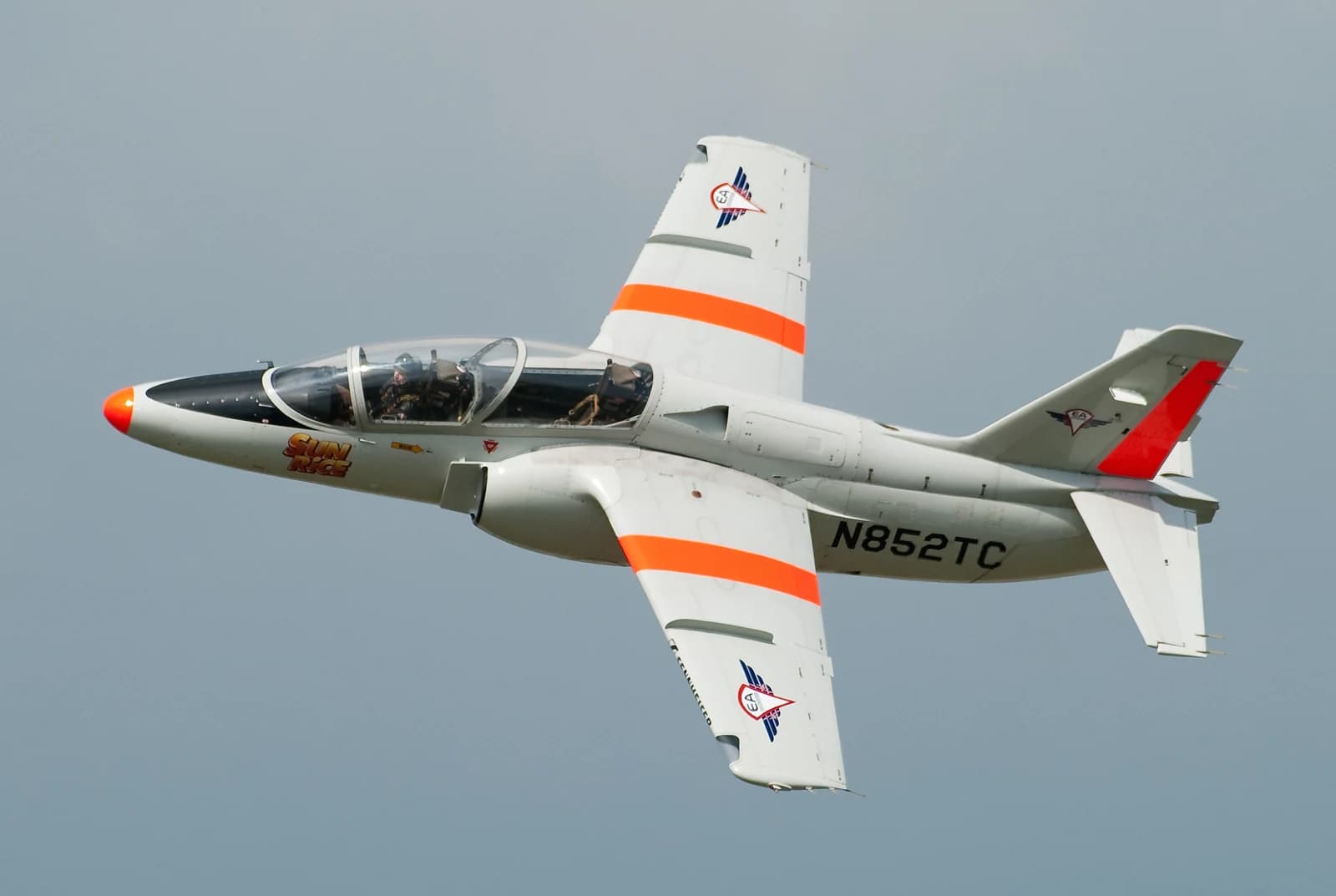

Credit
bomberpilot · CC BY-SA 2.0 · Resized / WebP conversion · CC BY-SA 2.0 · Source ↗ · Modified


Preparing your view.
At a glance
True scale
Side by side. From every angle. A human reference for perspective.
3.22 MB · Loads when you open it| Model | Length | Width / span | Height |
|---|---|---|---|
| SIAI-Marchetti S.211 | ≈ 9.31 m | ≈ 8.43 m (Wingspan) | ≈ 3.8 m |
| SIAI-Marchetti SF.260 | ≈ 7.1 m | ≈ 8.35 m (Wingspan) | ≈ 2.73 m |
Scaled uniformly to the sourced length of 9.31 m. The shape was turned square to the axes; the height was fitted to the sourced 3.8 m; the width was fitted to the sourced 8.43 m wingspan. Not an official model or a measured survey.
ForceTally · All rights reserved
Scaled uniformly to the sourced length of 7.1 m. The shape was turned square to the axes; the width was fitted to the sourced 8.35 m wingspan. Not an official model or a measured survey.
ForceTally · All rights reserved
The human reference is a generic 1.75 m figure. Models describe external size, not combat performance.
Measured figures
S-211 · Length
Single source9.31 m (30 ft 7 in)[source]
Configuration
| Specification | SIAI-Marchetti S.211 | SIAI-Marchetti SF.260 |
|---|---|---|
| Type | Jet trainer / Light attack aircraft[source] | Trainer /Light attack[source] |
| National origin | Italy[source] | Italy[source] |
| Manufacturer | SIAI-Marchetti Aermacchi[source] | SIAI-Marchetti Aermacchi Alenia Aermacchi Leonardo S.p.A.[source] |
| Status | Active service with the Philippine Air Force[source] |
SF-260M · Length
7.10 m (23 ft 4 in)[source]
Ferry; S-211 · with max internal and external fuel, at 3,150 kg (6,940 lb) at 500 km/h (310 mph; 270 kn) at 9,150 m (30,020 ft)
Single sourceS-211 · maximum on internals with 30 minutes reserve fuel
Single source1,668 km (1,036 mi, 901 nmi) maximum on internals with 30 minutes reserve fuel[source]
2,483 km (1,543 mi, 1,341 nmi) with max internal and external fuel, at 3,150 kg (6,940 lb) at 500 km/h (310 mph; 270 kn) at 9,150 m (30,020 ft)[source]
SF-260M · 2 crew, with maximum fuel
Single source1,650 km (1,030 mi, 890 nmi) 2 crew, with maximum fuel[source]
SF-260M · 1 × Textron Lycoming O-540-E4A5 / Textron Lycoming AEIO-540-D4A5 6-cylinder air-cooled horizontally-opposed piston engine
Single source1 × Textron Lycoming O-540-E4A5 / Textron Lycoming AEIO-540-D4A5 6-cylinder air-cooled horizontally-opposed piston engine, 190 kW (260 hp)[source]
S-211 · 1 × Pratt & Whitney Canada JT15D-4D turbofan
Single sourceS-211 · thrust
Single source1 × Pratt & Whitney Canada JT15D-4D 11.12 kN turbofan , 11.12 kN (2,500 lbf) thrust[source]
S-211 · fuel reserve
Single sourceS-211 · with
Single source3 hours 50 minutes with 30 minutes fuel reserve[source]
Bars compare reported quantities only. A larger figure does not make a system better; configurations and test conditions differ.
In service[source] |
| Primary users | Republic of Singapore Air Force (historical) Philippine Air Force Haitian Air Force (historical)[source] | Italian Air Force Libyan Air Force Philippine Air Force Belgian Air Force[source] |
|---|
| Number built | ~60[source] | 900 (2012)[source] |
|---|
| Manufactured | 1981–1994[source] | 1964–2017[source] |
|---|
| Introduction date | 1984[source] | April 1966 (FAA certification)[source] |
|---|
| First flight | 10 April 1981[source] | 15 July 1964[source] |
|---|
| Developed into | Aermacchi M-345[source] | — |
|---|
| Aspect ratio | 5.64[source] | 6.3:1 excluding tip-tanks[source] |
|---|
| Airfoil | root: NYU/KU 15%; tip: NYU/KU 13%[source] | root: NACA 641 1 -212 (modified); tip: NACA 641 1 -210 (modified)[source] |
|---|
| Fuel capacity | 800 L (210 US gal; 180 imp gal) internal with provision for 540 L (140 US gal; 120 imp gal) in two underwing drop tanks[source] | internal: 235 L (62 US gal; 52 imp gal) usable[source] |
|---|
| Stall speed | 138 km/h (86 mph, 75 kn) flaps down[source] | 126 km/h (78 mph, 68 kn) flaps and landing gear down[source] |
|---|
| Never exceed speed | 740 km/h (460 mph, 400 kn)[source] | 436 km/h (271 mph, 235 kn)[source] |
|---|
| g limits | +6 -3 clean; +5 -2.5 with external stores[source] | +6 -3 at max aerobatic T-O weight[source] |
|---|
| Time to altitude | 6,100 m (20,000 ft) in 6 minutes 12 seconds[source] | 1,500 m (4,900 ft) in 4 minutes 2,300 m (7,500 ft) in 6 minutes 50 seconds 3,000 m (9,800 ft) in 10 minutes[source] |
|---|
| Take-off run | 390 m (1,280 ft) ISA at sea level[source] | 384 m (1,260 ft)[source] |
|---|
| Landing run | 361 m (1,184 ft) ISA at sea level[source] | 345 m (1,132 ft)[source] |
|---|
| Take-off run to 15 m (49 ft) | 512 m (1,680 ft)[source] | — |
|---|
| Landing run from 15 m (49 ft) | 705 m (2,313 ft)[source] | — |
|---|
| Guns | gun pods[source] | — |
|---|
| Hardpoints | 4 with a capacity of 660 kg (1,460 lb) maximum[source] | — |
|---|
| Rockets | rocket launchers (such as the SNEB 68 mm rocket pods[source] | — |
|---|
| Bombs | unguided bombs[source] | — |
|---|
| Role | turbofan -powered military trainer aircraft[source] | Italian light aircraft[source] |
|---|
| Source measurement | SIAI-Marchetti started to develop the S-211 in 1976 as a private venture initiative, announcing its existence during the following year. In April 1981, the first prototype performed its maiden flight . The Singapore Air Force placed the first order for ten aircraft in 1983. Some 60 aircraft have been sold to air forces around the world. Following Aermacchi 's purchase of SIAI-Marchetti in 1997, the former has held the production rights to the type. An extensively redesigned and modernised derivative, the Aermacchi M-345 , has been developed by Alenia Aermacchi , and entered service in 2020.[source]SIAI-Marchetti S.211 · Lead; only the objects and conditions stated in this passage The S-211's single JTI5D-4C engine provides a maximum thrust output of 11.12 kN (2,500 lbs) and a specific fuel consumption of 0.57 lb/h/lb. This powerplant facilitates a maximum speed of 414 knots at 25,000 ft and a rate of climb of 5,100 ft per minute. Fuel is housed internally within both the integral wing tank and a bladder cell within the fuselage, accommodating a combined 955 L (210 U.S. gal). For greater range, a maximum of two drop tanks can be installed upon the inner hard points of the wing, each having a capacity of 323 L (71 U.S. gal). Fuel is transferred between the various tanks and to the engine via a double-ended turbine pump . Ground refuelling involves a single fill point present on the wing, which is fed either by gravity flow or by an optionally installed pressurised refuelling system.[source]SIAI-Marchetti S.211 · Design; only the objects and conditions stated in this passage Philippine Air Force (PAF) – 3 units active in 2024. 25 aircraft delivered, including one partially completed airframe for spare parts and 15 assembled locally by Philippine Aerospace Development Corporation . Due to accidents, 13 remain in inventory, 5 in active service as of September 2013 (Tail numbers 001,002,021,801 and 802). Another aircraft with tail number 008 is planned to be overhauled and brought back to service in 2014. 105th Training Squadron "Blackjacks" , 5th Fighter Wing 7th Tactical Fighter Squadron "Bulldogs" , replaced by KAI FA-50PH Fighting Eagle in 2015–2017.[source]SIAI-Marchetti S.211 · Operators / Military operators / Current; only the objects and conditions stated in this passage Two second-hand aircraft (ex-Haitian AF) are operated by private companies.[source]SIAI-Marchetti S.211 · Operators / Civilian operators; only the objects and conditions stated in this passage On 19 November 2023, two civilian registered, VH-DQJ and VH-DZJ, S-211 aircraft collided mid-air above Port Phillip Bay, 12 kilometres (7.5 mi) offshore from Mount Martha in Victoria, Australia. One aircraft (VH-DQJ) safely landed at Essendon Airport, while the other aircraft crashed into the water in Port Phillip. On 21 November, TV presenter Charley Boorman identified the two persons on board, one a photographer with whom he had worked; and, police announced that the main part of the crashed aircraft had been found in Port Phillip Bay.[source]SIAI-Marchetti S.211 · Accidents and incidents; only the objects and conditions stated in this passage Length: 9.31 m (30 ft 7 in)[source]SIAI-Marchetti S.211 · Specifications (S-211); only the objects and conditions stated in this passage Wingspan: 8.43 m (27 ft 8 in)[source]SIAI-Marchetti S.211 · Specifications (S-211); only the objects and conditions stated in this passage Height: 3.8 m (12 ft 6 in)[source]SIAI-Marchetti S.211 · Specifications (S-211); only the objects and conditions stated in this passage Wing area: 12.6 m 2 (136 sq ft)[source]SIAI-Marchetti S.211 · Specifications (S-211); only the objects and conditions stated in this passage Empty weight: 1,850 kg (4,079 lb)[source]SIAI-Marchetti S.211 · Specifications (S-211); only the objects and conditions stated in this passage Max takeoff weight: 2,750 kg (6,063 lb) (trainer, clean)[source]SIAI-Marchetti S.211 · Specifications (S-211); only the objects and conditions stated in this passage 3,150 kg (6,940 lb) (armed version)[source]SIAI-Marchetti S.211 · Specifications (S-211); only the objects and conditions stated in this passage Powerplant: 1 × Pratt & Whitney Canada JT15D-4D 11.12 kN turbofan , 11.12 kN (2,500 lbf) thrust[source]SIAI-Marchetti S.211 · Specifications (S-211); only the objects and conditions stated in this passage Cruise speed: 667 km/h (414 mph, 360 kn) maximum at 7,620 m (25,000 ft)[source]SIAI-Marchetti S.211 · Specifications (S-211); only the objects and conditions stated in this passage Stall speed: 138 km/h (86 mph, 75 kn) flaps down[source]SIAI-Marchetti S.211 · Specifications (S-211); only the objects and conditions stated in this passage Never exceed speed : 740 km/h (460 mph, 400 kn)[source]SIAI-Marchetti S.211 · Specifications (S-211); only the objects and conditions stated in this passage Range: 1,668 km (1,036 mi, 901 nmi) maximum on internals with 30 minutes reserve fuel[source]SIAI-Marchetti S.211 · Specifications (S-211); only the objects and conditions stated in this passage Ferry range: 2,483 km (1,543 mi, 1,341 nmi) with max internal and external fuel, at 3,150 kg (6,940 lb) at 500 km/h (310 mph; 270 kn) at 9,150 m (30,020 ft)[source]SIAI-Marchetti S.211 · Specifications (S-211); only the objects and conditions stated in this passage Endurance: 3 hours 50 minutes with 30 minutes fuel reserve[source]SIAI-Marchetti S.211 · Specifications (S-211); only the objects and conditions stated in this passage Service ceiling: 12,200 m (40,000 ft)[source]SIAI-Marchetti S.211 · Specifications (S-211); only the objects and conditions stated in this passage maximum sustained load at 4,575 m (15,010 ft): 3.4g[source]SIAI-Marchetti S.211 · Specifications (S-211); only the objects and conditions stated in this passage Rate of climb: 21 m/s (4,100 ft/min)[source]SIAI-Marchetti S.211 · Specifications (S-211); only the objects and conditions stated in this passage Time to altitude: 6,100 m (20,000 ft) in 6 minutes 12 seconds[source]SIAI-Marchetti S.211 · Specifications (S-211); only the objects and conditions stated in this passage Take-off run: 390 m (1,280 ft) ISA at sea level[source]SIAI-Marchetti S.211 · Specifications (S-211); only the objects and conditions stated in this passage Landing run: 361 m (1,184 ft) ISA at sea level[source]SIAI-Marchetti S.211 · Specifications (S-211); only the objects and conditions stated in this passage Take-off run to 15 m (49 ft): 512 m (1,680 ft)[source]SIAI-Marchetti S.211 · Specifications (S-211); only the objects and conditions stated in this passage Landing run from 15 m (49 ft): 705 m (2,313 ft)[source]SIAI-Marchetti S.211 · Specifications (S-211); only the objects and conditions stated in this passage Hardpoints: 4 with a capacity of 660 kg (1,460 lb) maximum[source]SIAI-Marchetti S.211 · Specifications (S-211); only the objects and conditions stated in this passage Rockets: rocket launchers (such as the SNEB 68 mm rocket pods[source]SIAI-Marchetti S.211 · Specifications (S-211); only the objects and conditions stated in this passage | The original model of the SF.260 was powered by a single Lycoming O-540 engine, capable of providing 260 hp. The standard engine made use of a carburetor , while a fuel injected engine was available as an optional extra. The SF.260 has been described as having the power to be immune to the gyration-like effects of turbulence and possessing a high rate of climb. During the 1980s, aerospace publication Flying stated the SF.260 to be: "the fastest normally aspirated piston single in production". The SF.260 holds the airspeed records for aircraft in its class over the 100 km (62 mi) and 1,000 km (620 mi) closed circuits. Later-built models often made use of turboprop engines; the initial model to be equipped as such, designated as the SF.260TP , was powered by a single Allison Model 250 engine, flat-rated at 350 shp.[source]SIAI-Marchetti SF.260 · Design; only the objects and conditions stated in this passage The pilot and up to two passengers (or pilot and one student in trainer versions) are accommodated under a broad, extensively glazed canopy . The pilot, who accesses the aircraft via purpose-built walkways along the wing, would be typically seated on the right-hand side of the cockpit; military pilots are trained to control the aircraft using their right hand on the stick and their left on the throttle.[source]SIAI-Marchetti SF.260 · Design; only the objects and conditions stated in this passage The SF.260WL was intended for pilot training, but was also used for ground support during the war in Chad . Dozens of Italian pilots served as instructors for Libyan cadets from 1977. Their number decreased in 1982, as they were supplemented by a group of 15 Libyan instructors, who had been trained at SIAI Marchetti's facilities in Italy. Libyan SF.260s played an important role during the country's involvement in Chad. They were used as light ground attack aircraft, using machine gun pods, rockets and bombs. Their first known actions took place in February 1978, when they participated in air strikes on the Chadian army garrison of Faya-Largeau together with Mil Mi-25 helicopters. As a result of the sustained bombardment, the majority of the 5,000 troops deployed there fled, and around 1,500 of them were taken prisoners on February 18.[source] |
|---|
| Designer | — | Stelio Frati[source] |
|---|
| Capacity | — | 1 passenger[source] |
|---|
| Propellers | — | 2-bladed Hartzell HC-C2YK-1BF/8477-8R constant-speed propeller , 1.93 m (6 ft 4 in) diameter[source] |
|---|
| Take-off run to 15 m (50 ft) | — | 606 m (1,988 ft)[source] |
|---|
| Landing run from 15 m (50 ft) | — | 606 m (1,988 ft)[source] |
|---|
Maximum take-off; SF-260M · Max takeoff weight
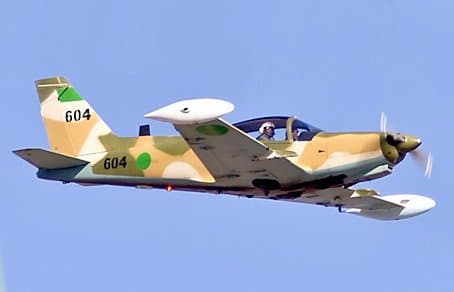
Single sourceAfter continuing the advance towards the south, by late November, pro-Libyan units had reached Dougia, only 60 kilometres north of N'Djamena. Libyan SF.260s were forward-deployed there, together with Mi-25s. On 8 December, these aircraft, joined on 12 December by Tu-22 bombers, D-30 howitzers , and M-46 field guns , started attacking N'Djamena. The week-long bombing caused a huge amount of destruction in the Chadian capital, and a number of civilian casualties that remains unknown today. After Habré fled to Cameroon , resistance collapsed and his surviving fighters escaped to Sudan .[source]SIAI-Marchetti SF.260 · Operational history / Libya; only the objects and conditions stated in this passage
F.250 – first prototype powered by 187 kW (250 hp) Lycoming O-540 -AID. The prototype, regn. I-ZUAR, was destroyed in a crash at Sestri Ponente , Genoa on 7 November 1965.[source]SIAI-Marchetti SF.260 · Variants / Aviamilano; only the objects and conditions stated in this passage
F.260 – two prototypes powered by 194 kW (260 hp) Lycoming O-540-E4A5[source]SIAI-Marchetti SF.260 · Variants / Aviamilano; only the objects and conditions stated in this passage
Royal Thai Air Force , 18 SF-260M (1973–1999)[source]SIAI-Marchetti SF.260 · Operators / Former military operators; only the objects and conditions stated in this passage
Length: 7.10 m (23 ft 4 in)[source]SIAI-Marchetti SF.260 · Specifications (SF-260M); only the objects and conditions stated in this passage
Wingspan: 8.35 m (27 ft 5 in) over tip-tanks[source]SIAI-Marchetti SF.260 · Specifications (SF-260M); only the objects and conditions stated in this passage
Height: 2.41 m (7 ft 11 in)[source]SIAI-Marchetti SF.260 · Specifications (SF-260M); only the objects and conditions stated in this passage
Wing area: 10.10 m 2 (108.7 sq ft)[source]SIAI-Marchetti SF.260 · Specifications (SF-260M); only the objects and conditions stated in this passage
Empty weight: 755 kg (1,664 lb)[source]SIAI-Marchetti SF.260 · Specifications (SF-260M); only the objects and conditions stated in this passage
Gross weight: 1,140 kg (2,513 lb)[source]SIAI-Marchetti SF.260 · Specifications (SF-260M); only the objects and conditions stated in this passage
Max takeoff weight: 1,200 kg (2,646 lb)[source]SIAI-Marchetti SF.260 · Specifications (SF-260M); only the objects and conditions stated in this passage
Powerplant: 1 × Textron Lycoming O-540-E4A5 / Textron Lycoming AEIO-540-D4A5 6-cylinder air-cooled horizontally-opposed piston engine, 190 kW (260 hp)[source]SIAI-Marchetti SF.260 · Specifications (SF-260M); only the objects and conditions stated in this passage
Propellers: 2-bladed Hartzell HC-C2YK-1BF/8477-8R constant-speed propeller , 1.93 m (6 ft 4 in) diameter[source]SIAI-Marchetti SF.260 · Specifications (SF-260M); only the objects and conditions stated in this passage
Maximum speed: 333 km/h (207 mph, 180 kn) at sea level[source]SIAI-Marchetti SF.260 · Specifications (SF-260M); only the objects and conditions stated in this passage
Cruise speed: 300 km/h (190 mph, 160 kn) at 75% power at 1,500 m (4,900 ft)[source]SIAI-Marchetti SF.260 · Specifications (SF-260M); only the objects and conditions stated in this passage
Stall speed: 126 km/h (78 mph, 68 kn) flaps and landing gear down[source]SIAI-Marchetti SF.260 · Specifications (SF-260M); only the objects and conditions stated in this passage
Never exceed speed : 436 km/h (271 mph, 235 kn)[source]SIAI-Marchetti SF.260 · Specifications (SF-260M); only the objects and conditions stated in this passage
Range: 1,650 km (1,030 mi, 890 nmi) 2 crew, with maximum fuel[source]SIAI-Marchetti SF.260 · Specifications (SF-260M); only the objects and conditions stated in this passage
Service ceiling: 4,700 m (15,300 ft)[source]SIAI-Marchetti SF.260 · Specifications (SF-260M); only the objects and conditions stated in this passage
Rate of climb: 7.6 m/s (1,500 ft/min)[source]SIAI-Marchetti SF.260 · Specifications (SF-260M); only the objects and conditions stated in this passage
Take-off run: 384 m (1,260 ft)[source]SIAI-Marchetti SF.260 · Specifications (SF-260M); only the objects and conditions stated in this passage
Landing run: 345 m (1,132 ft)[source]SIAI-Marchetti SF.260 · Specifications (SF-260M); only the objects and conditions stated in this passage
Take-off run to 15 m (50 ft): 606 m (1,988 ft)[source]SIAI-Marchetti SF.260 · Specifications (SF-260M); only the objects and conditions stated in this passage
Landing run from 15 m (50 ft): 606 m (1,988 ft)[source]SIAI-Marchetti SF.260 · Specifications (SF-260M); only the objects and conditions stated in this passage