
Credit
Unknown author Unknown author · Public domain · Resized · Public domain · Source ↗ · Modified


Preparing your view.
At a glance
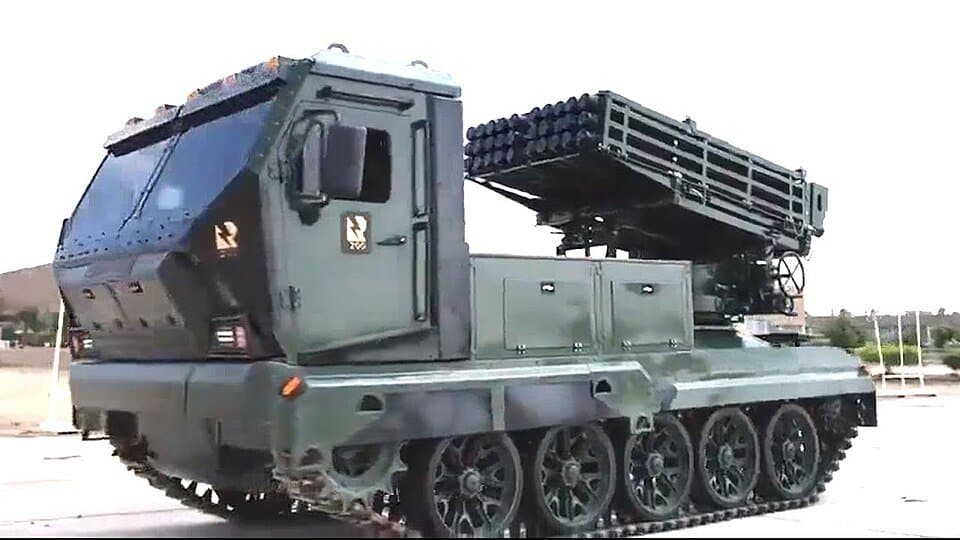
RAAD 200larger figure on 1 of 7
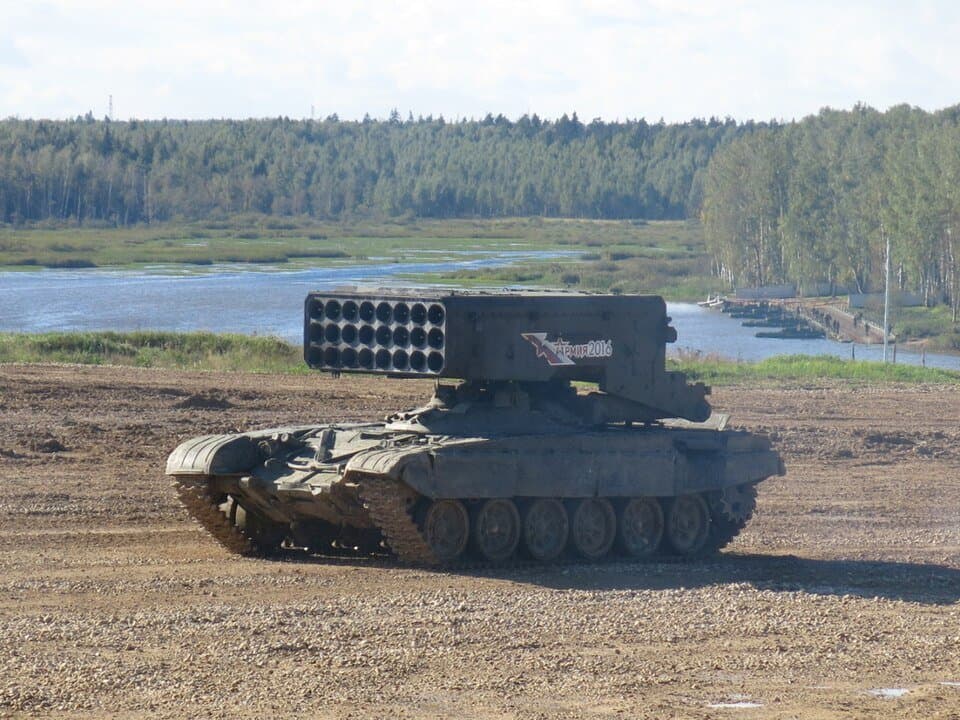
TOS-1larger figure on 6 of 7
Measured figures
Length
Single source6.5 m[source]
Length
Single sourceConfiguration
| Specification | RAAD 200 | TOS-1 |
|---|---|---|
| Type | Multiple rocket launcher[source] | Multiple rocket launcher[source] |
| Place of origin | Egypt[source] | Soviet Union[source] |
| Used by | See operators below.[source] | Soviet Union (historically), Russia , Azerbaijan , Armenia , Algeria , Syria , Iraq , Ukraine (captured from Russia)[source] |
| Designer | Ministry of Military Production[source] | Omsk Transmash Design Bureau |
Counts only measures both sources give with the same scope. A larger figure is not a better system.
9.5 m (31 ft 2 in)[source]
Mass
Single sourcebeing represented by the payload which is made of 30 Sakr 122 mm rockets hosted in three rows of 10 tubes each. It also has a curb weight of
Single sourcecombat mass of
Single sourcecombat mass of 18.58 tonnes, 1.98 tonnes being represented by the payload which is made of 30 Sakr 122 mm rockets hosted in three rows of 10 tubes each. It also has a curb weight of 16.60 tonnes.[source]
Mass
Single source45.3 t (100,000 lb)[source]
Four-stroke liquid-cooled HD12ZLG-M 6-cylinder in line turbocharged diesel engine with an output of at 2,000 rpm
Single sourceFour-stroke liquid-cooled HD12ZLG-M 6-cylinder in line turbocharged diesel engine with an output of 385 hp at 2,000 rpm.[source]
V-84 diesel
Single sourceV-84 diesel 840 hp (630 kW)[source]
RAAD 200 · Design · It also has a combat mass of 18,580 kg (18.58 tonnes) and a curb weight of 16,600 kg (16.60 tonnes), allowing it to carry a payload of 1,980 kg (1.98 tonnes). · payload of
Single sourcepayload of 1,980 kg (1.98 tonnes)[source]RAAD 200 · Design · It also has a combat mass of 18,580 kg (18.58 tonnes) and a curb weight of 16,600 kg (16.60 tonnes), allowing it to carry a payload of 1,980 kg (1.98 tonnes).
Bars compare reported quantities only. A larger figure does not make a system better; configurations and test conditions differ.
| Manufacturer | Military Factory 200[source] | Uralvagonzavod[source] |
|---|
| Transmission | Dry multi-plate clutch and a five forward speed mechanical transmission, with one reverse gear.[source] | — |
|---|
| Suspension | 10 torsion bars with four shock absorbers, the chassis being fitted with steel tracks with tension adjustment mechanism.[source] | — |
|---|
| Ground clearance | 400 mm[source] | — |
|---|
| Role | Egyptian armoured tracked self-propelled 122 mm multiple rocket launcher , unveiled in the EDEX 2023 exhibition[source] | — |
|---|
| Source measurement | The RAAD 200 measures 6.5 meters in length, 2.85 meters in width, and 3.1 meters in height. With a ground clearance of 400 mm, it can navigate challenging terrains. It also has a combat mass of 18,580 kg (18.58 tonnes) and a curb weight of 16,600 kg (16.60 tonnes), allowing it to carry a payload of 1,980 kg (1.98 tonnes).[source]RAAD 200 · Design; only the objects and conditions stated in this passage It can reach a maximum speed of 46 km/h and can handle gradients up to 35° and side slopes of 25°. Additionally, it has a fording depth of 1.1 meters and a minimum turning radius of 1.2 meters, highlighting its maneuverability in various environments. It also has an operational range of 400 km.[source]RAAD 200 · Maneuver; only the objects and conditions stated in this passage The vehicle's power comes from a four-stroke liquid-cooled turbocharged diesel engine, the HD12ZLG-M, made in Germany and assembled in China, is the only part in the system not provided in Egypt, 80% of the RAAD 200 being produced locally. This engine, featuring six inline cylinders, delivers an output of 385 hp at 2,000 rpm. It is equipped with a dry multi-plate clutch and a five-speed mechanical gearbox, with one reverse gear.[source]RAAD 200 · Maneuver; only the objects and conditions stated in this passage A pivotal feature of the RAAD 200 is its launcher specifications. It employs the BM-21 /BS-45 type launcher, capable of reaching up to 45 km. The launcher includes a base plate with a rotary disc and a spiral spindle, offering a wide range of motion - 55° vertically and 60° to 100° horizontally. This system enables a rapid launching rate of 30 rockets in 15 seconds.[source]RAAD 200 · Armament; only the objects and conditions stated in this passage The rockets used are of the Grad and Sakr types, 122 mm in diameter and 2,870 mm in length. The launcher control unit includes automatic control with two servo motors. Additional features of the RAAD 200 include rear outriggers for stability, a cabin folding system for adaptability, an air conditioning system for crew comfort, and comprehensive communication equipment.[source]RAAD 200 · Armament; only the objects and conditions stated in this passage | TOS-1 Buratino ( Russian : тяжёлая огнемётная система (ТОС-1) , romanized : Tyazhyelaya ognemyetnaya sistema (TOS-1) , Heavy Flamethrower System (TOS-1)) is a Soviet 220 mm 30-barrel (original system, Object 634 or TOS-1M ) or 24-barrel ( Object 634B or TOS-1A Solntsepyok ) multiple rocket launcher capable of using thermobaric warheads , mounted on a T-72 / T-90 tank chassis . TOS-1 was designed to attack enemy fortified positions and lightly armored vehicles and transports, particularly in open terrain. The system’s first combat tests took place in 1988 and 1989 in the Panjshir Valley during the Soviet–Afghan War . The TOS-1 was shown for the first time in public in 1999 in Omsk .[source]TOS-1 · Lead; only the objects and conditions stated in this passage The TOS-1 Buratino is intended to engage military personnel, equipment, and buildings, including fortified constructions. The nickname " Buratino " originates with the name of the hero of a Russian retelling of the Pinocchio tale (by Alexey Tolstoy ), given the perception of the big "nose" of the launcher (in the original Italian text of Pinocchio , the protagonist is a " burattino ", the Italian word for " puppet "). The combat vehicle acts within the combat order of infantry and tanks. The large mass of the launcher, combined with the short range of rockets launches (3,500 metres, 3,800 yards), forced an increase in the level of armor and use the chassis of the T-72 main battle tank. The TZM reloading vehicle was built on the chassis of a KrAZ-255 B cross-country truck and equipped with a crane for loading/unloading of the launcher. Production of KrAZ-255B has officially stopped in 1994. Therefore, TZM-T for later Soltsepyok was created based on the chassis of a T-72 variation T-72A .[source]TOS-1 · Development; only the objects and conditions stated in this passage In 2003, the improved TOS-1A Solntsepyok ("Scorching sunlight") system entered service with the range extended to 6 kilometres (6,600 yd) and a better ballistic computer.[source]TOS-1 · Development; only the objects and conditions stated in this passage In March 2020, Russia introduced a new rocket for the TOS-1A with a range of 10 kilometres (11,000 yd), achieved in part by weight and size reductions of a new fuel air explosive mixture in the warhead, while also increasing its power. Minimum range is extended from 400 to 1,600 metres (440 to 1,750 yd), so the shorter-range M0.1.01.04M rocket will be retained for close combat environments. In 2018, Russian NBC Protection Troops received 30 TOS-1A Solntsepyok (Sunburn) 220 mm multiple rocket launchers. |
|---|
| Curb weight | curb weight of 16,600 kg (16.60 tonnes)[source]RAAD 200 · Design · It also has a combat mass of 18,580 kg (18.58 tonnes) and a curb weight of 16,600 kg (16.60 tonnes), allowing it to carry a payload of 1,980 kg (1.98 tonnes). | — |
|---|
| Launcher capacity | 30 Sakr 122 mm rockets hosted in three rows of 10 tubes each[source]RAAD 200 · fitted Sakr 122 mm launcher outfit; three rows of ten tubes | 30-barrel[source]TOS-1 family: original 30-barrel system Object 634/TOS-1M only; not TOS-1A 24-barrel[source]TOS-1 family: Object 634B/TOS-1A 24-barrel configuration only; not original 30-barrel system |
|---|
| In service | — | 1988–present[source] |
|---|
| Wars | — | Soviet–Afghan War Nagorno-Karabakh conflict Second Chechen War War in Iraq (2013–2017) Syrian Civil War War in Donbas Second Nagorno-Karabakh War Russo-Ukrainian war[source] |
|---|
| Designed | — | 1988[source] |
|---|
| Produced | — | TOS-1: 1987–present TOS-1A: 2003–present[source] |
|---|
| Variants | — | TOS-1A[source] |
|---|
| Rate of fire | — | 30 rounds /15 s[source] |
|---|
| Former operator · Soviet Union | — | Soviet Union[source] |
|---|
| Reported operators | — |
|---|
Effective; TOS-1A
Single sourceThe Soviets used TOS-1 in 1989 during the Soviet withdrawal from Afghanistan . Russia used them during the Second Chechen War , where they performed well in urban and mountainous terrain.[source]TOS-1 · Operational history / Early uses; only the objects and conditions stated in this passage
The TOS-1 was used in Syria on 10 October 2015, by Syrian Army forces against rebel forces in Hama. In 2016, it was used against rebel forces in the Latakia mountains, with at least one being destroyed by a rebel Kornet ATGM near Northern Aleppo. It was used again by the Syrian Arab Army in April 2017 in the area of Palmyra, and later in the same month to destroy an ISIS camp. In November 2018, the system was deployed by the SAA against ISIS in Al-Safa region.[source]TOS-1 · Operational history / Early uses; only the objects and conditions stated in this passage
Improved MO.1.01.04 with heavier warhead and a longer range of 6,000 m (20,000 ft). Detonation produces a peak temperature of 3,700 °C (6,690 °F), and high heat persists after the blast.[source]TOS-1 · Components; only the objects and conditions stated in this passage