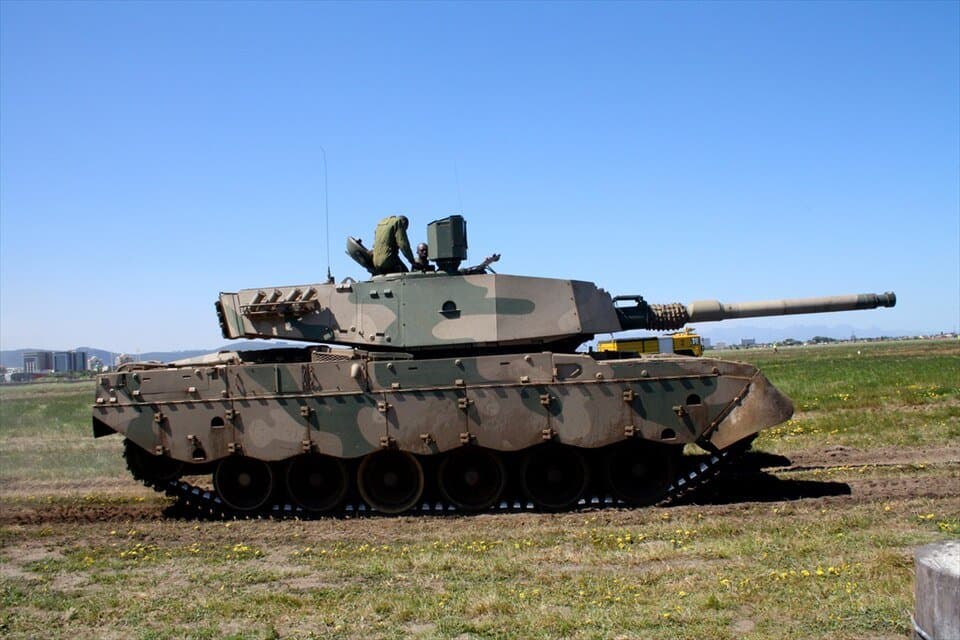

Credit
Bob Adams from George, South Africa · CC BY-SA 2.0 · Resized · CC BY-SA 2.0 · Source ↗ · Modified


Preparing your view.

At a glance
Olifant (tank)larger figure on 1 of 1
Pokpung-holarger figure on 0 of 1
Counts only measures both sources give with the same scope. A larger figure is not a better system.
True scale
Side by side. From every angle. A human reference for perspective.
3.31 MB · Loads when you open it| Model | Length | Width / span | Height |
|---|---|---|---|
| Olifant (tank) | ≈ 9.15 m | ≈ 3.38 m (Width) | ≈ 3.42 m |
| Pokpung-ho | ≈ 9.06 m | ≈ 3.5 m (Width) | ≈ 2.84 m |
Scaled uniformly so that the hull matches the sourced 7.557 m hull length. Thin antennas or poles standing above the body were pressed down to it, so they do not set the height; the width was fitted to the sourced 3.38 m. Not an official model or a measured survey.
ForceTally · All rights reserved
Scaled uniformly so that the hull matches the sourced 7 m hull length: ~ length. The width was fitted to the sourced 3.5 m. Not an official model or a measured survey.
ForceTally · All rights reserved
The human reference is a generic 1.75 m figure. Models describe external size, not combat performance.
Measured figures
Gun forward
Single sourceHull
Single sourceConfiguration
| Specification | Olifant (tank) | Pokpung-ho |
|---|---|---|
| Type | Main battle tank[source] | Main battle tank[source] |
| Place of origin | United Kingdom South Africa[source] | North Korea[source] |
| In service | 1976–present[source] | 2002–present[source] |
| Wars | South African Border War : Operation Moduler Operation Packer[source] | — |
Hull only 24 ft 9.5 in (7.557 m) With gun forward 32 ft 3 in (9.83 m)[source]
Hull length: ~
Single sourceHull length: ~7 m[source]
Mk.2
Single sourceRolls-Royce Meteor 4B (Mk.1) V-12 air-cooled Continental AV1790 turbo diesel engine (others) at 2550rpm (Meteor) others up to
Single sourceRolls-Royce Meteor 4B (Mk.1) V-12 air-cooled Continental AV1790 turbo diesel engine (others) 650 hp (480 kW) at 2550rpm (Meteor) others up to 1,040 hp (780 kW) (Mk.2)[source]
P’okpoong; explicitly uncertain source estimate
Single sourceThe P'okpoong engine is likely to have around 750–1,000 horsepower .[source]P’okpoong; explicitly uncertain source estimate
Bars compare reported quantities only. A larger figure does not make a system better; configurations and test conditions differ.
| Developed from |
|---|
Centurion (tank)[source] |
| — |
| Developed into | The Olifant led to the TTD also known as The Loggim program (TTD Program)[source] | — |
|---|
| No. built | 224[source] | — |
|---|
| Armour | 51–152 mm (2.0–6.0 in)[source] | — |
|---|
| Main armament | Ordnance QF 20 pounder 84 mm " GT-1 " (Mk.1) 105 mm L7 rifled gun " GT-3 " (others)[source] | 115 mm 2A20 (Chonma-215) 125mm 2A46 (Chonma-216)[source] |
|---|
| Secondary armament | Co-axial machine gun .30 cal[source] | 14.5mm KPVT heavy anti-aircraft machine gun (300 rounds), 7.62 mm PKT (Chonma-215/216) Dual AGS-30 automatic grenade launcher , Dual Bulsae-4M , Dual Igla MANPADS , 7.62 mm PKT (Chonma mod.2017 )[source] |
|---|
| Transmission | 5-speed Merrit-Brown Z51R Mk. F gearbox (Mk.1) automatic gearbox (Mk.1A, Mk.1B, Mk.2)[source] | — |
|---|
| Suspension | Modified Horstmann (Mk.1 and Mk.1A) Torsion Bar (Mk.1B and Mk.2)[source] | Torsion-bar[source] |
|---|
| Ground clearance | 1 ft 8 in (0.51 m)[source] | — |
|---|
| Manufacturer | Olifant Manufacturing Company[source]Olifant Mk.1 · original Centurion refurbishment programme | Ryu Kyong-su Tank Factory[source] |
|---|
| Used by | South Africa[source]Current operator explicitly identified by the equipment service role | Korean People's Army Ground Force[source] |
|---|
| Designer | — | Second Machine Industry Bureau[source] |
|---|
| Armor | — | Composite Armour. ERA plates optional. Maximum estimated armor thickness without ERA – 500 mm vs HEAT[source] |
|---|
| Engine | — | 12 cylinder diesel engine delivering 1,000 (±150) hp[source] |
|---|
| Hangul | — | 폭풍호[source] |
|---|
| Hanja | — | 暴風號[source] |
|---|
| RR | — | Pokpungho[source] |
|---|
| MR | — | P'okp'ungho[source] |
|---|
| Reported operators | — |
|---|