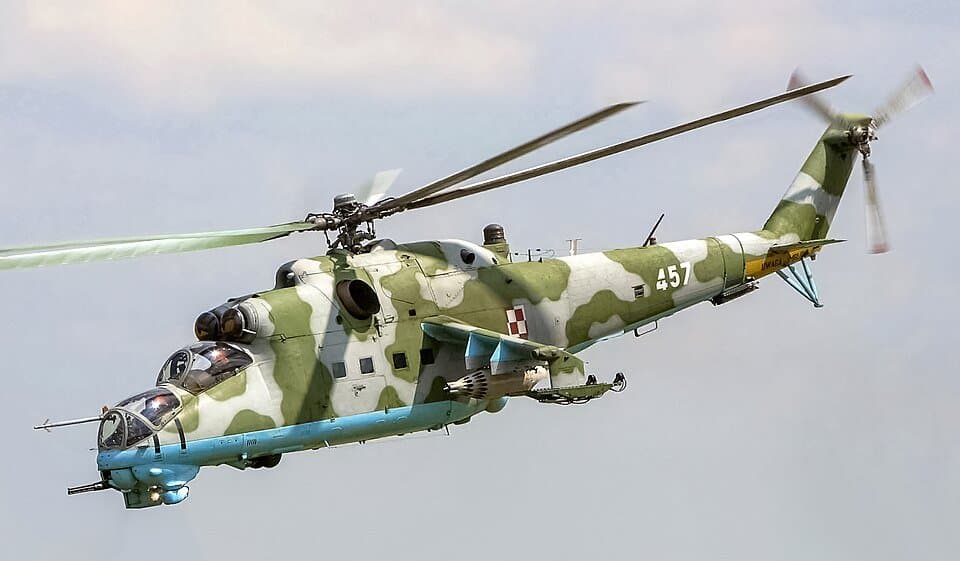

Credit
File:Mi24CP (modified).jpg : Cezary Piwowarski modified by FOX 52 derivative work: Georgfotoart · CC BY-SA 4.0 · Resized · CC BY-SA 4.0 · Source ↗ · Modified


Preparing your view.
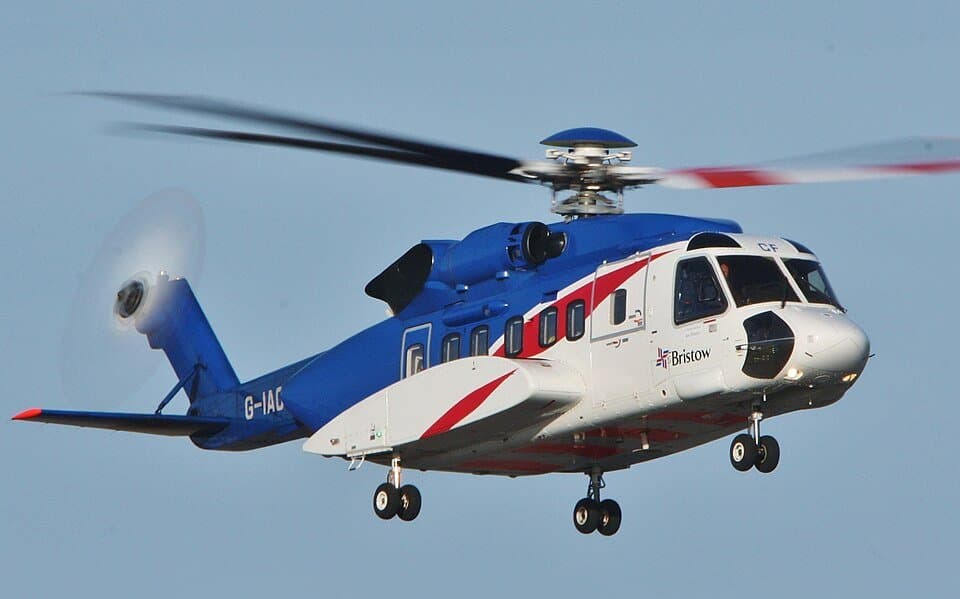

At a glance
Measured figures
Mi-24 · fuselage only
Single source17.5 m (57 ft 5 in) fuselage only[source]
S-92 · Length
Single sourceConfiguration
| Specification | Mil Mi-24 | Sikorsky S-92 |
|---|---|---|
| Type | Attack helicopter with transport capabilities, helicopter gunship[source] | Medium-lift transport/utility helicopter[source] |
| National origin | Soviet Union / Russia[source] | United States[source] |
| Manufacturer | Mil[source] | Sikorsky Aircraft[source] |
| Status | In service[source] |
68 ft 6 in (20.88 m)[source]
S-92 · fuselage
Single source17 ft 3 in (5.26 m) fuselage[source]
Mi-24 · stub wings
Single source6.5 m (21 ft 4 in) stub wings[source]
Mi-24 · 2 × Isotov TV3-117 turboshaft engines (2,200 shp) each
Single source2 × Isotov TV3-117 turboshaft engines, 1,600 kW (2,200 shp) each[source]
S-92 · 2 × General Electric CT7-8A turboshaft engines, 2,520 shp ( ) each
Single source2 × General Electric CT7-8A turboshaft engines, 2,520 shp (1,880 kW) each[source]
Mi-24 · 3,000 ft/min
Single source15 m/s (3,000 ft/min)[source]
Bars compare reported quantities only. A larger figure does not make a system better; configurations and test conditions differ.
In service[source]
| Primary users | Russian Aerospace Forces 58 other users (see Operators section below)[source] | CHC Helicopter Petroleum Helicopters International Bristow Helicopters Cougar Helicopters[source] |
|---|
| Number built | 2,648[source] | at least 300[source] |
|---|
| Manufactured | 1969–present[source] | 1998–present[source] |
|---|
| Introduction date | 1972[source] | 2004[source] |
|---|
| First flight | 19 September 1969[source] | December 23, 1998[source] |
|---|
| Developed from | Mil Mi-8[source] | Sikorsky S-70[source] |
|---|
| Capacity | 8 troops / 4 stretchers / 2,400 kg (5,291 lb) cargo on an external sling[source] | 19 passengers[source] |
|---|
| Main rotor area | 227 m 2 (2,440 sq ft)[source] | 2,492.3 sq ft (231.54 m 2 )[source] |
|---|
| Role | large helicopter gunship , attack helicopter and low-capacity troop transport[source] | — |
|---|
| Source measurement | The Mil Mi-24 ( Russian : Миль Ми-24 ; NATO reporting name : Hind ) is a large helicopter gunship , attack helicopter and low-capacity troop transport with room for eight passengers. It is produced by Mil Moscow Helicopter Plant and was introduced by the Soviet Air Force in 1972. As of 2026 , the helicopter is used worldwide by 52 countries.[source]Mil Mi-24 · Lead; only the objects and conditions stated in this passage During the early 1960s, it became apparent to Soviet designer Mikhail Mil that the trend towards ever-increasing battlefield mobility would result in the creation of flying infantry fighting vehicles , which could be used to perform both fire support and infantry transport missions. The first expression of this concept was a mock-up unveiled in 1966 in the experimental department of the Ministry of Aircraft's factory number 329, where Mil was head designer. The mock-up designated V-24 was based on another project, the V-22 utility helicopter, which never flew. The V-24 had a central infantry compartment that could hold eight troops sitting back to back, and a set of small wings positioned to the top rear of the passenger cabin, capable of holding up to six missiles or rockets and a twin-barreled GSh-23L cannon fixed to the landing skid.[source]Mil Mi-24 · Development; only the objects and conditions stated in this passage Mil engineers prepared two basic designs: a 7-ton single-engine design and a 10.5-ton twin-engine design, both based on the 1,300 kW (1,700 hp) Izotov TV3-177A turboshaft . Later, three complete mock-ups were produced, along with five cockpit mock-ups to allow the pilot and weapon station operator positions to be fine-tuned.[source]Mil Mi-24 · Development; only the objects and conditions stated in this passage The Kamov design bureau suggested an army version of their Ka-25 ASW helicopter as a low-cost option. This was considered but later dropped in favor of the new Mil twin-engine design. A number of changes were made at the insistence of the military, including the replacement of the 23 mm cannon with a rapid-fire heavy machine gun mounted in a chin turret, and the use of the 9K114 Shturm (AT-6 Spiral) antitank missile.[source]Mil Mi-24 · Development; only the objects and conditions stated in this passage Acceptance testing for the design began in June 1970, continuing for 18 months. Changes made in the design addressed structural strength, fatigue problems and vibration levels. Also, a 12-degree anhedral was introduced to the wings to address the aircraft's tendency to Dutch roll at speeds in excess of 200 km/h (124 mph), and the Falanga missile pylons were moved from the fuselage to the wingtips. The tail rotor was moved from the right to the left side of the tail, and the rotation direction reversed. The tail rotor now rotated up on the side towards the front of the aircraft, into the downwash of the rotor, which increased its efficiency. A number of other design changes were made until the production version Mi-24A ( izdeliye 245 ) entered production in 1970, obtaining its initial operating capability in 1971 and was officially accepted into the state arsenal in 1972.[source]Mil Mi-24 · Development; only the objects and conditions stated in this passage In 1972, following completion of the Mi-24, development began on a unique attack helicopter with transport capability. The new design had a reduced transport capability (three troops instead of eight) and was called the Mi-28 , and that of the Ka-50 attack helicopter, which is smaller and more maneuverable and does not have the large cabin for carrying troops. In October 2007, the Russian Air Force announced it would replace its Mi-24 fleet with Mi-28Ns and Ka-52s by 2015. However, after the successful operation of the type in Syria it was decided to keep it in service and upgrade it with new electronics, sights, arms and night vision goggles.[source]Mil Mi-24 · Development; only the objects and conditions stated in this passage The core of the aircraft was derived from the Mil Mi-8 (NATO reporting name "Hip") with two top-mounted turboshaft engines driving a mid-mounted 17.3 m (57 ft) five-blade main rotor and a three-blade tail rotor. The engine configuration gave the aircraft its distinctive double air intake. Original versions have an angular greenhouse-style cockpit; Model D and later have a characteristic tandem cockpit with a "double bubble" canopy . Other airframe components came from the Mi-14 "Haze". Two mid-mounted stub wings provide weapon hardpoints , each offering three stations, in addition to providing lift . The loadout mix is mission dependent; Mi-24s can be tasked with close air support, antitank operations, or aerial combat.[source]Mil Mi-24 · Design / Overview; only the objects and conditions stated in this passage The Mi-24's titanium rotor blades are resistant to 12.7 mm (.50 caliber) rounds. The cockpit is protected by ballistic-resistant windscreens and a titanium-armored tub. The cockpit and crew compartment are overpressurized to protect the crew in NBC conditions .[source]Mil Mi-24 · Design / Overview; only the objects and conditions stated in this passage Considerable attention was given to making the Mi-24 fast. The airframe was streamlined, and fitted with retractable tricycle undercarriage landing gear to reduce drag. At high speed, the wings provide considerable lift (up to a quarter of total lift). The main rotor was tilted 2.5° to the right from the fuselage to compensate for translating tendency at a hover. The landing gear was also tilted to the left so that the rotor would still be level when the aircraft was on the ground, making the rest of the airframe tilt to the left. The tail was also asymmetrical to give a side force at speed, thus unloading the tail rotor.[source]Mil Mi-24 · Design / Flight characteristics; only the objects and conditions stated in this passage A modified Mi-24B, named A-10, was used in several speed and time-to-climb world record attempts. The helicopter had been modified to reduce weight as much as possible—one measure was the removal of the stub wings. The previous official speed record was set on 13 August 1975 over a closed 1,000 km (620 mi) course of 332.65 km/h (206.70 mph); many of the female-specific records were set by the all-female crew of Galina Rastorguyeva and Lyudmila Polyanskaya. On 21 September 1978, the A-10 set the absolute speed record for helicopters with 368.4 km/h (228.9 mph) over a 15/25 km course. The record stood until 1986, when it was broken by the current official record holder, a modified British Westland Lynx .[source]Mil Mi-24 · Design / Flight characteristics; only the objects and conditions stated in this passage The Libyan air force used Mi-24A and Mi-25 units during their numerous interventions in Chad's civil war . The Mi-24s were first used in October 1980 in the battle of N'Djamena , where they helped the People's Armed Forces seize the capital.[source]Mil Mi-24 · Operational history / Chadian–Libyan conflict (1978–1987); only the objects and conditions stated in this passage It is difficult to find the total number of Mi-24s used in Afghanistan. At the end of 1990, the whole Soviet Army had 1,420 Mi-24s. During the Afghan war, sources estimated the helicopter strength to be as much as 600 units, with up to 250 being Mi-24s, whereas a (formerly secret) 1987 Central Intelligence Agency (CIA) report says that the number of Mi-24s in theatre increased from 85 in 1980 to 120 in 1985.[source]Mil Mi-24 · Operational history / Soviet war in Afghanistan (1979–1989); only the objects and conditions stated in this passage The Mi-24's favoured munition was the 80-millimetre (3.1 in) S-8 rocket , the 57 mm (2.2 in) S-5 having proven too light to be effective.[source]Mil Mi-24 · Operational history / Soviet war in Afghanistan (1979–1989) / First deployment and combat; only the objects and conditions stated in this passage The 23 mm (0.91 in) gun pod was also popular.[source]Mil Mi-24 · Operational history / Soviet war in Afghanistan (1979–1989) / First deployment and combat; only the objects and conditions stated in this passage The Mi-24 could carry ten 100-kilogram (220 lb) iron bombs for attacks on camps or strongpoints, while harder targets could be dealt with a load of four 250-kilogram (550 lb) or two 500-kilogram (1,100 lb) iron bombs.[source]Mil Mi-24 · Operational history / Soviet war in Afghanistan (1979–1989) / First deployment and combat; only the objects and conditions stated in this passage The war in Afghanistan brought with it losses by attrition. The environment itself, dusty and often hot, was rough on the machines; dusty conditions led to the development of the twin PZU ('PyleZashchitnoe Ustroystvo') air intake filters. The rebels' primary air-defence weapons early in the war were heavy machine guns and antiaircraft cannons, though anything smaller than a 23 millimetre shell generally did not do much damage to an Mi-24. The cockpit glass panels were resistant to 12.7 mm (.50 in calibre) rounds.[source]Mil Mi-24 · Operational history / Soviet war in Afghanistan (1979–1989) / Attrition in Afghanistan; only the objects and conditions stated in this passage Initially, the attack doctrine of the Mi-24 was to approach its target from high altitude and dive downwards. After the introduction of the Stinger, doctrine changed to " nap of the earth " flying, where they approached very low to the ground and engaged more laterally, popping up to only about 200 ft (61 m) in order to aim rockets or cannons. Countermeasure flares and missile warning systems would be installed in all Soviet Mil Mi-2 , Mi-8, and Mi-24 helicopters, giving pilots a chance to evade missiles fired at them. Heat dissipation devices were also fitted to exhausts to decrease the Mi-24's heat signature. Tactical and doctrinal changes were introduced to make it harder for the enemy to deploy these weapons effectively. These reduced the Stinger threat, but did not eliminate it.[source]Mil Mi-24 · Operational history / Soviet war in Afghanistan (1979–1989) / Attrition in Afghanistan; only the objects and conditions stated in this passage Afghan Air Force Mi-24s in the hands of the ascendant Taliban gradually became inoperable, but a few flown by the Northern Alliance , which had Russian assistance and access to spares, remained operational up to the US invasion of Afghanistan in late 2001. In 2008, the Afghan Air Force took delivery of six refurbished Mi-35 helicopters, purchased from the Czech Republic. The Afghan pilots were trained by India and began live firing exercises in May 2009 in order to escort Mi-17 transport helicopters on operations in restive parts of the country. India would also supply four upgraded Mil-35s to the Afghan Air Force in 2015.[source]Mil Mi-24 · Operational history / Soviet war in Afghanistan (1979–1989) / Mi-24s in Afghanistan after Soviet withdrawal; only the objects and conditions stated in this passage Three Mi-24s were used by Mobutu's army and were later acquired by the new Air Force of the Democratic Republic of the Congo . These were supplied to Zaire in 1997 as part of a French-Serbian contract. At least one was flown by Serbian mercenaries. One hit a power line and crashed on 27 March 1997, killing the three crew and four passengers. Zimbabwean Mi-24s were also operated in coordination with the Congolese Army.[source]Mil Mi-24 · Operational history / First and Second Congo Wars (1996–2003); only the objects and conditions stated in this passage Two second-hand Mi-24Vs procured from Ukraine earlier in the 1990s were used by the Yugoslav Special Operation Unit (JSO) against Kosovo Albanian rebels during the Kosovo War .[source]Mil Mi-24 · Operational history / Kosovo War (1998–1999); only the objects and conditions stated in this passage During the Ivorian Civil War , five Mil Mi-24s piloted by mercenaries were used in support of government forces. They were later destroyed by the French Army in retaliation for an air attack on a French base that killed nine soldiers.[source]Mil Mi-24 · Operational history / Ivorian Civil War (2002–2004); only the objects and conditions stated in this passage The Polish contingent in Iraq used six Mi-24Ds after December 2004. One of them crashed on 18 July 2006 in an air base in Al Diwaniyah . Polish Mi-24Ds used in Iraq were not returned to Poland due to their age, condition, low combat value of the Mi-24D variant, and high shipping costs; depending on their condition, they were transferred to the new Iraqi Army or scrapped.[source]Mil Mi-24 · Operational history / Iraq War (2003–2011); only the objects and conditions stated in this passage The Myanmar Air Force used the Mi-24 in the Kachin conflict against the Kachin Independence Army . Two Mi-35 helicopters were shot down by the Kachin Independence Army during the heavy fighting in the mountains of northern Burma in 2012 and early 2013.[source]Mil Mi-24 · Operational history / Second Kachin conflict (2011–present); only the objects and conditions stated in this passage On 3 October 2014, ISIL militants reportedly used a FN-6 shoulder-launched missile in Baiji to shoot down an Iraqi Army Mi-35M attack helicopter. Video footage released by ISIL militants shows at least another two Iraqi Mi-35s brought down by light antiaircraft artillery.[source]Mil Mi-24 · Operational history / Post-U.S. Iraqi insurgency; only the objects and conditions stated in this passage In 2018, Pakistan received 4 Mi-35M Hind-E Gunships from Russia under the $153 million deal. They are now stationed at the Army Aviation Corps base at Quetta Cantonment . The gunships have since been used in several counter insurgency operations against various militant groups in the Balochistan province of Pakistan. In early 2022, a base in Nushki and a check-post in Panjgur belonging to the Frontier Corps Balochistan Paramilitary were attacked by BLA terrorists. The attack in Nushki was swiftly repulsed but the situation in Panjgaur was not good to which Mi-35 Hind and AH-1F Cobra gunships were called in for support. It provided much needed ground support and reconnaissance in the counter offensive which led to success.[source]Mil Mi-24 · Operational history / Balochistan Insurgency (2012–present); only the objects and conditions stated in this passage During the 2022 Russian invasion of Ukraine , both Ukraine and Russia have used Mi-24 helicopters. On 1 March 2022, Ukrainian forces shot down a Russian Mi-35M helicopter with MANPADS, in the Kyiv Reservoir (see also Battle of Kyiv ). On 5 May 2022, the helicopter was retrieved by Ukrainian engineers in Vyshgorod . Two Russian Mi-35 were shot down by a MANPADS on 5 March 2022. On 6 March, one Mi-24P with registration number RF-94966 was shot down by Ukrainian MANPADS in Kyiv Oblast. On 8 March 2022 one Ukrainian Mil Mi-24 from the Ukrainian 16th Army Aviation Brigade was lost over Brovary , Kyiv. Pilots Col. Oleksandr Maryniak and Cptn. Ivan Bezzub were killed. On 17 March a Russian Mi-35M was reported destroyed by Ukrainian Ministry of Defence , unknown location. On 1 April 2022, two Ukrainian Mi-24s reportedly entered Russia and attacked an oil storage facility in Belgorod .[source]Mil Mi-24 · Operational history / Russian invasion of Ukraine (2022–present); only the objects and conditions stated in this passage As of 27 May 2025, claimed losses compiled by Oryx blog are listed as following: 4 Mi-24P, 4 Mi-24V/P/35M, 10 Mi-35M for the Russian side, and 2 Mi-24P and 7 Mi-24 of unknown variant for the Ukrainian side.[source]Mil Mi-24 · Operational history / Russian invasion of Ukraine (2022–present); only the objects and conditions stated in this passage Serbian Air Force 4 Mi-35M, 11 Mi-35P[source]Mil Mi-24 · Operators; only the objects and conditions stated in this passage Capacity: 8 troops / 4 stretchers / 2,400 kg (5,291 lb) cargo on an external sling[source]Mil Mi-24 · Specifications (Mi-24); only the objects and conditions stated in this passage Length: 17.5 m (57 ft 5 in) fuselage only[source]Mil Mi-24 · Specifications (Mi-24); only the objects and conditions stated in this passage 19.79 m (65 ft) including rotors[source]Mil Mi-24 · Specifications (Mi-24); only the objects and conditions stated in this passage Wingspan: 6.5 m (21 ft 4 in) stub wings[source]Mil Mi-24 · Specifications (Mi-24); only the objects and conditions stated in this passage Height: 6.5 m (21 ft 4 in)[source]Mil Mi-24 · Specifications (Mi-24); only the objects and conditions stated in this passage Empty weight: 8,500 kg (18,739 lb)[source]Mil Mi-24 · Specifications (Mi-24); only the objects and conditions stated in this passage Max takeoff weight: 12,000 kg (26,455 lb)[source]Mil Mi-24 · Specifications (Mi-24); only the objects and conditions stated in this passage Powerplant: 2 × Isotov TV3-117 turboshaft engines, 1,600 kW (2,200 shp) each[source]Mil Mi-24 · Specifications (Mi-24); only the objects and conditions stated in this passage Main rotor diameter: 17.2 m (56 ft 5 in)[source]Mil Mi-24 · Specifications (Mi-24); only the objects and conditions stated in this passage Main rotor area: 227 m 2 (2,440 sq ft)[source]Mil Mi-24 · Specifications (Mi-24); only the objects and conditions stated in this passage Maximum speed: 320 km/h (200 mph, 170 kn)[source]Mil Mi-24 · Specifications (Mi-24); only the objects and conditions stated in this passage Cruise speed: 270 km/h (170 mph, 150 kn)[source]Mil Mi-24 · Specifications (Mi-24); only the objects and conditions stated in this passage Range: 450 km (280 mi, 240 nmi)[source]Mil Mi-24 · Specifications (Mi-24); only the objects and conditions stated in this passage Service ceiling: 5,750 m (18,860 ft)[source]Mil Mi-24 · Specifications (Mi-24); only the objects and conditions stated in this passage Rate of climb: 15 m/s (3,000 ft/min)[source]Mil Mi-24 · Specifications (Mi-24); only the objects and conditions stated in this passage flexible 12.7 mm Yakushev-Borzov Yak-B Heavy machine gun . (Original variant) flexible twin-barrel GSh-23L autocannon on the Mi-24VP, Mi-24VM and Mi-35M with 450 rounds. (Most variants) fixed twin-barrel GSh-30K autocannon on the Mi-24P. (Hind-F) PKB passenger compartment window mounted machine guns[source]Mil Mi-24 · Specifications (Mi-24); only the objects and conditions stated in this passage Total payload claimed is up to 2,400 kg of external stores from Mi-24P. Inner hardpoints can carry 500 kg. Outer hardpoints can carry 250 kg Wing-tip pylons can only carry the 9M17 Phalanga (in the Mi-24A-D), the 9K114 Shturm complex (in the Mi-24V-F) per each side.[source]Mil Mi-24 · Specifications (Mi-24); only the objects and conditions stated in this passage Bombs within weight range, up to 500 kg MBD multiple ejector racks KGMU2V submunition/mine dispenser pods[source]Mil Mi-24 · Specifications (Mi-24); only the objects and conditions stated in this passage GUV-8700 gunpod (with a 12.7 mm Yak-B + 2 × 7.62 mm GShG-7.62 mm combination or one 30 mm AGS-17 ) UB-16 S-5 rocket launchers UB-32 S-5 rocket launchers S-24 240 mm rocket 9M17 Fleyta (a pair on each wingtip pylon)[source]Mil Mi-24 · Specifications (Mi-24); only the objects and conditions stated in this passage R-60, R-60M Infrared missiles[source]Mil Mi-24 · Specifications (Mi-24); only the objects and conditions stated in this passage | — |
|---|
| Variants | — | Sikorsky CH-148 Cyclone Sikorsky VH-92[source] |
|---|
| Cabin dimensions | — | 20 ft (6 m) long by 6.6 ft (2 m) tall[source] |
|---|
| Blade section | — | - root: Sikorsky SC2110; tip: Sikorsky SSC-A09[source] |
|---|
| Disk loading | — | 9.8 lb/sq ft (48 kg/m 2 )[source] |
|---|
| Power/mass | — | 0.23 hp/lb (0.38 kW/kg)[source] |
|---|
Maximum take-off; S-92 · Max takeoff weight
Single source