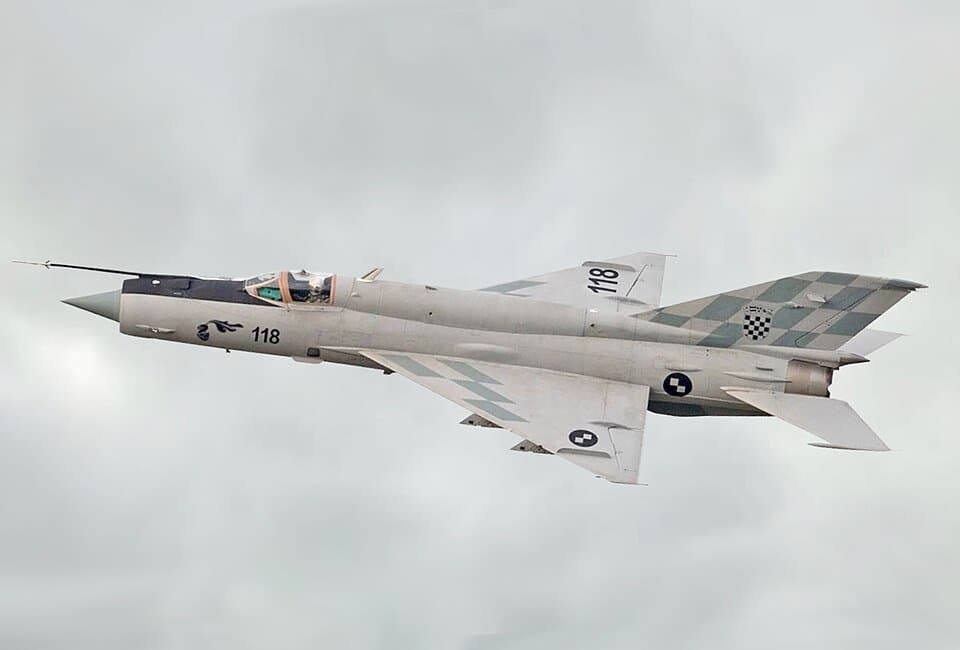
Credit
Gojanovic123456789 · CC BY-SA 4.0 · Resized · CC BY-SA 4.0 · Source ↗ · Modified


Preparing your view.

At a glance
Measured figures
MiG-21bis · excluding pitot boom
Single source14.7 m (48 ft 3 in) excluding pitot boom[source]
Length
Single sourceConfiguration
| Specification | Mikoyan-Gurevich MiG-21 | Shenyang J-16 |
|---|---|---|
| Type | Fighter and interceptor aircraft[source] | — |
| National origin | Soviet Union[source] | People's Republic of China[source] |
| Designer | Mikoyan-Gurevich[source] | — |
| Status | In service[source] | In service[source] |
| Primary users | Soviet Air Forces (historical) Indian Air Force (historical) North Korean Air Force Angolan Air Force |
21.9 m (71 ft 10 in)[source]
Gross; MiG-21bis · with two R-3S missiles
Single sourceMaximum take-off; MiG-21bis · unprepared or metal planking runway
Single source8,725 kg (19,235 lb) with two R-3S missiles[source]
8,800 kg (19,401 lb) unprepared or metal planking runway[source]
Empty; Empty weight
Single sourceMaximum take-off; Max takeoff weight
Single sourceMiG-21bis · 1 × Tumansky R-25-300 afterburning turbojet thrust dry
Single sourceMiG-21bis · with afterburner
Single source1 × Tumansky R-25-300 afterburning turbojet, 40.18 kN (9,030 lbf) thrust dry, 69.58 kN (15,640 lbf) with afterburner[source]
2 × Shenyang WS-10B afterburning turbofans with afterburner
Single source2 × Shenyang WS-10B afterburning turbofans , 135 kN (30,000 lbf) with afterburner[source]
45,000 ft/min
Single source230 m/s (45,000 ft/min)[source]
Bars compare reported quantities only. A larger figure does not make a system better; configurations and test conditions differ.
| — |
| Number built | 11,496 (10,645 produced in the USSR, 840 in India , 194 in Czechoslovakia )[source] | ~ 470 - ~ 500 (As of 2026 )[source] |
|---|
| Manufactured | 1959–1986[source] | 2017–present[source] |
|---|
| Introduction date | 1959 (MiG-21F)[source] | 2015–16[source] |
|---|
| First flight | 14 February 1955 (Ye-2)[source] | — |
|---|
| Variant | Chengdu J-7[source] | — |
|---|
| Guns | 1 × internal 23 mm Gryazev-Shipunov GSh-23 L autocannon with 200 rounds[source] | — |
|---|
| Hardpoints | 5 (4 underwing + 1 ventral, reserved for fuel droptanks) , with provisions to carry combinations of: Rockets: 4 × S-24 or 4× UB-16-57 rocket pods (4×16 57mm rockets) Missiles:[source] | Munitions on 12 external hardpoints, including:[source] |
|---|
| Airfoil | root: TsAGI S-12 (4.2%); tip: TsAGI S-12 (5%)[source] | — |
|---|
| Landing speed | 250 km/h (160 mph; 130 kn)[source] | — |
|---|
| Time to altitude | 17,000 m (56,000 ft) in 8 minutes 30 seconds[source] | — |
|---|
| Thrust/weight | 0.76[source] | — |
|---|
| Take-off run | 830 m (2,720 ft)[source] | — |
|---|
| Landing run with SPS and brake parachute | 550 m (1,800 ft)[source] | — |
|---|
| Rockets | 4 × S-24 or 4× UB-16-57 rocket pods (4×16 57mm rockets)[source] | — |
|---|
| Bombs | 2 × 500 kg (1,100 lb) and 2 × 250 kg bombs[source] | — |
|---|
| Role | — | Multirole strike fighter[source] |
|---|
| Manufacturer | — | Shenyang Aircraft Corporation[source] |
|---|
| Primary user | — | People's Liberation Army Air Force[source] |
|---|
| Developed from | — | Shenyang J-11 Su-30MKK[source] |
|---|
| g limits | — | +9[source] |
|---|
| Reported operators |
| — |
|---|