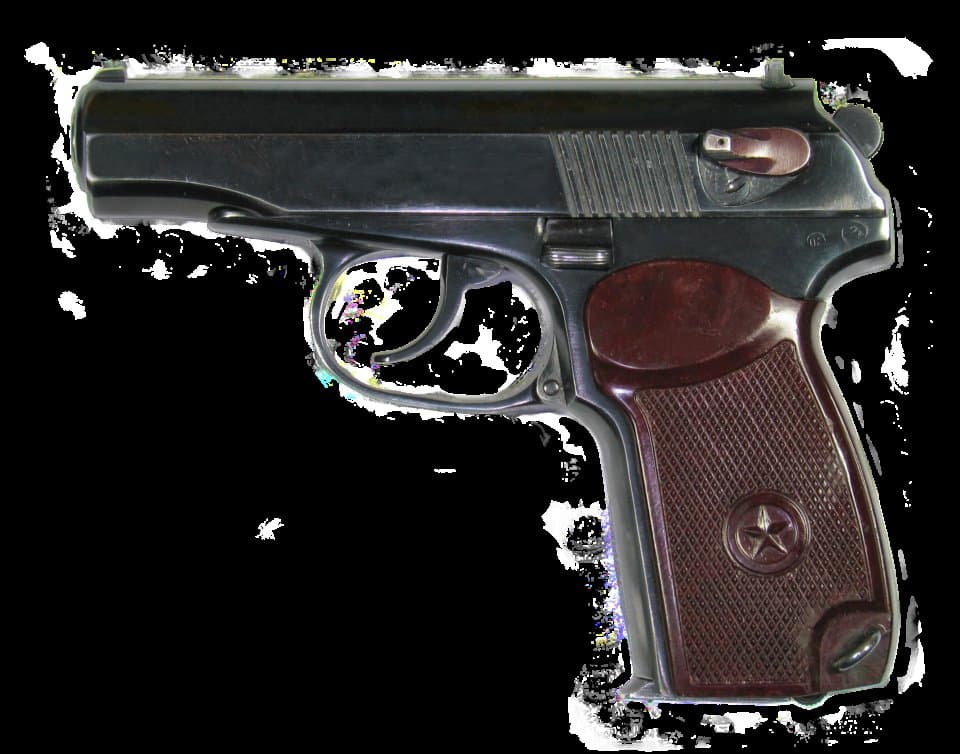
Credit
Razumhak · CC BY-SA 3.0 · Resized · CC BY-SA 3.0 · Source ↗ · Modified


Preparing your view.

BSmall arms
At a glance
Makarov pistollarger figure on 0 of 4
Mk 13 riflelarger figure on 4 of 4
Counts only measures both sources give with the same scope. A larger figure is not a better system.
Measured figures
Length
Single source161.5 mm (6.36 in)[source]
Length
Single sourceConfiguration
| Specification | Makarov pistol | Mk 13 rifle |
|---|---|---|
| Type | Semi-automatic pistol[source] | — |
| Place of origin | Soviet Union[source] | — |
| In service | 1951–present[source] | 2001–present[source] |
| Used by | See Users[source] | United States[source] |
| Wars | First Indochina War Vietnam War Laotian Civil War Cambodian Civil War Communist insurgency in Thailand Nicaraguan Revolution Salvadoran Civil War Lebanese Civil War Soviet–Afghan War South African Border War Angolan Civil War Tuareg rebellion (1990–1995) Burundian Civil War First Chechen War Second Chechen War War in Afghanistan (2001–2021) Russo-Georgian War Libyan Civil War Syrian civil war War in Donbas Colombian Conflict Russo-Ukrainian war |
1207 mm (47.5")[source]
Muzzle velocity
Single source315 m/s (1,030 ft/s)[source]
Bars compare reported quantities only. A larger figure does not make a system better; configurations and test conditions differ.
War in Afghanistan Iraq War[source] |
| Designer | Nikolay Makarov[source] | Accuracy International / Remington Arms[source] |
|---|
| Designed | 1948[source] | — |
|---|
| Manufacturer | Izhevsk Mechanical Plant (USSR/Russia: 1949–2013) Kalashnikov Concern (Russia: 2013–present) Ernst Thaelmann (Germany) Arsenal AD (Bulgaria) Norinco (China) Factory 626 (China)[source] | Accuracy International[source] |
|---|
| Produced | 1949–present[source] | — |
|---|
| No. built | 5,000,000[source] | — |
|---|
| Variants | See Variants[source] | Mk 13 MOD 5 Mk 13 MOD 7[source] |
|---|
| Cartridge | 9×18mm Makarov .380 Auto 9x18mm 7N16 (PMM variant)[source] | .300 Winchester Magnum[source] |
|---|
| Action | Blowback[source] | Bolt action[source] |
|---|
| Feed system | 8-round detachable box magazine (10- and 12-round available on the PMM) 80-round drum magazine[source] | 5-round magazine (MOD 5)[source] |
|---|
| Sights | Blade front, notch rear (drift adjustable)[source] | Nightforce Advanced Tactical Riflescope[source] |
|---|
| Former operator · Chechen Republic of Ichkeria | Chechen Republic of Ichkeria[source] | — |
|---|
| Former operator · India | India[source] | — |
|---|
| Former operator · Indonesia | Indonesia[source] | — |
|---|
| Former operator · North Korea | North Korea[source] | — |
|---|
| Former operator · Romania | Romania[source] | — |
|---|
| Former operator · Soviet Union | Soviet Union[source] | — |
|---|
| Source measurement | The Makarov Pistol ( Russian: Пистолет Макарова , romanized : Pistolet Makarova , IPA: [pʲɪstɐˈlʲet mɐˈkarəvə] , lit. 'Makarov's Pistol'), commonly known simply as the PM or Makarov , is a single action, semi-automatic pistol manufactured by the Russian company Kalashnikov Concern . The PM was designed by Nikolay Makarov to replace the TT pistol , becoming the standard service pistol of the Soviet Armed Forces and the Militsiya in 1951. It is chambered in the 9×18mm Makarov round which is unofficially named for the pistol.[source]Makarov pistol · Lead; only the objects and conditions stated in this passage In 2003, the PM was formally replaced by the MR-443 Grach in the Russian Armed Forces , and by the Ministry of Internal Affairs from 2006. However, this replacement has been very slow, with the PM yet to be entirely supplanted in the Russian military and police. As of 2015, the PMM and Grach were the service pistol of the Russian Airborne Troops . In September 2019, Rostec announced its SR-2 Udav pistol went into mass production as the Makarov replacement for the Russian Armed Forces. The Udav fires 9×21mm Gyurza rounds which are claimed to pierce 1.4 mm of titanium or 4 mm of steel at a 100 meters.[source]Makarov pistol · Operational Use; only the objects and conditions stated in this passage The advent of the assault rifle after the war, and the subsequent adoption of the future AK-47 in 1947, relegated the pistol to a light, handy self-defense weapon.[source]Makarov pistol · Development; only the objects and conditions stated in this passage As a result, in December 1945, two separate contests for a new service pistol were created, respectively for a 7.62mm and 9mm calibre pistol.[source]Makarov pistol · Development; only the objects and conditions stated in this passage It was later judged that the new 9.2×18mm cartridge, designed by Boris Vladimirovich Semin, was the best round suited for the intended role.[source]Makarov pistol · Development; only the objects and conditions stated in this passage Nikolay Makarov , a recent engineering graduate from the Tula Mechanical Institute , participated in the contest along with several prominent firearms engineers in the Soviet Union. Makarov's design, influenced by the German Walther PP , stood out from the others through its sheer simplicity, excellent reliability, quick disassembly, and robustness after stringent testing. During testing in April 1948, Makarov's pistol experienced 20 times fewer malfunctions than the competing Baryshev and Sevryugin counterparts, and required fewer parts. Therefore, Soviet authorities selected Makarov's design in 1949 for further development and optimization for mass production . Tooling was set up in the Izhevsk plant for production and, after many significant design changes and tweaks, it was formally adopted by the Soviet Armed Forces as the 9mm Pistolet Makarova , or PM , in December 1951.[source]Makarov pistol · Development; only the objects and conditions stated in this passage The chrome-lined, four-groove, 9.27mm caliber barrel is pressed and pinned to the frame through a precision-machined ring.[source]Makarov pistol · Design / Barrel; only the objects and conditions stated in this passage The 7 kg recoil spring wraps around and is guided by the barrel. The spring-loaded trigger guard is pivoted down, allowing removal of the slide.[source]Makarov pistol · Design / Barrel; only the objects and conditions stated in this passage The front sight is integrally machined into the slide, and a 3–4 mm wide textured strip is engraved on top of the slide in order to prevent aim-disturbing glare. The rear sight is dovetailed into the slide and multiple heights are available to adjust the impact point.[source]Makarov pistol · Design / Sights; only the objects and conditions stated in this passage The 9×18mm cartridge is an appropriate cartridge in blowback-operated pistols; producing a respectable level of energy from a gun of moderate weight and size.[source]Makarov pistol · Operation / Blowback design; only the objects and conditions stated in this passage The PM is a semi-automatic firearm, therefore its rate of fire depends on how rapidly the shooter squeezes the trigger. Spent cartridge casings are ejected some 5.5–6 meters away to the shooter's right and rear.[source]Makarov pistol · Operation / Trigger mechanism; only the objects and conditions stated in this passage The PMM is able to use existing 9.2×18mm PM cartridges and has other minor modifications such as more ergonomic grip panels as well as flutes in the chamber that aid in extraction.[source]Makarov pistol · Variants / PMM; only the objects and conditions stated in this passage They were available in .380 ACP in addition to the standard 9mm Makarov round and commercially featured a nickel finish.[source]Makarov pistol · Variants / Baikal / IJ-70; only the objects and conditions stated in this passage The Baikal IZH-79-8 is a modified version of the standard Makarov pistol, with an 8 mm barrel, modified to allow it to fire gas cartridges .[source]Makarov pistol · Variants / Baikal / Baikal IZH-79-8; only the objects and conditions stated in this passage The military version was produced from 1959 to 1960 in Factory 626, and featured a characteristic shield embossed with 5 stars on the grip shell.[source]Makarov pistol · Variants / Production outside Russia / China; only the objects and conditions stated in this passage | — |
|---|
| Calibre | — | .308[source] |
|---|
| Country of origin | — | United Kingdom[source] |
|---|
| Reported operators |
| — |
|---|