
FORCETALLY
Loading the evidence…
Preparing your view.


Preparing your view.
At a glance
M60 machine gunlarger figure on 4 of 4
Measured figures
Length
Single source1,105 mm (43.5 in)[source]
Length
Single sourceConfiguration
| Specification | M60 machine gun | M79 grenade launcher |
|---|---|---|
| Type | General-purpose machine gun Medium machine gun[source] | Grenade launcher[source] |
| Place of origin | United States[source] | United States[source] |
| In service | 1960–present[source] | 1961–present[source] |
| Used by | See Users[source] | See Users |
M79 grenade launcherlarger figure on 0 of 4
Counts only measures both sources give with the same scope. A larger figure is not a better system.
73.1 cm (28.78 in)[source]
Caliber
Single source7.62 mm (0.308 in)[source]
Bars compare reported quantities only. A larger figure does not make a system better; configurations and test conditions differ.
| Wars | Vietnam War Laotian Civil War Dominican Civil War Cambodian Civil War Moro conflict The Troubles Lebanese Civil War Cambodian–Vietnamese War Sino-Vietnamese War Salvadoran Civil War Operation Urgent Fury Operation Just Cause Persian Gulf War Operation Gothic Serpent War in Afghanistan Iraq War Cambodian–Thai border stand-off Colombian armed conflict Insurgency in the Philippines Bougainville conflict Myanmar conflict various others[source] | Vietnam War Cambodian Civil War Laotian Civil War Communist insurgency in Thailand Dominican Civil War Communist Insurgency War The Troubles Operation Marajoara Lebanese Civil War South African Border War Sino-Vietnamese War Salvadoran Civil War Falklands War Bougainville conflict War in Afghanistan (2001–2021) Iraq War Gulf War Desert Storm Sistan and Baluchestan insurgency 2008–2011 Cambodia–Thailand border crisis 2010 Burma border clashes Syrian Civil War Battle of Marawi Myanmar Civil War[source] |
|---|
| Designed | 1952–1957[source] | 1953–1960[source] |
|---|
| Manufacturer | Saco Defense U.S. Ordnance[source] | Springfield Armory , Action Manufacturing Company , Kanarr Corporation , and Thompson-Ramo-Wooldridge[source] |
|---|
| Unit cost | US$6,000 (M60E3)[source] | — |
|---|
| Produced | 1957–present[source] | 1961–1971 (U.S.)[source] |
|---|
| Variants | See Variants[source] | — |
|---|
| Cartridge | 7.62×51mm NATO[source] | 40×46mm grenade[source] |
|---|
| Action | Gas-operated , short-stroke gas piston, opened rotating bolt[source] | Break-action[source] |
|---|
| Feed system | Disintegrating belt with M13 Links[source] | Breech-loaded[source] |
|---|
| Sights | Iron sights[source] | Blade and leaf type[source] |
|---|
| Designer | — | Springfield Armory[source] |
|---|
| No. built | — | 350,000 (U.S. only)[source] |
|---|
| Role | — | single-shot , shoulder-fired, break-action grenade launcher[source] |
|---|
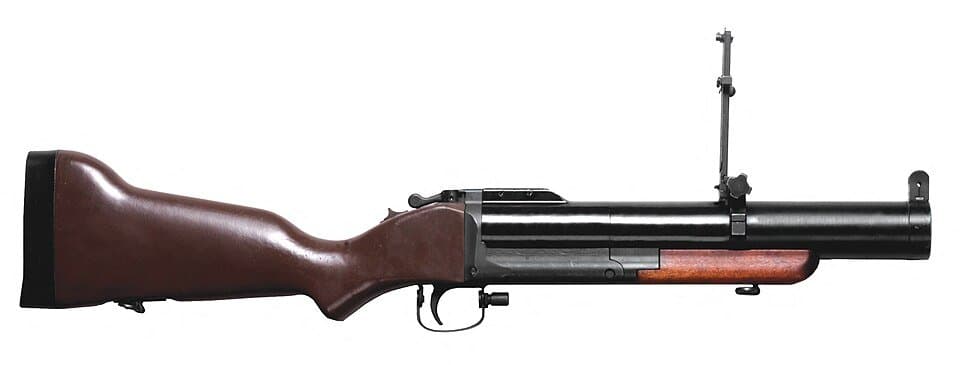
| Source measurement | — | The M79 grenade launcher is a single-shot , shoulder-fired, break-action grenade launcher that fires a 40×46mm grenade , which uses what the US Army calls the High-Low Propulsion System to keep recoil forces low, and first appeared during the Vietnam War . Its distinctive report has earned it colorful nicknames such as "Thumper," "Thump-Gun," "Bloop Tube," "Big Ed," "Elephant Gun," and "Blooper" among American soldiers as well as "Can Cannon" in reference to the grenade size; Australian units referred to it as the "Wombat Gun", while British soldiers adopted the "Elephant Gun" moniker. The M79 can fire a wide variety of 40 mm rounds including explosive, anti-personnel , smoke , buckshot , flechette (pointed steel projectiles with a vaned tail for stable flight), and illumination. While largely replaced by the M203 , the M79 has remained in service in many units worldwide in niche roles.[source]M79 grenade launcher · Lead; only the objects and conditions stated in this passage The M79 was a result of the US Army 's Project Niblick , an attempt to increase firepower for the infantryman by having an explosive projectile more accurate with further range than rifle grenades , but more portable than a mortar . Project Niblick created the 40 x 46 mm grenade, but was unable to create a satisfactory launcher for it that could fire more than a single shot. One of the launchers at Springfield Armory was the three-shot "harmonica" T148 (not to be confused with the later, underbarrel XM148 ), which did see some limited production and fielding in Vietnam, but problems with the three-round magazine prevented widespread acceptance. The other design was a single-shot break-open, shoulder-fired weapon, the S-3. This was refined into the S-5, which resembled an oversized single-barrel shotgun. Unable to solve the problems with the multi-shot T148 launcher, the Army adopted the S-5 as the XM79. With a new sight, the XM79 was officially adopted as the M79 on December 15, 1960.[source]M79 grenade launcher · History; only the objects and conditions stated in this passage However, its single-shot nature was a serious drawback. Reloading after every shot meant a slow rate of fire and an inability to keep up a constant volume of fire during a firefight. This led the Navy to develop the China Lake Grenade Launcher , which was produced for deployed SEAL Teams. For close-in situations, the minimum arming range (the round travels 30 meters to arm itself) and the blast radius meant a grenadier had to use his .45 ACP (11.43 mm) M1911 pistol, or fire and hope that the grenade acted as a giant slow bullet. Special grenades for close-in fighting were created to compensate, though a soldier was not always able to load one in the heat of battle. Moreover, the size and weight of both the M79 and its ammunition meant that a grenadier armed with this weapon could not also carry a rifle, having only a sidearm to use in a firefight after expending his rounds. Some grenadiers did choose to carry a slung M16 rifle in lieu of a sidearm.[source]M79 grenade launcher · History; only the objects and conditions stated in this passage Some US Navy SEALs and Army Special Forces in Iraq were seen using the M79 due to its greater accuracy and range compared to the M203 (350 meters effective versus 150 meters effective). The M79 saw notable limited use during Operation Iraqi Freedom , such as for clearing IEDs . The grenade launcher also sees continued use as a mission-specific tool with Special warfare combatant-craft crewmen .[source]M79 grenade launcher · History; only the objects and conditions stated in this passage Visually, the M79 grenade launcher resembles a large bore, break-action, sawed-off shotgun , and is simple in design, having only five major parts: a receiver group, a fore-end assembly, a barrel group, a sight assembly, and a stock. The fore-end assembly beds the barrel to the receiver. The stock is made out of wood or fiberglass. A rubber pad affixed to the buttstock absorbs some recoil. The front sight is a fixed blade. The rear sight on the M79 is a folding ladder–style leaf sight. When folded, the leaf sight acts as a fixed sight at close range. A grenadier may simply point and shoot with high accuracy. When unfolded, the leaf sight can be adjusted for ranges from 75 to 375 meters, in 25-meter increments. Additionally, Appendix A of the U.S. Army field manual for the M203 includes instructions on attaching the M16 rifle grenade sight to the M79's stock and marking the sling for indirect fire at elevations greater than 40°.[source]M79 grenade launcher · Design; only the objects and conditions stated in this passage The M406 40 mm HE (high explosive) grenades fired from the M79 travel at a muzzle velocity of 75 meters per second. The M406 contained enough explosive to produce over 300 fragments that travel at 1,524 meters per second within a lethal radius of 5 meters. This round incorporated a spin-activation safety feature which prevents the grenade from arming while still within range of the shooter; it armed itself after traveling a distance of about 14–27 meters. The round would not arm at point blank ranges and it usually did not have enough kinetic energy to kill, although it sometimes penetrated the abdomen or caused large hematomas.[source]M79 grenade launcher · Ammunition / Explosive; only the objects and conditions stated in this passage |
|---|
| Country of origin | — | United States[source]Inventory Origin column; table 8, row 38, cell 3; revision 1377789308; retrieved 2026-10-01 |
|---|
| Reported operators |
|
|
|---|