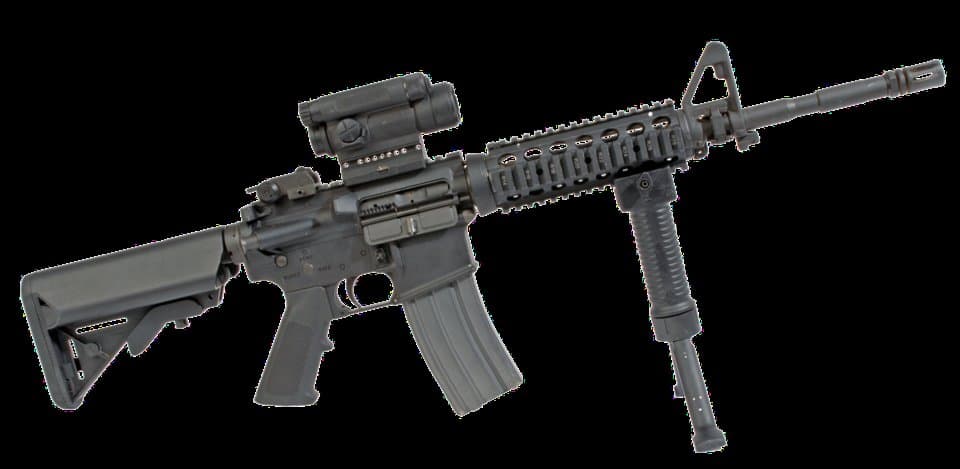

Credit
Photo Courtesy of PEO Soldier · Public domain · Resized · Public domain · Source ↗ · Modified


Preparing your view.

BSmall arms
At a glance
M4 carbinelarger figure on 0 of 1
Mk 13 riflelarger figure on 1 of 1
Counts only measures both sources give with the same scope. A larger figure is not a better system.
Measured figures
stock extended
Single sourcestock retracted
Single sourceConfiguration
| Specification | M4 carbine | Mk 13 rifle |
|---|---|---|
| Type | Assault rifle Carbine[source] | — |
| Place of origin | United States[source] | — |
| In service | 1994–present[source] | 2001–present[source] |
| Used by | See Users[source] | United States[source] |
| Wars | See Conflicts[source] |
33 in (838 mm) ( stock extended) 29.75 in (756 mm) (stock retracted)[source]
Length
Single source1207 mm (47.5")[source]
Effective; area targets
Single sourceEffective; individual/point targets
Single sourceMaximum; Maximum firing range
Single source500 m (550 yd) (individual/point targets) 600 m (660 yd) (area targets)[source]
3,600 m (3,900 yd)[source]
Effective; Effective firing range
Single source1,300 meters (1,421 yd)[source]
cyclic
Single source700–970 rounds/min cyclic[source]
M193 round
Single sourceM855A1 round
Single sourceM855 round
Single source2,970 ft/s (910 m/s) ( M855A1 round) 2,887 ft/s (880 m/s) (M855 round) 2,986 ft/s (910 m/s) (M193 round)[source]
Bars compare reported quantities only. A larger figure does not make a system better; configurations and test conditions differ.
War in Afghanistan Iraq War[source] |
| Designed | 1982–1993[source] | — |
|---|
| Manufacturer | Colt's Manufacturing Company FN Herstal Remington Arms[source] | Accuracy International[source] |
|---|
| Unit cost | $700 (avg. cost) in 2012 $647 per unit in 2015[source] | — |
|---|
| Produced | 1987–present[source] | — |
|---|
| No. built | 500,000 (as of 2021)[source] | — |
|---|
| Variants | See Variants[source] | Mk 13 MOD 5 Mk 13 MOD 7[source] |
|---|
| Cartridge | 5.56×45mm NATO[source] | .300 Winchester Magnum[source] |
|---|
| Action | Gas-operated , closed rotating bolt , Stoner bolt and carrier piston[source] | Bolt action[source] |
|---|
| Feed system | 30-round detachable STANAG magazine[source] | 5-round magazine (MOD 5)[source] |
|---|
| Sights | Iron sights or various optics[source] | Nightforce Advanced Tactical Riflescope[source] |
|---|
| Role | assault rifle[source] | — |
|---|
| Source measurement | The M4 carbine (officially Carbine, Caliber 5.56 mm, M4 ) is an assault rifle developed in the United States during the 1980s. It is a shortened version of the M16A2 assault rifle. The M4 is extensively used by the U.S. military , which decided to largely replace the M16 rifle in U.S. Army (starting 2010) and U.S. Marine Corps (starting 2016) combat units as the primary infantry service rifle . The M4 has been adopted by over 60 countries, and has been described as "one of the defining firearms of the 21st century".[source]M4 carbine · Lead; only the objects and conditions stated in this passage Following the military adoption of the Armalite AR-15 as the M16 rifle , carbine variants were also adopted for CQC operations, the first of which was the CAR-15 family of weapons, which was used in the Vietnam War . However, these rifles had design issues, as the barrel length was halved to 10 inches (25 cm), which upset the ballistics , reducing its range and accuracy and leading to considerable muzzle flash and blast, meaning that a large flash suppressor had to be fitted.[source]M4 carbine · History / Development of the M4; only the objects and conditions stated in this passage In 1983, the 9th Infantry Division requested a Quick Reaction Program (QRP) for a 5.56mm carbine to replace the M1 carbine and M3 submachine gun in service.[source]M4 carbine · History / Development of the M4; only the objects and conditions stated in this passage Later, the gun was updated with improved furniture and a barrel with rifling of 1 turn in 7 inches (180 mm).[source]M4 carbine · History / Development of the M4; only the objects and conditions stated in this passage The ARDC recommended additional commonality with the M16A2 rifle, as well as lengthening the barrel to 14.5 inches (370 mm).[source]M4 carbine · History / Development of the M4; only the objects and conditions stated in this passage In June 1985, the Picatinny Arsenal was given a contract to produce 40 prototypes of the XM4. Initially a joint program between the Army and Marines, the Army withdrew its funding in 1986. The XM4 was finished in 1987, and the Marines adopted 892 for that fiscal year , with the designation "carbine, 5.56mm, M4". Owing to experience from the 1991 Gulf War , the Army gave Colt its first production contracts for M4 carbines in May and July 1993, and M4A1 carbines for United States Special Operations Command (SOCOM) operators in February 1994.[source]M4 carbine · History / Development of the M4; only the objects and conditions stated in this passage Interest in the M4 carbine was accelerated after the Battle of Mogadishu (1993) , in which Rangers complained that their M16 rifles were "unwieldy", whereas members of Delta Force in the same battle, equipped with the CAR-15, had no such complaints. The M4 carbine first saw action in the hands of U.S. troops deployed to Kosovo in 1999 in support of the NATO -led Kosovo Force . It was subsequently used heavily by U.S. forces during the war on terror , including in Operation Enduring Freedom and the Iraq War . In the Army, the M4 had largely replaced M16A2s as the primary weapon of forward-deployed personnel by 2005. The M4 carbine also replaced most submachine guns and selected handguns in U.S. military service, as it fires more effective rifle ammunition that offers superior stopping power and is better able to penetrate modern body armor .[source]M4 carbine · History / Development of the M4; only the objects and conditions stated in this passage The M4–M4A1 conversion increases weapon weight from 7.46 lb (3.38 kg) to 7.74 lb (3.51 kg), counting a backup iron sight, forward pistol grip, empty magazine, and sling.[source]M4 carbine · History / Improved M4; only the objects and conditions stated in this passage The program aimed to replace the M4 Carbine and the M249 SAW with weapons that would compensate for their perceived deficiencies when fighting at longer ranges, as well as addressing concerns about the effectiveness of traditional 5.56×45mm ammunition against troops wearing body armor in a future peer or near-peer conflict.[source]M4 carbine · History / Replacement efforts / Next Generation Squad Weapon; only the objects and conditions stated in this passage Textron submitted a cased-telescoped (CT) ammunition-firing rifle for the program; FN Herstal submitted their HAMR IAR re-chambered in 6.8mm caliber; PCP Tactical submitted a modified Desert Tech MDRx ; SIG Sauer submitted a redesigned MCX variant known as the MCX-SPEAR.[source]M4 carbine · History / Replacement efforts / Next Generation Squad Weapon; only the objects and conditions stated in this passage The M4, and its variants, is a lightweight 5.56×45mm NATO (and .223 Remington ) caliber, gas-operated, magazine-fed, air-cooled selective fire AR-15-pattern firearm .[source]M4 carbine · Design; only the objects and conditions stated in this passage The receiver is made of forged 7075-T6 aluminum, while the 14.5 in (368 mm) barrel, bolt, bolt carrier, and fire control group are made of steel; these components can be easily serviced and replaced by unit armories, enabling the addition of enhanced components and thus making the platform readily upgradable.[source]M4 carbine · Design; only the objects and conditions stated in this passage The M4 is a shorter and lighter variant of the M16A2 rifle, sharing much of the same operation mechanisms and has 80% parts commonality; the chief differences are a shorter barrel of 14.5 inches rather than 20 inches as well as a shortened receiver extension and buffer.[source]M4 carbine · Design; only the objects and conditions stated in this passage The M4's maneuverability makes it beneficial for non-infantry troops (vehicle crews, clerks and staff officers), as well as for close-quarters battle . The M4, along with the M16A4, has mostly replaced the M16A2 in the Army and Marines. The U.S. Air Force , for example, has transitioned completely to the M4 for Security Forces squadrons, while other armed personnel retain the M16A2. The U.S. Navy uses M4A1s for Special Operations and vehicle crews. However, the M4's shorter barrel reduces its range, with its rear iron sights integrated in the (removable) carry handle only adjustable from 300 m (328 yd) up to 600 m (656 yd), compared to the M16A2 rear iron sights integrated in the fixed carry handle, which can reach up to 800 m (875 yd).[source]M4 carbine · Design; only the objects and conditions stated in this passage In 2002, the Block II modification kit was adopted featuring two new upper receivers: the Special Purpose Receiver (SPR) with a 16 or 18 in (406 or 457 mm) barrel and Close Quarter Battle Receiver (CQBR) with a 10.3 in (262 mm) barrel. M4A1s fitted with the SPR were designated by the Navy as the Mk 12 Special Purpose Rifle , a type of designated marksman rifle . M4A1s with the CQBR were designated the Mk 18 Mod 0. The Block II program then focused on component improvements to the M4A1, with the adoption of the heavier "SOCOM profile" barrel in 2004 and free-float Rail Interface System II (RIS-II) handguard from Daniel Defense in 2008. Owing to the modularity of the AR-15/M4 platform, some operators have replaced issued optics, handguards, and buttstocks with aftermarket ones.[source]M4 carbine · Design / Accessories / Special Operations Peculiar Modification; only the objects and conditions stated in this passage The M4A1 carbine is a fully automatic variant of the basic M4 carbine. The M4A1 was developed in May 1991 and entered service in 1994; starting in 2014 the U.S. Army began upgrading all of its existing M4s to the M4A1 standard. The M4A1 was the first M4 model with the removable carry handle. The M4A1 has a "S-1-F" (safe/semi-automatic/fully automatic) trigger group, while the M4 has a "S-1-3" (safe/semi-automatic/3-round burst) trigger group. The M4A1 is used by almost all U.S. special operation units and is the standard service rifle across the U.S. Army (including conventional forces). It has a maximum effective range of 500 to 600 meters (550–660 yd). The fully automatic trigger gives a more consistent trigger pull, which leads to better accuracy. According to Mark Westrom, owner of ArmaLite, Inc. , automatic fire is better for clearing rooms than burst fire.[source]M4 carbine · Variants / M4A1; only the objects and conditions stated in this passage The Close Quarters Battle Receiver (CQBR) was originally a Special Operations Peculiar Modification (SOPMOD) program item that would increase the close quarters maneuverability of the M4A1 by mating the lower receiver with a 10.3-inch (262 mm) barreled upper receiver; with the CQBR installed, the weapon would then be classified as the Mk. 18 CQBR . The Mk. 18 CQBR may be issued as a standalone complete weapon system to SOCOM personnel, or as a separate upper receiver for their M4A1 to enable greater mission flexibility.[source]M4 carbine · Variants / Mk 18 CQBR; only the objects and conditions stated in this passage The SOPMOD program also introduced the Special Purpose Receiver (SPR), a 16-or-18 in (406-or-457 mm) barreled upper receiver that would be mated to an M4A1 lower receiver to allow the weapon to serve as a designated marksman rifle (DMR). Although originally intended as an upper receiver kit for the M4A1 like the CQBR, the SPR would eventually be issued as a standalone complete rifle designated the Mk. 12 Special Purpose Rifle , with some assembled from M4A1 lower receivers.[source]M4 carbine · Variants / Mk 12 SPR; only the objects and conditions stated in this passage The SOPMOD Block II is a more radical modification kit for the baseline M4A1 that can be fitted at first-echelon unit maintenance level. Components of the Block II were phased in gradually, but the most distinctive feature is the free-floated Daniel Defense Rail Interface System II (RIS II), first issued in 2008. The RIS II is available in 9.5 inches for the Mk 18 Mod 1 or 12.5 inches for the M4A1. Other components of the Block II include the L3 Advanced Target Pointer Illuminator Aiming Laser (ATPIAL), or the AN/PEQ-15 as well as the LA5 high-power variants, and the ELCAN SpecterDR 1-4 optic.[source]M4 carbine · Variants / SOPMOD Block II; only the objects and conditions stated in this passage The CNA conducted surveys on 2,608 troops returning from combat in Iraq and Afghanistan over the previous 12 months.[source]M4 carbine · Performance / 2006 CNA report; only the objects and conditions stated in this passage Only troops who fired their weapons at enemy targets were allowed to participate. 917 troops were armed with M4 Carbines, making up 35% of the survey. 89% of M4 users reported they were satisfied with the weapon. 90% were satisfied with handling qualities such as handguards, size, and weight.[source]M4 carbine · Performance / 2006 CNA report; only the objects and conditions stated in this passage Despite 863 minor stoppages—termed "class one" stoppages, which require 10 seconds or less to clear, or "class two" stoppages, which require more than ten seconds to clear—the M4 functioned well, with over 98% of the 60,000 total rounds firing without a problem. The Army said it planned to improve the M4 with a new cold-hammer-forged barrel to give longer life and more reliable magazines to reduce the stoppages. Magazine failures caused 239 of the M4's failures. Army officials said the new magazines could be combat-ready by spring if testing went well. The Army began issuing an improved STANAG magazine in March 2009.[source]M4 carbine · Performance / 2007 dust test; only the objects and conditions stated in this passage In early 2010, two journalists from the New York Times spent three months with soldiers and Marines in Afghanistan. While there, they questioned around 100 infantrymen about the reliability of their M4 carbines, as well as the M16 rifle. Troops did not report reliability problems with their rifles. While only 100 troops were asked, they fought at least a dozen intense engagements in Helmand Province , where the ground is covered in fine powdered sand (called "moon dust" by troops) that can stick to firearms. Weapons were often dusty, wet, and covered in mud. Intense firefights lasted hours with several magazines being expended. Only one soldier reported a jam when his M16 was covered in mud after climbing out of a canal . The weapon was cleared and resumed firing with the next chambered round. Furthermore, a Marine chief warrant officer reported that there were no issues with his battalion 's 700 M4s and 350 M16s.[source]M4 carbine · Performance / Reliability; only the objects and conditions stated in this passage In a study conducted by the Army Marksmanship Unit , they found that at a distance of 300 yd (270 m), the M16 achieved a 24 in (610 mm) grouping , and the M4 achieved a 32 in (810 mm) grouping, which dropped to 12 in (300 mm) and 18 in (460 mm) respectively when using match grade ammunition. As the average male torso is 18–19 in (460–480 mm) wide, author Chris McNab concluded that this meant the M4 can be consistently accurate up to 300 yards, and noted that the frequent usage of optical attachments meant it could be accurate to higher ranges.[source]M4 carbine · Performance / Accuracy; only the objects and conditions stated in this passage The weight of the cyclic components of the gun has been doubled (while retaining the weapon's weight at less than 8 pounds).[source]M4 carbine · Performance / ArmWest, LLC modified M4; only the objects and conditions stated in this passage The M4 was developed and produced for the United States government by Colt Firearms, which had an exclusive contract to produce the M4 family of weapons through 2011. However, a number of other manufacturers offer M4-like firearms. Colt previously held a U.S. trademark on the term "M4". Many manufacturers offer production firearms that are essentially identical to a military M4, but with a 16-inch (41 cm) barrel. The Bushmaster M4 Type Carbine is a popular example. Civilian models are sometimes colloquially referred to as "M4gery" ( / ɛ m ˈ f ɔːr dʒ ər i / em- FOR -jə-ree , a portmanteau of "M4" and "forgery.") Colt had maintained that it retained sole rights to the M4 name and design, while other manufacturers had long maintained that Colt had been overstating its rights, and that "M4" had now become a generic term for a shortened AR-15.[source]M4 carbine · Trademark issues; only the objects and conditions stated in this passage | — |
|---|
| Country of origin | United States[source]Inventory Origin column; table 1, row 7, cell 3; revision 1375383109; retrieved 2026-10-02 United States[source]Inventory Origin column; table 2, row 5, cell 3; revision 1366308210; retrieved 2026-10-02 United States[source]Inventory Origin column; table 1, row 8, cell 2; revision 1369000565; retrieved 2026-10-02 United States[source]Inventory Origin column; table 3, row 5, cell 2; revision 1375865979; retrieved 2026-10-01 United States[source]Inventory Origin column; table 4, row 7, cell 3; revision 1348750748; retrieved 2026-10-02 United States[source]Inventory Origin column; table 3, row 37, cell 3; revision 1377349156; retrieved 2026-10-02 | United Kingdom[source] |
|---|
| Designer | — | Accuracy International / Remington Arms[source] |
|---|
| Reported operators |
| — |
|---|