
Credit
Gertrud Zach · Public domain · Resized · Public domain · Source ↗ · Modified


Preparing your view.
At a glance
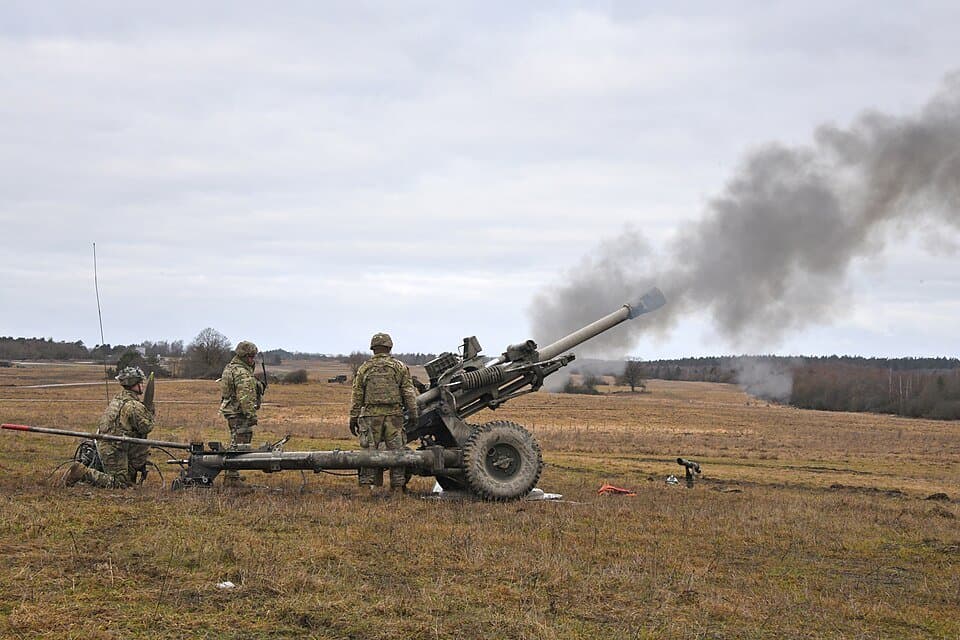
M119 howitzerlarger figure on 1 of 2
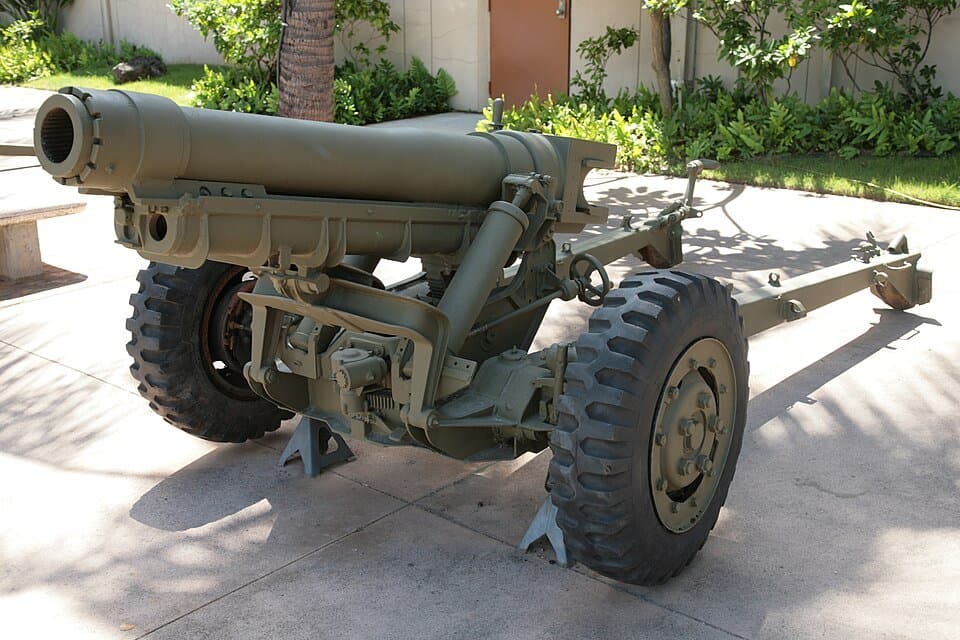
M3 howitzerlarger figure on 1 of 2
Counts only measures both sources give with the same scope. A larger figure is not a better system.
Measured figures
Cannon alone
Single sourceCombat
Single sourceWith BII
Single sourceWithout BII
Single sourceWith BII: 5,110 lb (2,320 kg) Without BII: 4,690 lb (2,130 kg) Cannon alone: 1,389 lb (630 kg) Combat: 4,268 lb (1,936 kg)[source]
Mass
Single source2,495 lb (1,130 kg)[source]
for 3 minutes Sustained for 30 minutes
Single sourceMaximum
Single sourceMaximum: 8 rpm for 3 minutes Sustained: 3 rpm for 30 minutes[source]
Burst
Single sourceSustained
Single sourceMuzzle velocity
Single source1,020 ft/s (311 m/s)[source]
Bars compare reported quantities only. A larger figure does not make a system better; configurations and test conditions differ.
Configuration
| Specification | M119 howitzer | M3 howitzer |
|---|---|---|
| Type | Towed field gun[source] | Light Howitzer[source] |
| Place of origin | United States[source] | United States[source] |
| Used by | See operators[source] | United States[source] |
| Wars | War in Afghanistan (2001-2021) Iraq War Saudi Arabian–led intervention in Yemen Russian invasion of Ukraine[source] | World War II First Indochina War Korean War[source] |
| Manufacturer | Joint Manufacturing Technology Center of Rock Island Arsenal[source] | — |
| Produced | 1989–2013[source] | 1943–1945[source] |
| Variants | M119, M119A1, M119A2, M119A3[source] | — |
| Shell | Semi-fixed 105 x 372 mm R[source] | 105 × 372 mm R[source] |
| Elevation | -5.625° (−100 mils) to +69.975° (+1,244 mils)[source] | −9° to 30°[source] |
| Traverse | 5.625° (100 mils) left or right[source] | 45°[source] |
| Sights | 3 × M90A2 telescope, M137A1 panoramic telescope[source] | — |
| Role | lightweight 105 mm howitzer ,[source] | — |
| Source measurement | The M119 howitzer is a lightweight 105 mm howitzer , used by the United States Army . It is the American licensed version of the British L119 light gun . The M119 is typically towed by the M1097 or M1152 High Mobility Multi-Purpose Wheeled Vehicle (HMMWV) , and can be easily airlifted by helicopter , or airdropped by parachute .[source]M119 howitzer · Lead; only the objects and conditions stated in this passage The howitzer was designed and produced by the British Royal Ordnance Factories as the L118 light gun . In the L118 configuration, the 105 mm ammunition is cased separate loading ammunition. The L118 entered service with the British Army in 1976 and is used by parachute and commando field artillery regiments. It saw combat during the Falklands War , where the 30 guns in action fired up to 400 rounds per gun per day, mostly at "charge super"—i.e., the most powerful propellant charge available.[source]M119 howitzer · Development; only the objects and conditions stated in this passage The L119 is the L118 reconfigured to fire NATO -standard 105 mm semi-fixed ammunition .[source]M119 howitzer · Development; only the objects and conditions stated in this passage The redesigned system operates the same, but modifies and simplifies some components, including a new buffer and recuperator with a majority of the components removed, and adds the Suspension Lockout System (SLOS) that fixes recoil length at 25 in (64 cm), which removes variable-recoil hardware, reduces stress on the carriage, and lowers buffer rod forces; the new system reduces cost, the system consists of 124 parts and the redesign will reduce that number by 40 percent to 75 parts and reusing 47 parts will consist of 65 percent for the current system, therefore only needing to manufacturing 28 new parts with overall weight savings of 45 lb (20 kg).[source]M119 howitzer · Development; only the objects and conditions stated in this passage with M67 propelling charges: M1 (HE) – High Explosive projectile, range: 11.5 km (7.1 mi), 2.1 kg of explosive filling M60 (WP) – White Phosphorus smoke generating projectile, range: 15.1 km (9.4 mi) (current variant: M60A2) M84 (HC) – Hexachloroethane smoke generating projectile, range: 11.5 km (7.1 mi) (current variant: 105 mm M84A1) M314 (VL) – Visible Light illuminating projectile, range: 19.5 km (12.1 mi) (current variant: M314A3) M444 (APICM) – Dual-Purpose Improved Conventional Munition (withdrawn from service), range: 11.5 km (7.1 mi) M916 (DPICM) – Dual-Purpose Improved Conventional Munition (withdrawn from service), range: 11.5 km (7.1 mi) M927 (HERA) – High Explosive Rocket Assisted projectile, range: 16.5 km (10.3 mi) M1064 (IR) – Infrared illuminating projectile, range: 19.5 km (12.1 mi) M1130 (HE PFF BB) – High Explosive Pre-Formed Fragments Base Bleed projectile – range: 13.0 km (8.1 mi)[source]M119 howitzer · Ammunition; only the objects and conditions stated in this passage with M176 propelling charges: M548 (HERA) – High Explosive Rocket Assisted projectile, range: 15.1 km (9.4 mi)[source]M119 howitzer · Ammunition; only the objects and conditions stated in this passage with M200 propelling charge: M760 (HE) – High Explosive projectile, range: 14.0 km (8.7 mi) M915 (DPICM) – Dual-Purpose Improved Conventional Munition (withdrawn from service), range: 14.1 km (8.8 mi)[source]M119 howitzer · Ammunition; only the objects and conditions stated in this passage with M219 propelling charge: M913 (HERA) – High Explosive Rocket Assisted projectile, range: 19.5 km (12.1 mi)[source]M119 howitzer · Ammunition; only the objects and conditions stated in this passage with M350 propelling charges: M1130A1 (HE PFF BB) – High Explosive Pre-Formed Fragments Base Bleed projectile, range 17.0 km (10.6 mi)[source]M119 howitzer · Ammunition; only the objects and conditions stated in this passage | The 105 mm Howitzer M3 was a U.S. light howitzer designed for use by airborne troops. The gun utilized the barrel of the 105 mm Howitzer M2 , shortened and fitted to a slightly modified split trail carriage of the 75 mm pack howitzer .[source]M3 howitzer · Lead; only the objects and conditions stated in this passage The process of building airborne forces in 1941 led to a requirement for an air-portable 105 mm howitzer. The weapon, initially designated T7, featured a barrel from the 105mm Howitzer M2 , shortened by 27 inches (690 mm) and combined with the recoil system and carriage from the 75 mm pack howitzer . A prototype reached trials at Aberdeen Proving Ground in March 1942.[source]M3 howitzer · Development and production; only the objects and conditions stated in this passage The howitzer was designed to fire the same ammunition as the M2 howitzer, however, it was found that the shorter barrel resulted in incomplete burning of the propelling charge. The problem could be solved by use of faster-burning powder, and otherwise, the design was considered acceptable and was standardized as the 105 mm Howitzer M3 on Carriage M3 . The carriage was soon succeeded by the M3A1, which had trails made from thicker steel plate. Even stronger tubular trails were designed, but never reached production.[source]M3 howitzer · Development and production; only the objects and conditions stated in this passage Even though the M3 was not mentioned in the February 1944 T/O&E, shortly before the Normandy airdrops some airborne divisions received a 105 mm glider field artillery battalion equipped with them as a supplement to their existing three 75 mm howitzer battalions (designated the M1A1 during World War II). 1/4 ton jeeps were used as prime movers . Later increased to four battalions, one, between 1943 and 1945, was converted to 105mm M3. The weapon was finally authorized as an option by the December 1944 TO&E, and by 1945 was employed by all airborne divisions in the European Theater .[source] |
| In service | — | 1943–present[source] |
| Designed | — | 1941[source] |
| No. built | — | 2,580[source] |
| Shell weight | — | 36 lb 10 oz – 43 lb 3 oz (16.6–19.6 kg)[source] |
| Breech | — | Horizontal-block[source] |
| Recoil | — | Hydro-pneumatic , constant[source] |
| Carriage | — | Split trail[source] |
| Country of origin | — | United States[source]Inventory Origin column; table 6, row 7, cell 4; revision 1372378584; retrieved 2026-10-02 United States[source]Inventory Origin column; table 4, row 14, cell 3; revision 1376110979; retrieved 2026-10-01 |
| Reported operators |
|
|
Burst: 4 rpm Sustained: 2 rpm[source]
The initial production of the M3 was adequate to equip the cannon companies of the three hundred infantry regiments that had been forecast in the initial war plans. The M3 was the primary weapon of these companies, and appeared in the table of organization and equipment (T/O&E) from early 1944 (six, in three platoons of two) Often the cannon companies were integrated into the division artillery. The infantry used 1½ ton cargo trucks as the prime mover. In an assessment written after the war "The cannon company of 1943-45 failed to live up to the expectations of the force designers of 1942. The main problem was the substitution of towed low-velocity howitzers for the self-propelled versions as originally intended. This howitzer, the M3, had a shorter barrel than the regular 105-mm howitzer M2, possessed no ballistic shield, and had an effective range of only 7,250 yards (6.63 km) as compared to 12,500 yards (11.4 km) for the M2."[source]M3 howitzer · Service; only the objects and conditions stated in this passage
T10 - variant with elevation increased to 65 degrees.[source]M3 howitzer · Variants; only the objects and conditions stated in this passage
M3 - based on M3A1 carriage for the 75 mm field howitzer.[source]M3 howitzer · Variants; only the objects and conditions stated in this passage
M3A1 - had stronger trails, made from 1 ⁄ 8 inch (3.2 mm) plate instead of 3 ⁄ 32 inch (2.4 mm).[source]M3 howitzer · Variants; only the objects and conditions stated in this passage
105 mm Howitzer Motor Carriage T38 - based on the M3 halftrack , never built.[source]M3 howitzer · Self-propelled mounts; only the objects and conditions stated in this passage
105 mm Howitzer Motor Carriage T82 (M3 in mount M3A1) - based on the Light Tank M5A1 chassis. Two pilots were built. The project was cancelled in June 1945 due to lack of requirement.[source]M3 howitzer · Self-propelled mounts; only the objects and conditions stated in this passage
The gun fired semi-fixed ammunition, similar to the ammunition of the M2 ; it used the same projectiles and the same 105 mm Cartridge Case M14, but with different propelling charge. The latter used faster burning powder to avoid incomplete burning; it consisted of a base charge and four increments, forming five charges from 1 (the smallest) to 5 (the largest). In an emergency, gunners were authorized to fire M1 HE rounds prepared for the Howitzer M2, but only with charges from 1 to 3. M1 HE rounds for the M3 could be fired from an M2 with any charge.[source]M3 howitzer · Ammunition; only the objects and conditions stated in this passage