Credit
Bandanschik · CC BY-SA 3.0 · Resized · CC BY-SA 3.0 · Source ↗ · Modified


Preparing your view.

BArtillery
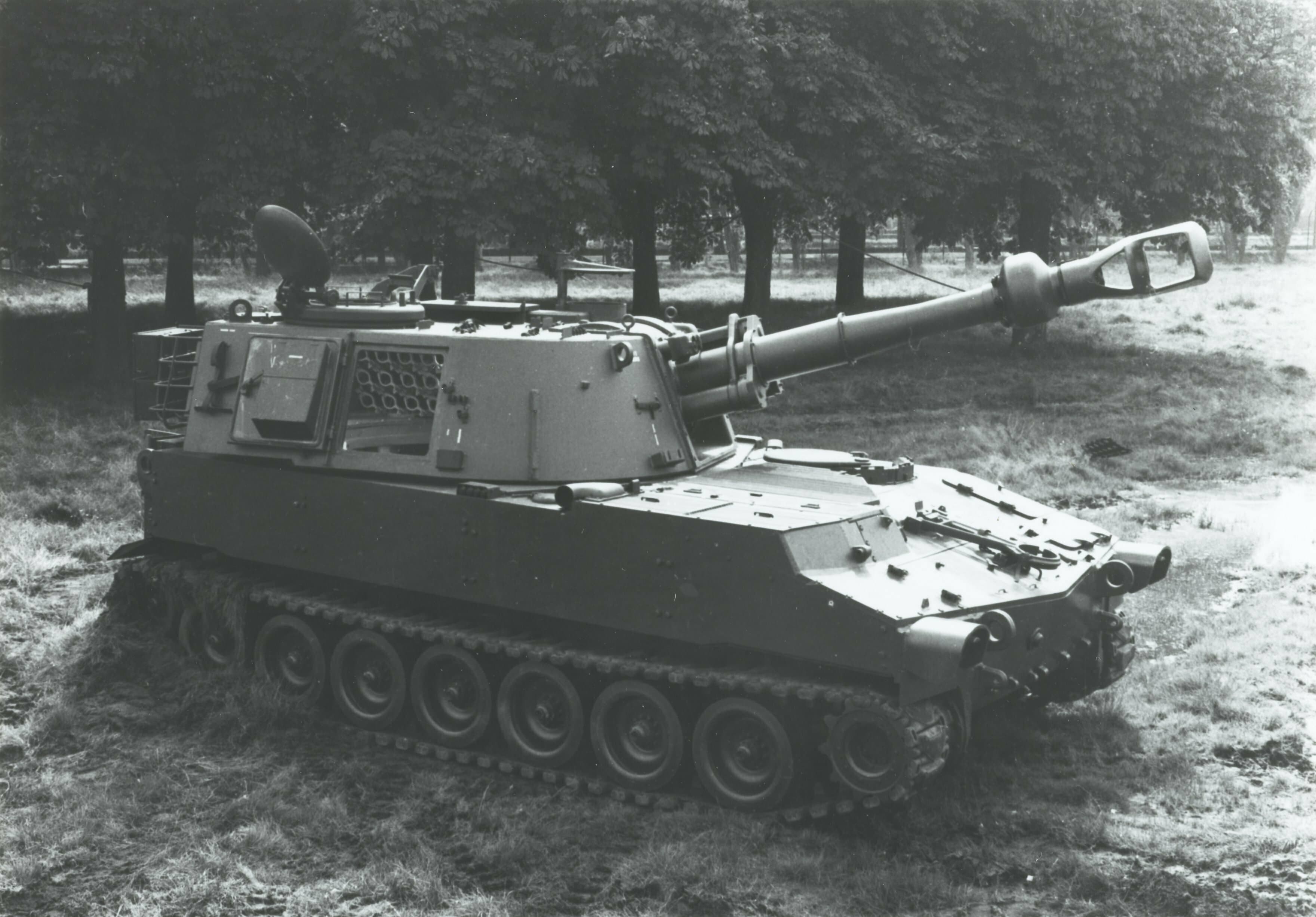
American 155 mm turreted self-propelled howitzer , first introduced in the early 1960s
At a glance
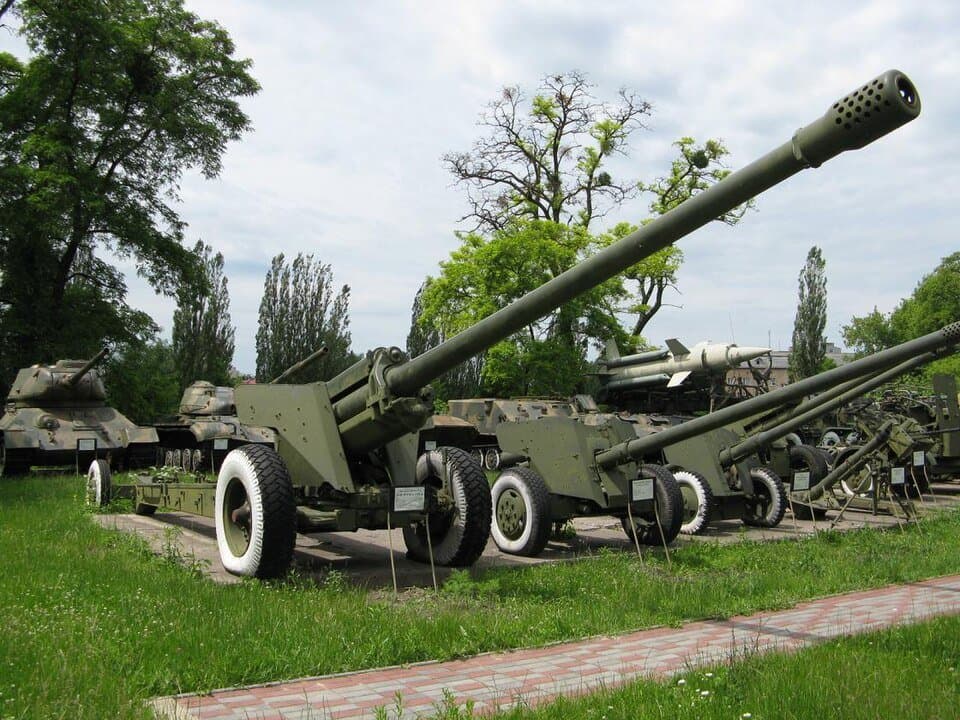
M-46 field gunlarger figure on 1 of 3
M109 howitzer
Measured figures
Length
Single source11.73 m (38 ft 6 in)[source]
Length
Single sourceConfiguration
| Specification | M-46 field gun | M109 howitzer |
|---|---|---|
| Type | Towed field gun[source] | Self-propelled artillery[source] |
| Place of origin | Soviet Union[source] | United States[source] |
| Wars | Vietnam War Cambodian Civil War Eritrean War of Independence South African Border War Six-Day War Yom Kippur War Ethiopian Civil War Angolan Civil War Uganda–Tanzania War Sino-Vietnamese conflicts (1979–1991) Lebanese Civil War Iran–Iraq War Sri Lankan Civil War First Nagorno-Karabakh War Yugoslav Wars Kosovo War Syrian Civil War Yemeni Civil War (2014–present) Second Nagorno-Karabakh War Tigray War Israeli–Lebanese conflict Russo-Ukrainian War[source] | Vietnam War Cambodian Civil War Yom Kippur War Western Sahara War Iran–Iraq War 1982 Lebanon war South Lebanon conflict (1985–2000) Persian Gulf War Iraq War Gaza War 2014 Israel–Gaza conflict War in Iraq (2013-2017) Yemeni Civil War (2014–present) , Saudi Arabian-led intervention in Yemen Syrian Civil War Russian invasion of Ukraine Gaza war 2025 Cambodian–Thai clashes |
Counts only measures both sources give with the same scope. A larger figure is not a better system.
length with gun forward of
Single sourceM109A1/A2/A3/A4/A5/A6/A7: hull length of
Single sourceM109: hull length of and length with gun forward of
Single sourceM109: hull length of 20.3 ft and length with gun forward of 30 ft M109A1/A2/A3/A4/A5/A6/A7: hull length of 20.3 ft, length with gun forward of 32 ft[source]
Mass
Single source7,700 kg (17,000 lb)[source]
) and combat weight of
Single sourceand combat weight of
Single sourceM109A1/A2/A3/A4/A5: empty weight of and combat weight of
Single sourceM109A6: non-combat weight of
Single source) M109A7: non- combat weight of
Single sourceMass · source measurement 4
Single sourceMass · source measurement 6
Single sourceMass · source measurement 8
Single sourceM109A1/A2/A3/A4/A5: empty weight of 52,000 lbs (23.6 metric tons) and combat weight of 55,000 lbs (24.95 metric tons) M109A6: non-combat weight of 56,400 lbs (25.6 metric tons) and combat weight of 62,000 lbs to 63,615 lbs (28.1 metric tons to 28.9 metric tons) M109A7: non- combat weight of 74,000 to 78,000 lbs (33.6 metric tons to 35.4 metric tons) and combat weight of 84,000 lbs (38 metric tons)[source]
32 Tons[source]M109A6 Paladin · combat loaded
Maximum; M109A7
Single sourceMaximum; Maximum speed
Single source35 mph (56 km/h) M109A7: 38 mph (61 km/h)[source]
Maximum; base-bleed
Single sourceMaximum; rocket assisted
Single sourceMaximum; unassisted
Single source27.15 km (16.87 mi) (unassisted) 35 km (22 mi) (base-bleed) 44 km (27 mi) (rocket assisted)[source]
Effective; Excalibur
Single sourceEffective; M109A1–A4
Single source@ 2.300 rpm M109A5–A6: Detroit Diesel 8V71T 8-cylinder water-cooled supercharged diesel engine
Single sourceM109A7
Single sourceM109: Detroit Diesel 8V71T 8-cylinder water-cooled turbocharged diesel engine @ 2,300 rpm M109A1–A4: Detroit Diesel 8V71T 8-cylinder water-cooled supercharged diesel engine
Single sourceV903
Single sourceM109: Detroit Diesel 8V71T 8-cylinder water-cooled turbocharged diesel engine 390 hp @ 2,300 rpm M109A1–A4: Detroit Diesel 8V71T 8-cylinder water-cooled supercharged diesel engine 405 hp @ 2.300 rpm M109A5–A6: Detroit Diesel 8V71T 8-cylinder water-cooled supercharged diesel engine 440 hp M109A7: V903 675 hp[source]
Bore L/55
Single sourceBore: 7.15 m (23 ft 5 in) L/55[source]
burst
Single sourcenormal
Single sourcesustained
Single source6 rpm (normal) 8 rpm (burst) 5 rpm (sustained)[source]
/3 min. Sustained
Single sourceMaximum
Single sourceMuzzle velocity
Single source930 m/s (3,051 ft/s)[source]
Bars compare reported quantities only. A larger figure does not make a system better; configurations and test conditions differ.
| Designed | 1946–1950[source] | 1952–1962[source] |
|---|
| Manufacturer | MOTZ[source] | Cadillac General Motors Chrysler BMY Harsco , formerly Bowen & McLaughlin York (1974–1994) United Defense (1994–2005) BAE Systems Inc. (2005–present) Samsung (1985–2015) Hanwha (2015–present)[source] |
|---|
| Produced | 1951–1971[source] | — |
|---|
| Shell | 130 x 845 mm R (R/184.6mm) separate-loading charge and projectile[source] | separate loading, bagged charge[source] |
|---|
| Breech | Horizontal sliding-wedge[source] | interrupted screw[source] |
|---|
| Recoil | hydro-pneumatic[source] | — |
|---|
| Carriage | Split-trail[source] | — |
|---|
| Elevation | −2.5° to 45°[source] | — |
|---|
| Traverse | 50°[source] | 360°[source] |
|---|
| In service | — | M109: 1963–present M109A1: 1973–present M109A2: 1979–present M109A6: 1994–present M109A7: 2015–present[source] |
|---|
| Used by | — | See Operators[source] |
|---|
| Armor | — | Aluminum alloy[source] |
|---|
| Main armament | — | M109: M126 155 mm 23 caliber, 28 rounds M109A1–A4: Watervliet Arsenal M185 155 mm 39 caliber, 28 rounds (A1) or 36 rounds (A2–A4) M109A5–A7: M284 155 mm 39 caliber[source] |
|---|
| Secondary armament | — | .50 caliber (12.7 mm) M2 machine gun[source] |
|---|
| Transmission | — | Allison Transmission XTG-411-2A, 4 forward, 2 reverse M109A6: Allison Transmission XTG-411-4 M109A7: HMPT-800[source] |
|---|
| Suspension | — | torsion bar[source] |
|---|
| Ground clearance | — | M109A7: longitudinal slope: 60 % lateral slope: 40 % trench: 72 in (1.8 m) fording: 42 in (1.07 m)[source] |
|---|
| Role | — | American 155 mm turreted self-propelled howitzer , first introduced in the early 1960s[source] |
|---|
| Status (M1299) | — | The M1299 was cancelled in March 2024 due, at least in part, to excessive barrel wear.[source]M1299 · source-literal variant status |
|---|
| Source measurement | — | The M109, is an American 155 mm turreted self-propelled howitzer , first introduced in the early 1960s to replace the M44 and M52 . It has been upgraded a number of times, most recently to the M109A7 . The M109 family is the most common Western indirect-fire support weapon of maneuver brigades of armored and mechanized infantry divisions. It has a crew of four: the section chief/commander, the driver, the gunner, and the ammunition handler/loader.[source]M109 howitzer · Lead; only the objects and conditions stated in this passage Primary by Watervliet Arsenal : M126 Cannon (or M126A1) 155 mm Howitzer (M109), M185 Cannon 155 mm Howitzer (A1/A2/A3/A4), or M284 Cannon 155 mm Howitzer (A5/A6)[source]M109 howitzer · Design / Armament; only the objects and conditions stated in this passage Secondary: .50 caliber (12.7 mm) M2 machine gun , Mk 19 Mod 3 40 mm Automatic Grenade Launcher , 7.62 mm M60 , M240 machine gun or L4 machine gun[source]M109 howitzer · Design / Armament; only the objects and conditions stated in this passage The M109 was powered by the 8V71T, a 8-cylinder water-cooled diesel engine, produced by the Detroit Diesel Engine Division of General Motors Corporation. The 8V71T is a turbocharged version of the 8V71 commercial truck engine. It was rated 390 hp at 2300 rpm and was used in the M107, M108, M110, and M578 series as well.[source]M109 howitzer · Design / Mobility; only the objects and conditions stated in this passage First produced in 1963. It had a 155 mm M126 cannon in an M127 mount, and carried 28 rounds of 155 mm ammunition. It was also armed with a .50cal M2HB machine gun with 500 rounds of ammunition. Easily identified by its short barrel and a double baffle muzzle brake with a large fume extractor just behind it. Maximum range of 14,600 meters.[source]M109 howitzer · Variants / M109; only the objects and conditions stated in this passage The West German army M109s were designated as the M109G, and featured a breechblock system developed by Rheinmetall extending the effective range to 18 kilometres (11 mi) or 18.5 kilometres (11.5 mi) according to some sources, a new fire control system, and three smoke dischargers mounted on either side of the turret as well.[source]M109 howitzer · Variants / M109 / M109G; only the objects and conditions stated in this passage Fielded in 1973, this modification replaced the M126 cannon with a 39 caliber M185, featuring a longer barrel while increasing maximum range to 18,100 meters.[source]M109 howitzer · Variants / M109A1; only the objects and conditions stated in this passage Incorporated 27 Reliability, Availability, and Maintainability (RAM) mid-life improvements. Most notably, the long barreled 155 mm M185 Cannon in the new M178 gun mount, ballistic protection for the panoramic telescope, counterbalanced travel lock, and the ability to mount the M140 bore sight alignment device. Stowage of 155 mm rounds increased from 28 to 36 rounds; .50cal ammunition remained at 500 rounds. Fielded in 1979.[source]M109 howitzer · Variants / M109A2; only the objects and conditions stated in this passage The K55 is a South Korean license produced variant of the M109A2. In the 1960s, the South Korean Army received M107 and M110 from the United States. However, the number of these self-propelled guns was insufficient to counter rapidly-growing North Korean artillery capabilities. In the 1970s, South Korea began mass-producing towed howitzers locally, but intelligence reports of North Korean 170 mm self-propelled artillery forced South Korea to look for a new self-propelled artillery system.[source]M109 howitzer · Variants / M109A2 / K55; only the objects and conditions stated in this passage In 1983, the German Army purchased 586 conversion kits from the FMS Corporation (now Marvin Land Systems) to convert its fleet of M109Gs to the M109A3G standard. This upgraded variant uses a new gun barrel developed by Rheinmetall, giving an extended range of 24 kilometres (15 mi). It also features a new fire-control system, and three forward firing 76 mm smoke grenade launchers on either side of the turret.[source]M109 howitzer · Variants / M109A3 / M109A3G; only the objects and conditions stated in this passage Soon after the adoption of A2/A3 versions, the Division Weapon Support System study was initiated in 1980, which by the end of the decade resulted in the development of several modernization packages. The most modest one was the Howitzer Extended Life Program update originally designated as M1903A3E1 and later adopted as M109A4, initially scheduled for 1985-1987 but actually fielded in 1989 in the Reserve Component of the US Army .[source]M109 howitzer · Variants / M109A4; only the objects and conditions stated in this passage This modification was also designed for the US Army Reserve, originally planned as an update for all M109A4s under the second phase of the Reserve Component Modified Armament System to bring the range up to the version adopted as M109A6. It was fielded in 1991 in much smaller numbers than originally devised due to the end of the Cold War .[source]M109 howitzer · Variants / M109A5; only the objects and conditions stated in this passage It replaced the 155 mm M185 cannon in an M178 mount with a 39-caliber 155 mm M284 cannon in an M182 mount developed for the M109A3E2 (see below), giving the A5 a maximum range of 22,000 meters with unassisted projectiles and 30,000 meters with rocket-assisted projectile (RAP) rounds. The vehicle can carry 36 complete rounds of ammunition and has a 440 hp engine instead of the standard 405 hp engine.[source]M109 howitzer · Variants / M109A5; only the objects and conditions stated in this passage The battery FDCs coordinates fire through a battalion or higher FDC. This allows the Paladin to halt from the move and fire within 30 seconds, with an accuracy equivalent to the previous models when properly emplaced, laid, and safed—a process that previously required several minutes under the best of circumstances. Tactically, this improves the system's survivability by allowing the battery to operate dispersed in pairs across the countryside, and allowing the howitzer to quickly move between salvos, or if attacked by indirect fire, aircraft, or ground forces.[source]M109 howitzer · Variants / M109A6 Paladin; only the objects and conditions stated in this passage Ammunition storage of 155 mm rounds was increased from 36 to 39.[source]M109 howitzer · Variants / M109A6 Paladin; only the objects and conditions stated in this passage This Swiss improved version produced by RUAG incorporates a new Swiss-designed L47 155 mm gun with an increased firing range of up to 36 km. It features an inertial navigation system coupled with a new gun-laying system, along with an ammunition storage increase of 40 rounds and 64 charges. The KAWEST (lit. Kampfwertsteigerung = upgrade of combat capabilities) requires only six crew members instead of eight. It is able to fire three-round bursts within 15 seconds, or maintain a constant firing rate of over one round per minute.[source]M109 howitzer · Variants / M109 KAWEST; only the objects and conditions stated in this passage Improvement of the Swiss Kawest variant, 133 in total were brought up to this standard:[source]M109 howitzer · Variants / M109 KAWEST WE; only the objects and conditions stated in this passage The K55A1 is fitted with the same electronics and fire control system as the K9. The self-propelled gun has significantly enhanced field operability and accuracy through the installation of Honeywell Aerospace 's TALIN 5000 INS (inertial navigation system), a satellite navigation device (GPS), and a speed calibrator. As a result, the vehicle automatically lays the gun in the desired direction and delivers a first round within 45 seconds between stops, or 75 seconds between maneuvers after receiving the shooting specification, which required 2 minutes and 11 minutes, respectively, on the K55.[source]M109 howitzer · Variants / K55A1; only the objects and conditions stated in this passage With the help of a new semi-autoloader, while charges are still inserted manually, the howitzer can fire 4 rounds per minute, increased from 2 to 3 rounds per minute. The improved suspension, involving a strut-type hydropneumatic buffer from Mottrol Co, Ltd., along with an enhanced chamber, allowed the vehicle to shoot K307 and K310 ammunition designed for K9 platform without laying spades at a maximum distance of 32 km. An APU (auxiliary power unit) was installed to operate the howitzer without turning on the main engine.[source]M109 howitzer · Variants / K55A1; only the objects and conditions stated in this passage The electric drive is faster than the previous hydraulic system, and the automatic rammer more consistently rams the round into the gun for consistent velocities and better accuracy. The updated power system was intended to "accommodate emerging networking technologies as they become ready" including "automation or electronic packages". The M109A7 can sustain a one-round per-minute rate of fire and a maximum rate of fire of four rounds per minute. Weighing 78,000 lb (35,000 kg), the M109A7 is 10,000 lb (4,500 kg) heavier than its predecessor, and it has the capacity to grow to 110,000 lb (50,000 kg). Even with the weight increase, the M109A7 can travel faster than previous versions at 38 mph (61 km/h) and is more maneuverable than a BFV.[source]M109 howitzer · Variants / M109A7; only the objects and conditions stated in this passage The Army is looking to increase the capabilities of the M109A7. By introducing the new XM1113 Rocket-Assisted Projectile (RAP) , it can reach 40 km (25 mi) from the current 39-caliber barrel. An additional XM1113 improvement over the legacy RAP round is the replacement of the high explosive, TNT, with an insensitive munition that is less volatile and less prone to unplanned detonation. The Army is working on an autoloader called the Extended Range Cannon Artillery (ERCA) to increase the sustained rate of fire to 6–10 rounds per minute.[source]M109 howitzer · Variants / M109A7; only the objects and conditions stated in this passage The HVP is capable of being fired out to 50 nautical miles (58 mi; 93 km) from a conventional cannon. It weighs 68 lb (31 kg) with a 46 lb (21 kg) flight body containing its guidance and warhead—less powerful, but more agile to hit small, high-speed targets. Modifications will be needed for the Paladin to effectively shoot the HVP, possibly including different propellant to achieve higher velocities, automated reloading systems to fire quickly enough to defeat salvo launches, improved barrel life, and a new fire control and sensor system. During a test of the Air Force's Advanced Battle Management System (ABMS) in September 2020, an HVP fired from an Army Paladin howitzer successfully intercepted a BQM-167 target drone simulating a cruise missile .[source]M109 howitzer · Variants / M109A7 / Hypervelocity projectile (HVP); only the objects and conditions stated in this passage A M109A7 155 mm SPH being tested at Yuma Proving Ground, Arizona[source]M109 howitzer · Variants / M109A7 / Hypervelocity projectile (HVP); only the objects and conditions stated in this passage Jointly developed by the Dutch firm RDM and the German firm Rheinmetall , the M109L52 was first revealed in 2002. The main improvement was replacing the M126 series gun with the longer 52-caliber cannon from the PzH 2000 , thus the MTLS ammunition of the PzH 2000 can be used. Improvements to the loading system were also made, resulting in an increased rate of fire from 3 rds/min to 9–10 rds/min, able to be sustained for up to 2 minutes. A total of 35 rounds can be carried.[source]M109 howitzer · Variants / Experimental vehicles / M109L52; only the objects and conditions stated in this passage The M1299 was a prototype self-propelled howitzer developed by BAE Systems in 2019 under the Extended Range Cannon Artillery (ERCA) program. It was based on the M109A7, and was primarily designed for the purpose of improving the M109A7's effective range. One battalion of vehicles is planned to begin a year-long operational assessment in 2023. It was expected to be fitted with an autoloader , which would have increased its rate of fire from 3 to 10 rounds per minute. The M1299 was cancelled in March 2024 due, at least in part, to excessive barrel wear. Advanced ammunition developed for the M1299 will continue development, and the U.S. Army will look for existing alternatives to fulfil its re-evaluated long-range fire support needs.[source]M109 howitzer · Variants / Experimental vehicles / M1299; only the objects and conditions stated in this passage The U.S. Army sought to replace the M109 with the XM2001 Crusader , initially part of the Armored Systems Modernization program. The program was canceled in May 2002 amid criticism that the program was not in line with the Army's long-term plans for lighter armored brigades. Funding was redirected to the Future Combat Systems Manned Ground Vehicles program, which produced the 18-ton XM1203 non-line-of-sight cannon as the program's lead effort. The Pentagon terminated the MGV program in 2009 due to concerns over its affordability. The U.S. Army's M1299 howitzer was planned to be completed in 2021 and was to undergo operational assessment in 2023. Due to issues with excessive wear on its barrel, the project was cancelled in April 2024. Sometime after, the U.S. Army initiated the Next Generation Howitzer (NGH) program utilizing studies and tests from the ERCA program, with the U.S. Army requesting $8 million for NGH RDT&E for FY2025.[source]M109 howitzer · Successors; only the objects and conditions stated in this passage Saudi Arabia − 24 in 2011, 110 M109A1B/A2 as of 2024[source]M109 howitzer · Operators / Current / M109A2/A3/A3B; only the objects and conditions stated in this passage Saudi Arabia − 48 second-hand M109A5 delivered between 2002 and 2004. None remained in service by 2011[source]M109 howitzer · Operators / Former / M109A5; only the objects and conditions stated in this passage 152 mm SpGH DANA – ( Czechoslovakia )[source]M109 howitzer · International equivalents; only the objects and conditions stated in this passage 15,5 cm bandkanon 1 – ( Sweden )[source]M109 howitzer · International equivalents; only the objects and conditions stated in this passage |
|---|
| Reported operators |
|
|
|---|
Effective; M109A1–A4 M107, HE
Single sourceEffective; M109A1–A4 (M549A1, RAP/HE) M109A5–A7: HE
Single sourceEffective; RAP
Single sourceM109A6 Paladin · cruising range · Range
Single sourceOperational; M109A7
Single sourceOperational; Operational range
Single sourceM109A1–A4: 18.1 km (11.2 mi) (M107, HE) 23.5 km (14.6 mi) (M549A1, RAP/HE) M109A5–A7: HE: 21 km (13 mi) RAP : 30 km (19 mi) Excalibur : 40 km (25 mi)[source]
216 mi (350 km) M109A7: 186 mi (300 km)[source]
214 miles[source]M109A6 Paladin · cruising range
22/30 (km)[source]M109A6 Paladin · High Explosive / Rocket Assisted Projectile