
FORCETALLY
Loading the evidence…
Preparing your view.


Preparing your view.
At a glance
Measured figures
Effective; Effective firing range
Single source50 m (55 yd)[source]
L129A2 exact named variant; not a sibling record · Barrel length
Single sourceStgw 25 exact named variant; not a sibling record · Barrel length
Single sourceStgw 25K exact named variant; not a sibling record · Barrel length
Single source18 in (457 mm)[source]L129A2 exact named variant; not a sibling record
16 in (406 mm)[source]Stgw 25 exact named variant; not a sibling record
12 in (305 mm)[source]Stgw 25K exact named variant; not a sibling record
Barrel length
Single source116 mm (4.6 in)[source]
Muzzle velocity
Single source420 m/s (1,378 ft/s)[source]
Bars compare reported quantities only. A larger figure does not make a system better; configurations and test conditions differ.
Configuration
| Specification | LMT Modular Ambidextrous Rifle System | TT pistol |
|---|---|---|
| Type | Assault rifle Battle rifle[source]LMT Modular Ambidextrous Rifle System · Type | Semi-automatic pistol[source] |
| Place of origin | United States[source]LMT Modular Ambidextrous Rifle System · Place of origin | Soviet Union[source] |
| In service | 2015 - present[source]LMT Modular Ambidextrous Rifle System · In service | 1930–present[source] |
| Designer | Lewis Machine & Tool Company[source]LMT Modular Ambidextrous Rifle System · Designer | Fedor Tokarev[source] |
| Manufacturer | Lewis Machine & Tool Company[source]LMT Modular Ambidextrous Rifle System · Manufacturer | Tula Arms Plant Izhevsk Arsenal Norinco FÉG FB Radom Cugir Arms Factory Chongyul Arms Plant Z111 Factory Zastava Arms[source] |
| Cartridge | 5.56×45mm NATO 7.62×51mm NATO 6.5mm Creedmoor[source]LMT Modular Ambidextrous Rifle System · Cartridge The MARS-L (light) assault rifle variants are chambered for the 5.56×45mm NATO intermediate cartridge , and the MARS-H (heavy) battle rifle and designated marksman rifle variants for the 7.62×51mm NATO , 6.5 mm Creedmoor or similar fully powered cartridges .[source]Design · explicit MARS-L/MARS-H cartridge scope MARS-H based designated marksman variant, chambered in 6.5 mm Creedmoor .[source]L129A2 · explicit MARS-L/MARS-H cartridge scope Swiss MARS-H-based designated marksman rifle chambered in 7.62×51mm NATO.[source]7.62mm Zf Stgw 20 · explicit MARS-L/MARS-H cartridge scope LMT's MRGG-A is a member of its Modular Ambidextrous Rifle System-Heavy (MARS-H) family, which are commonly described as AR-10-style rifles, but is chambered to fire the 6.5mm Creedmoor round.[source]MK24 Mid-Range Gas Gun-Assault · explicit MARS-L/MARS-H cartridge scope | 7.62×25mm Tokarev 9×19mm Parabellum[source] |
| Action | Gas-operated , rotating bolt (internal piston, not direct impingement ) or Short-stroke piston[source]LMT Modular Ambidextrous Rifle System · Action | Short recoil actuated , locked breech, single action[source] |
| Feed system | 5.56×45mm NATO : 30-round detachable box magazine 7.62×51mm NATO 20-round detachable box magazine[source]LMT Modular Ambidextrous Rifle System · Feed system | 8-round detachable box magazine[source] |
| Used by | — | See Users[source] |
| Wars | — | See Conflicts[source] |
| Designed | — | 1930[source] |
| Produced | — | 1930–1955 (in Soviet Union)[source] |
| No. built | — | 1,653,188[source] |
| Variants | — | See variants[source] |
| Sights | — | Front blade, rear notch 156 mm (6.1 in) sight radius[source] |
| Former operator · Bulgaria | — | Bulgaria[source] |
| Former operator · Finland | — | Finland[source] |
| Former operator · East Germany | — | East Germany[source] |
| Former operator · Nazi Germany | — | Nazi Germany[source] |
| Former operator · North Korea | — | North Korea[source] |
| Former operator · Latvia | — | Latvia[source] |
| Former operator · Poland | — | Poland[source] |
| Former operator · Romania | — | Romania[source] |
| Former operator · Soviet Union | — | Soviet Union[source] |
| Role | — | semi-automatic pistol[source] |
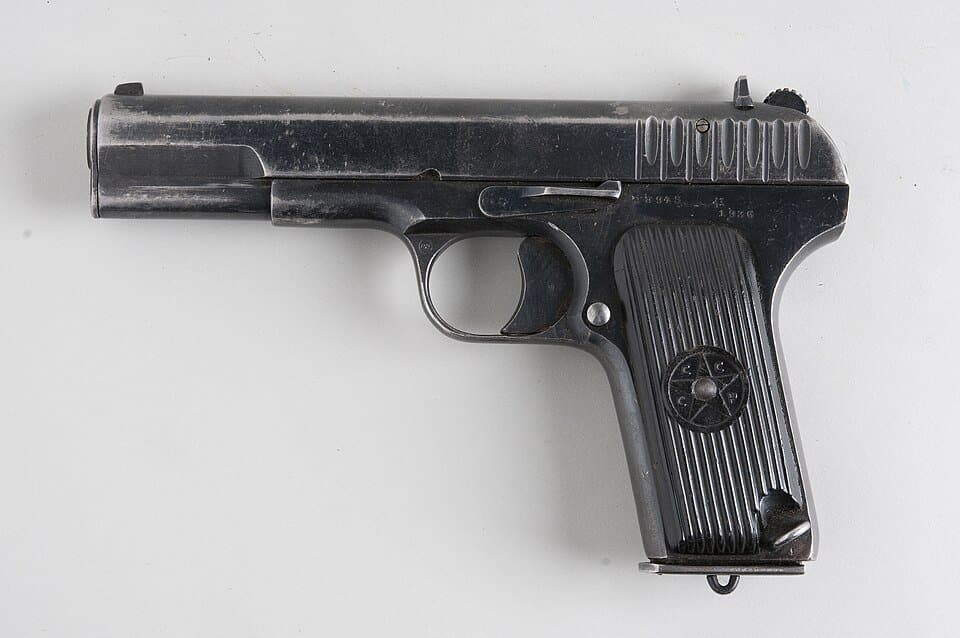
| Source measurement | — | Before 1930, the Soviet Union used a large variety of foreign-made semi-automatic pistols including: FN M1900 , FN M1903 , FN M1905 , M1921 "Bolo" Mauser , and the Colt M1911 , besides the Nagant M1895 revolver. In an attempt to simplify production, the Soviet Artillery Committee (which also oversaw small arms designs) decided to adopt a 7.62 mm pistol caliber, allowing Mosin-Nagant rifle barrels to be cut down to make pistols and submachine gun barrels. In 1930, the Red Army conducted trials to select a new standard-issue pistol and Tokarev's design was tested against upscaled versions of the Korovin pistol , and Sergei Aleksandrovich Prilutsky's 1920−1921 self-loading design as well as foreign pistols. Tokarev's design, considered to be lighter, more accurate and reliable than its competitors (despite being harder to disassemble), was adopted as the Tula-Tokarev Model 1930 , even though the pistol would only be officially adopted in the next year.[source]TT pistol · Development; only the objects and conditions stated in this passage The TT-33 is chambered for the 7.62×25mm Tokarev cartridge, which was itself based on the similar 7.63×25mm Mauser cartridge used in the Mauser C96 pistol. The 7.62×25mm cartridge is powerful, has an extremely flat trajectory, and is capable of penetrating thick clothing and soft body armor. Despite the power of the 7.62 mm round, the TT-33 has a relatively mild recoil.[source]TT pistol · Design details; only the objects and conditions stated in this passage As early as 1938, the Soviets mulled on a replacement for the TT-33, and trials were conducted. After testing several designs, including a submission from Tokarev, an 18-round design chambered for the 7.62 mm round by Pavel V. Voyevodin ( Voevodin pistol ) was chosen, but development was halted after the Germans launched Operation Barbarossa .[source]TT pistol · Design details; only the objects and conditions stated in this passage TT-33 : A modified and simplified version of the TT-30, it was replaced by the Makarov pistol . A civilian version of the T-33 was offered in the 2010s by the Molot Machine Building Plant . These pistols are externally similar to the original, but are chambered for 10×33mm cartridges containing a single rubber ball of 10 mm (0.39 in) diameter for self-defense purposes.[source]TT pistol · Variants / Soviet Union; only the objects and conditions stated in this passage Type 54 : Replaced the Type 51 in 1954. Roughly 420,000 were produced until 1985. Up to 50,000 Type 54s were exported to North Vietnam .[source]TT pistol · Variants / China; only the objects and conditions stated in this passage Model 213 : Export model by Norinco , it's a Type 54 fitted with an external safety and chambered for the 9×19mm Parabellum round.[source]TT pistol · Variants / China; only the objects and conditions stated in this passage NP-10 : Export model with interchangeable barrels. It can fire 7.62×25mm, 9×19mm, and .38 Super cartridges.[source]TT pistol · Variants / China; only the objects and conditions stated in this passage NP-15 : Export 9×19mm model with three white dot sights and a black rubber grip.[source]TT pistol · Variants / China; only the objects and conditions stated in this passage NP-17 : Export target-shooting 9×19mm pistol with a 116 mm (4.6 in) barrel and muzzle brake.[source]TT pistol · Variants / China; only the objects and conditions stated in this passage M48 : Also commonly known as the 48M , the Pisztoly 48 Minta is a licensed copy of the TT-33 produced by Fegyver- és Gépgyár (FÉG) from 1948 until 1958. They can be identified by the Rákosi or Kádár crest on the grips. About 100,000 were manufactured.[source]TT pistol · Variants / Hungary; only the objects and conditions stated in this passage Tokagypt 58 : An export version for Egypt chambered for the 9×19mm Parabellum round which was widely used by police forces there.[source]TT pistol · Variants / Hungary; only the objects and conditions stated in this passage Khyber Pass copy : Both legal and illegal TT pistols are still manufactured in various Pakistani Khyber Pass factories. Quality greatly varies, with some individual copies being almost indistinguishable from the original. These copies usually can be identified by the incorrect markings or crude finish. Due to the high pressure generated by the 7.62×25mm cartridge and the often poor quality of the steel and heat treatment of these copies, they can be dangerous to fire.[source]TT pistol · Variants / Pakistan; only the objects and conditions stated in this passage wz. 1933 : A licensed copy designated as Pistolet wzór 1933 , about 225,500 pistols were produced by FB "Łucznik" Radom from 1948 until 1955 following a limited production run in 1946−1947. It was replaced by the FB P-64 in 1967, though the wz. 1933 remained in limited service until the 1990s.[source]TT pistol · Variants / Poland; only the objects and conditions stated in this passage K14 : An upgraded version of the K-54VN also made by Z111 Factory, it has a barrel 11 mm (0.43 in) longer, an increased capacity of 13 rounds, with a wider grip to incorporate a double stack magazine . In early October 2014, the PAVN received 50 pistols for trials.[source]TT pistol · Variants / Vietnam; only the objects and conditions stated in this passage M70 : Not to be confused with the blowback M70 pistol also produced by Zastava, it's an M57 chambered for the 9×19mm cartridge. It uses a six-groove rifling instead of four.[source]TT pistol · Variants / Yugoslavia / Serbia; only the objects and conditions stated in this passage M88 : A compact and modernized version of the M70 9×19mm pistol with a 8-round magazine. While it largely retains the Tokarev operating mechanism, externally it bears little resemblance to the TT-33. It features a frame-mounted safety.[source]TT pistol · Variants / Yugoslavia / Serbia; only the objects and conditions stated in this passage While the TT-33 was used in small numbers during the Spanish Civil War , the first major use of the Tokarev pistol was during the Winter War against Finland. The Finns managed to capture a number of TT-33 pistols and PPD submachine guns , which they used until they ran out of 7.62 mm Tokarev ammunition.[source]TT pistol · Service history; only the objects and conditions stated in this passage During World War II , both the Germans and the Finns made use of captured TT-33 pistols, though the former had the advantage of making use of the 7.63×25mm Mauser cartridge, which can be loaded in TT pistols (though the 7.62×25mm Tokarev cannot be fired in weapons chambered for the 7.63 mm round due to the increased pressure of the Soviet cartridge). Captured pistols were re-issued to German troops as the Pistole 615(r) .[source]TT pistol · Service history; only the objects and conditions stated in this passage |
| Reported operators |
|
|