
FORCETALLY
Loading the evidence…
Preparing your view.


Preparing your view.
At a glance
Measured figures
LMT Modular Ambidextrous Rifle System · Length · "Maximum"
Single source914 mm (36.0 in) ("Maximum")[source]LMT Modular Ambidextrous Rifle System · Length
Configuration
| Specification | LMT Modular Ambidextrous Rifle System | M134 Minigun |
|---|---|---|
| Type | Assault rifle Battle rifle[source]LMT Modular Ambidextrous Rifle System · Type | Rotary medium machine gun[source] |
| Place of origin | United States[source]LMT Modular Ambidextrous Rifle System · Place of origin | United States[source] |
| In service | 2015 - present[source]LMT Modular Ambidextrous Rifle System · In service | 1963–present[source] |
Length
801.6 mm (31.56 in)[source]
Maximum; Maximum firing range
Single source3,280 ft (1,000 m; 1,090 yd)[source]
L129A2 exact named variant; not a sibling record · Barrel length
Single sourceStgw 25 exact named variant; not a sibling record · Barrel length
Single sourceStgw 25K exact named variant; not a sibling record · Barrel length
Single source18 in (457 mm)[source]L129A2 exact named variant; not a sibling record
16 in (406 mm)[source]Stgw 25 exact named variant; not a sibling record
12 in (305 mm)[source]Stgw 25K exact named variant; not a sibling record
Barrel length
Single source558.8 mm (22.00 in)[source]
Variable
Single sourceVariable, 2,000–6,000 rounds/min[source]
Muzzle velocity
Single source2,800 ft/s (853 m/s)[source]
Bars compare reported quantities only. A larger figure does not make a system better; configurations and test conditions differ.
| Designer | Lewis Machine & Tool Company[source]LMT Modular Ambidextrous Rifle System · Designer | General Electric[source] |
|---|
| Manufacturer | Lewis Machine & Tool Company[source]LMT Modular Ambidextrous Rifle System · Manufacturer | General Electric Dillon Aero Garwood Industries Profense[source] |
|---|
| Cartridge | 5.56×45mm NATO 7.62×51mm NATO 6.5mm Creedmoor[source]LMT Modular Ambidextrous Rifle System · Cartridge The MARS-L (light) assault rifle variants are chambered for the 5.56×45mm NATO intermediate cartridge , and the MARS-H (heavy) battle rifle and designated marksman rifle variants for the 7.62×51mm NATO , 6.5 mm Creedmoor or similar fully powered cartridges .[source]Design · explicit MARS-L/MARS-H cartridge scope MARS-H based designated marksman variant, chambered in 6.5 mm Creedmoor .[source]L129A2 · explicit MARS-L/MARS-H cartridge scope Swiss MARS-H-based designated marksman rifle chambered in 7.62×51mm NATO.[source]7.62mm Zf Stgw 20 · explicit MARS-L/MARS-H cartridge scope LMT's MRGG-A is a member of its Modular Ambidextrous Rifle System-Heavy (MARS-H) family, which are commonly described as AR-10-style rifles, but is chambered to fire the 6.5mm Creedmoor round.[source]MK24 Mid-Range Gas Gun-Assault · explicit MARS-L/MARS-H cartridge scope | 7.62×51mm NATO[source] |
|---|
| Action | Gas-operated , rotating bolt (internal piston, not direct impingement ) or Short-stroke piston[source]LMT Modular Ambidextrous Rifle System · Action | Electrically driven rotary breech[source] |
|---|
| Feed system | 5.56×45mm NATO : 30-round detachable box magazine 7.62×51mm NATO 20-round detachable box magazine[source]LMT Modular Ambidextrous Rifle System · Feed system | Disintegrating M13 linked belt or linkless feed; dependent on installation (500–5,000-round belt)[source] |
|---|
| Used by | — | See Users[source] |
|---|
| Wars | — | Vietnam War Third Indochina War United States invasion of Grenada United States invasion of Panama Soviet–Afghan War Falklands War Gulf War Operation Restore Hope War in Afghanistan (2001–2021) Iraq War[source] |
|---|
| Designed | — | 1960[source] |
|---|
| Produced | — | 1962–present[source] |
|---|
| Variants | — | See Design and variants[source] |
|---|
| Barrels | — |
|---|
| Sights | — | Dependent on installation; no fixed sights[source] |
|---|
| Role | — | American 7.62×51mm NATO six-barrel rotary machine gun[source] |
|---|
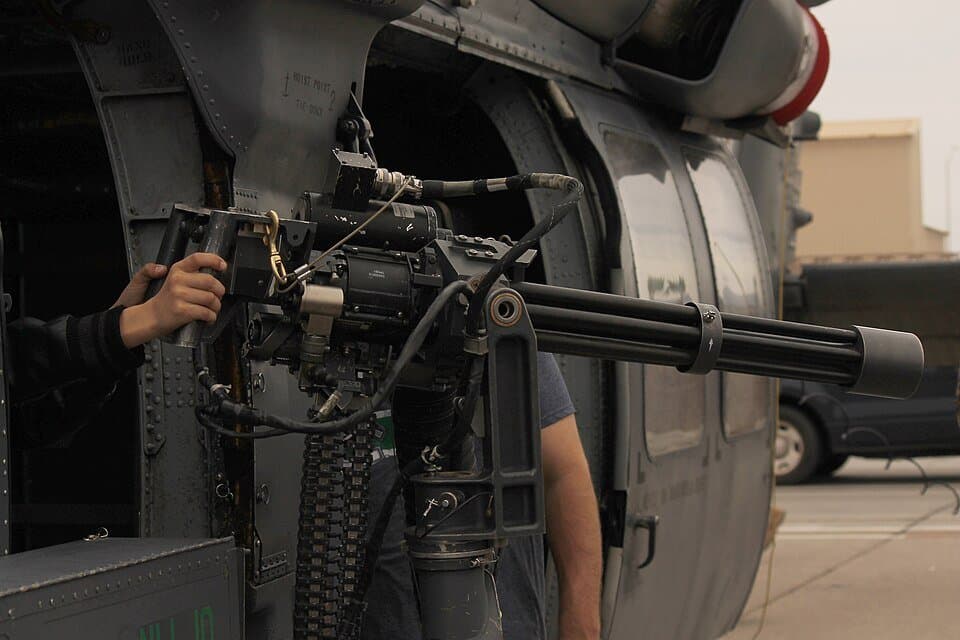
| Source measurement | — | The M134 Minigun is an American 7.62×51mm NATO six-barrel rotary machine gun with a high rate of fire (2,000 to 6,000 rounds per minute ). It features a Gatling -style rotating barrel assembly with an external power source, normally an electric motor . The "Mini" in the name is in comparison to larger-caliber designs that use a rotary barrel design, such as General Electric's earlier 20 mm M61 Vulcan , and "gun" for the use of rifle ammunition as opposed to autocannon shells.[source]M134 Minigun · Lead; only the objects and conditions stated in this passage The ancestor to the modern minigun was the hand cranked mechanical Gatling gun invented in the 1860s by Richard Jordan Gatling . He later replaced the hand-cranked mechanism with an electric motor , a relatively new invention at the time. Even after Gatling slowed the mechanism, the new electrically powered Gatling gun had a theoretical rate of fire of 3,000 rounds per minute, roughly three times the rate of a typical modern, single-barreled machine gun. Gatling's design received U.S. Patent #502,185 on July 25, 1893. Despite his improvements, the Gatling gun fell into disuse after cheaper, lighter-weight, recoil and gas operated machine guns were invented; Gatling himself went bankrupt for a period.[source]M134 Minigun · History / Background: electrically driven Gatling gun; only the objects and conditions stated in this passage During World War I , several German companies were working on externally powered guns for use in aircraft. One of these designs was the Fokker-Leimberger , an externally powered 12-barrel rotary gun using the 7.92×57mm Mauser round; it was claimed to be capable of firing over 7,000 rpm, but suffered from frequent cartridge-case ruptures due to its "nutcracker" rotary split-breech design, which is different from that of conventional rotary gun designs. None of these German guns went into production during the war, although a competing Siemens prototype (possibly using a different action), which was tried on the Western Front , scored a victory in aerial combat. The British also experimented with this type of split-breech during the 1950s, but they were also unsuccessful.[source]M134 Minigun · History / Background: electrically driven Gatling gun; only the objects and conditions stated in this passage To develop a more reliable weapon with a higher rate of fire, General Electric designers scaled down the rotary-barrel 20 mm M61 Vulcan cannon for 7.62×51mm NATO ammunition. The resulting weapon, designated M134 and known as the "Minigun", could fire up to 6,000 rounds per minute without overheating. The gun has a variable (i.e. selectable) rate of fire, specified to fire at rates of up to 6,000 rpm with most applications set at rates between 3,000 and 4,000 rounds per minute.[source]M134 Minigun · History / Minigun: 1960s–Vietnam; only the objects and conditions stated in this passage The core of the M134D was a steel housing and rotor. To focus on weight reduction, a titanium housing and rotor were introduced, creating the M134D-T which had reduced weight from 62 lb (28 kg) to 41 lb (19 kg). The gun housing had a 500,000-round lifespan before it wore out, which was far higher than a conventional machine gun's 40,000-round lifespan but lower than that of other rotary guns. A hybrid of the two weapons resulted in the M134D-H , which had a steel housing and titanium rotor. It was cheaper with the steel component and only 1 lb (0.45 kg) heavier than the M134D-T, and restored its lifespan to 1.5 million rounds. The M134D-H is currently in use on various 160th Regiment platforms.[source]M134 Minigun · History / Dillon Aero minigun; only the objects and conditions stated in this passage Garwood Industries created the M134G version with several modifications to the original GE system. The optimum rate of fire was determined by Garwood to be around 3,200 rounds per minute (rpm). The M134G is being produced with this firing rate as well as 4,000 rpm and the previous standard 3,000 rpm rate. Garwood Industries made several other modifications to the 1960s Minigun design in order to meet modern-day military and ISO standards. This includes modifications to the drive motor, feeder and barrel clutch assembly.[source]M134 Minigun · History / Garwood Industries minigun; only the objects and conditions stated in this passage Another variant was developed by the USAF specifically for flexible installations, beginning primarily with the Bell UH-1N Twin Huey helicopter, as the GAU-17/A. Produced by General Dynamics , this version has a slotted flash hider. The primary end users of the GAU-17/A have been the USN and the United States Marine Corps (USMC), which mount the gun as defensive armament on a number of helicopters and surface ships. GAU-17/As from helicopters were rushed into service for ships on pintle mountings taken from Mk16 20 mm guns for anti-swarm protection in the Gulf ahead of the 2003 Iraq War - 59 systems were installed in 30 days. The GAU-17/A is designated Mk 44 in the machine gun series and is generally known as the Mk 44 when installed on British warships.[source]M134 Minigun · Design and variants; only the objects and conditions stated in this passage The weapon is part of both the A/A49E-11 armament system on the UH-1N; and of the A/A49E-13 armament subsystem on the USAF Sikorsky HH-60H Pave Hawk helicopter. The weapons on these systems feature a selectable fire rate of either 2,000 or 4,000 rpm. There is mention of a possible GAUSE-17 designation (GAU-Shipboard Equipment-17), in reference to the system when mounted on surface ships, though this would not follow the official ASETDS designation system's format.[source]M134 Minigun · Design and variants; only the objects and conditions stated in this passage The first AC-130A Gunship IIs did away with the MXU-470/A mounts and instead used GAU-2/As, and not only had four 7.62mm GAU-2/A minigun mounts, but added four 20mm M61 Vulcan 6-barrel rotary cannons; this configuration was upgraded two years later in 1969 by removing two each of the GAU-2/As and M61s and adding two 40 mm (1.58 in) L/60 Bofors cannons in the aptly named AC-130A 'Surprise Package'.[source]M134 Minigun · Design and variants / Gun pods and other mounting systems; only the objects and conditions stated in this passage This configuration lasted two more years until, in late 1971, the AC-130E Pave Aegis arrived, which did away with the miniguns altogether and one of the 40mm Bofors and instead went to the configuration of two 20mm M61 Vulcan, one 40mm L/60 Bofors and one 105 mm (4.13 in) M102 howitzer , a configuration that lasted until the early 2000s when the AC-130Hs (the AC-130Es had had an avionics upgrade and redesignated to H models) underwent a refit and the two M61 Vulcans were removed and replaced with one General Dynamics 25 mm (0.984 in) GAU-12/U Equalizer 5-barrel rotary cannon (while still retaining the H suffix).[source]M134 Minigun · Design and variants / Gun pods and other mounting systems; only the objects and conditions stated in this passage The improved MXU-470/As were even being proposed for lighter aircraft such as the Cessna O-2 Skymaster used by Forward Air Controllers but proved too heavy and cumbersome. A fit of two MXU-470/As was also tested on the Fairchild AU-23A Peacemaker , though the Royal Thai Air Force later elected to use another configuration with the M197 20 mm cannon.[source]M134 Minigun · Design and variants / Gun pods and other mounting systems; only the objects and conditions stated in this passage |
|---|
| Reported operators |
|
|
|---|